
What if the best casting design isn’t the weldment’s current shape? Converting weldment to casting works best as a function-led redesign, not a one-for-one transfer of plates, seams and brackets. The change raises practical questions: which features can be cast, and will the revised part preserve its fit and performance?
Those concerns are valid. Start with the part’s operating requirements and production needs, then assess how its geometry, material and critical interfaces should translate into an iron casting. A foundry technical assessment can identify design considerations early, before the transition reaches production.
This guide explains how to evaluate feasibility, redesign weldment features for casting and select an appropriate iron material, including Gray Iron, Ductile Iron or Malleable Iron. It also outlines how to move from technical review through casting samples and sample approval. Bowmanville Foundry has produced custom iron castings since 1902 and provides technical support to help manufacturers assess proposed conversions.
Key Takeaways
- Start with the part’s function, operating requirements and production context to judge whether converting weldment to casting is a sound engineering choice.
- Review draft, wall transitions, parting strategy and mold access to identify geometry that may need redesign for castability.
- Compare interfaces, machining, inspection and production needs with the part’s requirements rather than assuming one manufacturing route is always better.
- Use a technical assessment to guide material selection, design development and planning for machining, heat treating or surface coating.
- Set sample approval criteria before production so the prototype casting can be checked against agreed fit and performance requirements.
When does converting a weldment to a casting make engineering sense?
A weldment is an assembly of separate parts joined by welding. A casting is formed by pouring molten metal into a mold, where it solidifies into the required component. The metal casting process can combine features previously made from multiple pieces, but the conversion changes how the part is manufactured. Treat the assembly drawing as a useful reference, not necessarily as a pattern for the new design.
Consider an assessment when a part contains multiple joined pieces, interfaces or fabrication steps that might be consolidated, or when another production approach may better suit the required output. Fewer joining interfaces or a simpler manufacturing route can be design goals, but neither guarantees better performance. The decision depends on the component’s function, service conditions, production volume, geometry, material requirements and finishing needs. A foundry technical assessment can evaluate the proposed design before development proceeds.
Which weldment characteristics make a conversion worth assessing?
Start with assemblies made from several welded pieces. Map each piece, joint and interface to the function it performs. Some features may be candidates for integration into a cast component; others may need to remain distinct for attachment, movement, access or maintenance. This review can reveal opportunities to simplify manufacturing without assuming fewer parts will automatically make the component stronger or more reliable. Any expected performance change needs engineering review.
What should remain unchanged after the manufacturing method changes?
Before changing the geometry, define the requirements the redesigned part must preserve. Record its intended functions, load paths, mating interfaces and operating conditions, along with dimensional requirements, attachment points and specified machining or finishing. These details give the foundry and design team a shared basis for reviewing the proposed casting.
A practical conversion-success statement should guide design review and sample evaluation. For example: “The redesigned component must perform the same defined functions under the documented operating conditions, preserve the specified mating dimensions and attachment points, and meet the drawing’s machining and finishing requirements.” Adapt the statement to the part’s actual requirements rather than relying on a general goal such as “match the weldment.”
How to assess weldment geometry for iron casting
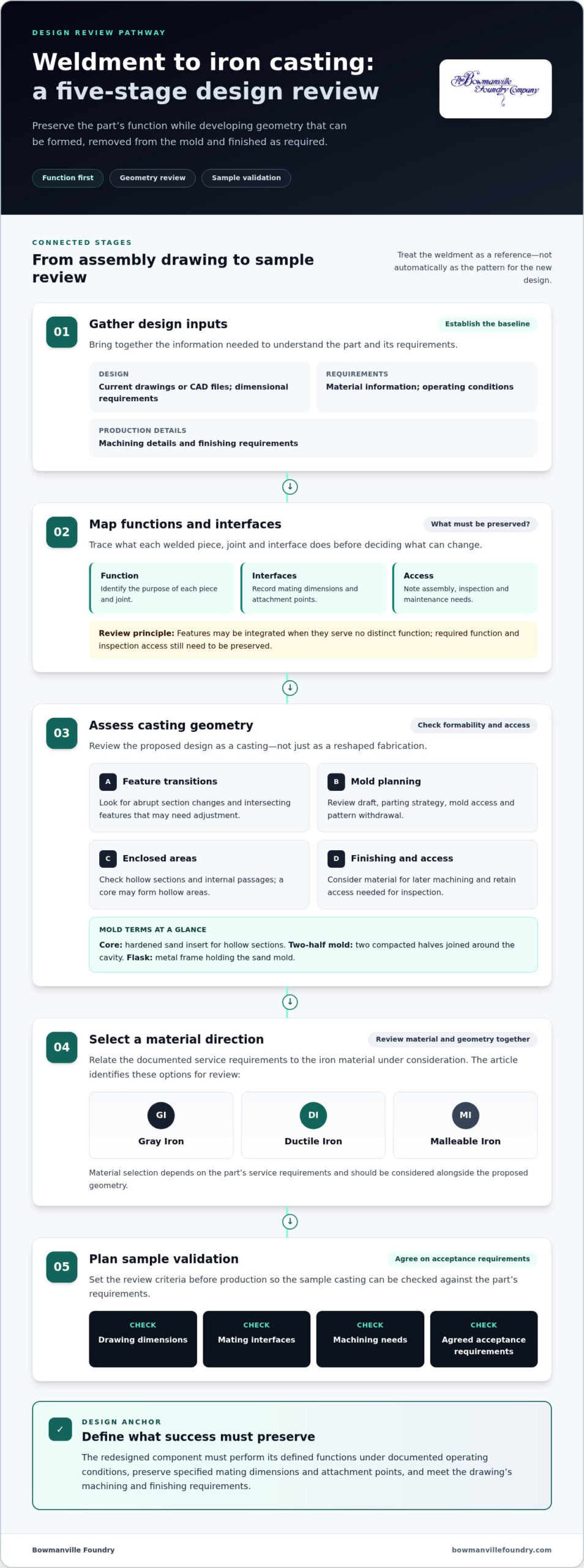
Assess the existing assembly and proposed casting as related but distinct designs. The goal is to preserve function while developing geometry that can be formed, removed from the mold and finished as required. A technical assessment can identify part-specific design questions early, before pattern development and sample production.
- Gather design inputs. Collect current drawings or CAD files, dimensional requirements, material information, operating conditions, machining details and finishing requirements.
- Map functions. Identify the purpose of each welded piece, joint and interface, and note which features must remain accessible for assembly, inspection or maintenance.
- Assess geometry. Review draft, wall transitions, parting strategy, mold access and enclosed or hollow areas. Check whether fabrication details can be simplified without changing function.
- Select a material direction. Relate service requirements to the iron material under consideration. Review material and geometry together, not as separate decisions.
- Plan validation. Define how the sample casting will be assessed against drawing dimensions, interfaces, machining needs and other agreed acceptance requirements.
Which weldment details need redesign before casting?
Look closely at abrupt section changes, intersecting features, enclosed spaces and shapes inherited from the fabrication of plates or other pieces. These details may need adjustment for mold formation or pattern withdrawal. Separate welded features can be integrated into the casting if they serve no distinct function, but the redesign must preserve required function and inspection access. CAD files help the engineering team compare proposed geometry with the original assembly and document changes for review.
How do cores, patterns, and mold design affect feasibility?
A core is a hardened sand insert used to form hollow sections in a casting. Its position and shape affect mold planning, particularly when an internal passage must meet openings or leave material for later machining. Pattern design and the parting strategy also affect how the mold cavity is formed and how the casting is removed.
A two‑half mold joins two compacted mold halves around the cavity; a flask is the metal frame that holds the sand mold, and mold compaction forms the cavity around the pattern. Castability depends on geometry, mold design, material and required finishing.
Share the design inputs with Bowmanville Foundry for an early technical assessment of the proposed iron casting. A review of casting design requirements can help identify geometry questions before the design advances to pattern development.
Weldment versus casting: compare performance, material, and production needs
Compare the current weldment and proposed casting against the same drawing requirements and operating conditions. This keeps the review focused on the part’s function rather than assuming one manufacturing route is always preferable. Converting weldment to casting may consolidate pieces or change joining and finishing steps, but suitability depends on geometry, material properties, inspection needs and production context.
| Consideration | Weldment | Casting |
|---|---|---|
| Design flexibility | Geometry is shaped by the parts being joined and the access needed to assemble them. | Features may be combined in one component, subject to mold, pattern and castability requirements. |
| Joining interfaces | Welds and connections join separate pieces; review which interfaces serve a functional purpose. | Some interfaces may be designed into a single casting, while attachment and mating features still need to meet requirements. |
| Machining | Machining may be needed at specified mating or attachment surfaces. | Identify surfaces that require machining and include them in the casting design and finishing plan. |
| Inspection | Inspection applies to the assembly and its joints, as required by the drawing. | Inspection criteria must address the casting and any specified machined features. |
| Production requirements | Assess the assembly steps and production context for the required output. | Assess pattern and mold planning, material, finishing and validation needs for the intended production. |
How should the required iron grade be evaluated?
Begin with the component’s loading, wear and impact requirements, and consider service in low temperature environments where relevant. Bowmanville Foundry produces Gray Iron, Ductile Iron, Malleable Iron and Austempered Ductile Iron. Ductile Iron is a nodular iron that combines high tensile strength with good ductility, suitable for medium to large castings. Malleable Iron is a type of nodular iron used for small castings that need good tensile strength and ductility. Select a grade based on the part’s documented requirements; the how to choose the ideal iron casting grade guide provides further material-selection context.
Which downstream operations belong in the comparison?
Include machining, heat treating and surface coating where the part specification requires them. Compare critical dimensions, mating interfaces and finish requirements against the current drawing, then identify which operations belong after casting. For designs that need finished components, Bowmanville Foundry’s guide to integrated iron casting and machining offers related information.
Bowmanville Foundry produces three grades of Gray Iron and five grades of Austempered Ductile Iron. A technical assessment can help relate material and post-processing choices to the part’s function and production requirements.
Moving a weldment conversion from concept to sample approval
Manage a weldment-to-casting conversion through defined review and approval stages. Bowmanville Foundry supports the process with pattern development, casting production, post-processing and technical assessment. The sequence below gives engineering and procurement teams clear decision points before production begins.
- Submit drawings and requirements. Provide current drawings, CAD files, assembly details, material requirements and relevant operating conditions. Identify critical dimensions, mating interfaces, machining needs, finishing requirements and inspection or acceptance criteria.
- Complete a technical assessment. A foundry engineer evaluates the feasibility of the part design. This early review helps identify questions about geometry, material, pattern development and finishing before sample production.
- Develop the design and pattern. Review proposed changes against the existing assembly and documented functions. Resolve design questions and agree on the casting geometry and pattern approach before making the sample.
- Produce and inspect samples. Assess the prototype casting against the agreed drawing, material requirements, critical dimensions and specified post-processing needs.
- Record sample approval. Document inspection results, design changes and acceptance decisions. Sample approval lets the customer validate a prototype casting before full production begins.
Typical lead times are four to eight weeks, depending on current business conditions. Tooling can be produced in two to four weeks. Use these timelines for planning, then agree on project milestones and approval requirements for the specific conversion.
What information helps a foundry assess the conversion?
Send the current drawing and CAD files alongside assembly details, material requirements and the part’s operating conditions. Mark critical dimensions, interfaces and surfaces that require machining or finishing. Include the inspection and acceptance requirements for the existing part, so the foundry can assess the proposed design against the application, not geometry alone.
How should the sample be reviewed before production?
Compare the sample with the agreed drawing, mating interfaces and customer-defined functional requirements. Review specified material and finishing needs, then record any discrepancies, design revisions and acceptance decisions before approving the production approach. For related engineering considerations, see Bowmanville Foundry’s guide to optimizing custom iron casting production.
To begin a technical assessment, submit your weldment drawings and requirements to Bowmanville Foundry.
Plan your weldment-to-casting assessment with Bowmanville Foundry
A successful conversion moves through clear engineering decision gates: confirm the part’s function, review its geometry, assess material requirements, plan post-processing and agree on sample approval criteria. This sequence gives design and procurement teams a shared basis for evaluating the proposed casting before it advances to production.
Bowmanville Foundry has produced custom iron castings since 1902. Its capabilities include Gray Iron, Ductile Iron, Malleable Iron and Austempered Ductile Iron, supported by pattern development, casting production and post-processing such as machining, heat treating and surface coating. The foundry operates from a 38,000 square foot plant and was the first foundry in Canada to achieve ISO certification, in 1996.
What support can help advance a conversion project?
A foundry technical assessment is an early feasibility step. It reviews the proposed design and manufacturing requirements, helping identify questions about geometry, material and finishing before sample production. Casting and post-processing can be considered together against the component’s documented requirements, including machined interfaces or specified surface treatments.
For converting weldment to casting, this assessment connects the design review to the production route. The goal is to establish what the casting must do, how it will be evaluated and which technical decisions remain before a sample can be approved.
What should the next engineering discussion cover?
Prepare the current assembly drawing or CAD files, a concise description of the part’s function and operating conditions, and information about material needs, critical interfaces and finishing requirements. Include the production context and any customer-defined inspection or acceptance criteria. These details keep the discussion focused on the actual component rather than an abstract shape change.
A technical/sales engineer can review the part requirements with your team and help identify the next decision, such as refining the proposed geometry, assessing material direction or defining sample approval criteria. An on-site visit can be arranged when a direct review of the part or its application would assist the assessment.
Contact Bowmanville Foundry to discuss your drawings and requirements, and arrange technical assistance for your weldment conversion.
Move your casting concept toward a validated design
Converting weldment to casting is a function-led engineering decision, not simply a transfer of assembly geometry. Document the part’s function and operating conditions, then assess its geometry, iron material, machining and finishing needs. Compare the proposed design with the weldment against the same requirements, and use sample approval to validate the prototype before production.
A foundry technical assessment can identify design questions early and establish practical next steps. Bowmanville Foundry has produced custom iron castings since 1902 and operates from a 38,000 square foot plant. It was the first foundry in Canada to achieve ISO certification in 1996.
Bring your drawings, CAD files and part requirements to the discussion. Discuss your weldment conversion with Bowmanville Foundry and take the next step toward an iron casting design that meets your documented needs.
Frequently Asked Questions
Can every weldment be converted to a casting?
No. Feasibility depends on the part’s function, geometry, material requirements, production context and acceptance criteria. Some assemblies may suit a casting redesign, while others rely on separate pieces or joining details that must remain. A foundry technical assessment reviews the drawings and requirements, identifies design questions and helps determine whether the casting concept merits further development. The assessment should consider the actual application, not just whether the assembly’s shape can be reproduced.
What information is needed to assess converting a weldment to a casting?
Provide current drawings or CAD files, assembly details, material requirements, critical dimensions and operating conditions. Include the function of each component, interfaces that must remain compatible, and any machining or finishing needs. Inspection and acceptance requirements are also useful. This information helps the foundry assess geometry, material direction and validation needs before pattern development or sample production. Clear inputs make the technical review specific to the part’s application.
Does a weldment need to be redesigned before it can be cast?
Often, the geometry needs review because a weldment is designed around fabrication and joining, while a casting must suit mold and pattern requirements. The assessment may examine draft, section transitions, parting strategy, cores and features that could be integrated. The objective is to preserve required function and interfaces while developing geometry suitable for casting. Do not assume a one-for-one transfer of the assembly shape is the right design.
How do you choose an iron grade for a converted part?
Choose a material direction based on the part’s service requirements, not solely on the material used for the existing assembly. Review loading, wear, impact, temperature conditions, strength and ductility needs. Bowmanville Foundry produces Gray Iron, Ductile Iron, Malleable Iron and Austempered Ductile Iron. A technical assessment can relate documented application requirements to material selection and identify what needs further evaluation before the design moves to sample production.
What is sample approval in a weldment-to-casting project?
Sample approval is the process where the customer validates a prototype casting before full production begins. Review the sample against agreed drawings, mating interfaces, functional requirements and acceptance criteria. Record inspection results, any required design changes and the approval decision. This creates a defined engineering and procurement review point, helping ensure the production design reflects the validated sample and documented requirements before production proceeds.
How long does it take to convert a weldment to a casting?
The project schedule depends on design complexity, technical review, pattern development, sample production and approval requirements. Bowmanville Foundry’s typical lead times are four to eight weeks, depending on current business conditions, and tooling can be produced in two to four weeks. These figures are planning information, not a project-specific schedule for the full conversion. Account for the project’s design reviews, sample requirements and approval process when planning the timeline.
Can machining and finishing be included after casting?
Yes. Bowmanville Foundry offers post-processing services that include machining, heat treating and surface coating. The required operations depend on the drawing, dimensional requirements, material and finished-component needs. Identify critical interfaces, machined surfaces and finish requirements during the technical assessment. This allows the casting design and downstream operations to be considered together and helps define the component condition for sample approval and production planning.
