
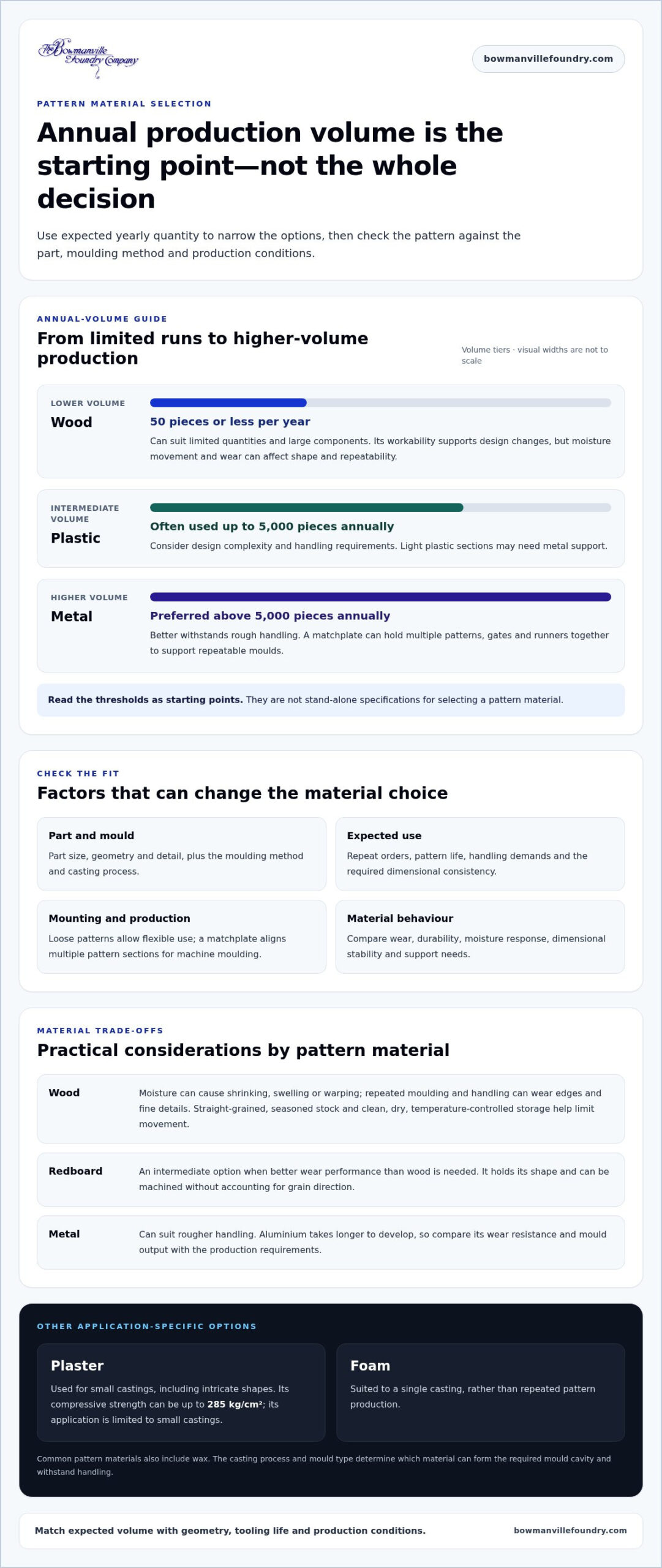
The least durable pattern material can still be the right choice for a short run. For castings produced at 50 pieces or less per year, wood may be suitable; plastic tooling is often used for annual volumes up to 5,000 pieces, while metal is the pattern material of choice above 5,000 pieces annually. These are starting points for casting pattern material selection, not a substitute for considering the part and moulding process.
Production quantity is a useful starting point, but it is only one part of casting pattern material selection. Wear, dimensional stability, moisture exposure, durability and weight all affect how well a pattern holds its shape and supports repeatable moulding. Part geometry and the moulding method also influence which material suits production requirements.
This article compares wood, plastic and metal patterns, and explains how annual volume, repeat orders, geometry and handling affect the choice. It also covers why moisture resistance and pattern stability matter, helping you weigh material trade-offs against your production needs.
Key Takeaways
- Match pattern material to expected use and repeat orders; production quantity is a useful starting point, not the only consideration.
- Account for wood’s moisture-related movement and wear when dimensional stability and repeated moulding matter.
- Consider plaster for small, intricate castings, while weighing its application limits against part size and complexity.
- Compare water resistance, durability, weight and repair needs to identify which material best suits the production conditions.
Wood pattern wear and dimensional stability
Wood patterns are easy to shape and modify for sand moulding, but moisture and repeated handling affect their service life. Their suitability depends on the required surface quality and dimensional consistency.
Wood Pattern Wear
Wood pattern wear is the gradual damage caused by repeated moulding, handling and contact with compacted sand. Wood is less strong and wear-resistant than metal, so edges and fine details can deteriorate with repeated use. This matters when a pattern must produce consistent moulds over an extended run. Pine is easy to work, while harder mahogany can withstand more pattern use.
Dimensional Stability and Casting Accuracy
Dimensional stability is a pattern’s ability to retain its shape and size as conditions change. Wood absorbs moisture and can shrink, swell or warp as humidity and temperature vary. This movement can alter the mould cavity, affecting casting dimensions and surface finish. A smooth pattern surface helps reduce casting defects, while stable gating and runner features support repeatable mould formation. These considerations are important when parts require consistent dimensions.
Wood Selection and Seasoning
Selecting and seasoning wood properly helps limit movement during pattern use. Choose straight-grained stock without knots or other natural defects, then season it before machining. Pine is inexpensive and workable, but grain direction matters when shaping thin details. Teak and mahogany are also used for patterns. For a large pattern, pine can form most of the body, with mahogany used at edges and surfaces.
Wood’s low weight and workability make it practical for large patterns and design changes. It can provide a good surface finish, and a pattern-maker can machine or repair it without complex tooling. Store patterns in a clean, dry, temperature-controlled space. Inspect them before production for wear, cracks or movement that could alter the cavity.
Each pattern material has limitations: wood can move with moisture and wear with use; plastic patterns may be fragile, with light sections needing metal support; metal patterns better withstand rough handling; and foam patterns suit a single casting. The right choice depends on the moulding method, part geometry and required repeatability.
Pattern material selection by production quantity
Annual volume helps narrow pattern choices, but part size, geometry, repeat orders and moulding method also matter. As a practical guide, wood may suit production of 50 pieces or less per year, plastic tooling is often used up to 5,000 pieces annually, and metal is preferred above 5,000 pieces annually. In casting pattern material selection, these volume thresholds are starting points rather than stand-alone specifications.
Start by estimating annual quantity and the likelihood of repeat orders. Then assess the part’s size, shape and detail, along with handling demands and casting process. Compare these requirements with the pattern’s durability, mounting and production method.
- Small quantity: A wooden pattern can suit a large component made in limited numbers. Its workability supports changes when the design develops.
- Intermediate volume: Plastic tooling can support annual production up to 5,000 pieces. Consider design complexity and handling, since light plastic sections may need metal support.
- Higher volume: Metal patterns are preferred above 5,000 pieces annually. A matchplate holds multiple patterns, gates and runners together, supporting repeatable moulds for similar castings.
Mounting determines how a pattern fits the manufacturing process. Loose patterns allow flexible use, while a matchplate aligns multiple pattern sections for machine moulding. Choose based on the moulding method and how consistently each component must be positioned.
Redboard is an intermediate option when better wear performance than wood is needed. It holds its shape and can be machined without accounting for grain direction. For higher-volume work, compare its wear resistance and mould output with aluminium. Metal may suit rougher handling, although aluminium takes longer to develop.
A sound casting pattern material selection decision connects expected volume with geometry, tooling life and production conditions. A casting buyer’s guide can help organize these considerations before finalizing the casting process.
Plaster patterns: advantages, limitations and applications
Common pattern materials include wood, metal, plastic, plaster, foam and wax. The casting process and mould type determine which material can form the required mould cavity and withstand handling.
Plaster Pattern Applications
A plaster pattern is a casting form made by pouring a plaster mixture into a mould created with a sweep pattern or wooden master. Foundries use plaster patterns for small castings, including intricate shapes. This can suit components where detail matters more than producing large castings. The pattern’s size and complexity help determine whether plaster meets the manufacturing requirements.
Plaster Pattern Advantages and Limitations
Plaster patterns can have a compressive strength of up to 285 kg/cm2. That strength supports their use in small, detailed casting work, where the pattern must retain its form during mould preparation. Their main limitation is application size: plaster patterns are described as suitable only for small castings. A larger part calls for a pattern material suited to its dimensions and handling demands.
Process and Mould Considerations
Pattern material selection depends on the casting process because each moulding method uses the pattern differently. Wooden patterns commonly suit green-sand and air-set moulding, including core processes. Investment casting uses wax patterns that melt out to create the mould cavity, while lost-foam casting uses polystyrene that vaporizes ahead of the molten metal. Understand these differences before choosing tooling for a specific metal casting.
Pattern construction also varies with the shape and mould layout. A sweep pattern forms large, consistent moulds with circular cross-sections, while a skeleton pattern uses wooden strips and frames. Gated patterns combine patterns with gates and runners to form several castings in one mould. In sand casting, these arrangements help match a wooden pattern to the component and production method.
Water resistance, durability, versatility and weight
Pattern materials vary in moisture response, wear life, handling weight and suitability for different applications. In sand casting, these properties affect maintenance and how consistently a pattern forms the required cavity.
Material Properties and Practical Trade-offs
Material properties matter because exposure and repeated handling can change a pattern’s condition during production. Wood is light to handle, but moisture can cause it to move. Polyurethane boards resist moisture and heat better than wood. Plastic patterns are lightweight, though delicate sections may need metal support. Metal patterns tolerate rough handling, while foam suits a single casting. Use these differences to guide material selection for the application.
Polyurethane patterns combine dimensional stability with the ability to reproduce detailed, complex designs. Their precision can help when the mould cavity includes fine features. Assess the pattern’s working environment and the level of detail required, rather than relying on material category alone.
Aluminium Pattern Durability and Development Time
Aluminium patterns withstand rough handling better than redboard, but take longer to develop. This trade-off matters when tooling preparation is part of the production schedule. Redboard and aluminium have comparable resistance to sand wear and can produce similar numbers of moulds. Compare handling conditions, required pattern life and development timing before choosing between them.
For repeated use, consider whether the pattern’s surfaces and dimensions will remain suitable throughout the planned production cycle. Aluminium’s resistance to handling can be useful when equipment moves frequently between moulding operations.
Usage and Pattern Durability
Estimated annual usage indicates how often a pattern will face moulding, sand contact and handling. Frequent cycles call for durable material that retains useful detail. Occasional casting has different tooling demands from a continuing production programme, so include likely repeat orders when assessing service life.
Before pattern-making begins, consider annual usage, part detail, moisture exposure and the moulding environment. Polyurethane can support detailed designs over extended runs, while foam suits a single casting. Matching these properties to actual operating conditions helps maintain pattern accuracy.
To discuss iron casting requirements alongside tooling considerations, contact Bowmanville Foundry.
Bowmanville Foundry: Malleable Iron Castings
Bowmanville Foundry produces Malleable Iron Castings for small components that require good tensile strength and ductility. It also produces Ductile Iron Castings and Gray Iron Castings. Once you understand the pattern requirements, compare the casting material with the component’s service conditions.
Turn to Bowmanville Foundry for iron castings and guidance on selecting a suitable grade for the application. Post-Processing Services are available when finishing is part of the production requirement. Sharing the component’s intended function, geometry and operating conditions provides a clear starting point for the technical discussion.
Contact Bowmanville Foundry to discuss your casting requirements or visit bowmanvillefoundry.com.
Turn your pattern decision into a production plan
Before committing to tooling, consider the material choice as part of the wider production plan. Record the part geometry, expected order pattern, moulding method, dimensional priorities and storage conditions. These details connect casting pattern material selection to the component’s actual use, rather than treating the pattern as an isolated purchase. Revisit the decision if design revisions or changing demand alter how often the pattern will be used.
Prepare the drawing or CAD files, along with notes on service conditions, required finishing and anticipated repeat orders. This gives the technical discussion a clear starting point and helps identify which casting and pattern considerations need to be addressed together. For iron casting projects, Bowmanville Foundry offers Malleable Iron Castings, Ductile Iron Castings and Post-Processing Services.
Contact Bowmanville Foundry to discuss your project. A well-defined set of requirements can make the next production decision clearer and more focused.
Frequently Asked Questions
What Is Pattern in Casting?
A casting pattern is a model used to form the mould cavity that receives molten metal. Its geometry represents the intended component, with allowances incorporated where the design requires them. For example, draft gives the pattern a taper for removal from the mould. The pattern’s parting arrangement also affects where the mould separates and how the casting features are formed.
How do part size, shape, and complexity affect pattern material choice?
Large patterns must be practical to support, handle and position, while intricate shapes require material that can hold fine details. Thin ribs and walls need pattern sections strong enough to resist damage during mould preparation. A component with undercuts may also require loose-piece construction. Consider how cores, parting surfaces and pattern removal interact with the geometry, not just the overall dimensions.
How do production volume and required pattern life affect material selection?
Higher output means more cycles of mould compaction, handling and sand contact, making pattern wear a greater concern. Include likely repeat orders when estimating service life. A one-time project, for example, places different demands on tooling than a continuing production programme. The pattern must retain useful detail and alignment throughout the intended production schedule.
What pattern material is best for sand casting prototypes and low-volume production?
Wood often suits sand-casting prototypes and low-volume work because it is workable and can be modified as designs develop. For a single casting, foam can suit a lost-foam process, where the pattern is consumed during pouring. The choice depends on whether the prototype needs physical pattern tooling, how often revisions are expected and the required mould surface.
What pattern materials are used for high-volume foundry production?
Metal patterns are common in sustained, high-volume production because they tolerate repeated moulding and handling. Aluminium is often selected for matchplate and cope-and-drag equipment in automated moulding. Iron pattern equipment is used in high-pressure moulding, shell moulding and some heat-cured resin core processes. The moulding method and pattern configuration determine which metal tooling is suitable.
How do pattern material cost and manufacturing time compare in Canada?
Pattern expenditure and fabrication time depend on the material, part geometry, tooling complexity, required mounting and expected production volume. Wood is relatively easy to machine and alter, while aluminium can take longer to develop but withstand rougher handling. Design revisions may also affect the schedule. In Canada, project requirements determine the appropriate tooling approach and quote for the work.
