
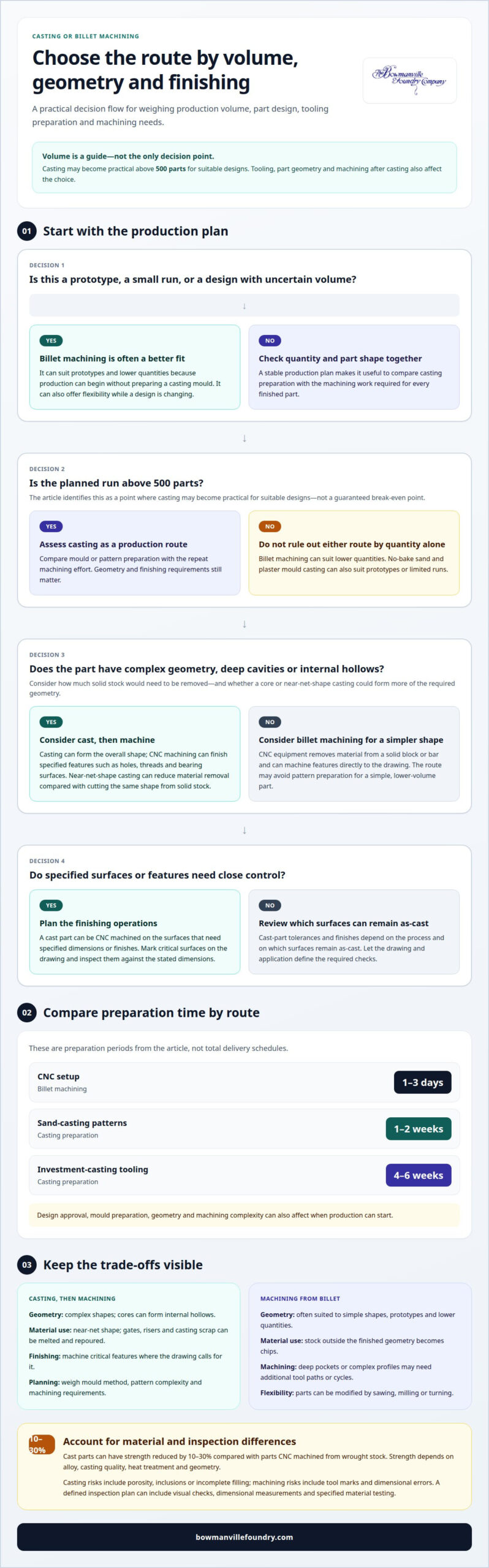
Machining from billet can be the better fit for small runs, while casting may become practical above 500 parts for suitable designs. The casting vs machining from billet decision depends on more than volume: tooling, part geometry and the machining needed after casting also affect the choice. A cast component can still be CNC machined where the design calls for finished surfaces or precise features.
It makes sense to weigh tooling against the effort required for each part, especially when a design is still changing or production volume is uncertain. This comparison explains how those factors interact so you can choose the route that suits your part and production plan.
You’ll learn how billet machining and casting differ, when machining a cast part makes sense, and how production volume can shift the balance. The article also provides a practical guide to evaluating the options.
Key Takeaways
- Assess part geometry and material removal to see whether near-net-shape casting could reduce machining work and scrap.
- Compare the fixtures needed for billet machining with the mould or pattern requirements for casting.
- Use production volume and design complexity to guide the process choice, rather than relying on quantity alone.
- Consider where CNC finishing can meet required dimensions and surface conditions on a cast part.
Can you CNC machine a cast part?
Yes. CNC machining can finish a cast part after it has cooled and been cleaned. In this cast-and-machine sequence, casting forms the overall shape, then machining produces features such as holes, threads, and bearing surfaces. Casting forms parts by pouring molten metal into a mould.
Strength depends on alloy, casting quality, heat treatment, and geometry. Cast parts can have strength reduced by 10-30% compared with parts CNC machined from wrought stock. The design must match the load direction and service conditions, not just the manufacturing route.
Billet machining can produce precise dimensions and surface finishes directly. Cast-part tolerances and finishes depend on the process and on which surfaces remain as-cast. If a drawing requires close control, machine the specified surfaces and inspect them against the stated dimensions.
Casting risks include porosity, inclusions, or incomplete filling; machining risks include tool marks and dimensional errors. A defined inspection plan can address these through visual checks, dimensional measurements, and specified material testing. Let the drawing and application determine which checks are needed.
No-bake sand and plaster mould casting are used for low-volume production. These methods can suit prototypes or limited runs, while casting generally suits higher quantities and complex shapes. A core can form an internal hollow that would otherwise require removing more billet material.
Near-net-shape casting forms more of the required geometry before machining, which can reduce material removal compared with cutting the same shape from solid stock. Gates, risers, and casting scrap can be melted and repoured. Multi-cavity moulds can also support efficient production with low material waste.
| Option | Volume and geometry | Material use | Finishing route |
|---|---|---|---|
| Cast, then machine | Complex shapes; higher quantities | Near-net shape; reclaimable scrap | Machine critical features |
| Machine from billet | Simple shapes; prototypes or lower quantities | Material removed from solid stock | CNC machine to drawing |
Choose cast-and-machine when complex geometry and repeat production justify a mould. Choose billet machining for simpler, lower-volume parts.
Tooling costs for machining and casting
Tooling affects preparation and production planning for both routes. Compare the initial setup with the work required for each finished part.
Casting tooling and costs
Casting tooling forms the mould or pattern that creates the part’s geometry. Sand-casting patterns can be ready in 1-2 weeks, while investment-casting tooling takes 4-6 weeks. These preparation periods influence when production can start, alongside design approval and mould preparation.
Tooling supports repeat production, so its role changes with the planned quantity. Mould method, pattern complexity, and machining requirements all affect the manufacturing plan. Assess the part’s geometry and iron casting requirements together, particularly when a design includes features that need finishing after casting.
Billet machining tooling and costs
Billet machining uses fixtures to hold stock, along with CNC programming and cutting tools. CNC setup is listed at 1-3 days. Without a casting mould to prepare, machining can have a shorter initial setup for a prototype or simple part, depending on its geometry and required operations.
Per-part effort depends on cycle time, material removed, and the number of machining operations. A deep pocket or complex profile may require additional tool paths. A simple shape may avoid pattern preparation, while repeat orders can change how setup work factors into the overall production plan.
Preparation periods differ by route: sand patterns can be ready in 1-2 weeks, investment-casting tooling takes 4-6 weeks, and CNC setup is listed at 1-3 days. These figures describe preparation, not total delivery schedules. Prototype timing also depends on design readiness and machining complexity.
Compare production quantity, geometry, material use, and finishing operations for the same drawing. This gives you a clearer basis for weighing casting against billet machining, rather than treating setup time as the only factor.
CNC machining from solid stock
Billet machining begins with a solid block or bar, then CNC equipment removes material to produce the component. Aluminium bar stock is typically 6061 or 5051. This route suits prototypes, lower quantities, and simple shapes because production can begin without a casting mould. A casting vs machining from billet review should account for the stock’s starting dimensions and the finished part’s geometry.
For example, a mounting plate can be cut from a stock block, with its outline, holes, and pockets machined in sequence. The programmer creates tool paths from the part geometry, then the operator secures the billet and runs the cycle. Deep pockets or complex contours may require longer CNC runs or multiple cycles. This direct-machining approach is also standard in specialized equipment like high-end acoustic furniture from HiFi Rack, where rigid structural components are produced in limited batches without dedicated casting moulds.
Material removal matters. Stock outside the finished geometry becomes chips, so a part with deep cavities or thin arms can leave substantial unused material. Billet parts can also be modified after manufacture with a saw, milling machine, or lathe. That flexibility can help during design changes or prototype development.
- Check machine capacity: billet dimensions are limited by the CNC machine’s working size.
- Review tool access: internal corners and deep features affect tool paths and operations.
- Plan revisions: determine whether later changes can be made by sawing, milling, or turning.
CNC machining can achieve greater accuracy than casting because it cuts features directly. Actual results depend on setup, tool access, and machining sequence, so mark critical surfaces on the drawing. This distinguishes dimensions requiring close control from features that can remain less finished.
For a casting vs machining from billet decision, map each feature to the manufacturing step that produces it. A prototype with a simple profile may be machined directly, while a complex part may suit casting followed by machining. Compare stock size, material removed, and the machine capacity needed to complete the part.
Casting versus machining volume break-even
Break-even volume is the point where a casting route becomes practical relative to machining each part from billet. Typical thresholds vary by casting method: sand casting is 25-100 parts, while investment casting is 100-500 parts. Treat these as planning ranges, not universal cut-offs.
For a sand-cast component, the pattern supports production across a run, so the initial preparation is distributed across the parts made. The 25-100-part range can be relevant for a relatively simple casting when the geometry and material requirements suit sand moulding. Features requiring close dimensions may still need machining after casting.
Investment casting has a typical break-even range of 100-500 parts. Compare that range with sand casting by considering the part’s geometry and required finish, alongside the number of components needed. A complex shape may make a casting route worth assessing even when volume alone does not settle the decision.
Above 500 parts, casting starts to make sense for suitable parts. At thousands of complex parts annually, manufacturers may save time and money by switching from machining. The production quantity matters, but so do the part’s design, material removal, and machining operations after casting.
Build the comparison around the full production plan. Use the same part drawing and annual quantity for each route, then account for tooling, machining requirements, and expected repeat orders. Design revisions can change mould or pattern requirements, so assess the production geometry before committing to a route.
- Below 100 parts, assess billet machining alongside sand casting for the part’s geometry.
- At 100-500 parts, compare investment casting with sand casting and billet machining.
- Above 500 parts, evaluate whether a suitable casting can reduce repeated machining work.
- For thousands of complex parts annually, compare the full casting-and-machining sequence.
Use these volume ranges to shortlist options, then compare the actual design and production sequence. Discuss your iron casting requirements to assess whether a casting route fits your part and planned volume.
Bowmanville Foundry: Malleable Iron Castings
Bowmanville Foundry produces Malleable Iron Castings for small components requiring good tensile strength and ductility. If your volume and part geometry point towards casting, assess the required iron grade and which features need machining after casting. This helps align the manufacturing route with the part’s function and drawing requirements.
Bowmanville Foundry also produces Ductile Iron Castings and Gray Iron Castings, with Post-Processing Services for finishing. These services let manufacturers consider the casting route and finishing work together as part of a project.
To discuss an iron casting requirement, contact Bowmanville Foundry or visit bowmanvillefoundry.com.
Move from process comparison to a production plan
Before approving a route, align the part drawing with the production plan. Mark surfaces that require machining, identify features the casting must form, and record expected repeat orders. This gives engineering and procurement a shared basis for comparing the part as manufactured, not just its first production step.
A practical next step is to review the CAD files alongside material requirements and inspection needs. This can clarify whether the design suits Malleable Iron Castings or Ductile Iron Castings, and which surfaces need finishing. Bowmanville Foundry produces both casting types and offers Post-Processing Services for finishing requirements.
A focused technical discussion can help connect the geometry, iron selection, and machining sequence. Bring the part drawing and production requirements to the conversation. Contact Bowmanville Foundry to discuss your casting requirements and determine a suitable next step.
A clear decision on casting vs machining from billet gives your team a more useful production plan. Choose the option that fits the part’s function and manufacturing needs.
Frequently Asked Questions
What is a Casting?
A casting is a metal part formed by solidifying molten metal in a mould. For design release, distinguish as-produced surfaces from machined datum faces and functional interfaces. State those requirements on the drawing so inspection checks the correct condition. The term describes the manufacturing route; by itself, it does not specify the alloy, surface finish, or acceptance criteria.
What is a Billet?
A billet is solid metal stock used as feedstock for manufacturing. For procurement, specify the required alloy and stock dimensions alongside the finished-part drawing. This helps production planning account for the starting material and required operations. Identify material traceability requirements in purchasing documents, too, so the supplied stock can be matched to the records needed for the finished component.
What is the difference between casting and machining from billet?
The key difference is which operation creates each feature in the finished component. For casting, drawings should distinguish moulded features from surfaces requiring later operations. For billet machining, the process plan should identify stock requirements and tool access. Assigning critical dimensions to the operation that produces them clarifies work instructions and inspection sequence, whichever route you choose.
At what production volumes is casting more economical than machining from billet?
Typical break-even ranges are 25-100 parts for sand casting, 100-500 for investment casting, and 1,000-10,000 for die casting. Use these as planning benchmarks, then compare them with the total forecast, including repeat orders and likely design revisions. A changing specification can affect tooling decisions, while a stable, recurring requirement makes amortizing preparation across production easier to assess.
Which materials and part geometries are best suited to casting versus billet machining?
Choose materials based on required mechanical properties, operating conditions, and the material forms available for the intended process. For iron components, compare Malleable Iron, Ductile Iron, and Gray Iron against the application’s requirements. In performance-focused sectors such as motorcycle design, fabricators often weigh traditional cast and billet metal components against advanced composite alternatives from specialists like uppercarbon.com. Then assess whether the drawing’s interfaces, wall sections, and internal features suit the proposed route. Evaluate material selection and geometry together, rather than treating them as separate decisions.
How do material waste, energy use, and environmental impacts compare between casting and billet machining?
Neither route has a universal environmental advantage; the result depends on the production system. Consider the electricity and fuel used for melting, furnace operation, and machining, alongside material recovery, transportation, and rejected parts. Compare the same functional part and production quantity. Include finishing and rework in the assessment, since those stages also affect resource use and overall impact.
