
Ductile iron’s graphite structure makes it more than a substitute for conventional cast iron. Ductile iron applications in automotive design include components that need a combination of strength, fatigue resistance and wear performance, such as crankshafts, suspension parts, and selected brake and steering components. Its spherical graphite nodules distinguish it from grey iron’s flake graphite structure.
For engineers and casting buyers, material selection depends on a part’s loads, geometry and service conditions. Ductile iron can provide high strength and useful ductility, while austempered ductile iron (ADI) offers a different property profile for demanding components, including steering knuckles and brake spiders.
This article explains how ductile iron is produced, how its microstructure relates to strength and wear, and where it is used in automotive systems. It also outlines how to assess material choice and casting design, helping you determine whether a ductile iron casting suits a component’s requirements.
Key Takeaways
- Understand how spherical graphite nodules distinguish ductile iron from grey iron and contribute to its mechanical behaviour.
- Assess how abrasion resistance and fatigue strength relate to component loads and service conditions.
- Identify where ductile iron and ADI can suit automotive parts, including steering knuckles and brake spiders.
- Connect material and part requirements with casting options and post-processing services for your project.
What is Ductile Iron?
Ductile iron is cast iron with spherical graphite nodules, rather than grey iron’s flakes. To make it, foundries add magnesium or cerium to molten iron, changing the graphite structure before casting. Austempered ductile iron (ADI) receives an additional controlled heat treatment after casting, which develops its distinct mechanical properties.
That microstructure supports strength and ductility together. ASTM A536 Grade 65-45-12 has minimum tensile strength of 65,000 psi and minimum yield strength of 45,000 psi. Its minimum elongation is 12 percent in 2 inches or 50 mm. These properties help engineers assess whether a casting can meet load requirements while retaining some deformation capacity.
Strength-to-weight ratio matters when engineers compare castings with steel forgings or aluminium components. ADI can reduce component weight by 10% compared with a steel forging. In a light truck trailer wheel hub example, an ADI part was 2% lighter than its aluminium counterpart. These comparisons apply to the described components, not every design.
Vehicle mass targets also shape material decisions. A forecast for 2015 to 2025 projected cast iron would comprise 8 percent of total vehicle weight despite overall vehicle weight reductions. For ductile iron applications in automotive design, geometry, wall thickness and load paths influence the casting’s weight. There is no single useful weight range for every casting, since component size and function vary.
Durability depends on more than material strength. Engineers consider fatigue, impact, wear surfaces and operating loads. Ductile iron’s machinability supports accurate finished features, while its strength can help maintain rigidity in a lighter design. The required casting mass therefore depends on the component’s geometry, material grade and service demands, not a universal target.
Ductile iron castings normally contain over 3 percent carbon. Its mechanical properties are similar to steel and far exceed those of standard cast irons. Strength-to-weight ratio, wear resistance, and machinability make the material suitable for automotive components, where lighter castings can still retain rigidity.
Its tensile strength, yield strength and machinability allow lighter castings to be produced while retaining rigidity. In the described austempered ductile iron light truck trailer wheel hub, the part cost roughly 30% less than its aluminium counterpart. This cost-effectiveness makes ductile iron an option for automakers balancing performance and budget considerations.
Abrasion resistance and fatigue strength
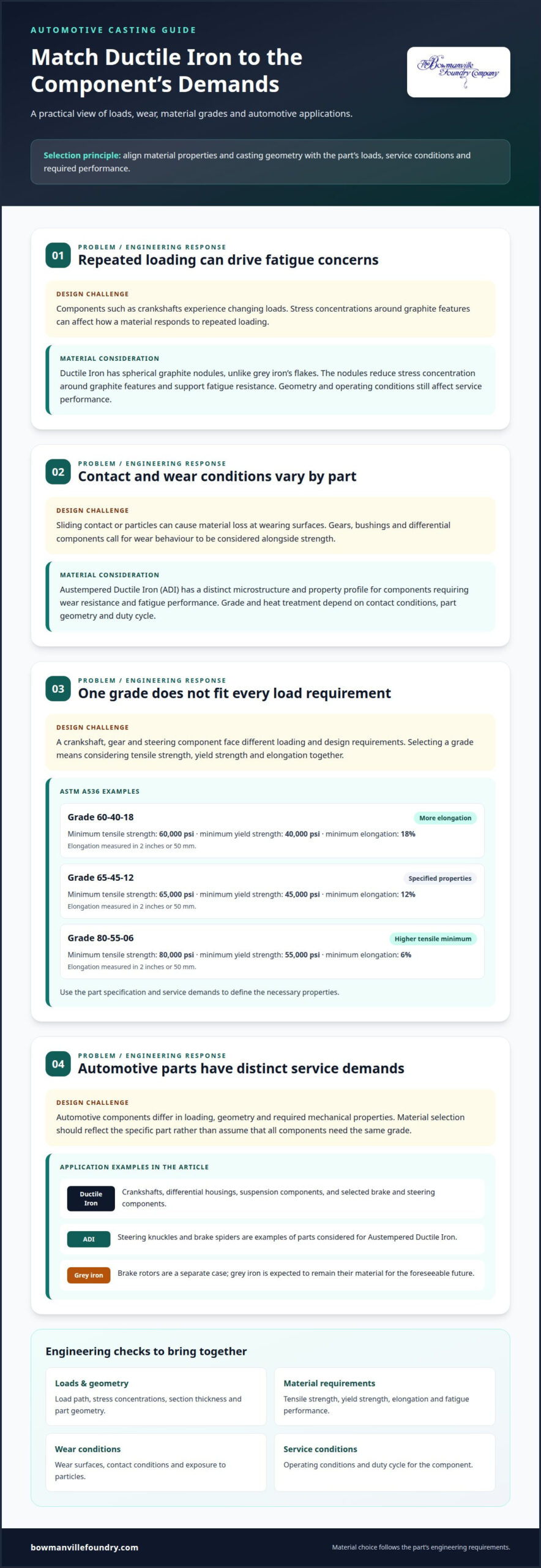
Ductile iron’s graphite nodules influence how the material responds to repeated loading. Unlike grey iron’s flakes, the nodules reduce stress concentration around graphite features. This microstructure supports fatigue resistance under changing loads, such as those acting on a crankshaft during engine operation. Strength is useful, but geometry and operating conditions still affect service performance.
ASTM A536 grades define different mechanical property combinations. Grade 60-40-18 has minimum tensile strength of 60,000 psi, yield strength of 40,000 psi, and elongation of 18 percent in 2 inches or 50 mm. Grade 80-55-06 has minimum tensile strength of 80,000 psi, yield strength of 55,000 psi, and elongation of 6 percent in 2 inches or 50 mm. Engineers match these properties to the part’s loading.
Abrasion resistance matters where surfaces encounter sliding contact or particles. Gears, bushings and differential components show why wear behaviour needs to be considered alongside strength. Austempered ductile iron (ADI) has a different microstructure and property profile for components requiring wear resistance and fatigue performance. The appropriate grade and heat treatment depend on contact conditions, part geometry and duty cycle.
Failure risks include fatigue cracking under repeated stress, fracture under excessive loading, and material loss at wearing surfaces. A casting with insufficient section thickness or an unsuitable grade may not withstand its intended loads. Environmental exposure and surface contact also affect performance. These are design and material-selection limits, not reasons to assume all ductile iron components behave alike.
For an automotive casting, assess the load path, stress concentrations, wear surfaces and required tensile properties together. Then align the material specification and casting geometry with the component’s service conditions. Ductile iron casting requirements can be considered in relation to these engineering factors, including the balance between fatigue strength and wear resistance.
Ductile iron in automotive applications
Automotive engineers use ductile iron for engine, drivetrain, suspension, steering and brake components. Material choice depends on each part’s loads, geometry and required mechanical properties.
Reasons for Component Use
Ductile iron supports complex automotive components that need strength, toughness and castable geometry. Its properties suit parts such as crankshafts, differential housings and suspension components, where engineers balance loads with design requirements. ADI steering knuckles and brake spiders are examples of parts considered for this material. Brake rotors are a separate case: grey iron is expected to remain their material for the foreseeable future.
Automotive Ductile Iron Grades
Automotive grade selection matches required tensile strength, yield strength and elongation to the part’s service demands. ASTM A536 includes grades such as 60-40-18, 65-45-12 and 80-55-06; ADI has separate grade specifications. The grade matters because a crankshaft, gear or steering component faces different loading and design requirements. Engineers use the part specification to define the necessary properties.
For Canadian and international specifications, ASTM A536 is a reference for ductile iron, while ADI standards include ASTM 897-90 and 897M-90 and the European EN-1564:1997. These identifiers name specifications, not a universal automotive requirement; the component drawing or purchasing specification determines which applies.
Applications span engine blocks, crankshafts, camshafts, gears, bushings, suspension, brakes and steering. Ductile iron can be cast into intricate shapes, allowing engineers to integrate features into components. Ford’s use of ductile iron crankshafts illustrates its role in engine design, while differential housings are used in pickup and industrial vehicles.
Electric propulsion does not remove the need for structural and moving components. EV engineers still assess suspension, steering, braking and drivetrain parts against their loads and mechanical requirements. Ductile iron may suit a design where its properties and cast geometry meet the requirements; the propulsion system alone does not determine material choice.
Why is ductile iron used for automotive components?
Ductile iron combines tensile strength with useful ductility across several automotive systems. Engine blocks, crankshafts and camshafts are examples of components made from it. The material’s damping capacity exceeds steel’s, which can help reduce noise and vibration. This behaviour matters to vehicle designers where mechanical loads and vibration occur together.
Suspension components offer another application. Their geometry and load paths differ from those of engine parts, so engineers select material properties for each function. Ductile iron can be cast into intricate shapes, supporting components with complex features. Casting geometry is therefore part of the material decision, rather than the alloy being the only design variable.
Operating conditions also matter. Ductile iron can withstand high temperatures and pressures in automotive components, supporting their service demands. Engine parts illustrate why these conditions are considered alongside tensile strength, toughness and fatigue resistance. A grade suitable for one component will not automatically suit another; loading and operating environment inform the choice.
Material comparisons should consider the complete component, not a single property. Ductile iron and carbon-fibre composites have different material characteristics, while its damping differs from steel. These comparisons do not make the materials interchangeable. Engineers weigh geometry, required mechanical properties and operating conditions before specifying a casting.
For procurement and design teams, the practical takeaway is to connect the material specification to the component’s function. A crankshaft, suspension part and engine block each place different demands on a casting. Define the required properties and geometry together, then assess whether ductile iron meets those requirements. This gives teams a focused basis for evaluating automotive casting designs.
Ductile iron is used to manufacture automotive engine blocks, crankshafts, camshafts and suspension components. These examples show its role across distinct automotive functions. Its damping properties can help reduce vehicle noise and vibration, another consideration when assessing a component. The examples do not mean every part has identical requirements; they show why material choice depends on the component’s function and design needs.
Bowmanville Foundry: Ductile Iron Castings
Bowmanville Foundry produces Ductile Iron Castings for manufacturers assessing material, geometry and finishing requirements. When a component design calls for foundry input, the foundry’s iron casting experience can help align specified requirements with a suitable casting approach.
Useful project details include CAD files, critical dimensions, required material properties and machining needs. Bowmanville Foundry also offers Gray Iron Castings, Malleable Iron Castings and Post-Processing Services for projects with different material or finishing requirements. The component specification determines the appropriate option.
Contact Bowmanville Foundry to discuss your iron casting requirements.
Plan the next step for your casting design
A sound evaluation of ductile iron applications in automotive design starts with the part’s functional requirements, not the alloy name alone. Define the loads, interfaces, critical dimensions and finishing operations that affect performance. This gives engineering and procurement teams a practical basis for discussing casting feasibility and production needs.
Bowmanville Foundry offers Ductile Iron Castings, Malleable Iron Castings and Post-Processing Services. These services and products support projects where material selection and finishing requirements need to be considered together. A clear specification focuses the discussion on the component’s geometry, required properties and intended application.
Bring your casting requirements and design details to the next conversation. Contact Bowmanville Foundry to discuss your project and identify a suitable path forward.
Frequently Asked Questions
What automotive parts are commonly made from ductile iron?
Common applications include engine, drivetrain, suspension, steering and braking components. One example is the ADI timing gear used in Cummins Series B and C diesel engines. Ductile iron components can also have complex geometry, making the material relevant when a part’s shape and required mechanical properties need to be considered together.
How does ductile iron compare with cast steel, grey iron, and aluminium in automotive parts?
Ductile iron, grey iron and aluminium have different mechanical properties, so suitability depends on each part’s design requirements. Ductile iron offers tensile strength and ductility, while aluminium may suit designs with different mass priorities. Engineers can compare candidates by assessing required strength, wear behaviour, vibration demands and component geometry for the intended application.
What are the typical costs of ductile iron automotive parts compared with alternatives?
Manufacturing requirements vary by part. Component geometry, material grade, production volume, tooling needs and finishing operations shape a project’s scope. For a useful procurement comparison, define these requirements consistently across candidate materials. This helps assess how each option fits the design, manufacturing process and required post-processing without relying on a generalized comparison.
