
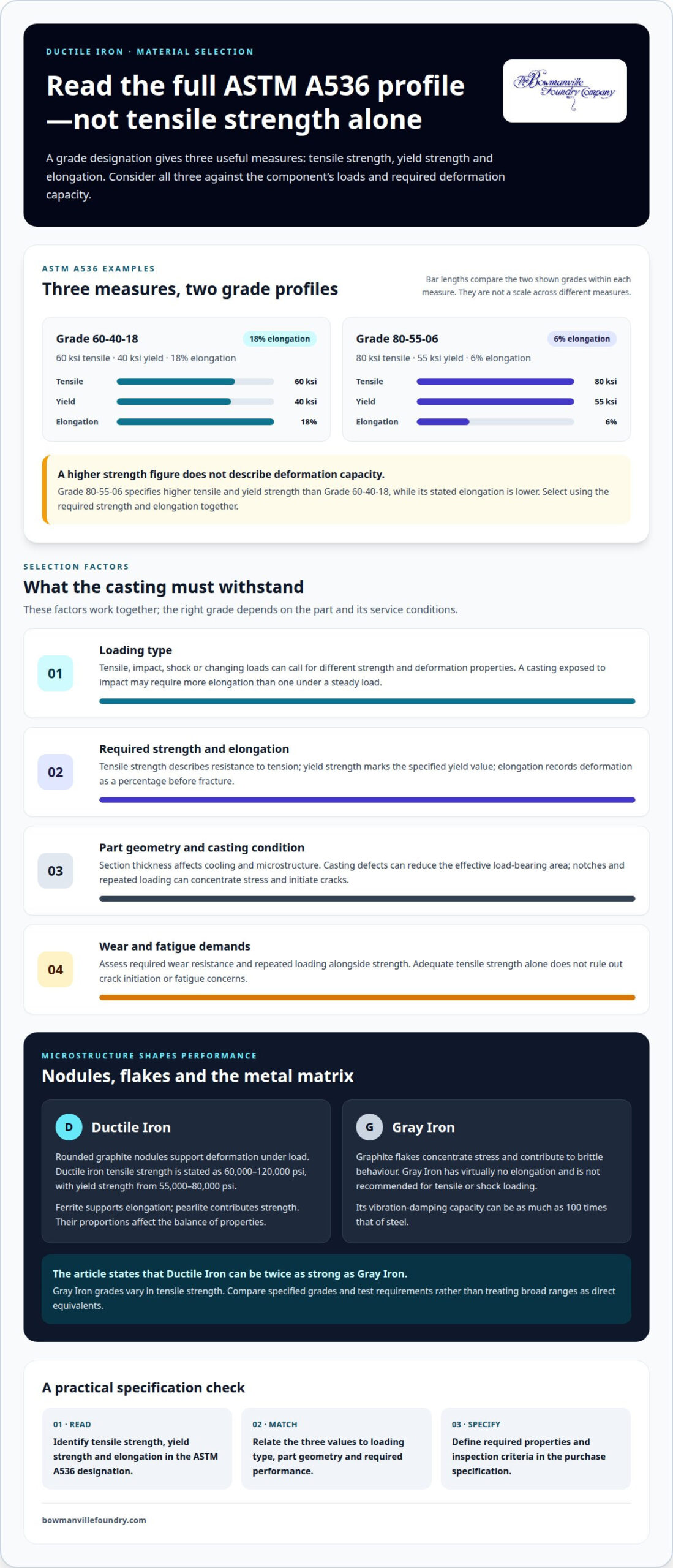
Higher strength doesn’t have to mean giving up all capacity to stretch. For ductile iron for high-strength parts, the nodular graphite microstructure helps distinguish it from Gray Iron, whose flake graphite structure contributes to its brittle behaviour. ASTM A536 grade 60-40-18 illustrates the balance: it specifies 60 ksi ultimate tensile strength, 40 ksi yield strength and 18% elongation.
Choosing ductile iron for high-strength parts means balancing strength, ductility and the demands placed on the finished casting. A high strength value alone does not show how much a part can deform before fracture or whether its properties suit the application.
This article explains how ductile iron’s graphite nodules and metal matrix affect its behaviour, and how to read ASTM grade designations. It also compares strength, elongation and ductility with Gray Iron, helping you identify which properties matter when specifying a casting.
Key Takeaways
- Read ASTM A536 designations to identify a grade’s tensile strength, yield strength and elongation.
- Assess how graphite shape and the metal matrix affect a casting’s strength and ability to deform under load.
- Compare Ductile Iron, Gray Iron and Malleable Iron against the part’s loading conditions and required mechanical properties.
- Use technical guidance and casting resources to clarify material requirements before moving a design towards production.
What is Ductile Iron?
Ductile Iron is cast iron with rounded graphite nodules that support deformation under load. Its properties make it suitable for industrial castings where strength and impact resistance matter.
Industrial and Heavy Equipment Uses
Industrial machinery uses ductile iron castings for components that must carry mechanical loads and meet defined shape requirements. Their strength and ductility can suit equipment exposed to vibration, changing loads or impact. The application determines which grade properties matter most: loading direction, part geometry and required performance all inform material selection.
Heat Treatment and Part Strength
Heat treatment changes ductile iron’s matrix, affecting strength, ductility, and toughness. Annealing can produce a ferritic structure, while austempering creates a different balance of mechanical properties. ASTM A536 provides grade designations; purchase specifications can define the required properties and inspection criteria. Section thickness affects cooling and microstructure, while casting defects can reduce the effective load-bearing area. These factors matter when evaluating a part’s strength and toughness alongside its grade.
Cast iron contains about 2.5% to 4.5% carbon and usually breaks after less than 1% stretch. Ductile iron is produced by adding a closely controlled amount of magnesium alloy to molten iron with low phosphorus and sulfur content. Ductile cast iron applications include crankshafts and gears, and ductile iron is used in shock-load applications such as rock crushing.
More than 500 members of the Cast Iron Pipe Century Club are cities or utilities with cast iron pipe still in service after 100 years.
Ductile iron microstructure and ASTM grade designations
Graphite nodules and the surrounding matrix shape ductile iron’s mechanical properties. ASTM A536 designations help engineers compare grades by tensile strength, yield strength, and elongation.
ASTM A536 Grade Designations
ASTM A536 uses tensile and yield strength in ksi, followed by elongation as a percentage. Grade 80-55-06 specifies 80 ksi tensile strength, 55 ksi yield strength, and 6% elongation. This format gives engineers measurable criteria for comparing material requirements. Selecting ductile iron for high-strength parts means considering all three values, not ranking grades by tensile strength alone.
Grade-Specific Microstructures and Properties
Ferrite and pearlite proportions affect strength and ductility. Grade 65-45-12 contains graphite nodules in a ferrite matrix with a smaller amount of pearlite; grade 80-55-06 has a ferrite and pearlite matrix. Ferrite supports elongation, while pearlite contributes strength. For ductile iron for high-strength parts, this structure-property relationship helps align a grade with the component’s loading needs.
Properties of Selected ASTM Grades
Grade 80-55-06 specifies 80 ksi tensile strength, 55 ksi yield strength, and 6% elongation. Ductile iron grades can vary in microstructure and strength characteristics, so both are relevant when comparing them. These examples show why grade selection should account for the required strength and deformation capacity together.
Elongation and ductility
Ductility describes a material’s capacity for plastic deformation before fracture; elongation records that deformation as a percentage. Ductile iron grades commonly list elongation between 10% and 18%, giving engineers a measurable comparison; selection must also account for brittle fracture and fatigue, since notches, defects, or repeated loading can concentrate stress and initiate cracks despite adequate tensile strength.
Elongation Under Stress
Under tensile stress, graphite nodules influence how the surrounding matrix deforms. Elongation measures the percentage increase in a test specimen’s length before fracture. A higher value indicates greater deformation capacity, which can help a part tolerate load changes before failure. For example, a casting exposed to impact may require more elongation than one under a steady load.
Strength and Elongation Trade-Offs
Strength and elongation often trade off as the metal matrix changes. A pearlitic structure can increase tensile and yield strength, while ferrite supports deformation and toughness. Engineers match grade properties to load type, geometry and required wear resistance. A component designed for high strength under a steady load may accept less elongation than one exposed to impact or changing loads.
Ductile iron’s strength and ductility compared with Gray Iron
Ductile and Gray Iron both contain graphite, but its shape changes how each material responds to stress. Ductile iron’s rounded nodules support deformation, while Gray Iron’s flakes concentrate stress and contribute to brittle fracture. This microstructural difference affects tensile strength, elongation and suitability for loaded castings.
Ductile iron tensile strength ranges from 60,000 to 120,000 psi, with yield strength from 55,000 to 80,000 psi. It can be twice as strong as Gray Iron. Gray Iron grades can vary in tensile strength, so compare specified grades and test requirements rather than treating broad ranges as direct equivalents. Compare specified grades and test requirements, rather than treating these ranges as direct equivalents.
Gray Iron has virtually no elongation and is not recommended for tensile or shock loading. Its graphite flakes make it brittle under those conditions. Ductile iron’s nodules allow greater deformation before fracture, making it a stronger candidate when a component must carry tensile loads or absorb impact. Gray Iron can provide excellent vibration damping, with capacity as much as 100 times that of steel.
Carbon content alone does not determine the choice: listed ranges are 3.0%-3.9% for ductile iron and 2.0-4.0% for Gray Iron. For a gear or other stressed casting, weigh tensile and yield strength, elongation, vibration demands, and loading type together. The better fit depends on the required mechanical properties, not simply which iron has the higher strength.
Malleable Iron
Malleable Iron is used for small castings that need good tensile strength and ductility. Its balance of properties suits parts that must carry tension while accommodating some deformation. Malleable cast iron has a listed carbon content of 2.0-3.0%, but carbon content alone does not determine a casting’s mechanical performance. The grade and finished part requirements also matter.
For a small bracket, linkage or similar component, tensile strength indicates resistance to pulling loads, while ductility describes deformation before fracture. Both properties affect how a part responds to service loads. Prioritizing strength without considering ductility may not suit a part exposed to impact or changing loads. Greater deformation capacity may help a component accommodate some load variation, depending on its geometry and operating conditions.
Begin material selection with the part’s function, load direction and required mechanical properties. Compare those demands with the specified grade of malleable iron and the casting’s shape, including thin sections and transitions, which influence how it carries stress. Malleable iron is distinct from ductile iron, which suits medium to large castings. For a small component requiring both tensile strength and ductility, assess the full specification rather than choosing by material name alone.
Free Casting Buyers Guide
The free Casting Buyer’s Guide gives casting purchasers and design engineers a reference point for defining part requirements. For a ductile iron component, relate required tensile strength, yield strength, and elongation to its service loads. ASTM A536 designations, such as 65-45-12, express these mechanical properties in a consistent format. This helps frame grade selection around performance requirements rather than a material name alone.
Before production, organize the part drawing or CAD files, dimensional requirements and expected loading conditions. Note hollow sections that require a core and areas where wall thickness changes. These details describe the geometry the casting process must produce. Identify machining and other finishing requirements as well, so the intended finished part is clear from the outset.
Use the guide to compare design needs with casting requirements. A part with complex geometry, for example, may need a different design discussion from a simple component under steady loading. Record the operating environment, critical dimensions and required material properties together. This gives procurement teams and engineers a clear basis for discussing the specification, evaluating design constraints and planning the transition from drawing to production.
Bowmanville Foundry: Ductile Iron Castings
Bowmanville Foundry produces ductile iron castings for parts requiring a defined balance of strength and ductility. Its offerings also include grey iron castings, malleable iron castings and post-processing services. These options support material selection and finishing needs for industrial components. A technical assessment can consider geometry, loading conditions and required mechanical properties to connect the part specification with appropriate casting requirements.
For design questions that benefit from direct review, Bowmanville Foundry can send a technical or sales engineer to your facility to assess your needs and requirements. Drawings or CAD files, operating conditions and critical dimensions provide useful context. An on-site assessment can focus on casting feasibility, material requirements and how the finished component must fit its assembly or equipment.
Quality systems also matter in casting procurement. Bowmanville Foundry was the first foundry in Canada to achieve ISO certification in 1996. To discuss a ductile iron part or refine its specifications, contact Bowmanville Foundry.
Frequently Asked Questions
What ductile iron grades offer the highest tensile strength and yield strength?
ASTM A536 grade 120-90-02 is the highest-strength designation discussed here, indicating 120 ksi tensile strength and 90 ksi yield strength. The designation also indicates 2% elongation. This grade may suit ductile iron for high-strength parts where strength requirements take priority, but its lower elongation means deformation capacity also deserves attention. Specify the required properties in the part documentation.
What design and machining considerations apply to high-strength ductile iron components?
Account for tool access, fixturing and areas where machining could leave thin walls or sharp transitions. A recessed feature, for example, may need a cutter path that avoids damaging nearby surfaces. Define which surfaces are functional and how the part will be held during machining. These details help preserve the intended geometry and avoid unnecessary machining operations.
What industries use high-strength ductile iron parts, and what components are common?
Industries using iron castings include pumps and valves, agriculture, railroad, hardware and electrical equipment. Common component forms include pump housings, valve bodies, equipment brackets and electrical enclosures. The appropriate grade depends on each part’s structural role and service loads. A housing supporting an assembly, for example, has different design demands from a bracket carrying a concentrated load.
How does ductile iron compare with cast steel and forged steel for high-strength parts?
For a specific comparison, ASTM A536 ductile iron grade 60-40-18 lists 60 ksi tensile strength, 40 ksi yield strength, and 18% elongation; ASTM A27 cast steel grade 60-30-22 lists 60 ksi tensile strength, 30 ksi yield strength, and 22% elongation. The material gives no comparable information for forged steel.
What heat treatments improve the strength and toughness of ductile iron?
Annealing can produce a ferritic matrix, and grade 60-40-18 is annealed to provide excellent ductility and impact strength. Austempering creates a different balance of mechanical properties.
