
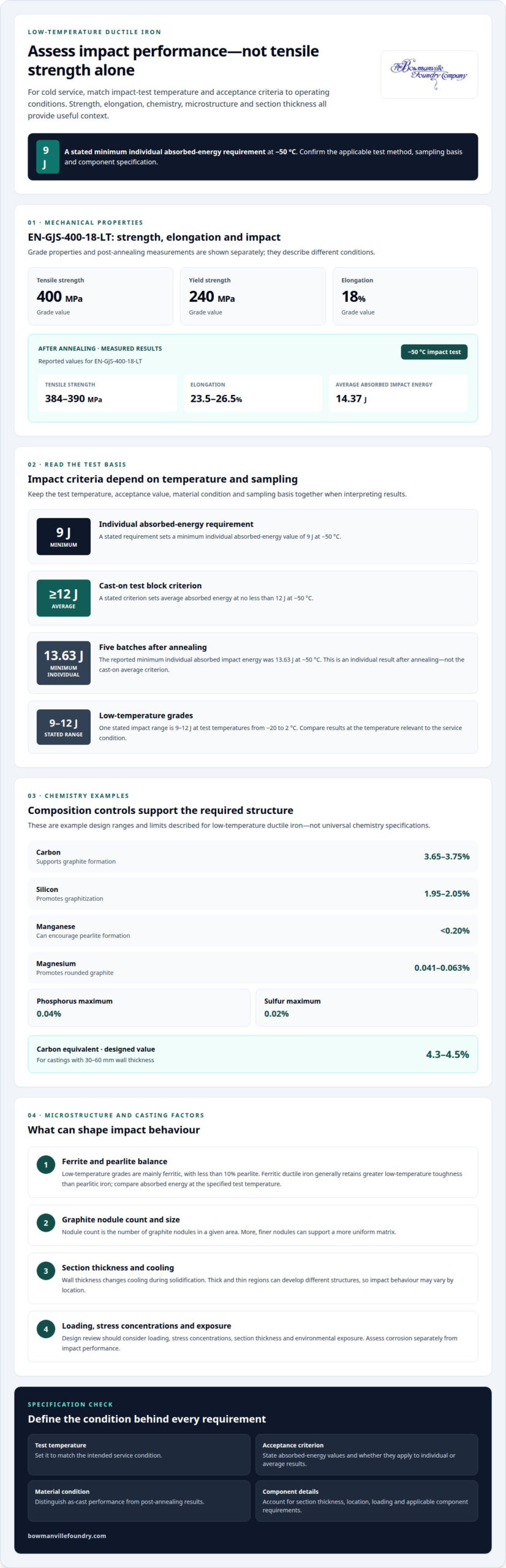
A tensile-strength result alone doesn’t establish how ductile iron will behave in the cold. Selecting ductile iron for low temperature service also means considering impact energy at the service temperature; one stated requirement sets a minimum individual absorbed-energy value of 9 J at -50 °C.
That distinction matters when a casting must retain useful toughness as temperatures fall. Composition, carbon equivalent, and microstructure influence impact behaviour, while strength and elongation offer additional measures of mechanical performance.
This article explains how these factors affect low-temperature impact performance. It covers key mechanical properties, the roles of carbon and alloying elements, why a predominantly ferritic matrix matters, and how casting conditions and wall thickness shape test results. The goal is to give engineers and casting buyers a practical basis for assessing material requirements and specifying ductile iron castings for demanding service conditions.
Key Takeaways
- Assess low-temperature performance using impact behaviour alongside tensile strength and elongation, rather than relying on a single mechanical property.
- Understand how carbon equivalent and the balance of alloying elements can influence the matrix structure and impact response.
- Learn why graphite nodules and a predominantly ferritic matrix matter when evaluating as-cast ductile iron.
- Use the material guidance and foundry services to align an iron casting choice with part design, performance requirements and finishing needs.
Mechanical properties
Mechanical properties describe how a material responds to load and impact. For ductile iron for low temperature service, consider impact energy alongside tensile strength and elongation.
EN-GJS-400-18-LT Mechanical Properties
EN-GJS-400-18-LT is a ductile iron grade defined by strength and elongation properties. Its tensile strength is 400 MPa, yield strength 240 MPa, and elongation 18%. After annealing, measured tensile strength was 384-390 MPa, elongation 23.5%-26.5%, and average absorbed impact energy 14.37 J at -50 °C.
ASTM Low-Temperature Ductile Iron Specifications
Low-temperature impact-resistant ductile iron is described as similar to ASTM A536 grade 60-40-18. An ASTM A395 designation alone does not establish a universal impact value; define the required test temperature and acceptance criterion in the component specification.
Minimum Service Temperature by Grade
Minimum service temperature is the lowest temperature at which a grade meets its specified criteria. For ductile iron for low temperature service, match the impact-test temperature and acceptance criteria to operating conditions. A stated requirement sets minimum individual absorbed energy at 9 J at -50 °C.
Low-temperature impact-resistant ductile iron microstructure
Matrix structure and graphite nodules influence impact behaviour, environmental durability, and fracture response.
Nodule Count and Impact Resistance
Nodule count is the number of graphite nodules in a given area. More, finer nodules can support a more uniform matrix. Low-temperature grades are mainly ferritic, with less than 10% pearlite; one stated impact range is 9-12 J at -20 to 2°C.
Shock Resistance in Cold Service
Shock resistance is a material’s ability to absorb sudden loading without fracturing. Ductile iron and steel can have similar mechanical properties; however, shock resistance varies by grade and condition. Compare impact-test results for the specific ductile iron and steel grades at the intended service temperature. Corrosion resistance is also grade- and condition-dependent; some ductile iron grades may provide better corrosion resistance than some steel grades, although superficial rust can occur.
Brittle-Fracture Risks and Design Limits
Brittle fracture is sudden cracking with little plastic deformation. Canadian and CSA requirements depend on the applicable component specification, so define the test temperature, absorbed-energy criteria, and certification records accordingly. Impact testing assesses cold-service performance. Design review should also consider stress concentrations, section thickness, and loading. Lower temperatures can reduce impact tolerance, so no single minimum temperature applies to every grade. Assess environmental exposure and corrosion separately.
Chemical composition and carbon equivalent
Elemental composition is the proportion of each chemical element in an iron melt. Carbon supports graphite formation; an experimental design used 3.65%-3.75%. Silicon promotes graphitization, with a specified range of 1.95%-2.05%. Manganese can encourage pearlite formation, so the design limited it to below 0.20%. For ductile iron for low temperature service, these elements need to be controlled as a balanced chemistry.
Magnesium is the nodularizing element that promotes rounded graphite; an example range was 0.041%-0.063%. Phosphorus and sulfur are residual elements controlled in the melt; their specified maximums were 0.04% and 0.02%, respectively. These limits help manage composition relevant to impact performance.
Carbon equivalent is an index combining carbon and silicon effects on solidification. For castings with 30-60 mm wall thickness, the designed value was 4.3%-4.5%. In ductile iron for low temperature service, the resulting matrix and graphite structure also influence impact behaviour.
As-cast microstructure and impact performance
As-cast microstructure is the matrix and graphite structure formed during solidification, without subsequent heat treatment.
Ferritic and Pearlitic Low-Temperature Toughness
A ferritic matrix is an iron-rich phase; pearlite consists of ferrite and cementite. Ferritic ductile iron generally retains greater low-temperature toughness than pearlitic iron. Pearlite’s harder structure can lower impact tolerance. Compare absorbed energy at the specified test temperature, not phase names alone. A cast-on test block criterion sets average absorbed energy of at least 12 J at -50 °C.
Section Thickness and Impact Properties
Section thickness is the local distance through a casting wall. It alters cooling during solidification, so thick and thin regions can develop different structures. Impact behaviour may therefore vary by location. For castings in the 30-60 mm wall-thickness range, requirements pair thickness with mechanical criteria. Assess impact energy separately, since tensile strength alone does not describe low-temperature toughness.
Post-annealing results offer a separate comparison from as-cast performance: the five ductile iron batches had a minimum individual absorbed impact energy of 13.63 J at -50 °C. This describes individual results after annealing, rather than the cast-on average criterion, so condition and sampling basis should remain clear when assessing toughness.
The page lists EN-JS-1025 as a related standard for low-temperature impact-resistant ductile iron. An example low carbon content is 3.5%, while example high and low manganese contents are 0.5% and 0.1%, respectively. These composition examples provide context for material selection, while impact testing remains the direct measure of performance at the relevant temperature.
Ductile, Gray and Malleable Iron Castings
Bowmanville Foundry produces small and medium-sized Ductile Iron, Gray Iron, and Malleable Iron castings. These families differ in graphite structure and mechanical behaviour. Start selection with the part’s function, loading, geometry, and service conditions, then match those needs to the required iron grade.
Ductile Iron combines high tensile strength with good ductility. For cold service, assess impact performance at the specified temperature alongside other required properties. Gray Iron is available in three grades, allowing selection to reflect the component’s stated requirements. Malleable Iron is used for small castings that need good tensile strength and ductility. Identify required properties and operating conditions in the drawings and purchase specifications so material selection aligns with the component’s design.
Gray Iron
Gray Iron is a cast iron in which graphite forms flakes within the metallic matrix. This distinguishes it from the rounded graphite structure of Ductile Iron. The flakes help damp vibration, making Gray Iron useful for machine bases and housings where vibration control matters. However, this structure limits ductility and tensile response compared with nodular irons, so selection should reflect loading and fracture requirements.
Gray Iron castings suit components where rigidity, vibration damping, and cast geometry are central design needs. Examples include equipment frames and covers, provided the selected grade meets the drawing’s mechanical requirements. For cold service, assess impact loading separately: vibration damping does not establish low-temperature toughness. Specify service temperature, loads, interfaces, and inspection criteria in the part documentation. Bowmanville Foundry produces Gray Iron castings.
Malleable Iron
Malleable Iron can be considered for small castings where strength and ductility are required. Its temper-carbon graphite forms during heat treatment. This structure allows more plastic deformation than the flake graphite in Gray Iron, making the material suitable for compact components subject to mechanical loading. Bowmanville Foundry produces Malleable Iron castings.
Applications can include small fittings and hardware when their geometry and strength requirements suit the material. For a part operating at low temperatures, assess the specified service temperature and impact requirements separately; the material name alone does not establish cold-service performance. Identify loads, dimensions, interfaces, and required properties in the drawings and purchase specifications. These criteria help the casting design and production teams assess material fit and finished-part requirements.
Free Casting Buyers Guide
The Free Casting Buyers Guide helps purchasers assess iron casting requirements. Bowmanville Foundry provides it alongside detailed technical data and application guides to support iron-grade selection. Use these resources to frame material selection around the component’s intended function, rather than choosing by grade name alone.
Begin by defining the operating conditions and part requirements: service temperature, applied loads, geometry, and finishing needs. Then identify the mechanical properties that matter, such as strength, ductility, or impact performance. For a casting intended for cold service, include the required test temperature and impact criteria in the specification. These details give the foundry a clearer basis for assessing material fit and casting design. The guide supports informed purchasing discussions, while the technical information connects material characteristics with the demands of the finished component.
On-Site Technical/Sales Engineer Visit
An on-site technical or sales engineer visit assesses casting needs and requirements at a customer’s facility. Customers can request a visit to discuss Ductile Iron, Gray Iron, or Malleable Iron castings, as well as required post-processing.
A useful assessment considers the component’s function, loading, service temperature, geometry, and specified material properties. For cold-service components, review impact criteria alongside strength and elongation requirements. Share available drawings, CAD files, and operating details to discuss design considerations in relation to the part’s intended use. The visit can also address casting feasibility, including features that affect mould design, cores, and machining allowances. Recording required properties, interfaces, and finishing operations helps align the casting specification with production needs. This gives engineering and procurement a shared basis for material selection.
Bowmanville Foundry: Post-Processing Services
Bowmanville Foundry supplies Ductile Iron, Gray Iron, and Malleable Iron castings, as well as post-processing services. These offerings support projects that need a cast component and finishing suited to its intended use.
Post-processing is relevant when a casting needs preparation before assembly or integration. Define required features in the drawing and purchase specification, including critical interfaces, dimensional requirements, and surface expectations. For cold-service components, distinguish finishing requirements from material qualification: finishing does not establish low-temperature impact performance. Specify required material properties and impact criteria separately from post-processing instructions so each is addressed clearly in production.
Share the component’s function, operating conditions, drawings, and finishing requirements to establish the scope of your casting project. Contact Bowmanville Foundry to discuss iron castings and post-processing.
Frequently Asked Questions
Which ductile iron grades meet low-temperature impact requirements?
EN-GJS-400-18-LT and QT400-18L are examples associated with low-temperature impact requirements; low-temperature impact-resistant ductile iron is also described as similar to ASTM A536 grade 60-40-18. The relevant grade depends on the specified test temperature, casting wall thickness, and required impact criteria. For a 30-60 mm wall-thickness range, stated requirements include mechanical-property limits alongside impact performance.
What Charpy V-notch impact values are required for ductile iron at low temperatures?
The stated absorbed-energy criteria include a minimum individual value of 9 J at -50 °C, while the cast-on test block criterion is an average of at least 12 J at -50 °C. These figures describe different acceptance measures, so they should not be treated as interchangeable. Confirm the governing specification’s test method, specimen requirements, and acceptance basis in the component documentation.
