
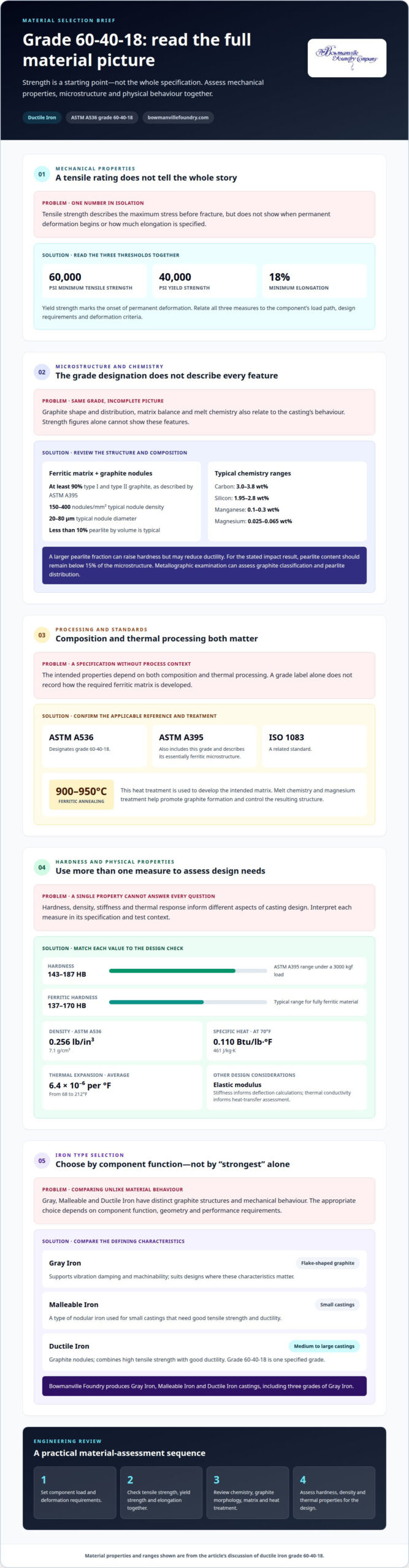
A tensile rating alone doesn’t describe how a casting will behave. The ductile iron grade 60-40-18 properties include a minimum tensile strength of 60,000 psi, a yield strength of 40,000 psi and minimum elongation of 18%. Its predominantly ferritic structure helps explain the balance of strength and ductility, while graphite content and distribution also influence performance.
For engineers and casting buyers, these figures are a useful starting point, but they should be considered alongside hardness, density, and microstructure. A specification supports a sound material choice only when the mechanical properties meet the component’s design and service requirements.
This article explains how chemistry and ferritic structure relate to grade 60-40-18 strength and elongation, then looks at its hardness and density. The article also examines how graphite nodularity and pearlite content contribute to the material’s behaviour, providing a basis for assessing whether this ductile iron grade fits your casting requirements.
Key Takeaways
- Assess chemistry and ferritic structure alongside strength and elongation when judging whether this grade suits a casting application.
- Consider graphite distribution and pearlite content as part of how the material’s microstructure relates to performance.
- Compare ductile, grey, and malleable iron according to the component’s design and required material properties.
- Use the Casting Buyers Guide and a technical assessment to organize casting requirements and material-selection discussions.
Ferritic Microstructure and Chemistry Control
Grade 60-40-18 ductile iron develops a ferritic matrix that supports ductility. Typical chemistry includes 3.0-3.8 wt% carbon, 1.95-2.8 wt% silicon, 0.1-0.3 wt% manganese, and 0.025-0.065 wt% magnesium. Phosphorus and sulfur levels are controlled as part of melt chemistry. Optional nickel additions of 0.50-1.00 wt% can modify the alloy. Melt chemistry and magnesium treatment help promote graphite formation and control the resulting structure.
ASTM A536 designates grade 60-40-18; ASTM A395 also includes this grade, while ISO 1083 is a related standard. Ferritic annealing uses 900-950°C heat treatment to develop the intended matrix. The resulting properties depend on both composition and thermal processing.
Machining is practical with suitable tooling; welding requires controlled procedures because localized heating can affect cast iron. This grade suits components where tensile strength and elongation are required together, including cast parts designed around those mechanical demands.
Tensile Strength, Yield Strength, and Elongation
A review of ductile iron grade 60-40-18 properties starts with three ASTM A536 tensile-test thresholds. Each describes a different aspect of a specimen’s response under load.
Tensile and yield strength
Tensile strength is the maximum stress a specimen withstands before fracture; yield strength marks the onset of permanent deformation. ASTM A536 grade 60-40-18 specifies minimum tensile strength of 60,000 psi and yield strength of 40,000 psi. For design, the yield value helps assess stresses that could leave lasting distortion, while tensile strength describes the upper limit before fracture. Relate both measures to the component’s load path and specified design requirements.
Elongation characteristics
Elongation measures the percentage increase in a tensile-test specimen’s length before fracture. Grade 60-40-18 requires a minimum elongation of 18%, indicating its specified deformation capacity during testing. Compared with grades 65-45-12 and 80-55-06, selection depends on balancing strength requirements with the required elongation. Document ductile iron grade 60-40-18 properties against the component’s loading and deformation criteria, rather than treating elongation as a stand-alone measure. The test result helps engineers assess material response; component geometry also informs design decisions.
Ferritic Microstructure and Graphite Content
In Grade 60-40-18, graphite forms rounded nodules within a mostly ferritic iron matrix. ASTM A395 describes Grade 60-40-18 ductile iron as having an essentially ferritic microstructure and at least 90% type I and type II graphite. These measures describe shape and distribution, not graphite’s total weight percentage. Typical nodule density ranges from 150-400 nodules/mm², with diameters of 20-80 μm. More uniform nodules help explain how ductile iron differs from iron containing flake-shaped graphite.
The ferritic matrix supports elongation, while graphite morphology influences how stress moves through the casting. Grade 60-40-18 typically contains less than 10% pearlite by volume. A larger pearlite fraction can raise hardness, but may reduce ductility. For ductile iron to meet the stated impact result, pearlite content should remain below 15% of the microstructure. Heat treatment can help develop the intended ferritic structure.
These microstructural features influence mechanical properties: graphite nodule shape and count, as well as the balance of the matrix, all matter. Metallographic examination can assess graphite classification and pearlite distribution alongside tensile-test results, giving engineers a fuller picture than the grade designation alone.
Hardness and Density
Hardness, density, elastic modulus, and thermal response each inform a different aspect of casting design.
Hardness characteristics
Brinell hardness measures resistance to indentation, providing a reference for surface response and machining considerations. ASTM A395 grade 60-40-18 has a hardness range of 143-187 HB under a 3000 kgf load. Fully ferritic material typically measures 137-170 HB. These ranges describe different specification and microstructure contexts, so interpret hardness alongside applicable material requirements and test conditions.
Density and related properties
Density is mass per unit volume; ASTM A536 lists 0.256 lb/in3 (7.1 g/cm3). Elastic modulus describes stiffness in the elastic range and informs deflection calculations. Thermal conductivity is a useful consideration when assessing heat transfer in ferritic ductile iron. At 70°F, specific heat is 0.110 Btu/lb·°F (461 J/kg·K). Average thermal expansion from 68 to 212°F is 6.4 × 10⁻⁶ per °F (11.5 × 10⁻⁶ per °C). These measures support mass, heat-transfer, and thermal-clearance assessments.
Gray, Malleable, and Ductile Iron Castings
The Bowmanville Foundry produces Gray Iron, Malleable Iron, and Ductile Iron castings. Its Gray Iron range includes three grades, giving buyers options within that material family. Because each iron type has a distinct graphite structure and mechanical behaviour, select material according to the component’s function, geometry, and performance requirements.
Gray Iron contains flake-shaped graphite, which supports vibration damping and machinability. It suits designs where those characteristics matter. Malleable Iron is a type of nodular iron used for small castings that need good tensile strength and ductility. Ductile Iron has graphite nodules and combines high tensile strength with good ductility, making it suitable for medium to large castings. Grade 60-40-18 is one example of a specified Ductile Iron grade.
For casting buyers, the practical question is not simply which iron is strongest. A housing that benefits from vibration damping may need different properties from a component exposed to tensile loading or impact. Geometry, machining needs, and service conditions also shape the choice. Matching the iron type to these requirements helps establish a suitable casting specification and keeps design and procurement teams aligned.
Free Casting Buyers Guide
Choosing an iron casting takes more than matching a grade name to a drawing. The Bowmanville Foundry’s free Casting Buyer’s Guide helps buyers and engineers assess casting requirements and iron-grade options. Use it early to connect the component’s function with the properties its application requires.
Start by defining the component’s role, loading conditions, and design features. Note wall sections, cores, machining allowances, and required surface finish. These details help distinguish material requirements from geometry and manufacturing considerations. For example, a part prioritizing ductility may prompt a different material discussion from one designed around vibration damping.
Use the guide to prepare a casting brief for engineering and procurement review. Gather the drawing or CAD files, production requirements, and specified mechanical properties. This gives discussions of Gray Iron, Malleable Iron, and Ductile Iron a clear application context. The goal is to base the casting specification on the component’s needs, rather than an assumed grade, before finalizing material and design decisions.
On-Site Technical Assessment
An on-site technical assessment reviews a part’s design and production requirements in its intended operating setting. The Bowmanville Foundry can send a technical or sales engineer to a customer’s facility to assess needs and requirements. To arrange a visit, describe the component, its operating demands, and the casting questions to address.
Provide available drawings or CAD files, the target material grade, expected loading, and any machining or finishing needs. This gives the engineer a basis for discussing Ductile Iron, Gray Iron, or Malleable Iron castings in relation to the part’s function. The assessment can consider design features, such as section changes or internal cavities, that affect casting feasibility.
Use the discussion to align engineering and procurement on specification priorities, production requirements, and post-processing needs. Reviewing the component in its operating setting can also clarify interfaces, access, and constraints that drawings may not fully convey. A defined set of questions helps focus the technical assessment and set practical next steps for the casting project.
Bowmanville Foundry: Ductile Iron Castings
The Bowmanville Foundry produces Ductile Iron castings for manufacturers assessing whether a specified grade suits a component’s design and service requirements. Technical data and application guides support evaluation of material properties, geometry, and machining needs. This is a practical next step when grade selection must align with a production component.
Bowmanville Foundry says it has provided malleable, ductile, and grey iron casting services since 1902. Its modern casting facility supports iron casting production, while its quality certification offers a documented basis for procurement and engineering discussions. Buyers can bring drawings or CAD files, grade requirements, and machining or finishing details into a technical review. This helps clarify how a ductile iron casting specification connects to the finished part and its intended use. Post-Processing Services can also be relevant when finishing operations form part of the casting scope.
For technical assistance with a ductile iron casting requirement, contact Bowmanville Foundry.
Frequently Asked Questions
What are the tensile strength, yield strength, and elongation requirements for ductile iron grade 60-40-18?
ASTM A536 grade 60-40-18 specifies a minimum tensile strength of 60,000 psi, a yield strength of 40,000 psi, and minimum elongation of 18%. These thresholds describe resistance to fracture, the onset of permanent deformation, and stretching during tensile testing. For a component with limited deformation allowance, compare design loads with yield strength, not tensile strength alone.
What are the hardness and impact properties of ductile iron 60-40-18?
ASTM A395 grade 60-40-18 has a Brinell hardness range of 143-187 HB under a 3000 kgf load. Optimized ferritic material has typical room-temperature Charpy V-notch impact values of 10-15 ft·lbf; reported values at −20°F (−29°C) are 6-11 ft·lbf. These impact results reflect different test temperatures, so they should not be treated as interchangeable.
What is the chemical composition of grade 60-40-18 ductile iron?
Typical composition includes carbon at 3.0-3.8 wt%, silicon at 1.95-2.8 wt%, manganese at 0.1-0.3 wt%, and magnesium at 0.025-0.065 wt%. Phosphorus is limited to ≤0.06 wt% and sulfur to ≤0.015 wt%; nickel additions of 0.50-1.00 wt% are optional. ASTM A395 lists a maximum silicon content of 2.50%, so distinguish standard limits from typical composition ranges.
What are the typical microstructure and nodularity requirements for 60-40-18 ductile iron?
ASTM A395 describes grade 60-40-18 as essentially ferritic, with at least 90% type I and type II graphite. Graphite nodularity is described as at least 85%, preferably above 90%. Typical nodule density is 150-400 nodules/mm², with diameters of 20-80 μm. These measurements characterize graphite shape and distribution within the casting’s microstructure.
How does ductile iron 60-40-18 compare with grades 65-45-12 and 80-55-06?
Grade 60-40-18 has minimum tensile strength of 60,000 psi, yield strength of 40,000 psi, and elongation of 18%. Selection among these grades depends on balancing the component’s strength requirements with its required elongation.
What applications commonly use ductile iron grade 60-40-18?
It suits cast components designed to require a combination of tensile strength and ductility, with a minimum tensile strength of 60,000 psi and minimum elongation of 18%.
