
Why does a metal component that takes only hours to cast often require twenty-six weeks to reach your assembly line? For many industrial professionals, managing iron casting lead times in Canada feels like a constant battle against opaque schedules and international shipping bottlenecks. You’ve likely experienced the frustration of a project stalling because a critical part is stuck in post-processing or delayed by a breakdown in offshore communication. It’s a common pain point that disrupts production and inflates overhead costs.
This guide provides the technical framework you need to reclaim control over your project timeline and ensure your industrial components arrive when they’re needed. You’ll learn how to identify hidden delays in the foundry production cycle and why integrating domestic engineering can significantly compress your schedule. We will examine current 2026 market benchmarks, compare the true cost of domestic versus international lead times, and outline specific strategies to streamline your process from initial design to the finished, machined part.
Key Takeaways
- Identify why lead time has become the primary KPI for industrial procurement in 2026 and its role in building a resilient Canadian supply chain.
- Learn how to navigate the variables affecting iron casting lead times Canada, from initial pattern development to the specific metallurgical requirements of malleable, ductile, or gray iron.
- Compare the hidden risks of international “landed lead times” against the predictability and reduced logistical complexity of domestic Canadian foundries.
- Master strategies such as Design for Manufacturability (DFM) to simplify moulding processes and reduce the time from design to finished part.
- Understand how integrated post-processing services within a single facility can eliminate external transit times and streamline your entire production schedule.
The Impact of Iron Casting Lead Times on Canadian Industrial Projects
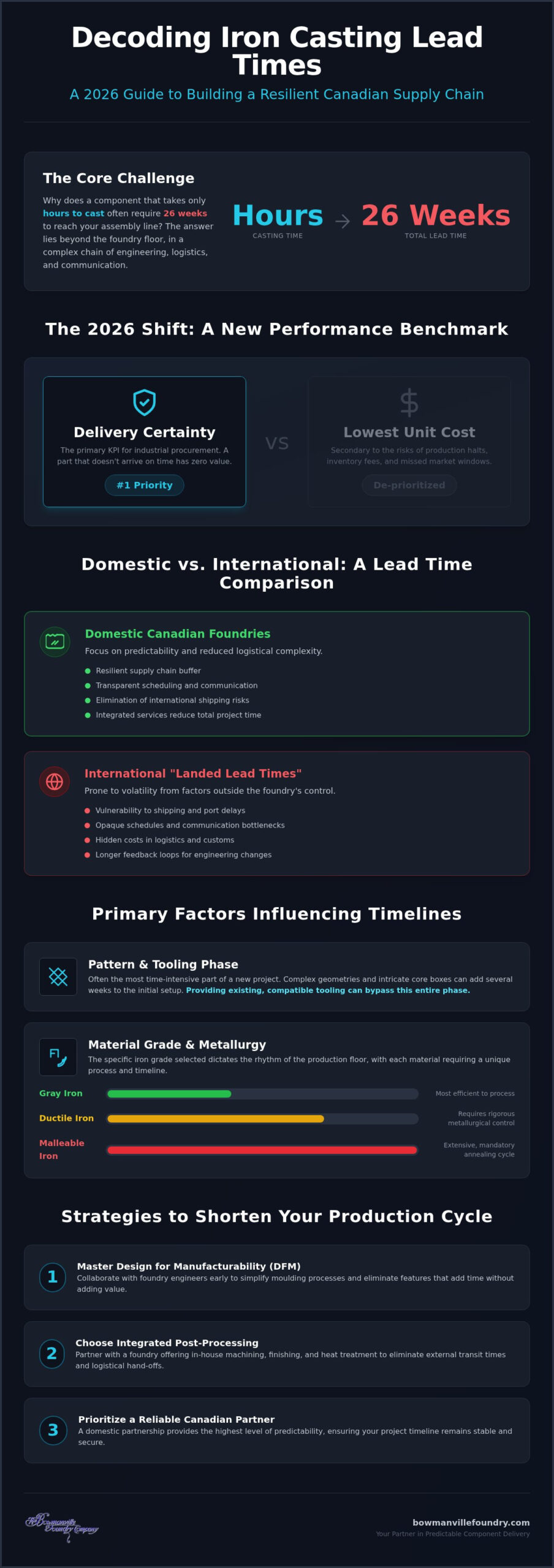
By 2026, the industrial environment has shifted its focus from the lowest unit cost to the highest delivery certainty. Lead time is now the primary Key Performance Indicator (KPI) for procurement professionals who recognize that a part that doesn’t arrive on time has zero value. This shift is driving a renewed interest in iron casting lead times Canada, as domestic manufacturing provides a buffer against the fragility of global logistics. Reliability isn’t just a preference; it’s a requirement for maintaining a resilient supply chain in a competitive market.
Just-in-time manufacturing models have placed immense pressure on foundry production schedules. When your assembly line operates with minimal safety stock, a delay of even a few days can stop production entirely. These delays carry heavy hidden costs, including elevated inventory carrying fees for the parts you do have and the risk of missing critical market windows. You aren’t just buying a component; you’re buying the stability of your project timeline and the assurance that your operations won’t grind to a halt.
Defining Lead Time in the Casting Industry
Precision in your terminology will help you avoid scheduling errors. It’s vital to distinguish between production lead time and total supply chain lead time. While production might only take weeks, the “design-to-delivery” window can be much longer. A foundational step in this process involves understanding cast iron and the specific physical properties that dictate its cooling and solidification rates. Canadian buyers must also account for administrative and engineering approval times. These internal steps often add significant time before the first mould is even prepared.
Current Market Trends Affecting Canadian Foundries
The 2026 market is defined by a massive trend toward reshoring. Businesses are moving production back to North America to avoid the volatility of international shipping and port delays. However, domestic iron casting lead times Canada are still influenced by local variables. Raw material availability, particularly for high-quality scrap metal, fluctuates in price and supply. Additionally, the specialized labour required for complex metallurgy is in high demand. Choosing a partner that can manage the entire process from pattern development to finishing in one facility is the most effective way to bypass external logistics bottlenecks and keep your project on track.
Primary Factors Influencing Custom Iron Casting Timelines
Understanding the technical variables that dictate iron casting lead times Canada requires a look at the foundry’s internal sequence. Lead times aren’t arbitrary figures; they’re the sum of specific engineering and metallurgical phases. Data found in Canadian manufacturing statistics often reflects how lead time variability in heavy industry is tied directly to technical complexity rather than just logistical availability. Every design choice you make, from geometry to material grade, has a direct impact on the production calendar.
The Pattern and Tooling Phase
Creating a custom pattern is frequently the most time-intensive part of any new project. A physical model must be engineered to account for metal shrinkage, draft angles, and gating systems. Complex geometries often require intricate core boxes, which can add several weeks to the initial setup. If you possess existing tooling that’s compatible with a foundry’s moulding equipment, you can often bypass this entire phase. This reduces the window for your first-article delivery and gets your project into the production queue much faster.
Material Grade and Metallurgical Requirements
The specific iron grade you select dictates the rhythm of the production floor. Each material follows a different path through the facility:
- Malleable Iron: This material requires an extensive annealing cycle after casting to achieve its characteristic ductility. This heat treatment is a fixed physical process that adds a predictable but mandatory duration to the timeline.
- Ductile Iron: The nodularization process involves precise magnesium treatment of the molten metal. It requires rigorous metallurgical control and sampling, which adds specialized steps to the melting and pouring sequence.
- Gray Iron: Generally the most efficient to produce. It’s ideal for high-volume runs where damping properties are more critical than high tensile strength, allowing for a faster throughput from the furnace to shakeout.
The Role of Post-Processing Services
Most industrial projects don’t end at the shakeout station. Secondary operations like heat treating, machining, and surface coating are often the “hidden” additions to iron casting lead times Canada. When these services are outsourced to third-party vendors, you lose weeks in transit and administrative hand-offs. Sourcing ready-to-use components from an integrated facility like Bowmanville Foundry eliminates these gaps. By handling everything from the initial pour to final machining and finishing under one roof, you ensure that tight tolerances and inspection requirements don’t result in unexpected shipping delays.
Domestic vs. International Lead Times: A Comparison for Canadian Buyers
Procurement teams often fall into the trap of comparing foundries based solely on the quoted production window. This approach ignores the “Landed Lead Time,” which is the total duration required for a component to reach your receiving dock. While an offshore supplier might offer a lower unit price, the logistical lag frequently offsets those savings. In the current 2026 industrial climate, iron casting lead times Canada offer a level of predictability that international routes simply cannot match. You aren’t just paying for the iron; you’re paying for the certainty that your assembly schedule remains intact.
The Total Cost of Ownership (TCO) must include the cost of capital tied up in transit. When parts are on a vessel for forty-five days, that’s capital you can’t use elsewhere. International port congestion and customs inspections add layers of risk that are difficult to quantify until they cause a project stoppage. Domestic sourcing eliminates these variables, providing a transparent timeline that simplifies your financial planning and operational forecasting.
Shipping and Logistics Realities
Logistical speed is the most visible advantage of a local partner. A national shipment typically arrives within two to five days, whereas international ocean transit rarely takes less than six weeks. This difference is amplified during the Canadian winter. While domestic carriers are equipped for northern climates, international supply chains are often disrupted by seasonal shifts at major global ports. Being in the same region also allows for rapid quality audits and site visits. You can’t easily fly an engineering team to another continent to resolve a casting defect, but a domestic foundry is always within reach for a face-to-face consultation.
Supply Chain Stability and Risk Mitigation
Resilience is built through proximity. Domestic sourcing protects your operations from the sudden geopolitical trade disruptions that have characterized the last few years. If your project requires an urgent design modification, time zone alignment becomes your greatest asset. Engineering approvals that take days with an offshore partner can be resolved in hours when your technical teams share the same workday. This communication speed directly impacts iron casting lead times Canada, as it prevents the administrative “dead time” that often plagues international projects. Utilizing a Canadian production buffer also lets you reduce your on-site inventory requirements. You don’t need to warehouse six months of stock when your supplier can replenish your supply in a fraction of that time.
Strategies to Shorten Your Iron Casting Production Cycle
Reducing iron casting lead times in Canada isn’t just about the speed of the furnace; it’s about the efficiency of the entire workflow. You can significantly compress your timeline by addressing bottlenecks before the first drop of molten metal is poured. One of the most effective methods is standardizing iron grades across multiple components. When you use the same grade of malleable or ductile iron for different parts, the foundry can batch your orders together. This reduces the number of furnace changeovers and optimizes the production run.
Optimizing the Design Phase
Design for Manufacturability (DFM) is your most powerful tool for time reduction. Minor adjustments to draft angles or the simplification of core geometries can drastically reduce the time required for moulding and cleaning. When you collaborate with foundry engineers early in the development cycle, you catch potential production issues while they’re still on the screen. To help your team navigate these choices, you should download our Free Casting Buyer’s Guide to learn about designing for faster production. This resource highlights how to avoid the common design-related delays that often stall new projects.
Effective Communication and Forecasting
Clear communication is the bedrock of a predictable schedule. A complete Request for Quote (RFQ) that includes all specifications, material properties, and post-processing requirements prevents the time-consuming back-and-forth of clarifications. Digital CAD integration and modern file sharing also accelerate the approval process, allowing engineering teams to verify designs and tolerances in real time. This technical transparency ensures that production begins with a finalized, validated design.
Forecasting also plays a vital role in supply chain management. By establishing annual blanket orders with scheduled releases, you allow the foundry to reserve furnace capacity and labour well in advance. This move transforms your relationship from a series of reactive transactions into a steady, planned partnership. It’s the most reliable way to stabilize iron casting lead times in Canada for long-term industrial projects. Finally, utilizing a facility with integrated post-processing services eliminates the transit time required to move parts between multiple vendors. When heat treating and machining happen in the same building as the casting, you eliminate days or even weeks of administrative and logistical lag.
Partnering with a Reliable Canadian Foundry for Predictable Delivery
Reliability in industrial procurement is a byproduct of experience and integrated capability. When you’re managing complex projects, the most effective way to stabilize your schedule is to partner with a facility that understands the nuances of metallurgical production. Bowmanville Foundry has provided this stability since 1902, offering a legacy of reliability that helps our clients avoid the common pitfalls of heavy manufacturing. We don’t just pour metal; we provide a managed production environment designed to meet your specific delivery requirements.
Our facility is unique in its ability to produce malleable, ductile, and gray iron castings under one roof. This versatility is a significant advantage for procurement professionals who need to source multiple components with varying material properties. By centralizing these diverse processes, we effectively minimize iron casting lead times in Canada for our partners. You won’t need to coordinate between different foundries for different iron grades, which simplifies your administrative oversight and reduces the risk of fragmented delivery schedules.
Quality control is another area where integration saves time. We adhere to rigorous ASTM standards to ensure every part meets your engineering specifications. Because our quality assurance team works alongside our production staff, inspections happen in real time. We also offer integrated post-processing services, including machining and heat treating. Handling these finishing steps in-house eliminates the “vendor-to-vendor” transit time that often adds weeks to a project’s final stage. Your parts move directly from the shakeout station to finishing and then to your dock, ensuring a seamless transition throughout the production cycle.
A Legacy of Industrial Reliability
Institutional knowledge is a powerful tool for preventing bottlenecks. Our century-long history has allowed us to refine our processes and develop a deep library of technical expertise. This experience ensures that we can anticipate potential production challenges during the design phase, long before they can cause delays. We’re committed to supporting Canadian industrial growth by providing a secure, domestic supply chain. Our national coverage ensures that whether your project is in the Maritimes or the West Coast, you receive the same consistent, professional service.
Streamlining Your Next Casting Project
Success begins with a technical consultation. Our engineers are ready to review your designs and help you select the most efficient iron grade and production method for your needs. We provide extensive technical data and application guides to assist your team in making informed decisions that prioritize both performance and speed. If you’re ready to secure your production schedule, you can Request an accurate iron casting quote for your project today. Let us help you navigate the complexities of 2026 procurement with the steady hand of an established Canadian partner.
Securing Your 2026 Production Schedule
Achieving predictable iron casting lead times Canada requires a transition from reactive purchasing to strategic engineering integration. By prioritizing domestic sourcing, you eliminate the uncertainty of international freight and gain the agility of time zone alignment. This guide has shown that compressing your timeline depends on early collaboration, standardizing material grades, and leveraging integrated post-processing services to remove vendor hand-offs. These steps don’t just save time; they protect your project’s financial viability.
Since 1902, we’ve specialized in manufacturing custom malleable, ductile, and gray iron components with a focus on technical mastery. Our facility provides comprehensive post-processing and finishing services on-site, ensuring your parts move from the furnace to your assembly line without unnecessary delays. We’re here to act as your knowledgeable partner in navigating the intricacies of modern metallurgy and heavy manufacturing.
To begin refining your procurement strategy, Download our Free Casting Buyer’s Guide to optimize your design. This resource provides the technical insights needed to make informed decisions that keep your industrial projects on track. We look forward to helping you build a more resilient and efficient supply chain.
Frequently Asked Questions
What is the average lead time for custom iron castings in Canada for 2026?
Average iron casting lead times Canada for 2026 range from 2 weeks for standard raw castings to as long as 26 weeks for specialized alloys like Carbidic Austempered Ductile Iron. For most ductile and gray iron projects, you should anticipate a production window of 5 to 9 weeks. These timelines are influenced by current foundry capacity and the complexity of the specific metallurgical grade required for your industrial application.
How does the grade of iron (malleable vs. ductile) affect the lead time?
The specific iron grade dictates the length of the production cycle due to required thermal treatments. Malleable iron involves a lengthy annealing process to achieve its mechanical properties, which adds mandatory days to the schedule. Ductile iron requires precise magnesium treatment and metallurgical testing during the pour. In contrast, gray iron often allows for faster throughput because it typically requires less intensive post-casting heat treatment or specialized cooling cycles.
Can I reduce my lead time if I already have the patterns?
Existing tooling can significantly reduce your initial delivery window by bypassing the pattern development phase. Since custom pattern construction and sampling can take anywhere from 4 to 24 weeks, providing compatible tooling allows the foundry to move directly into production scheduling. However, the foundry must first verify that your patterns are compatible with their specific moulding equipment and draft requirements to ensure consistent casting quality.
Why is a Canadian foundry often faster than an overseas supplier despite higher unit costs?
Canadian foundries offer faster delivery because they eliminate the ocean freight lag, which typically adds six weeks to any international order. While the unit price might be higher, the total landed lead time is much lower due to reduced transit and customs windows. Proximity also simplifies engineering approvals and quality audits, preventing the administrative delays that often occur when communicating across multiple time zones and languages.
What post-processing services add the most time to a casting order?
Post-processing services like machining can add 4 to 6 weeks to your order, while painting and coating typically require an additional 2 weeks. Heat treatments also add predictable but mandatory days to the cycle. Sourcing these services from an integrated facility helps stabilize iron casting lead times Canada by eliminating the transit time and administrative delays associated with moving parts between multiple secondary vendors.
How does design complexity directly impact the foundry production schedule?
Complexity dictates the number of cores and the intricacy of the moulding process. Parts with internal cavities require specialized core boxes that take longer to manufacture and set. High design complexity also increases the time needed for cleaning and finishing after the part is cast. Simplifying your design for manufacturability (DFM) is one of the most effective ways to ensure your project stays on a predictable production schedule.
What information should I include in my RFQ to get the fastest response?
To receive the fastest response, your RFQ should include finalized CAD files, material specifications such as ASTM grades, and estimated annual volumes. You should also clearly state any post-processing requirements like machining tolerances or heat treatment needs. Providing a complete technical package allows the foundry’s engineering team to assess the project’s feasibility and capacity requirements without the need for extensive back and forth clarifications.
Are there seasonal factors that affect iron casting lead times in Canada?
Winter weather and annual maintenance shutdowns are the primary seasonal factors affecting Canadian production. Heavy snowfall can disrupt national logistics and carrier availability, while many foundries schedule mandatory equipment maintenance during the summer months or year end holidays. Planning your orders around these predictable windows ensures that seasonal capacity shifts don’t result in unexpected delays for your critical industrial components and assembly lines.
