
Selecting the highest tensile strength iron for your component might seem like the safest bet, but over-engineering often leads to brittle failures and unnecessary budget overruns. You likely recognize the frustration of seeing a project stalled by material mismatch or unpredictable international supply chain delays. This industrial casting procurement guide is designed to eliminate that uncertainty. We provide the technical clarity needed to navigate the 2026 landscape, ensuring your components perform exactly as the blueprints demand without inflated costs.
You’ll gain a methodical framework for choosing between malleable, ductile, or gray iron based on the latest ASTM A536-26 and A48/A48M standards. We’ll examine how domestic sourcing within Canada can insulate your operations from the 25% tariffs on certain steel derivatives and volatile global shipping. By the end of this guide, you’ll understand how to optimize your design for post-processing and establish a reliable national supply chain that reduces your total cost of ownership. It’s about moving from technical curiosity to absolute certainty in your procurement decisions.
Key Takeaways
- Identify the distinct mechanical advantages of malleable, ductile, and gray iron to ensure your components meet specific engineering demands without the risk of over-engineering.
- Apply Design for Manufacturability (DFM) strategies, such as refining draft angles and wall thickness, to minimize production scrap and reduce your total cost of ownership.
- Utilize this industrial casting procurement guide to navigate the latest 2026 ASTM standards and ensure your technical specifications are current and compliant.
- Evaluate the benefits of integrated post-processing services, including heat treating and machining, to receive ready-to-use parts and simplify your internal production workflows.
- Strengthen your resilience against global supply chain disruptions by leveraging the institutional knowledge and logistical stability of a domestic Canadian foundry partner.
Navigating the Industrial Iron Casting Landscape in Canada
Industrial iron casting is far more than a commodity purchase. It is a custom-engineered solution designed to meet the rigorous demands of heavy industry across the country. In 2026, iron remains the foundational material for our national infrastructure because of its unmatched vibration damping and compressive strength. While some sectors explore lighter alternatives, the specific properties of cast iron ensure it remains indispensable for mining equipment, agricultural machinery, and municipal water systems. Modern manufacturing has shifted away from generic components toward high-precision, custom-engineered parts that require tighter tolerances and better metallurgical consistency. This industrial casting procurement guide helps professionals mitigate engineering risks and avoid the costly project delays that stem from incorrect material selection.
The complexity of modern procurement demands a structured approach. When specifications aren’t perfectly aligned with material capabilities, projects face budget overruns or premature part failure. Using a verified framework allows engineering teams to realize better performance from every casting. It’s about more than just a part; it’s about the integrity of the entire machine or system. This guide serves as a technical roadmap for those responsible for maintaining the high standards of Canadian industrial production.
The Role of the Modern Foundry Partner
A modern foundry doesn’t simply pour metal. It acts as a technical mentor that guides you through the intricacies of metallurgy. The transition from a basic supplier to a full-service engineering partner is critical for project success. This partnership begins with pattern development. Precision in the tooling stage determines the final quality and repeatability of the component. Choosing a national foundry partner is also a strategic move for Canadian supply chain resilience. With the 2026 market facing 25% tariffs on certain steel imports and fluctuating international logistics, domestic sourcing provides a predictable cost structure. It ensures your industrial casting procurement guide remains a tool for stability rather than a reaction to global volatility.
Strategic Considerations for Procurement Officers
Procurement officers must balance immediate mechanical requirements with long-term production costs. Selecting the correct iron grade is the first step. You must also consider how production volume influences the casting method and unit price. It’s essential to identify the need for secondary finishing services, such as machining or heat treating, during the initial design phase. Integrating these services with your foundry partner reduces the number of vendors in your supply chain. This lowers the total cost of ownership and simplifies logistics. A structured approach ensures that every specification is met without over-engineering the component or wasting resources on unnecessary material properties.
Selecting the Right Iron Grade: Malleable, Ductile, and Gray
Choosing the correct metallurgical profile is the most consequential decision in the industrial casting procurement guide process. It dictates the component’s lifespan, the safety of the entire assembly, and the total cost of production. Engineers must evaluate three primary variables: mechanical stress, impact frequency, and thermal cycling. Each iron type offers a distinct microstructure that solves specific engineering challenges. Selecting the wrong grade often results in brittle failure or unnecessary expenses from over-engineering.
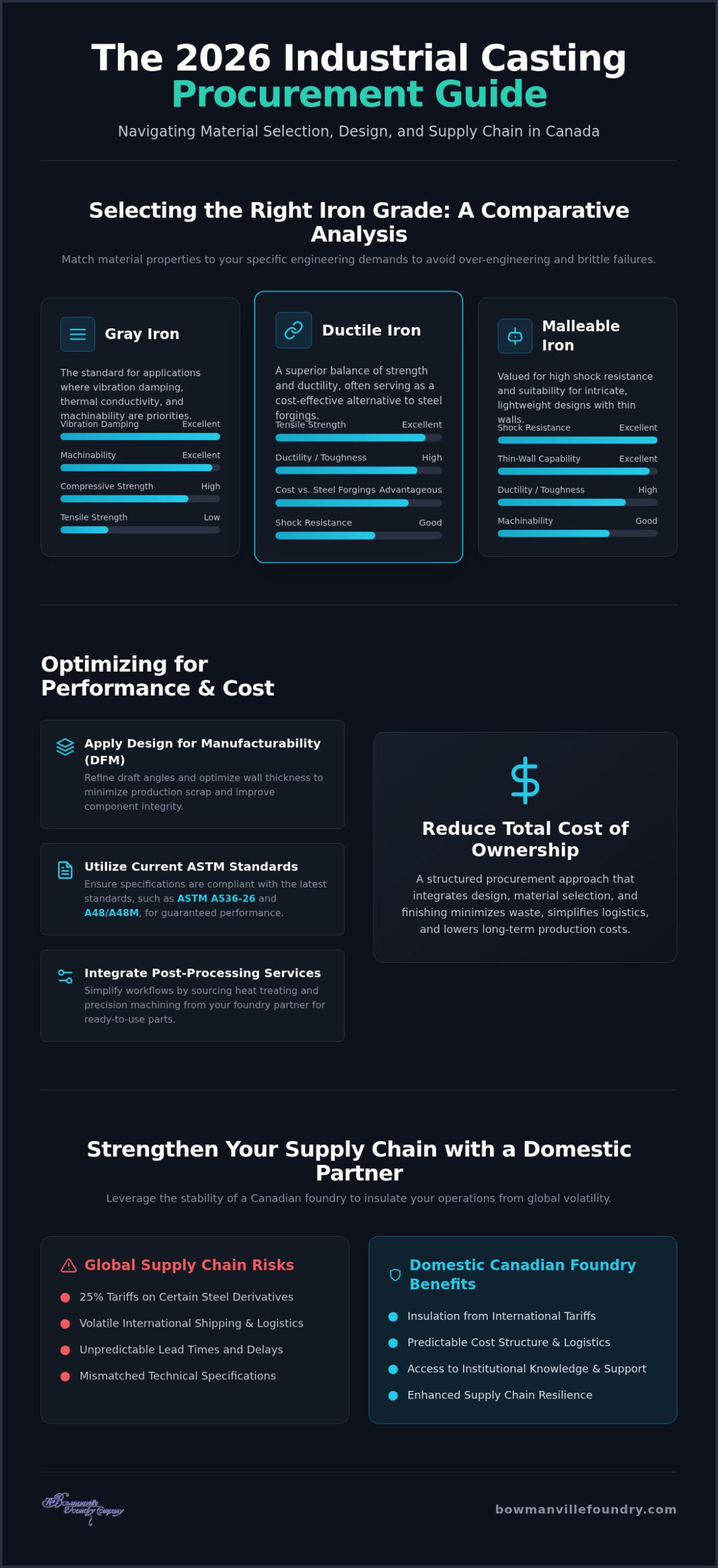
Malleable iron is particularly valued for its shock resistance and thin-wall capabilities. It allows for intricate, lightweight designs that maintain high toughness. Ductile iron provides a superior balance of strength and ductility, often serving as a cost-effective alternative to steel forgings. For high-stress applications, procurement officers should refer to the ASTM A536 specification to ensure the material meets the required tensile and yield strengths. Gray iron remains the standard for applications where vibration damping and machinability are the priorities.
Malleable Iron vs. Ductile Iron Performance
The primary difference between these two grades lies in their microstructure and production method. Malleable iron starts as white iron and undergoes a rigorous annealing process. This heat treatment transforms hard carbides into tempered carbon nodules, giving the material its namesake malleability. It’s the preferred choice for complex, small-to-medium parts that face sudden impacts. Ductile iron achieves its properties through nodularization during the melting process. This creates spherical graphite nodules that stop cracks from spreading. It’s generally the better choice for high-stress brackets and heavy housings. If you’re weighing these options for a new project, consult a specialized iron casting resource to compare specific mechanical properties.
Gray Iron: The Cost-Effective Solution
Gray iron is defined by its unique graphite flake structure. These flakes interrupt the continuity of the iron matrix, which provides two significant benefits: excellent vibration damping and superior machinability. The flakes act as internal lubricants, reducing tool wear during post-processing. This makes gray iron the ideal material for internal combustion components, massive equipment bases, and pump housings. While it doesn’t offer the impact resistance of ductile iron, its high cost-to-performance ratio makes it the standard for large-scale industrial production. It’s particularly effective in applications where compressive strength and thermal conductivity are more important than tensile strength.
Optimizing Design for Manufacturability and Total Cost
Efficient iron casting begins long before the first pour. Designing for Manufacturability (DFM) is a strategic process that aligns your engineering requirements with the physical realities of the foundry floor. By refining a design early, you can significantly reduce scrap rates and production costs. This industrial casting procurement guide emphasizes that small adjustments to wall thickness or draft angles often determine whether a part is a success or a costly failure. Proper draft angles, typically between 1.5 to 3 degrees, ensure that the pattern can be removed from the sand mold without damaging the cavity. Consistent wall thickness prevents uneven cooling, which is a primary cause of internal stress and structural weakness.
Your choice of material also dictates the complexity of the manufacturing cycle. For instance, selecting malleable iron necessitates a specific annealing schedule, whereas certain ductile iron grades might achieve required properties as-cast. Understanding these relationships allows you to realize long-term production savings through optimized pattern design. A well-constructed pattern is an investment that pays dividends over thousands of cycles by maintaining dimensional stability and reducing the need for manual finishing. It’s a pragmatic approach that prioritizes precision from the outset.
Reducing Defects through Collaborative Engineering
Collaborating with foundry engineers during the initial design phase is the most effective way to prevent shrinkage, porosity, and inclusions. Shrinkage occurs as the molten metal solidifies; it’s best managed by ensuring uniform sections and providing generous radii. Sharp corners create turbulence in the molten flow and act as stress risers. By using a mentor-based approach with your foundry partner, you can identify these risks on the blueprint before they manifest as physical defects. This proactive engineering ensures that the metal flows smoothly into every corner of the mold, resulting in a cleaner, stronger casting that meets every specification.
Calculating the Total Cost of Ownership (TCO)
A common mistake in procurement is focusing solely on the initial price per pound. A comprehensive industrial casting procurement guide looks beyond the foundry gate to calculate the Total Cost of Ownership (TCO). This calculation must include the costs of machining, heat treating, and surface coating. Receiving ready-to-use components from a single-source provider reduces internal assembly times and simplifies your logistics. Additionally, domestic quality control plays a vital role in TCO. By sourcing within Canada, you avoid the hidden costs of international shipping delays and the risk of receiving sub-standard parts that lead to expensive field failures. Reliable quality and shorter lead times often outweigh a lower piece-price from an overseas supplier.
The Procurement Framework: ASTM Standards and Post-Processing
Establishing a rigorous procurement framework is the only way to ensure that your custom-engineered components arrive on-site ready for service. In the 2026 industrial landscape, ambiguity is the enemy of efficiency. This industrial casting procurement guide relies on the clarity provided by international standards to bridge the gap between engineering intent and foundry production. Adhering to these standards ensures that every shipment meets the required mechanical thresholds, regardless of the complexity of the part. It’s a pragmatic approach that protects your project from the risks of material failure and legal non-compliance.
To receive an accurate and competitive quote, your Request for Quotation (RFQ) must be comprehensive. Foundries require specific data points to calculate cycle times and material costs effectively. Your RFQ should include the following critical elements:
- Material Specification: Define the exact ASTM grade, such as ASTM A47/A47M for malleable iron or ASTM A48/A48M for gray iron.
- Dimensional Tolerances: Specify critical tolerances for mating surfaces and functional areas.
- Production Volume: Provide estimated annual volumes to determine the most cost-effective molding method.
- Quality Documentation: List any required certifications or non-destructive testing (NDT) protocols.
- Post-Processing Needs: Clearly state if the part requires machining, heat treating, or specialized coatings.
Deciphering ASTM Specifications for 2026
The most current standard for ductile iron is the ASTM A536-26 specification. When using this framework, it’s often more effective to specify the required mechanical properties, such as tensile strength, yield strength, and elongation, rather than a strict chemical composition. This allows the foundry to adjust the melt chemistry based on the specific section thickness of your part, ensuring the final component performs as intended. Relying on these national quality standards provides a common language between your procurement team and the foundry’s metallurgical experts. For a deeper technical breakdown of how to interpret and apply these specifications, the ASTM iron casting standards guide for Canadian engineers offers comprehensive coverage of the A47, A48, and A536 grades. It’s about ensuring technical certainty at every stage of the melt.
Maximizing Value through Integrated Finishing Services
Procuring a raw casting is only the first step. To truly optimize your supply chain, you should evaluate integrated post-processing services like machining and heat treating. Heat treating can significantly enhance the tensile strength and wear resistance of iron components, which is vital for high-impact industrial applications. For parts destined for harsh Canadian environments, surface coatings provide essential corrosion protection against road salts and industrial chemicals. Sourcing these services from a single national supplier eliminates the logistical headache of moving parts between multiple vendors. You can streamline your entire operation by downloading a comprehensive iron casting buyer’s guide to better understand these integrated service options.
Securing Your Supply Chain with a National Foundry Partner
A resilient supply chain is the backbone of successful industrial operations. While global sourcing once seemed like a primary cost-saving measure, the 2026 market reality has shifted the focus back to domestic stability. Relying on a 100% domestic supply chain for your custom iron components eliminates the risks associated with geopolitical friction and the 25% tariffs currently affecting certain metal imports. This industrial casting procurement guide highlights that a national foundry partner doesn’t just provide parts; they provide logistical certainty and technical support tailored to the Canadian regulatory environment. By keeping production close to home, you reduce lead times and ensure your engineering team has direct access to the experts overseeing the melt.
National foundries support a diverse range of sectors, from the resource-rich mining operations in the North to the precision manufacturing centres throughout the country. This broad experience allows a partner to apply cross-industry best practices to your specific project. It’s about leveraging a collective pool of technical data to solve unique application challenges. Within the C$1.3 billion Canadian ferrous metal foundry market, the 99 active businesses provide a critical network for national infrastructure. When you choose a partner with a deep understanding of this landscape, you’re investing in a relationship that prioritizes the longevity of your equipment and the efficiency of your procurement cycle.
The Value of Institutional Knowledge and Legacy
The role of craftsmanship remains vital even in modern automated casting facilities. A foundry that has been operating since 1902 possesses a library of institutional knowledge that software alone can’t replicate. This legacy allows experienced metallurgists to solve complex challenges, such as unexpected porosity in intricate geometries or specific heat-treatment requirements for high-wear parts. You can’t replace the intuition of a master founder who understands how iron behaves under varying conditions. Requesting a technical consultation allows you to tap into this expertise early in your project. It ensures your iron grade selection is technically sound and economically viable before you commit to full-scale production. It’s a pragmatic way to avoid the trial-and-error approach that often plagues less experienced suppliers.
Finalizing Your Procurement Strategy and RFQ
Your final step in this industrial casting procurement guide is to move from planning to execution. Start by preparing your technical drawings for a detailed production review with foundry engineers. These drawings should clearly indicate critical dimensions, draft angles, and surface finish requirements. It’s also beneficial to download a free casting buyer’s guide to ensure your team is aligned on the latest 2026 standards and terminology. Once your internal specifications are finalized, contact a national supplier for a comprehensive project quote. This quote should reflect the casting price, the value of integrated post-processing, and the assurance of domestic quality control. Finalizing your strategy with a reliable partner ensures your components meet every engineering specification on time and on budget.
Mastering the Future of Industrial Iron Procurement
Selecting between malleable, ductile, and gray iron requires a precise understanding of ASTM standards and design optimization. You’ve seen how Design for Manufacturability (DFM) reduces scrap and how calculating the total cost of ownership ensures long-term viability. Transitioning to a domestic supply chain isn’t just a logistical choice; it’s a strategic move to insulate your operations from global market volatility and unpredictable tariffs. By prioritizing technical clarity over the lowest initial piece-price, you protect the structural integrity of your infrastructure.
This industrial casting procurement guide serves as your technical roadmap for the year ahead. Since 1902, Bowmanville Foundry has provided the institutional knowledge and post-processing services required to deliver ready-to-use components across Canada. Download your free Iron Casting Buyer’s Guide from Bowmanville Foundry to access comprehensive technical data and application guides. You now have the framework to build a more predictable and high-performing supply chain. We look forward to supporting your next engineering challenge with the precision and reliability your projects demand.
Frequently Asked Questions
What is the primary difference between malleable and ductile iron?
Malleable iron is produced through a lengthy annealing process that converts white iron into a tough material with tempered carbon nodules. Ductile iron achieves its properties through the addition of magnesium or cerium to the melt, creating spherical graphite. While both offer ductility, malleable iron is often better for thinner, more complex parts, whereas ductile iron is preferred for larger, high-stress components.
How do I choose the right ASTM iron grade for a high-stress application?
Consult the ASTM A536-26 standard to identify the specific tensile and yield requirements for your application. For components facing extreme stress, specifying mechanical performance over chemical composition allows the foundry to optimize the melt for your part’s section thickness. This ensures the component maintains its integrity under load without becoming brittle or failing prematurely during service.
What post-processing services are essential for ready-to-use iron components?
Machining, heat treating, and surface coatings are the primary services required to transform a raw casting into a finished part. Integrating these services with a single supplier is a key recommendation in any industrial casting procurement guide. This approach minimizes logistical risks and ensures that the final tolerances and surface protections meet your engineering specifications before the part arrives at your facility.
How can I prevent common casting defects like porosity in my design?
Porosity is minimized by designing for uniform cooling and ensuring the mould is properly vented. You should avoid abrupt transitions in wall thickness, which can lead to hot spots where the metal stays liquid longer and creates voids. Collaborating with foundry engineers during the design phase allows for the placement of risers that feed molten metal into the casting as it shrinks.
What information is required to get an accurate iron casting quote?
An accurate quote requires technical drawings, the desired ASTM iron grade, estimated annual quantities, and a list of secondary operations. You should also specify any non-destructive testing requirements, such as X-ray or magnetic particle inspection. Providing a clear scope of work prevents hidden costs from surfacing later in the production cycle and ensures the foundry understands your quality expectations.
Why should I choose a national foundry over an international supplier?
Sourcing from a Canadian foundry provides protection against global supply chain disruptions and the 25% tariffs on certain metal derivatives. Domestic partners also offer better transparency and accountability for quality control. Working within the same time zone and legal jurisdiction simplifies communication and ensures that your project remains on schedule despite the volatility seen in international logistics and trade quotas.
Does gray iron offer better vibration damping than ductile iron?
Gray iron provides significantly better vibration damping than ductile iron due to its unique graphite flake microstructure. These flakes act as internal dampers that dissipate mechanical energy as heat. This property is essential for industrial equipment that must operate with high precision, as it prevents harmonic vibrations from affecting the performance or the lifespan of the machine.
What are the typical lead times for custom-engineered iron castings in Canada?
Lead times for custom iron castings in Canada typically depend on the complexity of the pattern and the extent of post-processing. While domestic production avoids the lengthy ocean transit times of 4 to 8 weeks, you should still plan for the initial tooling and sampling phases. Utilizing an industrial casting procurement guide helps you schedule these milestones effectively to avoid assembly line stoppages and project delays.
