
Selecting the hardest material available is often the fastest route to a brittle fracture in the field. If you’ve managed industrial machinery, you’ve likely dealt with the high maintenance costs and safety risks that follow a sudden component failure. It’s a frustrating reality when a part that looks perfect on paper snaps under the pressure of real-world operations. Choosing the right iron casting for high-stress applications isn’t just about maximizing strength; it’s about balancing ductility with damping capacity to ensure your equipment survives the most demanding environments.
In this guide, we’ll examine the technical landscape of metallurgy to help you select the optimal iron grade for your specific needs. You’ll learn how to distinguish between ductile and malleable iron to prevent failures and extend the lifespan of your critical components. We’ll also explore how selecting the correct casting can provide a cost-effective alternative to expensive steel forgings. By the end of this resource, you’ll have the technical certainty needed to make an informed procurement decision that prioritizes both safety and long-term performance.
Key Takeaways
- Identify the distinct mechanical requirements of static and dynamic loads to ensure structural integrity in demanding industrial environments.
- Compare the tensile strength of ductile iron against the superior shock resistance of malleable iron for thin-walled, high-stress components.
- Understand how damping capacity and fatigue life influence the long-term performance of iron casting for high-stress applications subject to constant vibration.
- Apply critical design principles, such as optimizing radii and wall transitions, to minimize stress concentrations and prevent brittle fractures in the field.
- Leverage over a century of Canadian manufacturing expertise to select a cost-effective iron grade that reduces maintenance costs and prevents catastrophic failure.
Defining High-Stress Environments in Industrial Casting
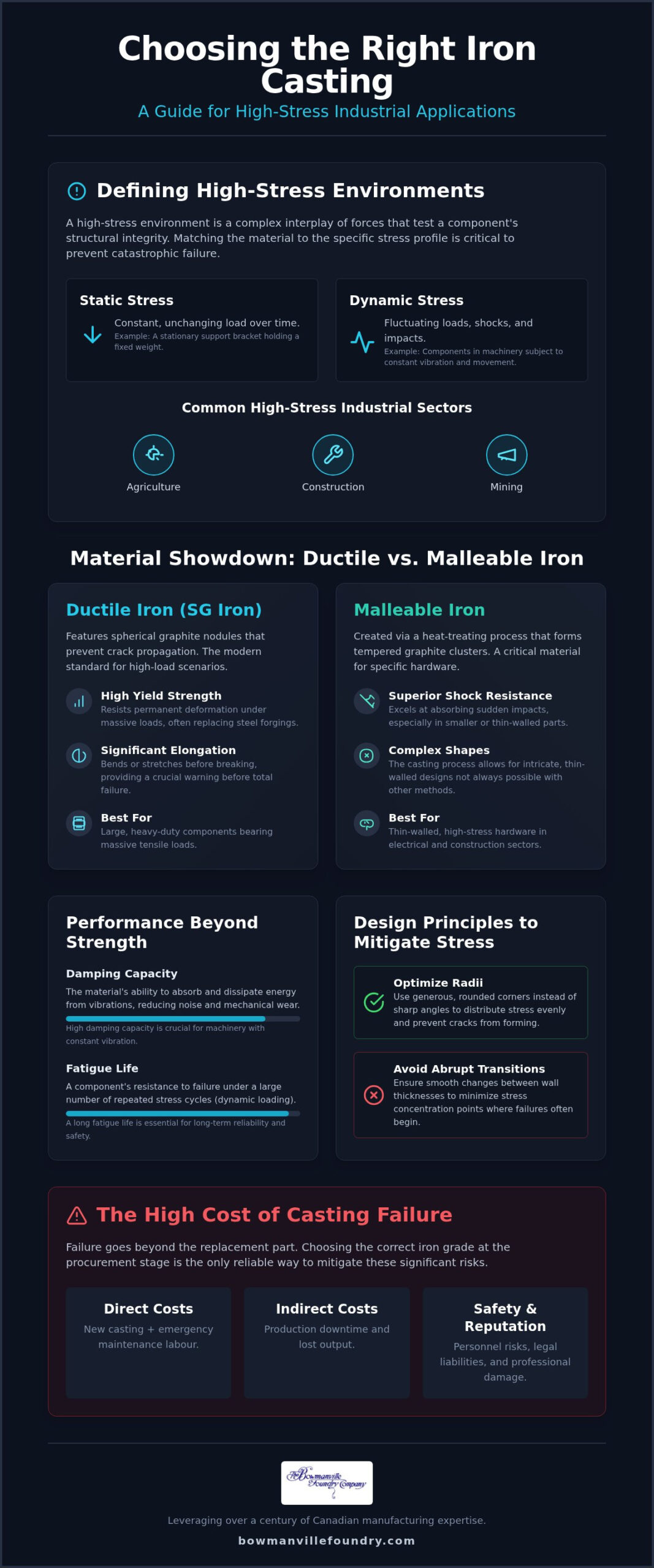
In industrial engineering, a high-stress environment is defined by more than just the weight a component carries. It involves a complex interplay of high tensile loads, constant vibration, and rapid thermal cycling. These forces test the limits of structural integrity every second the machinery is in motion. Selecting the right iron casting for high-stress applications requires a deep understanding of how these forces manifest during daily operation. If the material isn’t matched to the specific stress profile of the environment, the risk of catastrophic failure increases significantly.
Engineers must distinguish between static and dynamic stress to make an informed choice. Static stress remains constant over time, such as the weight held by a stationary support bracket. Dynamic stress, however, involves fluctuating loads, shocks, and impacts that can lead to fatigue over thousands of cycles. In most industrial machinery, dynamic stress is the primary concern. Material selection serves as the fundamental safeguard here. While design geometry is important, the inherent metallurgical properties of the iron grade determine how the part absorbs energy and resists cracking. In Canadian industrial engineering, safety factors are meticulously applied to account for these variables. These factors ensure that components operate well within their mechanical limits to protect both equipment and personnel.
Common High-Stress Industrial Sectors
Certain industries push metal components to their absolute physical limits. In agriculture, soil-engaging tools and heavy-duty brackets must withstand unpredictable impacts with rocks and compacted earth. The construction sector relies on iron for load-bearing joints and crane components where failure could lead to total site shutdowns. Mining represents perhaps the most punishing environment of all. Here, iron castings face a combination of extreme abrasion and high-impact crushing forces that would quickly destroy materials with insufficient toughness.
The Cost of Casting Failure
The consequences of a component failing in the field are rarely limited to the price of a replacement part. Direct costs include the new casting itself and the emergency maintenance labour required to install it. However, the indirect costs are often far more damaging to the bottom line. Production downtime can cost thousands of dollars per hour in lost output, while safety liabilities can lead to legal complications and damaged professional reputations. Brittle fracture is defined as the sudden, catastrophic failure of a material with little to no plastic deformation, often occurring without warning in poorly selected iron grades. Choosing the correct material at the procurement stage is the only reliable way to mitigate these risks effectively.
Material Comparison: Ductile vs. Malleable Iron for Tensile Loads
Selecting the correct alloy for an industrial component requires a nuanced understanding of how different iron grades respond to force. While many procurement professionals look strictly at tensile strength, the way a material deforms under pressure is often more critical. The primary distinction between ductile and malleable iron lies in their internal graphite structures. Ductile iron features “nodular” graphite in spherical shapes, which prevents crack propagation. Malleable iron undergoes a lengthy heat-treating process that transforms its carbon into “tempered” graphite clusters. Both materials are excellent choices for iron casting for high-stress applications, but they excel in different physical configurations.
Ductile Iron (SG Iron) Performance
Ductile iron is often considered the modern standard for high-load scenarios. Its yield strength, the point at which the metal begins to permanently deform, is remarkably high. In many cases, ductile iron grades defined by ASTM A536 provide a performance profile that allows them to replace expensive steel forgings without sacrificing safety. It offers significant elongation, meaning the part will stretch or bend before it snaps. This property provides a vital warning sign before total failure occurs. For large, heavy-duty components that must bear massive tensile loads, ductile iron is the pragmatic choice for Canadian engineers looking to balance cost and reliability.
The Unique Role of Malleable Iron
Malleable iron remains a critical material for specific high-stress hardware, particularly in the electrical and construction sectors. Its greatest advantage is its superior shock resistance in small or thin-walled parts. Because malleable iron begins the casting process as white iron, it possesses excellent fluidity, allowing it to fill intricate moulds that ductile iron might struggle to navigate. Once annealed, it becomes incredibly tough. It can withstand repeated impacts and “peening” without cracking, making it the preferred material for high-stress fittings and pipe clamps. If your design requires complex geometry and high impact resistance, you can consult with our technical team to determine if a malleable grade is the right fit.
While ductile and malleable iron handle tension and impact, gray iron serves a different purpose in high-stress environments. Its graphite flakes provide exceptional damping capacity. This allows the material to absorb energy and suppress vibrations that would otherwise lead to resonance-induced failure in high-speed machinery. Understanding these trade-offs ensures that your material selection is based on the actual physics of the application rather than just the highest number on a data sheet.
Managing Fatigue and Impact: Beyond Yield Strength
Designing for high-stress environments requires looking past simple yield strength. While a material might support a heavy static load, it can still fail prematurely under repeated stress cycles. This phenomenon, known as fatigue, accounts for a vast majority of industrial component failures. To select the ideal iron casting for high-stress applications, engineers must evaluate how a material manages energy, resists crack initiation, and responds to sudden mechanical shocks. Reliability in the field depends on matching the material’s internal structure to the specific dynamic forces it will encounter.
Fatigue Resistance in Ferrous Alloys
Fatigue life is determined by how well a material resists the formation and growth of microscopic cracks over millions of cycles. The internal structure of the iron plays a decisive role here. When stress is applied, cracks tend to originate at the surface, especially where there are imperfections or sharp transitions. A superior surface finish, often achieved through precise machining or heat treating, significantly delays this initiation. Once a crack begins, the graphite morphology dictates how quickly it spreads. Ductile iron’s spherical graphite nodules inhibit crack growth better than gray iron flakes. These nodules act as crack arrestors by blunting the tip of a propagating crack, forcing it to expend more energy to move through the metal matrix. This results in a much higher endurance limit for parts that face constant load reversals.
Damping Capacity and Vibration Stress
In many industrial settings, vibration is the primary source of stress. Continuous resonance can lead to rapid fatigue and mechanical wear in connected components. Gray iron is the industry benchmark for these scenarios because of its exceptional damping capacity. The graphite flakes within gray iron act as internal friction points that convert vibrational energy into heat. This is why gray iron remains the preferred material for engine blocks, machine bases, and heavy-duty tool housings. By absorbing energy rather than transmitting it, gray iron reduces mechanical noise and prevents resonance-induced failure in high-speed machinery. It’s a pragmatic solution for stabilizing equipment that must operate at high frequencies.
Impact toughness and thermal stability also factor into the long-term reliability of a casting. Impact toughness represents the material’s ability to absorb energy during a sudden, high-velocity blow. While ductile and malleable iron offer high impact resistance, they must also be evaluated for thermal stress. In applications involving rapid heating and cooling, the material’s coefficient of expansion becomes a critical design variable. Managing these factors requires a balanced approach. You must ensure the chosen grade provides enough strength to handle the peak load while maintaining the damping or toughness necessary for the specific operating conditions.
Design Principles to Mitigate Stress Concentrations
Even the highest-grade alloy will fail if the component’s geometry creates localized pressure points. While material selection provides the foundation, design principles act as the primary defense against mechanical failure. In an iron casting for high-stress applications, stress concentrations often occur at sharp corners or where wall thicknesses change abruptly. These areas become focal points for crack initiation. By using generous radii, engineers can distribute loads more evenly across the part’s surface, reducing the peak stress at any single point. This approach is essential for maintaining the structural integrity of components that face unpredictable dynamic loads.
Optimizing Casting Geometry
Uniformity is the goal during the cooling process. When a casting has thick and thin sections adjacent to one another, the thinner sections cool and solidify faster than the thicker ones. This discrepancy creates internal casting stresses as the metal contracts at different rates. To prevent these “hot spots,” designers should aim for gradual transitions between wall thicknesses. Adding ribbing is another effective strategy; it increases the part’s stiffness and load-bearing capacity without significantly increasing the overall weight or creating massive sections that are difficult to feed during the pour. Proper gating and riser placement are also essential to ensure structural density, particularly in the most critical areas of the component.
Post-Processing for High-Stress Performance
Post-processing services provide the final layer of reliability for demanding environments. Heat treating is a critical step that many procurement professionals overlook. Processes like annealing or stress-relieving help eliminate the residual stresses introduced during the casting or machining phases. This results in improved ductility and a more stable grain structure. Surface coatings also play a role by protecting the iron from corrosion-induced stress cracking, which is a common issue in mining or marine settings. Finally, precision machining ensures that the part fits perfectly within its assembly. This avoids localized loading caused by misalignment, which can lead to premature failure even in well-designed parts.
Careful attention to these design details ensures that the physical properties of the iron are fully utilized. For more detailed specifications on tolerances and geometric best practices, you can review our Professional Iron Casting Design Guide to better understand how to optimize your components for long-term service.
Engineering Reliability with Bowmanville Foundry’s Custom Castings
Since 1902, Bowmanville Foundry has served as a technical partner for Canadian industrial sectors. Our facility is unique because we pour malleable, ductile, and gray iron under one roof. This versatility allows our team to recommend the most suitable iron casting for high-stress applications based on objective metallurgical data rather than inventory limitations. We don’t just supply parts; we provide a century of institutional knowledge to ensure your components withstand the rigours of the field. Every pour is backed by rigorous metallurgical testing and quality control protocols to verify that the final product matches your engineering specifications exactly.
The Bowmanville Advantage for Canadian Industry
Reliability in procurement is just as critical as a material’s yield strength. We support major industrial projects across the country with predictable lead times and components tailored to specific ASTM standards. Our in-house post-processing services, including machining and heat treating, allow us to maintain strict quality control throughout the entire manufacturing cycle. This integrated approach minimizes the logistical complexity of managing multiple vendors. By partnering with a proven, long-standing manufacturer, you reduce the risk of receiving parts that fail to meet the mechanical requirements of your high-load environments. We understand the gravity of industrial safety and prioritize precision in every casting we produce.
Next Steps for Your High-Stress Project
Choosing between different iron grades requires a balance of theory and practical experience. To assist in your selection process, we offer a Free Casting Buyer’s Guide that outlines the specific properties of our alloys and their performance in an iron casting for high-stress applications. If your project involves complex geometries or unique stress profiles, our team is available for technical consultations regarding custom pattern development. We act as mentors in the industrial space, helping you refine your designs to mitigate the stress concentrations discussed earlier in this guide. We’ll work with you to optimize your design for both manufacturability and long-term durability. Contact our engineering team to discuss your high-stress casting requirements and ensure your next project is built on a foundation of technical certainty.
Optimizing Material Integrity for Demanding Environments
Selecting the ideal iron casting for high-stress applications is a process that demands technical precision and a deep understanding of dynamic loads. By balancing material properties with optimized geometry and specialized post-processing, you can significantly reduce the risk of brittle fracture and extend the service life of your machinery. Bowmanville Foundry has served as a dependable partner to the Canadian industrial sector since 1902, offering a century of expertise across malleable, ductile, and gray iron grades. Our goal is to ensure that every component we produce meets the highest standards of structural integrity and performance.
Our team provides the institutional knowledge and in-house heat treating services needed to turn complex engineering requirements into reliable physical components. We’re committed to helping you make informed decisions that prioritize both safety and cost-effectiveness in your procurement process. To further explore your material options and technical specifications, Download our Free Casting Buyer’s Guide to select the right iron grade for your specific needs. We look forward to assisting you in building more resilient and reliable industrial systems.
Frequently Asked Questions
Is ductile iron stronger than gray iron for high-stress applications?
Ductile iron provides significantly higher tensile and yield strength than gray iron. Its nodular graphite structure allows the material to deform under load rather than fracturing suddenly. While gray iron is ideal for vibration damping, ductile iron is the superior choice for components facing high tensile loads or pressure.
Can iron casting replace steel for high-impact industrial parts?
Ductile iron frequently serves as a cost-effective alternative to steel forgings in high-impact applications. It offers comparable strength and toughness while providing better design flexibility and lower machining costs. Many heavy-duty brackets and joints are now cast in ductile iron to achieve high reliability without the expense of fabricated steel.
What ASTM standards govern iron casting for high-stress use in Canada?
The most common standards used by Canadian engineers are ASTM A536 for ductile iron and ASTM A47 for malleable iron. These specifications define the required tensile strength, yield strength, and elongation percentages. Adhering to these standards ensures that an iron casting for high-stress applications meets the safety and performance criteria of the project.
How does heat treating improve the stress resistance of an iron casting?
Heat treating improves stress resistance by homogenizing the iron’s microstructure and relieving internal tensions created during cooling. Processes such as annealing or normalizing increase the material’s toughness and ductility. This makes the casting less susceptible to brittle fracture when it encounters sudden mechanical shocks or thermal cycles in the field.
What is the difference between tensile strength and ductility in iron?
Tensile strength measures the maximum stress a material can withstand while being pulled before it fails. Ductility refers to the material’s ability to undergo permanent deformation or stretching before that break happens. In high-stress environments, a part needs enough ductility to absorb energy and provide a warning sign before a catastrophic failure occurs.
How do I prevent fatigue failure in custom-engineered iron components?
Preventing fatigue failure requires a combination of smart geometry and proper material selection. Use generous radii to eliminate sharp corners that act as stress risers. Selecting ductile iron is also effective because its spherical graphite nodules arrest crack growth. Ensuring a smooth surface finish through precision machining further reduces the risk of crack initiation.
Is malleable iron still used for high-stress hardware today?
Malleable iron remains a critical material for high-stress hardware, particularly in the electrical and construction sectors. Its ability to maintain toughness in very thin sections makes it ideal for pipe fittings, clamps, and small brackets. While ductile iron is common for larger parts, malleable iron’s unique fluid properties allow it to fill intricate moulds with high precision.
What are the common causes of casting failure in heavy-duty machinery?
Most failures in heavy-duty machinery stem from poor design geometry or incorrect material selection. Sharp internal corners and abrupt wall thickness transitions create localized stress points that lead to cracking. Additionally, using a brittle material in an environment with high impact or vibration will result in sudden fracture rather than safe deformation.
