
Imagine a critical component in your industrial machinery failing during a -30°C cold snap because the metal became brittle and shattered under impact. It’s a costly and frustrating reality for many Canadian operations where extreme temperatures and high-stress environments demand more than just standard gray iron. You need a material that offers both the intricate geometry of a casting and the exceptional toughness of a forging. This guide explains why malleable iron casting Canada remains the definitive solution for parts that must withstand heavy impacts without sacrificing precision.
We’ll help you navigate the technical complexities of selecting the correct ASTM A47 grade for your specific application and show you how to avoid the supply chain delays often associated with overseas foundries. You’ll discover how partnering with a domestic expert for post-processing and engineering support ensures the long-term durability of your industrial parts. This article provides a clear path from initial metallurgical curiosity to technical certainty for your next project.
Key Takeaways
- Understand how the metallurgical heat-treatment process of malleable iron provides the unique impact resistance and ductility required for Canada’s demanding industrial environments.
- Learn to differentiate between gray, ductile, and malleable iron grades to ensure your material selection aligns perfectly with your component’s mechanical stress and vibration-dampening needs.
- Master the interpretation of current ASTM A47 specifications to guarantee your supply chain maintains rigorous international engineering standards for safety and performance.
- Identify the logistical and technical advantages of sourcing malleable iron casting Canada from a domestic facility to eliminate customs delays and minimize lead times.
- Discover how partnering with a legacy foundry for post-processing and engineering support can streamline your production and ensure the long-term durability of ready-to-use parts.
The Landscape of Malleable Iron Casting in Canada
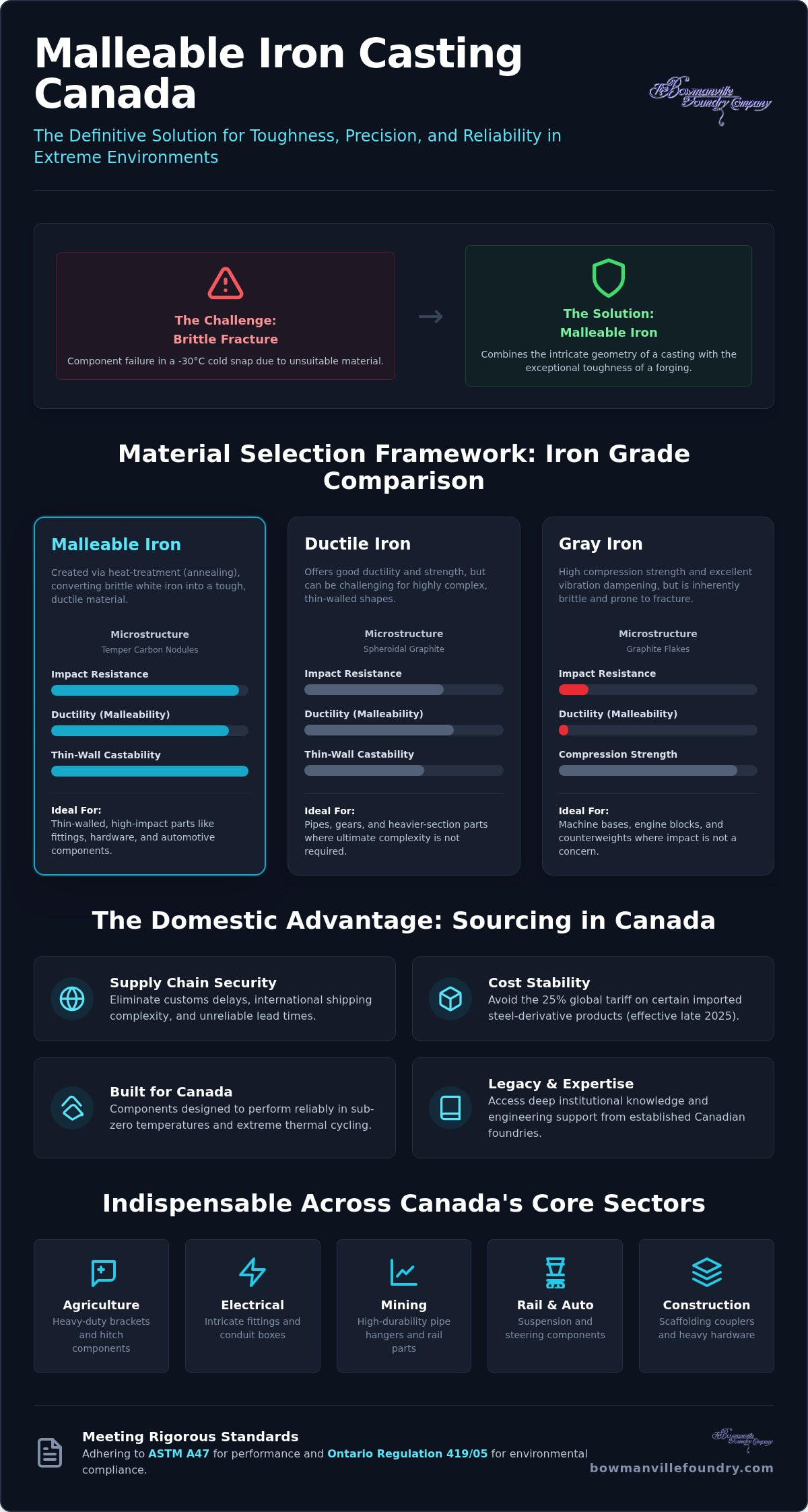
The Canadian primary metals manufacturing sector contributed $11.1 billion to the GDP in 2023. This economic weight is anchored by foundries that transform raw materials into the essential components keeping our power grids, farms, and mines operational. Within this sector, malleable iron casting Canada serves a vital niche. Unlike standard gray iron, which is prized for its compression strength but remains brittle, Malleable iron undergoes a rigorous annealing process that alters its microstructure. This transformation results in a material that combines the castability of iron with the toughness and ductility typically associated with steel. It’s the ideal choice for thin-walled components that must withstand significant impact without fracturing.
Domestic production remains a cornerstone of Canadian industrial self-reliance. Relying on overseas foundries often introduces unacceptable risks, including unreliable supply chains and the complexity of navigating international shipping regulations. By maintaining a robust domestic casting capacity, Canadian industries ensure they have immediate access to high-quality components designed to meet local environmental challenges, such as extreme thermal cycling. Choosing a local partner also eliminates the 25% global tariff on certain imported steel-derivative products implemented in late 2025, providing a more stable cost structure for long-term projects.
Historical Significance and Modern Industrial Infrastructure
The roots of Canadian iron works stretch back to the early 20th century, with institutions like Bowmanville Foundry established in 1902. These legacy foundries have evolved from manual, labour-intensive shops into modern facilities that prioritize precision and environmental compliance. Modern operations now adhere to strict standards like Ontario Regulation 419/05 to manage air emissions while utilizing advanced metallurgical testing to ensure every pour meets ASTM international standards. This century-long evolution has created a deep reservoir of institutional knowledge, allowing Canadian foundries to solve complex engineering challenges that newer, less experienced facilities might struggle to address.
Key Canadian Industries Utilizing Malleable Iron
Malleable iron is indispensable across several core Canadian sectors due to its unique mechanical properties. In the agricultural sector, it’s used for heavy-duty brackets and hitch components that must endure constant vibration and shock. The electrical industry relies on malleable castings for fittings and conduit boxes because the material can be cast into intricate, thin-walled shapes while remaining strong enough to protect critical infrastructure. Other major users include:
- Mining: High-durability pipe hangers and specialized rail components for underground transport.
- Rail and Automotive: Suspension parts and steering components where failure is not an option.
- Construction: Scaffolding couplers and heavy-duty hardware that require high tensile strength and ductility.
The ability of malleable iron casting Canada to perform reliably in sub-zero temperatures makes it the preferred material for these industries, ensuring that critical infrastructure remains functional regardless of the season.
Understanding the Unique Properties of Malleable Iron
Malleable iron is a cast white iron that has been subjected to a prolonged annealing heat-treatment to convert its carbon content into temper carbon nodules, thereby providing enhanced ductility. This metallurgical transformation is essential for components that must endure high-stress industrial environments without the risk of sudden, brittle fracture. Unlike gray iron, where graphite exists in flakes that can act as internal stress risers, malleable iron contains graphite in the form of irregular, nodular aggregates. This unique microstructure provides high tensile strength and significant impact resistance, ensuring that parts remain intact even under severe mechanical loads.
For engineers, the primary benefit of malleable iron casting Canada lies in its versatility. It’s particularly effective for complex, thin-walled designs where ductile iron might suffer from casting defects or where steel forgings would be prohibitively expensive to produce. If you’re currently evaluating iron grades for a specific project, our Free Casting Buyer’s Guide provides detailed technical data to assist in your decision-making process.
The Annealing Process and Metallurgical Superiority
The transition from brittle white iron to a tough material occurs during a multi-day heat treatment called annealing. During this phase, the iron carbides in the white iron break down through a process known as graphitization. This creates a ferritic or pearlitic matrix that allows the metal to deform slightly under load rather than snapping. For those looking to deepen their technical understanding, reviewing established Sourcing and Production Standards helps clarify how these heat treatments are regulated to ensure consistent mechanical performance across different production batches.
Mechanical Performance in Varied Canadian Climates
Canadian infrastructure faces unique environmental stressors, ranging from the humid maritime air of the Atlantic provinces to the bone-dry, sub-zero winters of the Prairies. Malleable iron is particularly resilient in these conditions. While some ferrous metals become dangerously brittle when temperatures drop below -30°C, malleable iron maintains much of its impact resistance. This makes it a preferred choice for outdoor electrical fittings and agricultural machinery that must remain operational year-round. The mechanical reliability of malleable iron casting Canada in extreme weather is a key factor for national infrastructure projects. It also exhibits excellent stability against thermal expansion and contraction, preventing the warping or cracking often seen in less stable materials during seasonal transitions.
Selection Framework: Malleable vs. Ductile and Gray Iron
Selecting the appropriate iron grade is a critical decision that influences both the performance and the total lifecycle cost of a component. While all three primary types of iron have their place in Canadian manufacturing, they serve distinct engineering purposes. Gray iron remains the most economical choice and is preferred for its exceptional vibration dampening and compression strength. It’s ideal for low-stress applications like manhole covers or heavy machine bases where brittleness isn’t a significant concern. However, for parts subjected to tension or impact, engineers must look toward ductile or malleable options.
Ductile iron is generally reserved for large, heavy-duty structural components. Its high tensile strength makes it suitable for massive gears and crankshafts. In contrast, malleable iron casting Canada is the premier choice for small-to-medium parts that require a specific combination of toughness and castability. Because Malleable iron properties allow for thinner wall sections than ductile iron without sacrificing integrity, it’s often the most efficient material for intricate hardware and fittings. Weighing the initial material cost against the expenses of machining and finishing is essential to determining the most cost-effective solution for your project.
When to Prioritize Ductility and Toughness
Identifying applications where sudden impact is a high risk is the first step in this selection framework. Components such as brackets, levers, and pipe fittings often encounter shock loads that would cause gray iron to shatter. Malleable iron is specifically engineered to allow for slight deformation before a break occurs, providing a safety margin in critical systems. This fatigue resistance ensures that industrial parts maintain their structural reliability over millions of cycles, reducing the frequency of replacement in high-use machinery.
Cost-Benefit Analysis for Medium-Volume Production
Evaluating the total “ready-to-use” cost requires looking beyond the price per kilogram. Malleable iron offers excellent machinability, which significantly reduces tool wear and processing time during post-casting operations. For medium-volume production runs, these savings often outweigh the slightly higher initial moulding fees. By choosing the right grade, you can minimize scrap rates and post-casting defects, ensuring a more predictable and profitable production schedule. When sourcing malleable iron casting Canada, the superior surface finish and dimensional accuracy of the material often lead to a lower final cost compared to steel forgings or large ductile castings, especially for complex geometries.
Sourcing and Production Standards for Canadian Foundries
Adherence to rigorous metallurgical standards is the only way to ensure that malleable iron casting Canada performs as intended in high-stress environments. In the foundry, quality control isn’t a final step but a continuous process that begins with the chemical analysis of the base melt. Modern facilities use spectrometry to verify the precise levels of carbon, silicon, and manganese before the iron is poured. Once cast, non-destructive testing (NDT), such as magnetic particle inspection or ultrasonic testing, identifies internal anomalies that aren’t visible to the naked eye. These layers of scrutiny guarantee that every component leaving the facility possesses the structural integrity required for industrial service.
Navigating ASTM and Industrial Specifications
Canadian procurement professionals must be fluent in the specifications that govern ferrous metals. The primary standard for this material is ASTM A47/A47M-99(2022)e1, which covers ferritic malleable iron castings for general engineering use. ASTM A47 serves as the definitive benchmark for malleable iron quality because it mandates specific tensile, yield, and elongation properties that ensure the material’s mechanical reliability in safety-critical applications. When evaluating suppliers, always request Certified Material Test Reports (CMTRs). These reports confirm that the batch meets the specific engineered grade requested, rather than a generic commercial grade that might lack the necessary ductility for your application.
Optimizing Design for Manufacturability (DFM)
The transition from a CAD model to a physical part requires careful consideration of how molten metal behaves within a mould. Design for Manufacturability (DFM) is the practice of refining part geometry to improve casting yield and component strength. By involving foundry engineers early in the development cycle, you can optimize the placement of gates and risers to prevent internal porosity and shrinkage. This collaboration ensures that the metal flows evenly through thin sections, which is particularly important for the complex shapes often required in malleable iron. To simplify this process and avoid common procurement pitfalls, we recommend consulting our Free Casting Buyer’s Guide before finalizing your designs.
Partnering with a Legacy Canadian Iron Foundry
Partnering with a legacy institution like Bowmanville Foundry provides a level of reliability that newer or international competitors often struggle to match. Established in 1902, we’ve spent over a century refining the metallurgical processes required for high-quality malleable iron casting Canada. This longevity isn’t just a historical footnote. It represents a vast library of institutional knowledge that we apply to every engineering project. Whether you’re dealing with complex thin-walled geometries or need precise technical data to meet ASTM standards, our team acts as a steady mentor throughout the procurement process. We prioritize transparency and educational support, ensuring you make informed decisions that lead to the long-term success of your components.
By providing extensive documentation and answering detailed inquiries, we position ourselves as a teacher in the industrial space. We’re more interested in your project’s success than a simple sale. This commitment to technical mastery ensures that the components you receive are not only durable but also engineered for maximum efficiency. In an industry where precision is paramount, having a partner with over 120 years of experience provides the reassurance needed to navigate complex technical landscapes with confidence.
Custom Engineering and Post-Processing Capabilities
Receiving a raw casting is only half the solution. To ensure maximum efficiency on the assembly line, we offer integrated Post-Processing Services, including precision machining, specialized heat treating, and surface coating. Handling these steps within the foundry environment ensures that tight tolerances are maintained. It also prevents the material’s specific properties from being compromised by third-party handling. This “ready-to-use” approach reduces your internal labour costs and simplifies your inventory management, providing finished parts that are ready for immediate installation.
Streamlining Supply Chains with Domestic Production
Sourcing within Canada eliminates the logistical headaches of international shipping, such as unpredictable customs delays and the 25% global tariff on certain imported steel-derivative products implemented in late 2025. Domestic production means you can operate with shorter lead times and clearer communication. Our team works in your time zone and understands your specific regulatory environment. This proximity allows for more agile responses to design changes or urgent production needs. It’s a reliable, no-nonsense partnership that ensures your supply of malleable iron casting Canada remains stable despite global economic pressures. Download your Free Casting Buyer’s Guide from Bowmanville Foundry today.
Securing Long-Term Durability for Canadian Infrastructure
Selecting the right metallurgical solution is a foundational decision that dictates the performance and safety of your industrial components. As we’ve detailed, the unique ductility and impact resistance of malleable iron provide a critical safety margin, especially in Canada’s demanding sub-zero environments. By prioritizing domestic production and adhering to rigorous ASTM A47 standards, you eliminate the risks of brittle failure and avoid the complexities of international logistical bottlenecks. It’s about ensuring that every part performs reliably under the specific mechanical stresses of your application.
Our facility has been manufacturing high-quality iron castings since 1902, providing national Canadian coverage and a deep reservoir of institutional knowledge. We’re committed to acting as a knowledgeable partner, offering detailed technical data and integrated post-processing to deliver ready-to-use parts directly to your assembly line. We invite you to Request a Custom Iron Casting Quote for Your Canadian Project to ensure your next production run reflects the precision and integrity your project requires. We’re ready to help you achieve technical certainty in your malleable iron casting Canada sourcing strategy.
Frequently Asked Questions
What is the main difference between malleable and ductile iron?
The primary difference lies in the metallurgical production process and the resulting graphite shape. Malleable iron is produced by heat-treating white iron to create temper carbon nodules, while ductile iron utilizes magnesium additions to create spherical graphite during the pour. Malleable iron is typically superior for thin-walled components requiring high impact resistance, whereas ductile iron is better suited for heavy, thick-section structural parts.
Can malleable iron castings be used for high-pressure Canadian plumbing applications?
Malleable iron castings are a standard choice for high-pressure plumbing and gas fittings across Canada. These components are often specified under ASTM A197 for cupola malleable iron, providing the necessary ductility to prevent cracking under pressure or thermal stress. While the material is robust, you must ensure that the specific fitting is rated for the pressure requirements of your system and complies with provincial plumbing codes.
How does the Canadian climate affect iron casting performance?
The extreme cold of the Canadian climate can cause some ferrous metals to become brittle and prone to fracture. Malleable iron casting Canada is specifically chosen for outdoor infrastructure because it maintains its toughness and impact resistance at sub-zero temperatures. This material stability prevents sudden failure in agricultural machinery or electrical hardware that must endure the significant thermal cycling common in our northern environment.
What are the typical lead times for custom iron casting in Canada?
Lead times for custom iron castings depend on the complexity of the pattern development and the volume of the production run. Typically, domestic Canadian sourcing offers a significant time advantage by eliminating the weeks of transit and customs processing required for overseas shipments. Working with a local foundry allows for more agile scheduling and faster response times for engineering adjustments, ensuring your assembly line stays on schedule.
Is malleable iron more expensive than gray iron?
Malleable iron is generally more expensive than gray iron because of the intensive multi-day annealing process required to achieve its ductile properties. Gray iron is a simpler, as-cast material, making it the lower-cost option for basic applications. However, the higher initial cost of malleable iron is often offset by its superior machinability and the reduced risk of component failure in high-stress industrial environments.
What post-processing services are available for iron castings at Bowmanville Foundry?
Bowmanville Foundry provides comprehensive Post-Processing Services to deliver ready-to-use components. These services include precision machining to meet tight tolerances, specialized heat treatments to alter mechanical properties, and various surface coatings for corrosion resistance. By integrating these processes within the foundry, we reduce the logistical complexity of your supply chain and ensure that every part arrives at your facility fully finished and assembly-ready.
How do I choose the right iron grade for a new industrial part?
Choosing the correct iron grade requires a thorough analysis of the part’s operating environment, mechanical load, and weight requirements. You should evaluate whether the component needs the vibration dampening of gray iron or the impact resistance of malleable iron. For a detailed decision-making framework, we recommend consulting our Free Casting Buyer’s Guide, which provides the technical data needed to align material properties with your specific engineering goals.
