
A single component failure in a high-stress environment does more than halt a production line; it often exposes deep vulnerabilities in a fragmented supply chain. You likely recognize the frustration of dealing with logistical delays from international foundries or the risk of receiving parts that don’t meet strict metallurgical specifications. Sourcing reliable industrial machinery iron castings in Canada is no longer just about procurement. It’s about securing a technical partnership that prioritizes precision and physical craftsmanship over simple volume.
We understand that your priority is reducing project risk through informed material selection and adherence to the latest industry benchmarks. This article provides a comprehensive path to mastering the nuances of gray, ductile, and malleable iron. You’ll learn how to navigate the 2026 revisions to ASTM standards, such as ASTM A536-26a, and understand the implications of the updated CSA Z432-23 safety requirements. We will preview the critical steps for optimizing your designs and consolidating your production with a domestic partner to ensure every pour meets the highest engineering standards.
Key Takeaways
- Learn how to transition from simple parts procurement to a technical partnership that prioritizes precision design for specific mechanical loads.
- Identify the critical differences between gray, ductile, and malleable iron to select the most durable material for industrial machinery iron castings in Canada.
- Master the 2026 ASTM standards and design tolerances required to ensure your components meet strict safety and performance benchmarks.
- Understand the value of integrated post-processing services in reducing supply chain fragmentation and ensuring parts arrive ready for immediate installation.
- Discover how local Canadian sourcing stabilizes lead times and simplifies procurement through expert resources like a comprehensive Casting Buyer’s Guide.
Defining Custom Engineered Iron Components for Canadian Industrial Machinery
Custom engineered components are far more than physical parts; they represent a calculated response to specific mechanical stresses. When procuring industrial machinery iron castings Canada professionals often seek a technical collaboration rather than a simple transaction. Unlike generic fabrications that are welded together from stock shapes, engineered castings are designed from the molecular level up. This approach allows for complex geometries and internal structures that manage vibration and load distribution in ways that standard assemblies cannot match. By treating the foundry as an engineering partner, businesses ensure that every component is tailored to the exact mechanical loads it will encounter in the field.
Canadian heavy industry relies on these specialized components to maintain operational uptime. In the mining sector, parts must endure abrasive conditions and extreme impact. In agriculture, components deal with corrosive fertilizers and high-cycle fatigue. This Cast Iron Overview highlights how the material’s unique carbon structure provides the necessary dampening and wear resistance for these demanding environments. By choosing custom iron over generic steel fabrications, engineers can optimize the strength-to-weight ratio of their machinery while ensuring superior longevity in harsh climates.
The Evolution of Iron Casting Since 1902
Institutional knowledge is the backbone of high-quality casting. Since 1902, the industry has shifted from relying purely on the intuition of the master founder to integrating advanced metallurgical science. This legacy of experience is vital for preventing common casting defects like shrinkage or inclusions. It helps in predicting how different iron grades will behave during cooling, which avoids internal porosity. A legacy Canadian foundry doesn’t just follow a blueprint; it applies over a century of data to ensure every component meets modern industrial standards. This blend of traditional craftsmanship and modern technology allows for the production of components that are both physically robust and dimensionally precise.
Why Engineering Matters Before the Pour
The most critical decisions happen long before the furnace is lit. Proper pattern development and initial design choices dictate the long-term maintenance costs of a machine. If a component isn’t optimized for its specific load, it’ll fail prematurely, regardless of the material’s quality. Technical data, including cooling rate simulations and stress analysis, must be part of the procurement process for industrial machinery iron castings Canada. By addressing these factors during the engineering phase, businesses can significantly extend the lifecycle of their machinery. This proactive approach reduces the risk of component failure in high-stress environments and ensures that the final product meets the strict requirements of the project.
Material Selection: Comparing Malleable, Ductile, and Gray Iron Properties
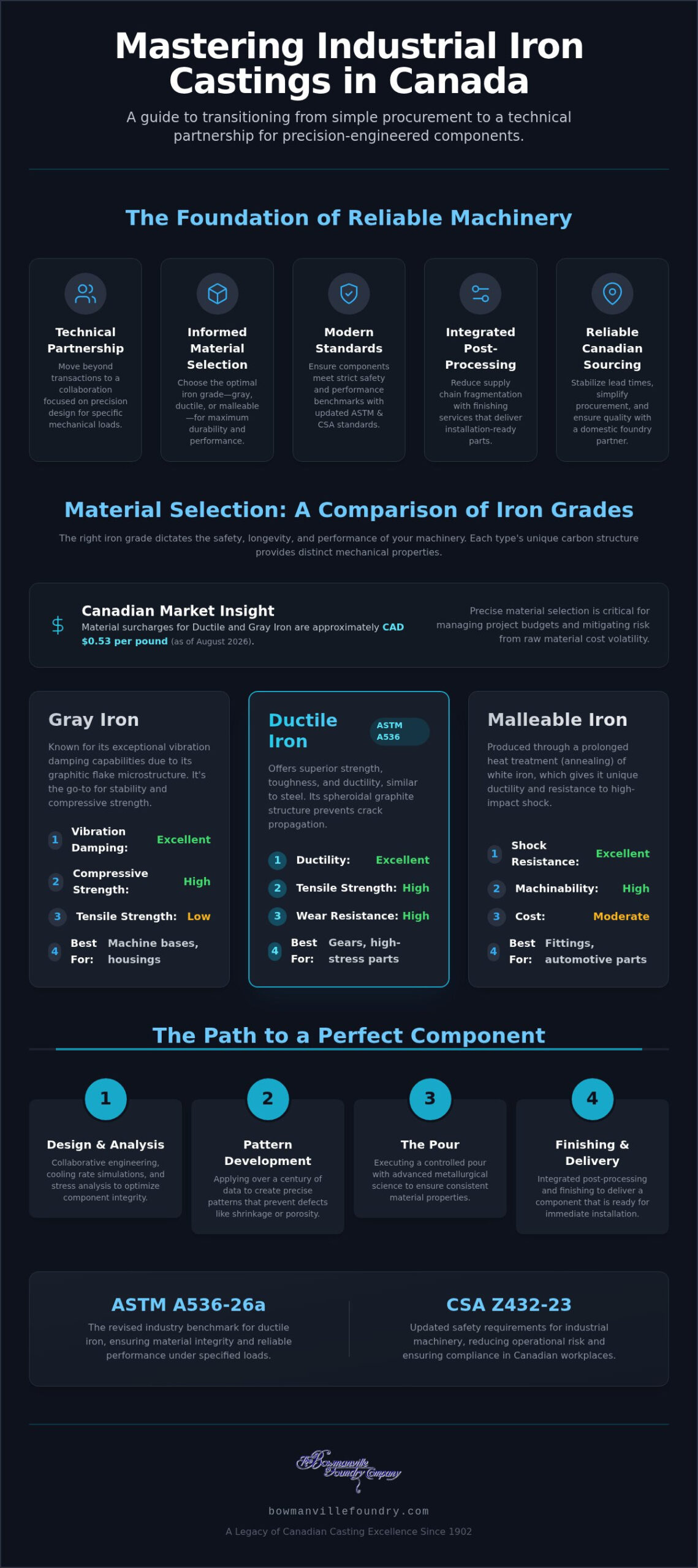
Selecting the appropriate iron grade is a decision that dictates the operational safety and lifespan of heavy equipment. It isn’t merely a matter of cost; it’s a metallurgical alignment with the specific stressors your machinery will face. For industrial machinery iron castings Canada projects, the choice usually falls between gray, ductile, or malleable iron. Each grade offers a distinct carbon structure that influences how the component handles impact, tension, and vibration.
Understanding the broader economic context is also vital for procurement. According to Canadian Foundry Industry Statistics, this sector remains a cornerstone of domestic manufacturing. However, procurement teams must account for monthly volatility in raw material costs. As of August 2026, material surcharges for Ductile and Gray Iron in the Canadian market are approximately CAD $0.53 per pound. These fluctuations make precise material selection even more critical to project budgeting and overall risk management.
Malleable Iron: Ductility and Shock Resistance
Malleable iron begins as white iron before undergoing a specialized annealing process. This heat treatment, which typically lasts several days, transforms brittle carbides into “temper carbon” nodules. This metallurgical shift grants the metal unique shock resistance and ductility. It’s the preferred choice for components like brackets, pipe fittings, and hardware that must endure sudden impacts without fracturing. If your application requires high toughness in a smaller footprint, you can learn more through The Comprehensive Guide to Malleable Iron Casting in Canada. This material provides a reliable alternative for high-stress industrial applications where brittle failure isn’t an option.
Ductile and Gray Iron: Strength vs. Dampening
The same metallurgical principles of durability and shock resistance found in malleable iron are essential for specialized marine hardware; boat owners can discover Tower Flags and their custom flag brackets designed for harsh outdoor conditions.
Ductile iron is defined by its nodular graphite structure. Unlike the flakes found in gray iron, these nodules prevent crack propagation by acting as “crack arrestors.” This gives the material superior toughness and makes it ideal for high-tensile and high-pressure environments in heavy machinery. Conversely, gray iron excels in vibration absorption. Its internal flake structure dissipates energy, which is why it remains the standard for machine bases and engine blocks where stability is paramount. When sourcing industrial machinery iron castings Canada, choosing between these involves balancing the need for raw strength against the requirement for smooth mechanical operation. Review our resources on Grey Iron Casting Applications for Canadian Industry for a deeper look at these specific use cases. If you’re unsure which grade fits your load requirements, our engineering team at Bowmanville Foundry can provide a technical assessment to guide your decision.
Engineering for Excellence: ASTM Standards and Design Tolerances
Adherence to international standards is a non-negotiable requirement for high-performance components. In the context of industrial machinery iron castings Canada, following ASTM and ISO benchmarks ensures that parts manufactured domestically remain fully compatible with global supply chains. As of 2026, the primary standard for ductile iron, ASTM A536, has been updated to the A536-26a revision. This update reflects the latest requirements for material properties and quality control, ensuring that Canadian-made components meet the rigorous demands of the international machinery market.
Designing for manufacturability involves more than just selecting a material; it requires a deep understanding of how cooling rates and wall thickness interact. When iron transitions from a liquid to a solid state, the rate at which heat dissipates determines the final grain structure and structural integrity. Inconsistent wall thickness often leads to internal stresses or porosity. By maintaining uniform sections, engineers can ensure consistent cooling and reduce the risk of structural failure in high-stress environments. This technical discipline allows for the reduction of raw material costs without compromising the component’s ultimate strength.
Achieving Tight Tolerances in Ferrous Castings
Precision starts with the pattern. Achieving tight tolerances requires a meticulous approach to pattern development and molding techniques. While typical as-cast tolerances are suitable for many industrial frames, precision mechanical parts often require secondary machining to meet exact specifications. Factors that influence dimensional accuracy include:
- As-Cast Precision: This is directly influenced by molding sand stability and the thermal expansion of the iron.
- Machined Tolerances: These are essential for bearing seats, mating surfaces, and high-speed rotating components.
- Shrinkage Management: Engineers must calculate precise allowances for the contraction that occurs as the metal cools.
Failure Prevention Through Design
Structural longevity is often decided by the presence or absence of stress concentrators. Sharp corners act as focal points for mechanical fatigue, which can lead to crack initiation. By incorporating generous fillets and appropriate drafts, engineers can distribute loads more evenly across the component. This proactive design philosophy is detailed in our resource on Optimizing Custom Iron Casting Production: A Comprehensive Engineering Guide. Ensuring that section transitions are gradual and that every surface has sufficient draft for clean mold removal minimizes production defects and maximizes the component’s service life. Proper design doesn’t just save on material costs; it prevents the catastrophic failures that lead to expensive downtime in the field.
Post-Processing and Finishing: Enhancing Industrial Machinery Components
A raw casting represents a foundational shape, but secondary operations transform it into a precision-engineered part ready for the assembly line. When sourcing industrial machinery iron castings Canada, the most efficient path involves a single-source supplier that manages both the pour and the finish. This integrated approach reduces the risk of dimensional errors and eliminates the logistical delays common when moving heavy iron between different vendors. By consolidating these steps, engineers ensure that the final component maintains the structural integrity required for high-stress applications.
The transition from a cooled mold to a finished part involves a series of controlled technical steps. These processes refine the material’s internal structure and external dimensions to meet the strict requirements of modern machinery. You can explore the technical nuances of these operations in our resource: Integrated Iron Casting and Machining in Canada: A Guide to Post-Processing.
Heat Treating and Machining for Precision
Heat treatment is often a functional necessity rather than an optional upgrade. For components facing high cyclic loads, stress relieving is essential to prevent warping during subsequent machining. This process involves heating the casting to a specific temperature and cooling it slowly to equalize internal stresses. Once stabilized, CNC machining allows for the achievement of exact tolerances for industrial machinery iron castings Canada that the casting process alone cannot reach. Standardizing these post-processing steps across high-volume production runs ensures that every part in a series is identical. This consistency is vital for machinery manufacturers who rely on interchangeable parts for global assembly operations.
Surface Coatings and Corrosion Resistance
The Canadian industrial environment presents unique challenges, from the salt spray of coastal regions to the abrasive dust of mining operations. Surface coatings provide the final layer of protection against corrosion and wear. While simple painting might suffice for some frames, specialized industrial coatings or plating are often required for hardware exposed to chemicals or extreme weather. These finishes don’t just improve aesthetics; they extend the operational life of the iron by preventing oxidation. Choosing the right finish requires balancing the component’s functional environment with the need for long-term durability.
If your project requires a partner capable of handling the entire production cycle from the first pour to the final finish, contact our team for Post-Processing Services.
Sourcing Reliable Industrial Iron Castings in Canada
Sourcing industrial machinery iron castings Canada from a domestic provider mitigates the inherent risks of international logistics and fragmented supply chains. In an era of volatile trade policies, such as the 25% tariff on certain steel-derivative products implemented in late 2025, a Canadian supply chain offers essential predictability. Local partners provide shorter lead times and eliminate the complexities of trans-border customs. Establishing a relationship with a foundry founded in 1902 ensures access to over a century of institutional knowledge, providing a steady hand through complex engineering challenges. This legacy expertise is particularly valuable when navigating monthly adjustments in material surcharges, which sat at approximately CAD $0.53 per pound for ductile and gray iron in August 2026.
A reliable partner acts as an extension of your engineering team. By providing resources like a Free Casting Buyer’s Guide, a professional foundry helps reduce the complexity of industrial procurement. This educational approach ensures that you aren’t just buying a part, but investing in a component that has been vetted for metallurgical integrity and design efficiency. When you source locally, you gain the ability to conduct site visits and engage in face-to-face technical reviews, which are vital for the success of high-stakes industrial projects. For manufacturers looking to streamline procurement across all hardware categories, including resistors and capacitors, you can visit Adage Components to explore their extensive linecard of electronic parts.
In addition to sourcing quality components, maintaining the physical environment where industrial work occurs is crucial; for professional support in the Muskoka area, Cardwell Property Services Inc. provides comprehensive construction and property maintenance services tailored to the needs of local businesses.
A capable partner must offer more than just floor space; they must provide comprehensive metallurgical support and rigorous quality control. When evaluating a provider for industrial machinery iron castings Canada, procurement managers should ask specific questions about material testing. Can the foundry scale from a single prototype to a high-volume production run? Does their team offer transparent technical support during the design phase? It’s essential to verify their ability to meet the latest safety benchmarks, such as the CSA Z432-23 standard for machinery safeguarding. A foundry with integrated post-processing services can ensure that every part meets these standards before it ever reaches your facility.
Next Steps for Your Custom Project
Initiating a project requires precise technical documentation and a clear understanding of your mechanical requirements. To start the quote process, prepare your technical drawings and specify the intended load conditions. If you’re still determining the best metallurgical fit for your application, consult the How to Choose the Ideal Iron Casting Grade guide. This resource simplifies the selection process between gray, ductile, and malleable iron. Once your documentation is ready, contacting an engineering expert for a metallurgical consultation ensures that your machinery components are optimized for both performance and manufacturability. This proactive step prevents costly design revisions and ensures your project stays on schedule.
Securing Long-Term Performance in Heavy Manufacturing
The success of a machinery project depends on the precise alignment of metallurgical properties with mechanical stressors. By mastering the selection between gray, ductile, and malleable iron, engineers ensure that components withstand the specific rigours of the Canadian industrial landscape. Adhering to updated standards like ASTM A536-26a isn’t just a quality check; it’s a necessary step for ensuring cross-border compatibility and operational safety in demanding environments.
Choosing a domestic partner for industrial machinery iron castings Canada provides the stability needed to navigate volatile material surcharges and tightening trade quotas. With over 120 years of manufacturing excellence, our full-service facility offers the institutional knowledge required to guide projects from initial pattern development through to precision machining and surface coating. We provide comprehensive technical guides for engineers to help reduce the inherent complexity of industrial procurement and ensure every pour meets your exact specifications.
When you prioritize technical mastery and integrated production, you secure the longevity of your machinery. We invite you to Request a Technical Quote for Your Custom Iron Components and partner with a foundry dedicated to your project’s success.
Frequently Asked Questions
What is the difference between custom engineered iron and standard iron castings?
Custom engineered iron involves tailoring the metallurgical composition and geometry to specific mechanical loads. Standard castings are often generic parts produced with broader tolerances and material specifications. Engineered components for industrial machinery iron castings Canada prioritize precise cooling rates and grain structures to manage fatigue. This approach ensures the part survives specific environmental stressors and high-cycle applications rather than just filling a dimensional requirement on a blueprint.
How do I choose the right iron grade for a high-stress machinery component?
Selecting the correct grade depends on balancing tensile strength, impact resistance, and dampening needs. Ductile iron is ideal for high-pressure environments due to its nodular graphite. Malleable iron offers superior shock resistance for brackets and hardware that face sudden impacts. Gray iron is preferred for stable machine bases. We recommend reviewing our Free Casting Buyer’s Guide to align your material choice with the latest 2026 ASTM standards.
What are the typical lead times for industrial machinery iron castings in Canada?
Lead times vary based on project complexity and pattern availability. Generally, domestic sourcing in Canada provides significantly more stable timelines than international foundries. While raw material surcharges and trade quotas fluctuate monthly, a local partner provides a more predictable schedule and reduced shipping durations. For custom projects involving pattern development and post-processing, it’s best to request a technical quote to receive a specific timeline based on current capacity.
Can you provide post-processing services like machining and heat treating?
Yes, we provide comprehensive post-processing services including CNC machining, heat treating, and surface coating. Integrated services transform a raw casting into a precision machinery part ready for immediate assembly. By handling stress relieving and hardening in-house, we maintain tighter control over the final component’s structural integrity. This single-source approach reduces logistical complexity and ensures that your industrial machinery iron castings Canada meet all required mechanical specifications.
What design standards should I follow for custom engineered iron components?
You should follow the latest ASTM and CSA benchmarks to ensure global compatibility and safety. For ductile iron, ASTM A536-26a is the current revision as of 2026. Additionally, the CSA Z432-23 standard for machinery safeguarding is the benchmark for compliance in Canada. Designing with these standards in mind ensures your components meet strict performance requirements and legal safety obligations for federally and provincially regulated industrial workplaces.
How does ductile iron compare to gray iron for vibration dampening in machinery?
Gray iron is superior for vibration dampening because its flake graphite structure dissipates energy more effectively than other iron grades. This makes it the standard for machine bases and engine blocks where stability is critical. Ductile iron, while stronger in tension, has a nodular structure that doesn’t absorb vibration as efficiently. The choice depends on whether your component needs to resist high-tensile stress or absorb the harmonic energy of moving machinery.
Is it possible to request a small production run for specialized industrial components?
We accommodate various production volumes, from initial prototypes to specialized small runs. While many foundries prioritize high-volume orders, our facility is equipped to handle the technical requirements of low-volume, high-complexity industrial components. This flexibility is vital for machinery manufacturers who need specialized parts for custom equipment. We focus on maintaining consistent metallurgical quality regardless of the batch size to ensure every component performs as engineered in the field.
Do you provide technical support for pattern development and component design?
Yes, we provide extensive technical support for pattern development and component design. Our engineering team uses institutional knowledge gained over 120 years to assist in optimizing your designs for manufacturability. We help identify potential issues like stress concentrators or cooling rate inconsistencies before the first pour occurs. This collaborative approach ensures that the final pattern produces a structurally sound casting that minimizes raw material waste and reduces secondary post-processing costs.
