
A raw iron casting is merely a starting point, not a finished solution. For many Canadian engineers, the real challenge begins after the pour, where managing a fragmented supply chain of separate casting, machining, and coating vendors often results in inconsistent quality and frustrating lead times. You likely recognize the difficulty of maintaining tight tolerances when a component moves between multiple facilities, which is why an integrated foundry quality assurance process is vital for project success.
This article demonstrates how specialized heat treating, precision machining, and surface finishing transform raw iron into precision-engineered, ready-to-assemble components. You’ll learn how these post-processing stages enhance mechanical properties and ensure full compliance with current standards, such as ASTM A536-26 for ductile iron and ASTM A48/A48M-22 for gray iron. We’ll also examine how consolidating these services reduces logistical risk and provides the technical certainty required for heavy industrial applications. By moving beyond the raw casting, you can streamline your procurement and realize better performance from every component.
Key Takeaways
- Understand how the transition from a raw “as-cast” state to a finished part involves a coordinated sequence of heat treating, machining, and surface finishing.
- Learn how specific heat treat cycles, including annealing and normalizing, optimize the metallurgical integrity and mechanical properties of malleable iron components.
- Discover how utilizing near-net-shape castings reduces machining time and material waste while leveraging the superior machinability of specialized iron grades.
- Explore how a comprehensive foundry quality assurance process ensures every finished component meets strict ASTM standards for industrial durability and safety.
- Identify the logistical advantages of using a single-source Canadian provider to eliminate multi-vendor bottlenecks and reduce overall supply chain risk.
Defining Foundry Post-Processing as a Quality Assurance Process
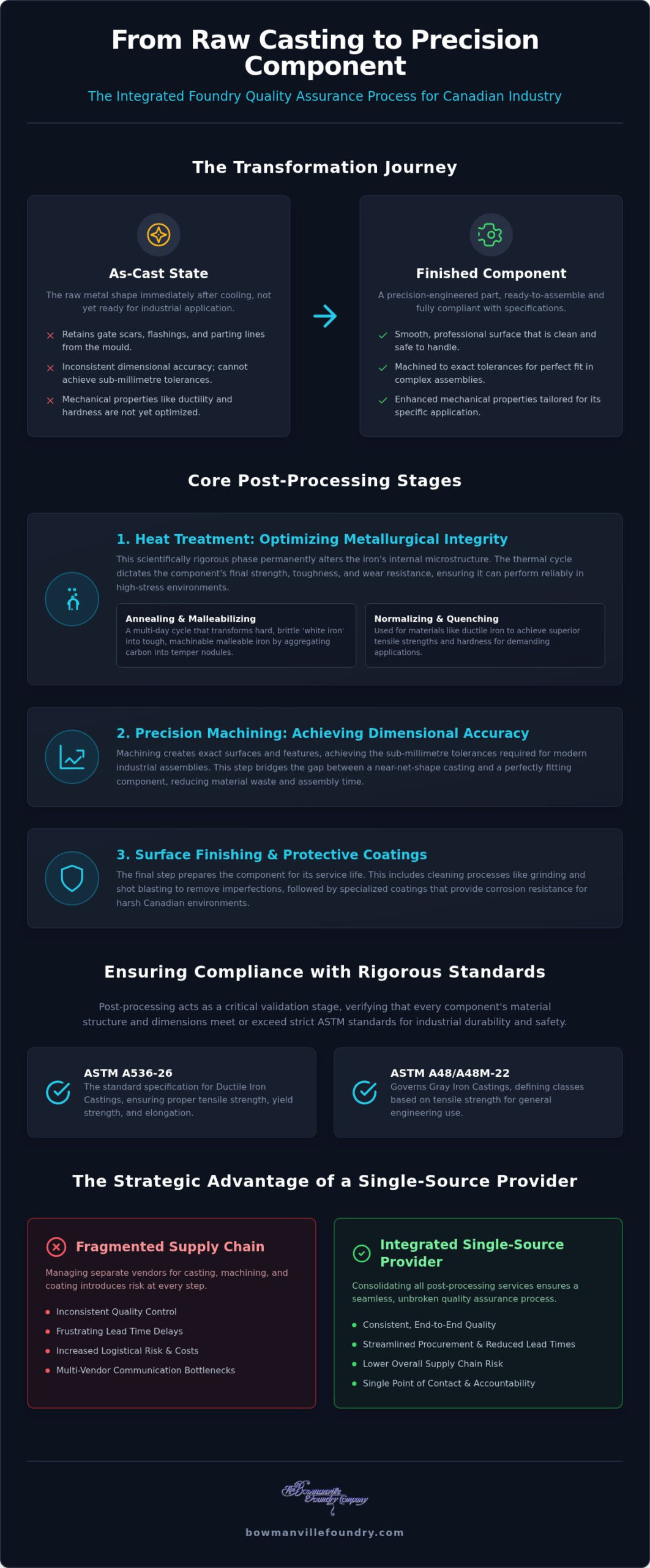
In the context of heavy manufacturing, a casting isn’t truly complete until it meets the specific mechanical and dimensional requirements of its intended application. Post-processing is the essential transition from an “as-cast” state-the raw metal shape immediately after cooling-to a precision-engineered industrial component. This phase is a core pillar of a comprehensive foundry quality assurance process, ensuring that every malleable, ductile, or gray iron part aligns with rigorous engineering specifications before it ever reaches your facility.
The scope of these secondary operations is broad and technical. It typically includes specialized heat treating to modify metallurgical properties, precision machining for exact tolerances, and surface finishing such as shot blasting or grinding. In some cases, it also involves the final assembly of multi-part components. While traditional foundry processes focus on the integrity of the pour and the cooling cycle, modern industrial applications demand more. Raw castings rarely meet the strict ASTM standards required for safety-critical hardware without these refinements. Post-processing acts as a validation stage, verifying that the material’s internal structure and external dimensions are fit for long-term service.
The Difference Between As-Cast and Finished Components
Visually, a raw casting often retains gate scars, flashings, and parting lines where the mold halves met. These remnants are removed through grinding and cleaning to create a professional, safe-to-handle surface. Beyond aesthetics, the mechanical differences are profound; secondary operations like heat treating alter the iron’s pearlite and ferrite balance to improve ductility or hardness. Post-processing is the bridge between the foundry floor and the assembly line.
Key Drivers for Post-Processing in Canadian Industry
Canadian engineers often face challenges with dimensional accuracy, as sand casting alone cannot consistently achieve the sub-millimetre tolerances required for many complex assemblies. Machining ensures these interfaces are exact. Additionally, environmental factors in Canada necessitate specialized surface properties; protective coatings provide the corrosion resistance needed for outdoor or chemical environments. By sourcing ready-to-use components, manufacturers also reduce their internal labour costs and avoid the logistical bottlenecks of managing multiple downstream service providers. This centralized approach ensures that the foundry quality assurance process remains unbroken from the initial melt to the final protective coating.
Heat Treatment: Optimizing Metallurgical Integrity
Heat treatment represents the most scientifically rigorous phase of the foundry quality assurance process. It’s the stage where the internal microstructure of the iron is permanently altered to meet specific engineering demands. While the initial pour defines the part’s shape, the heat treat cycle defines its soul; it dictates whether a component will bend under pressure, resist wear, or shatter upon impact. For Canadian engineers, understanding these thermal cycles is essential for ensuring that iron castings perform reliably in extreme temperatures and high-stress environments.
The choice of heat treatment depends heavily on the iron grade. Malleable iron is entirely dependent on a long-cycle thermal transformation to achieve its namesake properties. Ductile iron, while often strong in its as-cast state, can be normalized or quenched to reach superior tensile strengths. Success in this phase requires absolute temperature control within the furnace. Even a minor deviation can result in a matrix that fails to meet hardness specifications. Engineers looking to optimize their material selection can benefit from reviewing our industrial iron solutions to ensure the chosen cycle aligns with their performance goals.
Annealing and Malleabilizing Processes
Malleable iron begins its life as “white iron,” a material so hard and brittle it cannot be machined or subjected to shock. The malleabilizing process involves a multi-day annealing cycle where the casting is held at high temperatures to allow carbon to aggregate into temper carbon nodules. This transition is what gives the material its unique blend of toughness and machinability. By precisely managing the cooling rate, foundries can produce either a ferritic matrix for maximum ductility or a pearlitic matrix for higher strength. For a deeper look at these grade-specific metallurgical shifts, consult The Comprehensive Guide to Malleable Iron Casting in Canada.
Stress Relieving for Complex Geometries
Intricate grey iron castings often develop internal tensions as they cool at uneven rates within the sand mold. If these stresses aren’t addressed, the part may warp or crack during subsequent machining or in the field. Stress relieving involves reheating the casting to a sub-critical temperature, followed by a controlled, slow cooling process. This stabilizes the component’s dimensions and ensures that the foundry quality assurance process accounts for long-term structural integrity. Stress relieving prevents premature component failure in high-stress applications by eliminating the latent internal tensions that lead to fatigue cracking.
Precision Machining and Dimensional Accuracy
While the previous sections focused on the internal structure of the metal, precision machining addresses the external reality of industrial assembly. Near-net-shape castings provide a significant advantage over machining from solid billet stock because they minimize material waste and drastically reduce tool path time. By pouring a part that closely mirrors the final geometry, a foundry can limit machining to only the critical mating surfaces and bores. This efficiency is a hallmark of an integrated iron casting and machining approach, which ensures that the design intent is preserved from the mold to the CNC centre.
The machinability of the material itself is a key factor. Malleable iron, with its unique temper carbon nodules, offers excellent chip formation and reduced tool wear, making it ideal for high-volume production. Ductile iron also provides superior machinability compared to many steels, allowing for faster feed rates and better surface finishes. Incorporating these operations into the foundry quality assurance process allows for the early detection of any internal casting defects that might only become visible during deep boring or milling operations. It’s a final layer of validation that guarantees the integrity of the part’s cross-section.
Turning, Milling, and Drilling Operations
Secondary machining for iron brackets, housings, and fittings involves a variety of precision tasks. Turning operations establish concentricity for rotating parts, while milling creates flat, reliable mating planes. Drilling and tapping are particularly critical; ensuring thread integrity in ferrous castings requires specific tooling geometries to handle the material’s grain structure without causing micro-cracking. Using specialized carbide inserts and optimized spindle speeds prevents work hardening and ensures that every tapped hole meets the required class of fit for secure fastening.
Maintaining Critical Tolerances
Standard sand casting tolerances are generally sufficient for non-mating surfaces, but industrial assembly often requires precision that only CNC technology can provide. While a raw casting might have a tolerance of +/- 0.8 mm, machined interfaces often demand accuracy within +/- 0.02 mm or tighter. CNC centres allow for repeatable accuracy across high-volume runs, ensuring that every part in a 500-unit batch is identical. For specific engineering benchmarks and tolerance standards, engineers should consult the Optimizing Custom Iron Casting Production guide. Establishing critical datums early in the machining setup is the final step in securing the dimensional stability of the component.
Surface Finishing and Protective Coatings for Canadian Durability
Surface finishing represents the final critical stage of the foundry quality assurance process. It serves as the primary defence against the environmental stressors inherent to Canadian infrastructure. While the metallurgical integrity of the part is established in the furnace, its longevity in the field depends on how well it is shielded from the elements. Raw iron is naturally susceptible to oxidation. Without rigorous preparation and sealing, even the most robust ductile or malleable iron components can degrade when exposed to high humidity, seasonal temperature swings, and road salt. This phase ensures that the component arrives at your facility not just as a metal shape, but as a finished product ready for immediate installation.
Shot Blasting and Surface Cleaning
Mechanical cleaning begins with removing the oxide scale and residual sand that inevitably clings to the part after it leaves the sand mold. Shot blasting uses high-velocity abrasive media to strip the surface down to bare metal, ensuring a uniform and professional appearance. This process also reveals the true surface profile of the casting, allowing quality control teams to perform a final visual inspection for surface discontinuities that might have been hidden by scale. Beyond simple cleaning, shot blasting creates the mechanical “tooth” necessary for optimal coating adhesion. Industrial iron finish grades often target specific Ra (roughness average) values, typically ranging from 6.3 to 12.5 micrometres, to ensure that subsequent coatings bond permanently to the substrate without peeling or flaking. For architectural iron components, additional precision grinding is used to smooth parting lines and gate scars for a seamless aesthetic.
Industrial Coating Selection
Selecting the appropriate protective layer is a balance between performance and long-term cost. Liquid paint systems are versatile and easily touched up, making them suitable for interior machinery or parts that require specific colour matching. However, powder coating provides a thicker, more durable barrier with superior impact resistance for parts subjected to heavy physical handling. For components integrated into municipal water systems or bridge assemblies, hot-dip galvanizing or specialized plating offers the highest level of protection against the corrosive effects of Canadian winters. The choice of finish directly impacts the long-term maintenance cycle; a superior coating reduces the need for field repairs and extends the operational life of the assembly. For those ready to finalize their project specifications, you can request a quote for finished iron castings that meet your exact durability requirements.
The Strategic Advantage of Single-Source Finishing in Canada
Managing the procurement of industrial components often involves balancing multiple service providers, each responsible for a single stage of the production cycle. However, centralizing casting and post-processing within a single Canadian facility provides a significant strategic advantage. By eliminating the need to coordinate between separate casting, heat treating, machining, and coating vendors, engineers can drastically reduce supply chain complexity. This integrated approach ensures that the foundry quality assurance process remains seamless, with one team maintaining accountability for the component from the initial melt to the final protective layer.
Multi-vendor shipping introduces inherent risks, including logistical bottlenecks, increased freight costs, and potential damage during transit. When heavy iron castings are moved between facilities, lead times often extend as parts wait in queues at each downstream provider. A single-source solution eliminates these transit delays and the associated administrative burden. Integrated production scheduling allows the foundry to move parts directly from the cooling floor into the machining centre or heat treat furnace; this ensures a steady, predictable flow that aligns with your project timelines.
Streamlining Procurement for Canadian Projects
Procurement departments often face significant overhead when managing large-scale industrial projects. Sourcing ready-to-use components from a single provider reduces this administrative weight by consolidating multiple purchase orders and quality inspections into a single point of contact. Having metallurgical and machining expertise under one roof allows for real-time problem solving. If a machining challenge arises, the foundry team can immediately adjust the casting process to compensate. This internal synergy ensures that the finished part meets all engineering specifications without the “blame game” often found in fragmented supply chains.
Next Steps: Sourcing Ready-to-Use Components
To realize the full benefits of integrated finishing, it’s important to specify your post-processing requirements early in the design phase. Your initial Request for Quote (RFQ) should clearly outline the required tolerances, heat treatment cycles, and surface finish grades. Before finalizing your designs, we recommend reviewing our how to choose the ideal iron casting grade guide to ensure your material selection is optimized for the intended finishing operations. Our engineering team is available to discuss your specific finished component requirements and help you develop a streamlined production plan that meets your technical and logistical goals.
Optimizing Your Component Supply Chain
Transitioning from a raw casting to a precision-engineered part requires a meticulous approach to metallurgy and dimensional accuracy. By integrating heat treating, machining, and surface finishing into a unified foundry quality assurance process, you ensure that every component meets the rigorous demands of Canadian industrial applications. This single-source strategy effectively eliminates the logistical risks and inconsistent quality control often associated with multi-vendor procurement models.
With expertise serving the Canadian industry since 1902, we provide the technical support needed to navigate complex iron grade selection and finishing specifications. Our integrated casting and finishing capabilities allow us to deliver ready-to-use parts that align with your exact engineering benchmarks. Streamlining your supply chain doesn’t just save time; it builds long-term reliability into your essential infrastructure. We invite you to Request a Quote for Ready-to-Use Iron Components and partner with a team dedicated to technical mastery. We look forward to supporting your next project with the precision and integrity your designs deserve.
Frequently Asked Questions
What are the most common post-processing services for iron castings?
The most common services include heat treating, precision machining, and surface finishing. These operations are essential parts of a robust foundry quality assurance process. Heat treating alters the metallurgical structure, while machining achieves final dimensional accuracy. Surface finishing, such as shot blasting or painting, ensures the part is ready for assembly. Together, these steps transform a raw casting into a functional industrial component that meets modern Canadian engineering standards.
How does heat treating improve the machinability of malleable iron?
Heat treating converts brittle white iron into malleable iron by creating temper carbon nodules within a ferritic or pearlitic matrix. This transformation is critical because it prevents tool breakage and allows for faster machining speeds. The resulting microstructure provides excellent chip formation and reduces tool wear. It’s clear that without this specific annealing cycle, the material would remain too hard for standard turning or milling operations used in modern manufacturing.
Can you machine ductile iron to the same tolerances as steel?
Ductile iron can be machined to extremely tight tolerances that are comparable to those achieved with steel components. While as-cast tolerances are broader, CNC machining allows for precision within +/- 0.02 mm or better. Ductile iron’s graphite nodules actually provide a self-lubricating effect during the cutting process. This often results in superior surface finishes and consistent dimensional repeatability across high-volume production runs for industrial assemblies across Canada.
Why is shot blasting necessary before painting or coating an iron part?
Shot blasting is required to remove oxide scale and residual moulding sand from the casting surface. This mechanical cleaning process creates a uniform surface profile that ensures optimal adhesion for paints, powder coatings, or plating. If you don’t perform this step, the coating may flake or peel due to underlying contaminants. It also provides a final visual check for surface discontinuities as part of the overarching foundry quality assurance process.
How much do post-processing services typically add to the lead time?
The impact on lead time varies based on the complexity of the secondary operations required. Simple shot blasting might only add a day, while multi-day heat treat cycles or complex CNC machining can extend the timeline. However, sourcing these services from a single-source provider often results in a shorter total lead time. It’s because you eliminate the transit days and scheduling delays between a separate foundry and a machining centre.
Is it better to source machining from the foundry or a separate machine shop?
Sourcing machining directly from the foundry is generally the more efficient and reliable choice. This approach provides a single point of accountability for the finished part’s integrity. If a sub-surface defect is uncovered during machining, the foundry can immediately adjust the casting process to rectify the issue. It’ll also simplify your procurement logistics by consolidating multiple purchase orders and shipping requirements into one streamlined Canadian supply chain for ready-to-use parts.
What surface finishes are best for preventing rust in outdoor Canadian applications?
Hot-dip galvanizing and specialized powder coatings are the most effective options for resisting corrosion in harsh Canadian environments. These finishes provide a durable barrier against road salt, high humidity, and extreme temperature fluctuations. For components that require a specific colour or aesthetic finish, an industrial-grade liquid paint system over a properly shot-blasted surface also offers significant protection. The choice depends on the specific exposure levels and maintenance requirements of your project.
