
The most durable solution for high-vibration machinery isn’t always the newest alloy on the market. Often, it’s the specific metallurgical refinement found in diverse malleable iron casting applications. Many engineers find that standard materials fail prematurely in high-stress environments, or they struggle with the inconsistent quality of components sourced from offshore suppliers. It’s a common challenge to find a material that offers both high tensile strength and the fine-grain machinability required for complex industrial parts.
This guide explores how these castings solve reliability gaps by providing superior ductility and shock resistance. You’ll discover how their unique mechanical properties make them the preferred choice for demanding Canadian engineering projects. We’ll examine specific use cases for this material, review essential ASTM standards such as A197/A197M, and explain how choosing a reliable domestic foundry with integrated post-processing services can ensure consistent quality is at the centre of your production cycle.
Key Takeaways
- Understand how the specialized annealing process transforms white iron into a material defined by high ductility and exceptional shock resistance.
- Identify critical malleable iron casting applications within the heavy machinery and electrical transmission sectors where vibration dampening is a primary requirement.
- Learn why malleable iron is the superior metallurgical choice for thin-walled components that are often difficult to produce using ductile iron.
- Compare the mechanical trade-offs between malleable, ductile, and gray iron to select the optimal grade for your specific tensile strength and grain structure needs.
- Discover how partnering with an established Canadian foundry helps organize a more reliable supply chain through integrated post-processing and institutional expertise.
What is Malleable Iron? Understanding Material Properties for Industrial Use
To answer the question What is Malleable Iron?, one must look at its unique metallurgical journey. Unlike gray iron, which is cast into its final state, malleable iron begins as white cast iron. This initial state is extremely hard and brittle. Through a specialized annealing process, the material is transformed into a tough, ductile metal that excels in diverse malleable iron casting applications. Its signature mechanical properties include high tensile strength and impressive shock resistance, making it an ideal candidate for parts that endure repetitive stress.
The material’s performance is driven by its ferritic matrix. During heat treatment, carbon is pulled out of solution to form irregular nodules of temper carbon. This microstructure prevents the crack propagation common in more brittle irons. Because the grain structure is so fine and consistent, the material offers superior machinability. Engineers often choose it for complex parts that require precise drilling or tapping without the tool wear associated with harder ferrous metals.
The Annealing Process: Turning Brittle into Tough
The transformation occurs during a prolonged heat treatment cycle that can last several days. By heating the white iron to temperatures between 800°C and 950°C, the iron carbide breaks down. This process allows carbon nodules to form, which act as crack arrestors within the metal. Precise temperature control is vital here. If the cooling rate isn’t managed correctly, the casting may retain brittle pockets, leading to failure in the field. This level of metallurgical control is why established Canadian foundries prioritize heat treatment as a core part of their quality assurance.
Key Mechanical Specifications and ASTM Standards
Selecting the right grade requires a clear understanding of ASTM iron casting standards. These standards are the benchmark for quality in high-stress malleable iron casting applications across North America. Two common grades found in industrial projects are 32510 and 35018. The first three digits represent the minimum yield strength in psi, while the last two digits indicate the percentage of elongation.
- Grade 32510: Offers excellent ductility and is often used for general-purpose hardware.
- Grade 35018: Provides higher yield strength and is suited for more demanding structural components.
Evaluating these metrics helps engineers determine which grade will best handle the specific loads of their application. Accurate interpretation of these standards ensures that the final component meets both safety and performance requirements. It’s a methodical approach that replaces guesswork with technical certainty.
Primary Malleable Iron Casting Applications Across Canadian Industry
While some general resources suggest this material is limited to plumbing fixtures, the industrial reality in Canada tells a different story. The true breadth of malleable iron casting applications extends into heavy-duty sectors where mechanical failure isn’t an option. Its ability to be cast into complex, thin-walled shapes while maintaining high impact strength makes it indispensable for components that face constant mechanical stress. From the brackets and levers found in mining equipment to the specialized hardware in power generation, this iron grade serves as a reliable foundation for critical infrastructure.
In the agricultural sector, tillage tools and harvester parts must withstand both the abrasive force of soil and the high-frequency vibration of diesel engines. Malleable iron provides the necessary dampening to prevent fatigue cracks. Similarly, the railroad industry relies on this material for brake components and structural supports on rolling stock. These parts must endure extreme temperature shifts and massive structural loads that would cause less ductile irons to shatter under pressure.
Malleable Iron for Electrical and Construction Hardware
Outdoor infrastructure requires materials that don’t become brittle in sub-zero temperatures. Malleable iron is a staple for insulator caps, clamps, and connector fittings in electrical transmission lines. Its natural resistance to atmospheric corrosion is particularly valuable in the varied Canadian climate. When specifying iron casting for construction hardware, engineers prioritize this material for its structural integrity under tension and its ability to hold tight tolerances during machining and post-processing.
Automotive and Heavy Transportation Uses
High fatigue strength is the deciding factor in the transportation sector. Steering components and transmission housings are frequently subjected to cyclical loading that can lead to catastrophic failure in brittle materials. Because malleable iron can deform slightly without fracturing, it provides a safety margin that gray iron lacks. For those making an Engineering Selection: Comparing Malleable Iron to Ductile and Gray Iron Grades, the choice often hinges on the specific grain structure of the part. Malleable iron survives in long-haul transport environments because its temper carbon nodules act as internal buffers against shock.
If you’re designing a component for a high-vibration environment, consulting with an experienced partner can help you refine your design for better manufacturability. You can explore our range of malleable iron castings to see how these mechanical properties translate to finished, ready-to-use components.
Performance Benefits: Why Malleable Iron Excels in High-Vibration Environments
High-stress malleable iron casting applications often involve reciprocating motion or heavy impact. Malleable iron stands out because of its natural vibration dampening properties. These properties protect the entire mechanical assembly from premature wear. Unlike more rigid ferrous metals, the temper carbon nodules within the ferritic matrix absorb energy. This prevents micro-cracks from spreading into structural failures. It effectively acts as a shock absorber within the metal itself, which is why it’s so prevalent in engine-mounted components and heavy-duty brackets.
In Canadian industrial sites, low-temperature fracture toughness is a non-negotiable requirement. Malleable iron retains its mechanical integrity in extreme cold where other materials might become brittle and shatter. Additionally, the material’s ductility allows for “coining” or cold-working after the casting is complete. This process enables engineers to achieve precise dimensional accuracy on specific surfaces through localized pressure. It’s a pragmatic solution for achieving tight tolerances without always requiring secondary machining passes.
One major advantage over ductile iron is the material’s performance in thin-walled sections. Ductile iron can be difficult to cast in very thin profiles without a high risk of casting defects or inconsistent grain structure. Malleable iron maintains its mechanical properties even in intricate, lightweight designs. This allows for the creation of complex parts that are both light enough for modern transport standards and strong enough to handle industrial-grade loads.
Vibration Dampening and Fatigue Resistance
Reciprocating machinery and engine mounts require a material that manages internal friction efficiently. Malleable iron offers higher internal friction than steel but maintains significantly more structural toughness than gray iron. This balance allows it to absorb the energy of a vibrating system without propagating fatigue cracks. By dampening these harmonics, the material extends the service life of both the casting and the surrounding mechanical components. It’s a dependable choice for any environment where constant oscillation is a factor.
Machinability and Surface Finishing Advantages
Machinability is a critical factor in the total cost of production. The fine-grain structure of malleable iron reduces tool wear during high-speed machining operations, which is a distinct advantage over harder ferrous alloys. This allows for the production of complex geometries and intricate internal details that would be cost-prohibitive in other materials. Utilizing integrated iron casting and machining Canada services streamlines the supply chain. It ensures the foundry taking responsibility for the casting also manages the final tolerances. This one-stop approach reduces the risk of quality inconsistencies and ensures the component is ready for immediate assembly upon arrival.
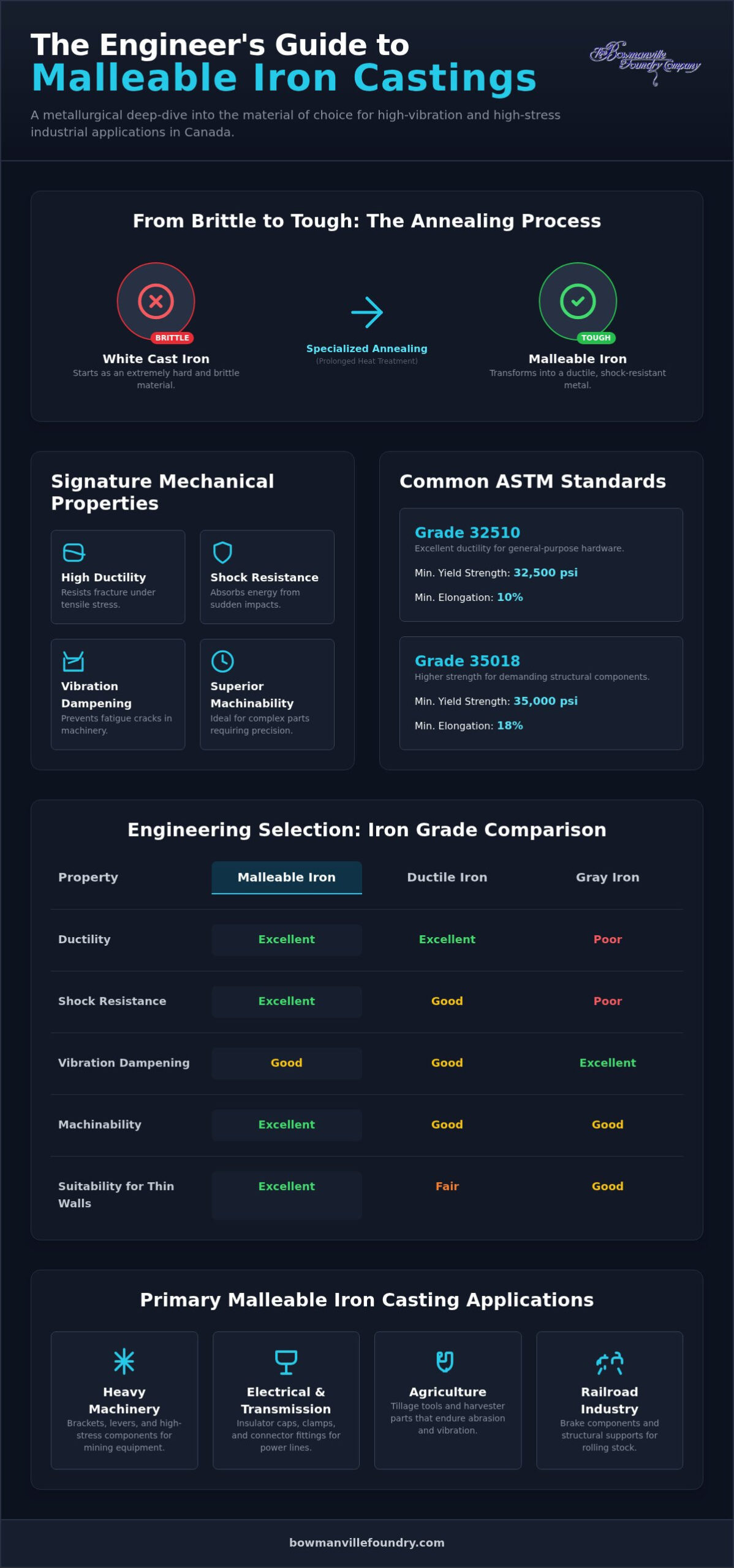
Engineering Selection: Comparing Malleable Iron to Ductile and Gray Iron Grades
Selecting the correct ferrous material requires more than just comparing tensile strength numbers on a spreadsheet. It involves a pragmatic evaluation of how a part will be manufactured, machined, and used in the field. For many malleable iron casting applications, the decision often comes down to balancing section thickness with the need for impact resistance. While modern alternatives exist, malleable iron remains the technically superior choice for specific geometries where other grades struggle to maintain consistent mechanical properties.
The primary framework for this decision should be based on how to choose iron casting grade specifications. Engineers must consider the strength-to-weight ratio, especially in smaller components. Malleable iron allows for the design of lighter, high-strength parts that can replace bulkier gray iron assemblies without sacrificing durability. This efficiency is critical in the transportation and agricultural sectors where reducing weight directly impacts fuel economy and machine performance.
When to Choose Malleable Over Ductile Iron
A common misconception in metallurgy is that ductile iron is a universal replacement for malleable iron. However, malleable iron holds a distinct “thin-wall” advantage. In small cross-sections, ductile iron is prone to “chilling,” which creates hard, brittle carbides that are nearly impossible to machine. Because malleable iron starts as white iron and undergoes a controlled annealing cycle, it achieves a uniform, fine-grain structure even in very thin profiles. This makes it the preferred material for high-tolerance components that require precision machining and a superior surface finish for plating or painting.
The Limitations of Gray Iron in High-Stress Roles
Gray iron is often selected for its excellent pourability and low cost, but its internal structure limits its use. The graphite flakes in gray iron act as internal stress risers, making the material brittle and unsuitable for impact-loading. In contrast, the temper carbon nodules in malleable iron allow the metal to deform slightly under stress rather than fracturing. When a component must survive sudden shocks or heavy vibrations, gray iron reaches its breaking point quickly. Malleable iron provides the necessary toughness to ensure long-term reliability in these high-stress environments.
Choosing the right material is a collaborative process that benefits from early engineering involvement. To ensure your project utilizes the most efficient material for your specific requirements, contact our technical team for a detailed casting review.
Optimizing Your Components with Bowmanville Foundry’s Custom Casting Services
Finding the right material is only half the battle; the other half is finding a manufacturing partner who understands the nuances of malleable iron casting applications. Bowmanville Foundry has operated since 1902, providing a level of institutional knowledge that helps engineers avoid common pitfalls in part design. By focusing on custom iron casting production, we ensure that every component is engineered for maximum longevity and field performance. Localized Canadian support also means reduced lead times and a more transparent supply chain, which is vital for maintaining production schedules in high-stakes industrial environments.
Choosing a domestic foundry allows for direct communication between your engineering team and our metallurgical experts. This proximity simplifies the procurement process and ensures that technical specifications aren’t lost in translation. Whether you’re developing a new bracket for heavy equipment or refining a connector for electrical transmission, our team provides the steady hand needed to guide a project from initial concept to a finished, high-performance part.
Custom Engineering and Design Support
Success in casting begins long before the first pour. Our engineers collaborate with your team to optimize part geometry, ensuring that the design is suited for the specific flow characteristics of malleable iron. Pattern development is a critical stage here; a well-designed pattern reduces the risk of casting defects and ensures dimensional consistency across high-volume runs. For those in the early stages of a project, utilizing our free casting buyer’s guide helps organize the technical requirements and selection criteria needed for a successful production cycle. We prioritize transparency, providing the documentation you need to make an informed decision for your specific application.
Post-Processing: Delivering Ready-to-Use Components
A casting is often just the starting point. To truly optimize a component, integrated post-processing services like heat treating, machining, and surface coating are essential. By offering single-source casting and machining, we reduce the complexity of your supply chain and take full responsibility for the final tolerances. This integrated approach ensures that the material’s properties are preserved throughout the finishing process. We maintain strict adherence to iron casting quality control protocols, which include thorough visual and dimensional inspections. Whether your part requires a specific protective coating to resist atmospheric corrosion or precision tapping for assembly, we deliver components that are ready to go straight into your production line.
Securing Reliability in High-Stress Engineering Projects
Malleable iron remains a cornerstone of modern industrial design because it balances toughness with precise manufacturability. By understanding the mechanical advantages of this material, engineers can solve complex challenges in high-vibration environments and thin-walled designs that other ferrous metals cannot match. From heavy transportation components to electrical transmission hardware, the range of malleable iron casting applications continues to expand as industries prioritize long-term durability and safety.
Successful implementation depends on choosing a partner with deep institutional knowledge and integrated technical capabilities. Bowmanville Foundry is a Canadian-owned and operated industrial foundry established in 1902. Our expertise is centred on custom-engineered components and full-service post-processing and machining. This ensures every part arrives at your facility ready for immediate assembly. We help you navigate the complexities of metallurgical selection to ensure your project stays on schedule and meets all safety standards.
Request a custom iron casting quote for your next project and leverage over a century of manufacturing expertise. We look forward to helping you realize your next engineering success with components built to endure.
Frequently Asked Questions
What are the most common malleable iron casting applications?
Malleable iron casting applications are primarily found in sectors requiring high shock resistance and vibration dampening. Common examples include insulator caps for electrical transmission, brackets for heavy machinery, and tillage tools for agricultural equipment. Railroad rolling stock also utilizes this material for brake components. These industries prioritize malleable iron because it can be cast into intricate, thin-walled shapes that maintain structural integrity under repetitive mechanical stress and harsh environmental conditions.
Is malleable iron better than ductile iron for high-stress parts?
Malleable iron is often the superior choice for high-stress parts with thin cross-sections where ductile iron might suffer from casting defects. While ductile iron offers high strength, it can be difficult to cast in very thin profiles without creating brittle pockets. Malleable iron’s specialized annealing process ensures a uniform grain structure throughout the entire component. This consistency makes it a dependable material for complex brackets and levers that must endure significant impact without fracturing.
Can malleable iron be used in sub-zero Canadian temperatures?
Malleable iron performs exceptionally well in sub-zero Canadian temperatures due to its high fracture toughness. Brittle materials often fail catastrophically in extreme cold, but the temper carbon nodules in malleable iron act as internal buffers. This prevents cracks from propagating through the metal matrix even when temperatures drop significantly. It’s a reliable material for outdoor infrastructure, such as electrical transmission hardware and agricultural machinery used in diverse climates across the country.
How does the annealing process affect malleable iron applications?
The annealing process is the critical step that defines the material’s mechanical capabilities for various malleable iron casting applications. By heat treating brittle white iron over a prolonged cycle, carbon is pulled into nodules called temper carbon. This transformation gives the iron its signature ductility and shock resistance. Without this controlled process, the material wouldn’t be suitable for high-vibration environments. The resulting ferritic matrix allows the casting to deform slightly under load rather than shattering.
What industries rely most on malleable iron castings?
The agricultural, transportation, and electrical utility industries are the primary users of this material. These sectors require components that can withstand constant vibration and heavy mechanical loads. Malleable iron is also a staple in the construction hardware industry for specialized fittings and connectors. Because the material offers a high strength-to-weight ratio in small parts, it’s often the preferred metallurgical solution for complex assemblies that must remain lightweight yet durable for long-term field use.
Why is malleable iron preferred for electrical fittings?
Malleable iron is preferred for electrical fittings because it combines natural corrosion resistance with the ability to be cast into complex, thin-walled geometries. Insulator caps and connector fittings must endure atmospheric exposure and mechanical tension without failing. The material’s fine-grain structure also allows for precise threads to be machined easily. This ensures a secure fit for critical infrastructure components that are difficult to replace once they’re installed in the field under demanding environmental conditions.
Can malleable iron be machined easily for complex designs?
Malleable iron is highly machinable due to its consistent grain structure and the presence of temper carbon. This allows for high-speed machining with significantly less tool wear compared to harder ferrous alloys. Engineers can design complex parts with intricate internal details and tight tolerances, knowing the material will respond predictably during secondary operations. Integrated post-processing services often utilize these properties to deliver ready-to-use components that meet strict engineering specifications for sophisticated industrial assemblies.
What ASTM standards apply to malleable iron castings in Canada?
The primary standard for cupola malleable iron is ASTM A197/A197M. Other common grades used in Canadian engineering projects include 32510 and 35018, which specify requirements for tensile strength, yield strength, and elongation. These standards ensure that the castings meet the necessary safety and performance benchmarks for industrial use. Adhering to these documented specifications allows procurement professionals to verify material quality and ensure consistency across large production runs for critical infrastructure projects across the country.
