
What if your foundry’s delivery date isn’t just a static entry on a calendar, but a shifting calculation based on technical precision and global market volatility? Many procurement professionals realize that unpredictable production schedules and a lack of transparency often lead to costly project delays. When you’re managing complex industrial orders, understanding the diverse factors affecting iron casting lead times becomes essential for maintaining operational stability. It’s frustrating to face foundry backlogs without a clear explanation of why your gray or ductile iron components are stalled in the production queue.
This guide provides the technical and operational clarity you need to optimize your procurement strategy for 2026. We’ll explore how variables like scrap metal pricing, AI-driven quality control, and post-processing requirements dictate your delivery timeline. You’ll learn how to move from guesswork to accurate forecasting while discovering the strategic advantages of partnering with an established Canadian foundry. By the end of this article, you’ll have a roadmap for reducing lead times and building a more reliable supply chain that prioritizes transparency, integrity, and technical mastery.
Key Takeaways
- Differentiate between the physical manufacturing duration and the total lead time queue to establish a more transparent and predictable procurement schedule.
- Understand how technical variables, such as part geometry and core complexity, are primary factors affecting iron casting lead times during the molding process.
- Recognize the impact of operational constraints, including facility capacity and the specialized Canadian labour market, on overall production throughput.
- Account for essential post-processing requirements like heat treating and machining, which often represent the final bottleneck in the casting journey.
- Leverage Early Foundry Involvement (EFI) and blanket orders to secure production slots and significantly reduce your delivery cycle duration.
Defining Lead Time in the Iron Casting Industry
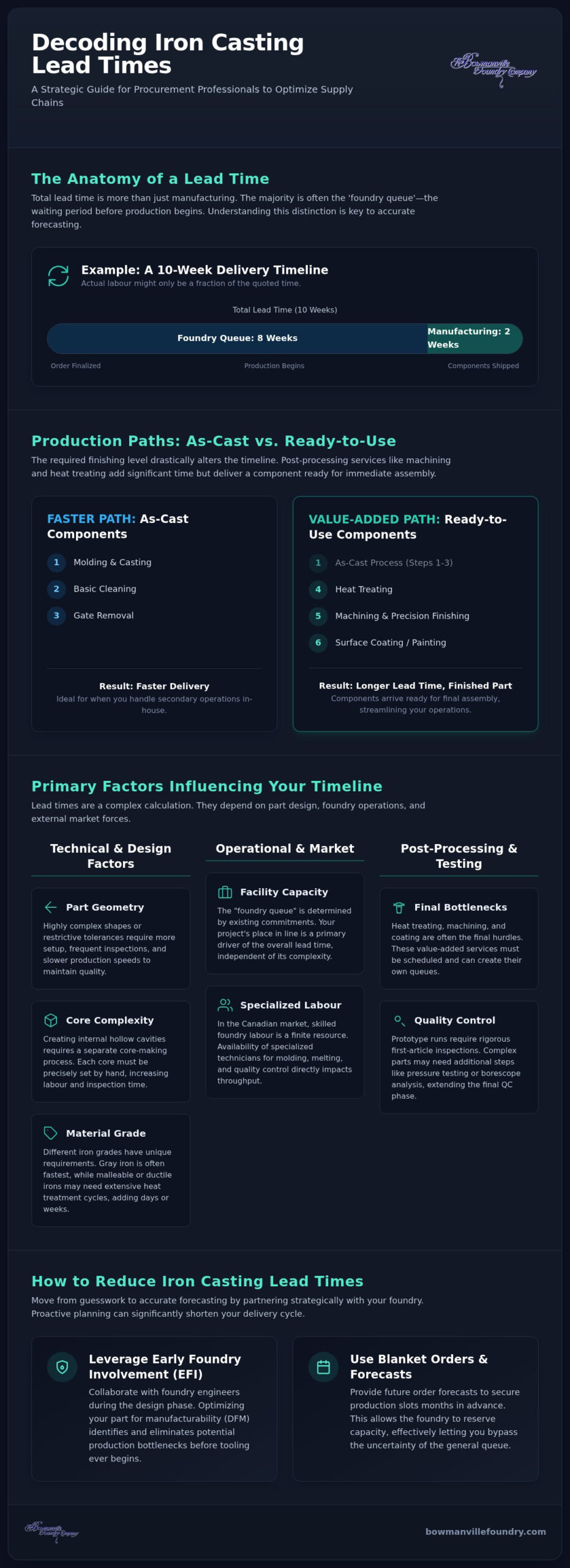
Lead time is the total duration from the moment an order is finalized until the finished components reach your receiving dock. It encompasses everything from administrative processing and tooling preparation to the final logistics of shipping. One of the most significant factors affecting iron casting lead times is the distinction between manufacturing time and the foundry queue. Manufacturing time refers to the physical labour and mechanical processes required to create the part. In contrast, lead time includes the waiting period before your project even reaches the furnace. This distinction is essential for procurement professionals who must realize that a foundry’s schedule reflects its current capacity and existing commitments. Different Cast iron production methods, such as those used for gray or malleable iron, require specific metallurgical controls that influence how a job moves through the facility. Seasonal industrial demand and order timing also play a heavy role in these calculations, as foundries often prioritize capacity based on long-term facility availability.
The Difference Between Casting and Finishing Timelines
When requesting a quote, you must distinguish between “as-cast” delivery and ready-to-use component delivery. As-cast components are raw castings that have undergone basic cleaning and gate removal. These are typically delivered faster because they bypass secondary operations. However, most modern industrial applications require ready-to-use parts that have undergone post-processing services. These value-added steps, including heat treating, machining, and surface coating, must be calculated as a separate phase of the total lead time. Setting realistic expectations also requires understanding the difference between prototype and production runs. Prototypes often involve longer initial timelines due to the need for new tooling development and rigorous first-article inspections before the foundry can organize a full-scale production schedule.
Facility Availability vs. Process Duration
The “foundry queue” is the primary reason why factors affecting iron casting lead times can seem disconnected from the complexity of the part itself. For example, a 10-week lead time might only include two weeks of actual labour and machine time. The remaining eight weeks represent the queue. Your project’s “slot” in this queue depends on how many orders are already committed to the molding lines. In the Canadian market, specialized skills and facility capacity are finite resources. To secure a predictable production window, it is helpful to provide the foundry with future order forecasts. Using blanket orders allows a foundry to reserve capacity for your projects months in advance, effectively bypassing the uncertainty of the general queue and ensuring your delivery schedule remains stable despite market fluctuations.
Technical Complexity and Design Factors
Design choices often serve as the primary internal factors affecting iron casting lead times. While external market forces are significant, the physical geometry of a component determines the labour hours required at each station. Design for Manufacturability (DFM) is a proactive strategy that identifies potential production delays before tooling even begins. For instance, parts with highly restrictive tolerances require more frequent dimensional inspections and higher precision in sand consistency. These requirements naturally extend the testing phase, as the foundry must verify that every pour meets the specified standards without excessive scrap rates. Collaborating with engineers during the design stage ensures that your specifications don’t inadvertently create bottlenecks in the molding line.
Cores and Hollow Cavities
The inclusion of internal cavities significantly increases the labour required for each casting. Core-making is a distinct production step that involves creating separate sand inserts to form hollow spaces within the final part. These cores must be hand-set or mechanically positioned with extreme accuracy to prevent shifting during the pour. Complex internal geometries also necessitate additional quality control steps, such as borescope inspections or pressure testing, to ensure no sand remains trapped within the casting. Core complexity directly correlates to molding lead time because every additional core represents a new point of potential delay in the assembly process.
Material Grades: Malleable, Ductile, and Gray Iron
When evaluating the factors affecting iron casting lead times, the specific metallurgical grade chosen for the part is often overlooked. Gray iron generally offers the shortest processing time because it typically doesn’t require extensive heat treatment after the casting has cooled. In contrast, malleable iron requires a lengthy annealing cycle that can add several days to the schedule. This heat treatment process is essential to transform the brittle white iron into a tough, ductile material, but it requires precise temperature control over an extended duration.
Ductile iron provides a middle ground, often requiring shorter heat treatment cycles than malleable iron while offering superior mechanical properties. Understanding how to choose the ideal iron casting grade is vital for balancing performance needs with your delivery deadline. If your project allows for flexibility in material selection, consulting with a foundry early in the design phase can help you identify grades that streamline production. You can find more technical data in our free casting buyer’s guide to help refine your specifications and reduce the complexity of your procurement journey.
Operational and External Market Variables
While design choices dictate the physical requirements of a part, operational variables determine when a foundry can actually initiate production. One of the most significant factors affecting iron casting lead times in 2026 is facility capacity management. Modern foundries have shifted away from measuring capacity solely by tonnage. Instead, they utilize sales dollar metrics and labour-hour availability to manage throughput. This approach accounts for the reality that a complex, low-weight component may occupy a molding line longer than a heavy, simple casting. Additionally, external constraints like energy costs and grid reliability play a role. A foundry’s ability to maintain a continuous pouring schedule depends on a stable power supply, as unplanned outages can disrupt metallurgical cycles and force production resets.
Labour Availability and Specialized Expertise
The skilled trade shortage across Canada remains a critical constraint on production speed. Foundries require specialized expertise in metallurgy and pattern making that isn’t easily replaced. Automated molding lines help mitigate some labour issues, but they require different technical inputs than traditional manual floors. When a foundry possesses deep institutional knowledge in complex materials like malleable iron, it significantly reduces the “rework” factor. High-quality first-pours mean fewer castings are rejected during inspection, which keeps the project moving through the facility without the delays associated with scrap and re-pouring. Relying on a team that understands these nuances is often the difference between a project that stays on track and one that falls behind due to technical errors.
Supply Chain and Logistics for Canadian Manufacturers
Global competition and geopolitical risks have pushed many organizations toward regionalizing their supply chains to ensure stability. Sourcing from a domestic Canadian foundry offers a distinct advantage by eliminating the unpredictability of international shipping and customs brokerage. As of September 2026, the global iron casting market is valued at approximately USD 131.9 billion, and this high demand can lead to bottlenecks at international ports. Domestic procurement allows for more direct communication and faster transit times. Understanding the logistics of Optimizing custom iron casting production is essential for procurement teams looking to minimize external risks. By keeping the supply chain within national borders, you reduce exposure to volatile shipping rates and ensure that raw material availability, such as scrap metal currently priced at $0.09/lb for rotors, is managed within a more stable local market.
Testing and Post-Processing Requirements
While the moulding and pouring phases are visually impressive, secondary operations often represent the most complex factors affecting iron casting lead times. Procurement teams don’t always realize how much time value-added services add to the production cycle. Heat treating, for instance, requires precise thermal cycles and skilled labour that can’t be rushed without compromising metallurgical integrity. Similarly, Non-Destructive Testing (NDT), such as ultrasonic or magnetic particle inspection, adds essential layers of validation. Pressure tests and full dimensional layouts are also time-intensive tasks. When these services are outsourced to third-party vendors, transit times between facilities further compound the delay. Utilizing a foundry with integrated post-processing capabilities streamlines the timeline by keeping the component within a single quality control system.
Machining and Surface Finishing
Machining specifications significantly influence the final delivery date. High-precision tolerances require specialized setups and multiple passes, which consume significant machine hours. If your design calls for complex boring, threading, or multi-axis milling, the time required for tool changes and dimensional verification increases. Surface coating also adds to the queue. Galvanizing involves specific immersion and cooling periods, while industrial painting requires controlled environments and curing times to ensure the finish adheres correctly to the iron substrate. You can learn more about coordinating these steps in our guide to Integrated iron casting and machining in Canada.
Quality Assurance and Certification
Compliance with ASTM standards is a non-negotiable requirement for many industrial applications. However, generating the necessary compliance documentation and material certifications adds an administrative layer to the project timeline. For new projects, the first-article inspection (FAI) is a critical milestone that determines when full production can begin. This process involves a comprehensive dimensional layout and metallurgical analysis of the initial samples to ensure they match the engineering drawings. While these stringent quality control measures might seem to slow down the process, they’re vital factors affecting iron casting lead times in the long run. By identifying and eliminating defects early, you avoid the massive delays associated with field failures or large-scale rejections.
If you need to simplify your supply chain and reduce the risk of post-processing bottlenecks, contact Bowmanville Foundry to discuss our in-house finishing and technical capabilities.
How to Reduce Iron Casting Lead Times
Strategic intervention in the early stages of a project is the most effective way to mitigate the various factors affecting iron casting lead times. While you can’t bypass the physical laws of metallurgy, you can eliminate the administrative and logistical friction that often stalls production. Early Foundry Involvement (EFI) allows our engineering team to review your designs before tooling is finalized. By identifying ways to simplify part geometry or reduce the number of internal cores, we can streamline the moulding process and decrease the likelihood of defects. This collaborative approach ensures that the design is optimized for the specific capabilities of the foundry floor, preventing the rework cycles that often plague complex industrial projects.
Strategic Procurement and Forecasting
Transitioning from a transactional ordering system to a long-term partnership model provides the stability needed for accurate delivery forecasting. Foundries operate most efficiently when they can organize their production schedules months in advance. By providing annual volume commitments or sharing your project roadmap, you allow the foundry to reserve facility capacity specifically for your needs. Blanket orders are a particularly effective tool in this regard; they secure your slot in the production queue and protect your project from sudden spikes in market demand. This level of transparency reduces the surprise factor for the foundry and ensures that raw materials and labour are allocated to your components well before the actual pour date.
The Bowmanville Foundry Advantage
Choosing a full-service partner eliminates the multi-supplier delays that often occur when castings must be shipped between different facilities for machining or heat treatment. At Bowmanville Foundry, we leverage over a century of Canadian manufacturing expertise to help you optimize every aspect of your order. Since 1902, we’ve specialized in malleable, ductile, and gray iron, providing a steady hand through intricate technical landscapes. Our in-house post-processing services ensure that quality control remains consistent from the initial melt to the final inspection. Accessing our technical data and buyer’s guides helps your team create right-first-time designs that move through our facility with maximum efficiency. We encourage you to Request an accurate iron casting quote and discuss your specific project timelines with our engineering team to realize the benefits of a streamlined, domestic supply chain.
Optimizing Your 2026 Casting Procurement Strategy
Managing a successful production schedule requires a deep understanding of the technical and market-driven factors affecting iron casting lead times. It isn’t just about dates on a calendar. By realizing how part geometry and specific material grades, such as malleable or ductile iron, influence the foundry queue, you can make more informed design decisions. Implementing strategic forecasting and early foundry involvement ensures your project remains a priority. Sourcing from a domestic partner provides the transparency needed to manage the industrial landscape without the unpredictability of international logistics.
Bowmanville Foundry has served the Canadian industry since 1902, offering specialized expertise in malleable, ductile, and gray iron. Our in-house machining and post-processing services allow us to maintain strict quality standards while streamlining your delivery timeline. To further refine your approach, Download our Free Casting Buyer’s Guide to optimize your procurement and gain the technical certainty required for your next project. We’re ready to help you build a more resilient and predictable supply chain.
Frequently Asked Questions
What is the typical lead time for custom iron castings in Canada?
Typical lead times for custom iron castings in Canada usually range from 8 to 12 weeks for new projects. Repeat orders with existing tooling often move faster, potentially shipping in 4 to 7 weeks. These durations are heavily influenced by the current foundry queue and facility availability at the time of your order. It’s important to realize that high-demand periods can extend these windows. Providing a clear project roadmap allows a foundry to better organize its production floor.
How does the choice of iron grade affect the production schedule?
The specific iron grade chosen is one of the primary factors affecting iron casting lead times due to varying metallurgical requirements. Gray iron often has the fastest turnaround because it typically requires minimal heat treatment. Ductile iron may require specific annealing cycles; meanwhile, malleable iron necessitates a lengthy heat treatment process to achieve its final properties. These additional thermal cycles add several days or even weeks to the total production schedule compared to simpler material grades.
Why do complex iron castings require more time than simple designs?
Complex designs require more time because they often involve intricate core-making and rigorous quality control inspections. Every internal cavity necessitates the creation of a separate sand core, which must be precisely positioned within the mould. Additionally, tighter dimensional tolerances require more frequent testing and adjustments to sand consistency and pouring temperatures. These technical requirements naturally slow the movement of a project through the moulding and cleaning departments of the facility, ensuring the final part meets all specifications.
Can I reduce lead times by providing my own patterns?
Providing your own patterns can reduce the initial tooling phase, but it doesn’t always guarantee a shorter total lead time. The foundry must first inspect the existing tooling to ensure it’s compatible with their specific moulding equipment and sand systems. If modifications are required to meet the foundry’s standards or to ensure casting quality, this can lead to unexpected delays. It’s often more efficient to have the foundry manage pattern development to ensure a right-first-time production run.
How much time does post-processing add to an iron casting order?
Post-processing services, such as machining, heat treating, and surface coating, typically add 2 to 4 weeks to an iron casting order. These value-added steps are essential for producing ready-to-use components but involve secondary operations that occur after the initial casting is cleaned. Utilizing a foundry with in-house finishing capabilities helps streamline this phase. It eliminates the transit times and administrative friction associated with shipping parts to third-party machine shops or coating facilities across the country.
What external market factors are currently impacting foundry lead times?
External factors affecting iron casting lead times in 2026 include raw material volatility, energy grid reliability, and the specialized labour market. Fluctuations in the price of scrap metal and pig iron can disrupt procurement cycles, while the ongoing shortage of skilled metallurgists affects overall facility throughput. Additionally, foundries must manage production around energy consumption standards and potential grid constraints. These variables can impact the frequency and volume of scheduled furnace pours, requiring careful coordination and proactive planning.
Does the order volume significantly change the estimated lead time?
Order volume significantly impacts lead times because larger batches require more time on the moulding line and greater furnace capacity. While a foundry might “squeeze in” a small prototype run, a high-volume production order must be carefully scheduled to avoid disrupting other commitments. However, large annual volume commitments or blanket orders actually help reduce lead times. They allow the foundry to reserve dedicated production slots for your project months in advance, providing much-needed stability.
How can early foundry involvement help meet tight project deadlines?
Early foundry involvement helps meet tight deadlines by identifying design optimizations that simplify the manufacturing process before tooling begins. When our engineering team reviews your project during the design phase, we can suggest modifications that reduce core requirements or improve pourability. This proactive approach eliminates the need for costly redesigns and re-pouring later. It ensures the transition from a conceptual drawing to a finished component is as efficient as possible, saving both time and costs.
