
While the automotive industry often chases the latest lightweight alloys, the structural integrity of a heavy-duty powertrain still depends on the thermal stability only gray iron engine blocks can provide. You likely understand the frustration of managing noise, vibration, and harshness (NVH) in high-stress assemblies, or the persistent risk of thermal warping when internal cooling galleries aren’t perfectly executed. It’s a complex task to balance precise internal geometries with the rigorous mechanical demands placed on modern OEMs. This article details why grey iron remains the premier choice for thermal conductivity and superior vibration damping in demanding applications. You’ll learn how to optimize your casting specifications to achieve maximum thermal performance and why a reliable domestic partner is essential for securing your production timeline. We’ll explore the technical nuances of ASTM A48 classifications, the metallurgical benefits of flake graphite, and the logistical advantages of keeping your manufacturing within Canada to avoid the uncertainties of international shipping and shifting tariffs.
Key Takeaways
- Understand how the graphitic microstructure of gray iron engine blocks facilitates superior thermal transfer and internal lubrication for high-performance assemblies.
- Discover how advanced sand casting techniques and precise core design enable the creation of complex internal cooling galleries required for modern engine geometries.
- Learn to navigate ASTM A48 standards to select the appropriate iron class based on specific tensile strength and mechanical stress requirements.
- Identify critical design tolerances and machining allowances that prevent “hard spots” and ensure efficient finishing during the post-processing phase.
- Recognize the logistical and technical benefits of sourcing castings from a domestic Canadian partner to mitigate supply chain risks and leverage legacy metallurgical knowledge.
The Role of Gray Iron in Modern Engine Block Manufacturing
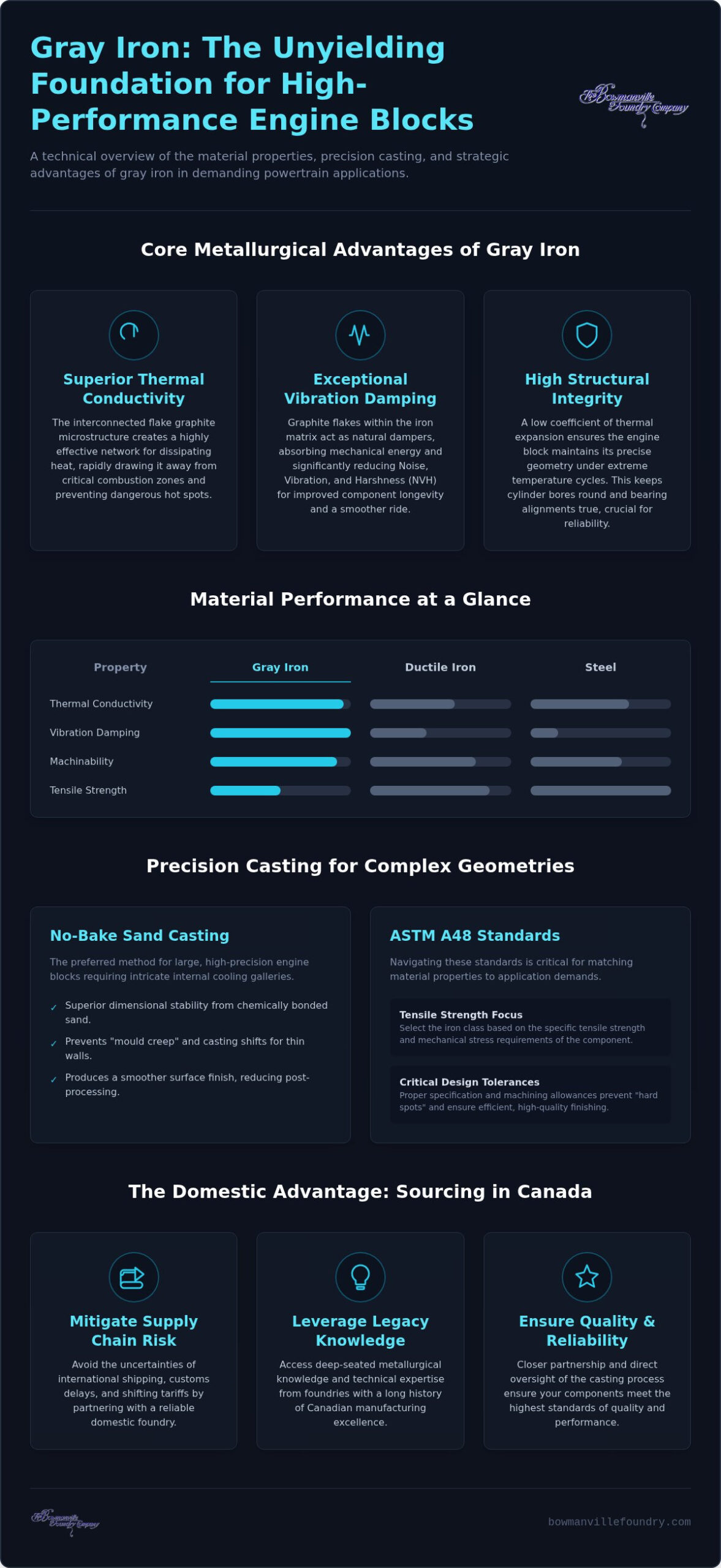
Gray iron is a specialized cast iron defined by a graphitic microstructure that appears grey when the metal is fractured. For Canadian OEMs, the decision to utilize gray iron engine blocks is rooted in the material’s unique metallurgical composition. Unlike steel or aluminum, gray iron contains graphite in a flake formation. These flakes provide a distinct advantage for internal lubrication and thermal transfer, making the material exceptionally well-suited for the high-friction environment of an internal combustion engine. Because the graphite flakes are interconnected, they create a network that facilitates the rapid movement of heat away from the combustion chamber.
When engineers evaluate Gray iron properties, they often prioritize the metal’s ability to maintain its shape under duress. The material’s low coefficient of thermal expansion ensures that cylinder bores remain round and main bearing alignments stay true, even as the engine cycles through extreme temperature ranges. This stability is a primary reason why gray iron remains the gold standard for heavy-duty and high-performance applications where reliability isn’t optional.
Vibration Damping and NVH Control
The internal structure of gray iron is essentially a composite material where the graphite flakes act as dampers within the iron matrix. This configuration is incredibly effective at absorbing mechanical energy and reducing engine noise. Damping capacity is the material’s ability to dissipate elastic energy. In high-RPM environments, this characteristic prevents resonance that could lead to the loosening of fasteners or the failure of gaskets. By controlling noise, vibration, and harshness (NVH), manufacturers can produce vehicles that feel more refined and robust. This damping effect doesn’t just improve the driver’s experience; it protects the longevity of every internal component by shielding them from the destructive forces of harmonic vibration.
Thermal Conductivity and Heat Dissipation
Effective heat management is what separates a reliable engine from one prone to failure. Gray iron engine blocks excel at preventing hot spots in the cylinder walls because the flake graphite provides a direct path for heat to reach the cooling galleries. While ductile iron offers higher tensile strength, it lacks the same level of thermal conductivity because its graphite is nodular rather than flake-like. Steel, though strong, cannot match the thermal efficiency or the dimensional stability of gray iron during rapid heat cycles. By choosing gray iron, designers ensure that the block resists warping and maintains the precise tolerances required for modern, high-efficiency piston rings to function correctly over hundreds of thousands of kilometres.
Casting Techniques for Precision Engine Components
The manufacturing of gray iron engine blocks relies on the sand casting process to accommodate the intricate geometries and varying section thicknesses inherent in powertrain design. Achieving a high-quality casting begins with precise control over the cooling rate. If the iron cools too quickly, it can form brittle iron carbides; if it cools too slowly, the resulting grain structure may be too coarse for high-stress applications. Foundries must manage this thermal cycle to ensure a consistent pearlitic microstructure, which provides the necessary hardness and wear resistance for cylinder bores without compromising machinability.
Precision in the foundry stage directly impacts the efficiency of the final assembly. By utilizing advanced molding techniques, manufacturers can reduce the amount of material that must be removed during finishing. For those seeking to refine their procurement process, reviewing a Free Casting Buyer’s Guide can provide additional technical benchmarks for evaluating foundry capabilities.
No-Bake vs. Green Sand Casting for Blocks
While green sand casting is effective for high-volume, simpler components, no-bake (chemically bonded) sand molding is often the preferred choice for large, high-precision engine blocks. No-bake molds offer superior dimensional stability because the sand is hardened with a chemical resin rather than moisture and pressure. This rigidity prevents “mould creep” or casting shift, which is vital when maintaining the thin wall sections between cylinder bores and cooling jackets. Additionally, no-bake molding produces a smoother surface finish, significantly reducing the labour required for post-processing and cleaning.
Managing Internal Core Complexity
The most challenging aspect of casting an engine block is the creation of internal cooling and oil galleries. These passages are formed using sand cores that must withstand the intense heat and pressure of molten iron without deforming. Effective core design is essential for several reasons:
- Gas Management: Cores must be designed with adequate venting to allow gases to escape. If gas is trapped, it creates porosity in the cylinder walls, leading to structural failure or leaks.
- Clean Passages: The core sand must break down easily after the metal solidifies so it can be completely removed, ensuring no obstructions remain in the coolant flow.
- Repeatable Accuracy: High-quality pattern development ensures that every core is identical, which is necessary for the long-term production runs required by Canadian OEMs.
Modern foundries prioritize these technical details to ensure that every casting meets the rigorous standards of the automotive and heavy-equipment industries. Proper core execution eliminates the risk of “blind” blockages that could cause catastrophic engine overheating in the field.
Evaluating Gray Iron Grades for Thermal and Mechanical Stress
Selecting the correct grade for gray iron engine blocks requires a precise understanding of ASTM A48 standards. This specification classifies grey iron based on the minimum tensile strength of the metal, measured in thousands of pounds per square inch (psi). While it’s tempting to specify the highest available strength, engineering a powertrain requires a calculated trade-off between mechanical durability and vibration control. As the tensile strength increases, the material’s damping capacity typically decreases because the volume of graphite flakes is reduced in favour of a denser iron matrix. For most Canadian OEM applications, Class 30 and Class 35 represent the ideal balance, providing sufficient structural integrity without sacrificing the noise-reduction qualities discussed in previous sections.
ASTM A48 Class Comparison for Engine Blocks
Class 25 and Class 30 are frequently utilized for light-duty blocks where excellent machinability and superior vibration damping are the primary goals. These grades allow for faster spindle speeds during finishing, which reduces production costs and tool wear. In contrast, Class 35 and Class 40 are the standard for heavy-duty or turbocharged engines that face higher internal cylinder pressures and mechanical loads. Beyond tensile strength, chemical control is vital for casting quality; for instance, sulphur levels must be carefully managed to prevent slag inclusions, while phosphorus content is monitored to ensure the iron remains fluid enough to fill thin-walled sections without becoming brittle.
Microstructure and Wear Resistance
The wear resistance of a cylinder bore is largely determined by its microstructure. A fully pearlitic matrix is essential for longevity because it provides a hard, stable surface that resists the scuffing action of piston rings over millions of cycles. The distribution of graphite also matters significantly for engine performance. Type A graphite flakes, which are randomly oriented and medium-sized, are the preferred choice because they promote uniform heat distribution and oil retention. Conversely, Type D graphite, which forms in finer, inter-dendritic patterns, can lead to localized soft spots and uneven bore wear. Phosphorus content can be adjusted to improve wear resistance by forming a hard constituent known as steadite within the iron matrix. Ensuring these metallurgical variables are tightly controlled during the pour is what separates a standard casting from a high-performance engine component.
Design Considerations and Critical Tolerances for Engine Blocks
The transition from a raw casting to a finished engine component requires a meticulous approach to design tolerances. For gray iron engine blocks, the casting design must account for specific machining allowances, which is the extra material left on the surface to be removed during finishing. If these allowances are too thin, the tool may not “bite” properly; if they are too thick, production costs and tool wear increase. Designers must also incorporate generous fillets and appropriate draft angles. Fillets prevent stress concentrations at internal corners, while draft angles ensure the pattern can be removed from the sand mold without damaging the mold walls. Proper draft angles typically range between 1 and 3 degrees, depending on the depth of the pocket.
One of the most significant risks during finishing is the presence of “hard spots,” or localized areas of chilled iron. These occur if thin sections cool too quickly, forming brittle iron carbides that are significantly harder than the surrounding pearlitic matrix. These spots can instantly dull or shatter expensive carbide cutting tools, leading to unplanned downtime. Managing the cooling rate and chemical composition is the only way to prevent these defects and keep machining costs predictable.
Machinability and Secondary Finishing
Gray iron’s exceptional machinability is a primary driver for its use in mass production. The graphite flakes within the metal act as a natural lubricant, reducing friction at the tool-workpiece interface and allowing for higher cutting speeds. This characteristic is especially beneficial when boring cylinder sleeves or aligning crankshaft journals. Utilizing integrated iron casting and machining Canada allows OEMs to consolidate their supply chain and reduce lead times. By handling both the pour and the precision finishing in a single facility, manufacturers can ensure that critical tolerances; these are often within microns for bearing bores; are met consistently. For technical assistance with your next project, consult with our casting specialists.
Heat Treating for Stress Relief
Complex engine blocks often contain internal stresses caused by uneven cooling across varying section thicknesses. If these stresses aren’t addressed, the block may experience dimensional “creep” after it’s been machined, potentially throwing cylinder bores out of round. Specifying a stress-relieving heat treatment involves heating the casting to a sub-critical temperature, typically between 510°C and 565°C, and then cooling it slowly. This process relaxes the internal tension without significantly altering the mechanical properties or hardness of the iron. While annealing can be used to improve machinability in very hard castings, it may reduce the overall tensile strength, so it must be applied with technical caution.
Sourcing Custom Gray Iron Engine Blocks in Canada
Partnering with a domestic foundry for gray iron engine blocks provides a level of supply chain security that international sources cannot match. With the Canadian government’s evolving trade policies and the 2026 reporting requirements for metal imports, domestic sourcing ensures that production schedules remain predictable and compliant. Legacy expertise is particularly critical when casting safety-critical components; foundries with over a century of experience possess the institutional knowledge to navigate the nuances of complex internal galleries and metallurgical consistency. This expertise translates into lower scrap rates and higher first-pass yields for gray iron engine blocks, as seasoned technicians understand how to control the pour to avoid the subtle defects that often plague less experienced operations. To ensure your project begins with the correct material specifications, you can utilize our resource on How to Choose the Ideal Iron Casting Grade to refine your requirements.
Supply Chain Reliability and Lead Times
Sourcing within Canada reduces logistics costs and the overall environmental impact of a project. By eliminating transoceanic shipping, OEMs gain faster access to their components and more flexible production cycles that aren’t vulnerable to port strikes or container shortages. Domestic sourcing is about more than proximity. It’s about certainty. Direct engineering collaboration between the OEM and the foundry is another major advantage. When designers can speak directly with the metallurgists and pattern makers, technical challenges are resolved quickly, preventing the costly delays that often occur in large-scale industrial projects. By handling both the moulding and finishing in one facility, a Canadian partner provides a streamlined path from initial design to the final machined block.
Quality Assurance in Ferrous Casting
Foundry quality control must be rigorous to ensure every casting meets the intended performance profile. Spectrographic analysis is used to verify that the chemical composition of the melt matches the specification before the pour begins. Post-casting, technicians perform hardness testing and ultrasonic inspection to detect any internal defects that could compromise the block’s integrity. These non-destructive testing (NDT) methods are essential for identifying porosity or inclusions that aren’t visible to the naked eye. A reliable partner doesn’t just deliver a part; they deliver technical certainty through documented inspections and metallurgical reports. To start your next project with expert guidance, download our Free Casting Buyer’s Guide.
Advancing Powertrain Performance with Technical Precision
The choice of material for heavy-duty powertrains remains a critical engineering decision. This article has outlined how the flake graphite microstructure of gray iron engine blocks provides the thermal conductivity and vibration damping necessary for long-term engine stability. By optimizing your casting specifications and adhering to precise ASTM A48 standards, you can reduce the risks of thermal warping and mechanical failure. Securing a reliable domestic partner ensures your project benefits from established metallurgical expertise and streamlined logistics.
Bowmanville Foundry has served Canadian industry since 1902, offering the technical certainty of a comprehensive in-house metallurgical lab and advanced NDT testing. Our full-service machining and finishing capabilities allow for a seamless transition from raw pour to finished component. We invite you to leverage our legacy of craftsmanship to ensure the success of your next powertrain project.
Request a Quote for Your Custom Gray Iron Project to begin a partnership built on industrial precision and dependable engineering support. We look forward to helping you achieve your production goals.
Frequently Asked Questions
Why is gray iron preferred over aluminum for heavy-duty engine blocks?
Gray iron provides superior thermal stability and vibration damping compared to aluminum alloys. While aluminum offers weight savings, it cannot match the structural integrity of gray iron engine blocks under the extreme pressures of heavy-duty operation. The material’s ability to resist warping and maintain bore roundness makes it the preferred choice for commercial and high-performance powertrains where reliability isn’t optional.
What are the most common ASTM grades used for gray iron engine blocks?
Most engine blocks are specified using the ASTM A48 standard, with Class 30 and Class 35 being the most prevalent. Class 30 is favoured for its excellent machinability and damping qualities in light-duty applications. For heavy-duty or turbocharged engines, Class 35 or Class 40 is typically selected to provide the higher tensile strength necessary to withstand increased cylinder pressures and mechanical stress.
How does gray iron improve engine noise, vibration, and harshness (NVH)?
The flake graphite structure of gray iron acts as an internal damper that absorbs and dissipates mechanical energy. This unique microstructure reduces the resonance and noise generated during combustion, leading to a more refined engine assembly. By controlling noise, vibration, and harshness (NVH), gray iron protects internal components from harmonic damage and improves the overall durability of the powertrain in high-RPM environments.
Can gray iron engine blocks be machined easily?
Gray iron is widely recognized for its excellent machinability because the graphite flakes act as a natural lubricant during the cutting process. This reduces friction at the tool tip and allows for higher spindle speeds compared to steel or ductile iron. Foundries that provide integrated post-processing services can deliver finished blocks that meet critical tolerances for crankshaft bores while minimizing tool wear and production costs.
What is the difference between gray iron and ductile iron for engine components?
The primary difference lies in the shape of the graphite; gray iron contains flakes, while ductile iron contains nodules. Gray iron offers superior thermal conductivity and vibration damping, which are essential for engine block stability. Ductile iron provides higher tensile strength and ductility but lacks the heat dissipation efficiency of gray iron engine blocks, making it better suited for components like brackets or gears.
Do gray iron engine blocks require heat treatment?
While not always mandatory, stress-relieving heat treatment is often specified for complex castings to prevent dimensional creep. This process involves heating the block to a sub-critical temperature to relax internal tensions caused by uneven cooling. Annealing is another option used to improve machinability in specific cases, though it must be managed carefully to ensure the final mechanical properties meet the original design requirements.
How do I ensure internal cooling passages are free of casting defects?
Ensuring clean internal passages requires a combination of high-quality core design and rigorous non-destructive testing (NDT). Foundries use specialized venting techniques to prevent core gases from creating porosity in the cylinder walls. After the pour, ultrasonic inspection and borescope examinations are employed to verify that cooling and oil galleries are free of obstructions, ensuring the engine maintains proper thermal management during operation.
What are the typical lead times for custom iron casting in Canada?
Lead times for custom iron castings vary based on the complexity of the pattern and the volume of the production run. Partnering with a domestic Canadian foundry significantly reduces the total turnaround time by eliminating the delays associated with international shipping and customs clearance. This proximity allows for direct engineering collaboration, ensuring that prototypes and production parts move through the facility with maximum efficiency.
