
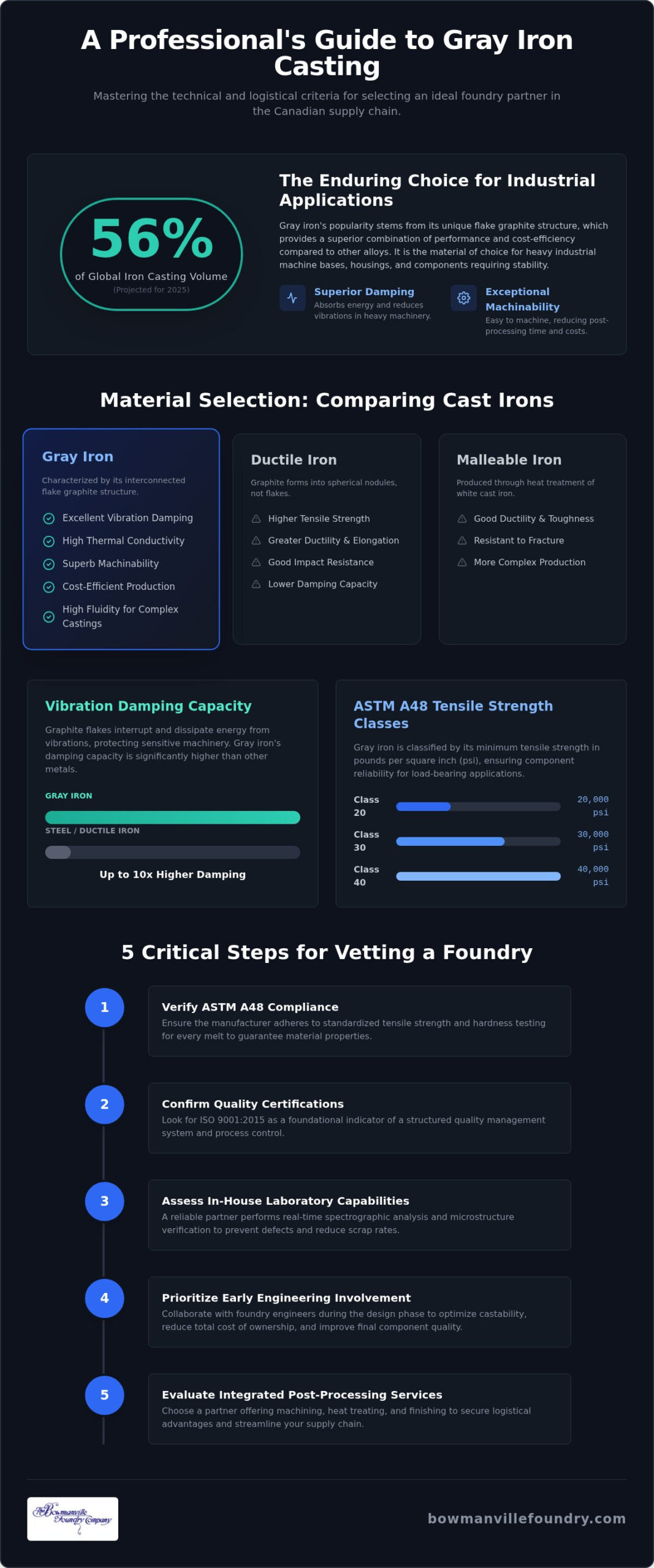
While specialized alloys often dominate modern engineering discussions, gray iron still accounts for 56% of the global iron casting volume in 2025. This enduring popularity is due to its superior vibration damping and machinability, yet many procurement professionals still struggle with inconsistent foundries and high scrap rates. Selecting the right gray iron casting manufacturers requires more than a simple comparison of quotes; it demands a rigorous evaluation of metallurgical precision and supply chain reliability.
You likely realize that a low initial price often masks the long-term expenses of poor quality control and extended lead times. This professional guide will help you master the technical and logistical criteria for selecting an ideal partner who adheres to ASTM A48 standards while providing the stability of a Canadian supply chain. We’ll examine the critical differences between iron grades and explain how integrated post-processing services can reduce your total cost of ownership. By following this framework, you can move from procurement uncertainty to technical certainty with a partner that values precision and the legacy of industrial labour.
Key Takeaways
- Understand how the unique flake graphite structure of gray iron provides the vibration damping and cost-efficiency required for heavy industrial machine bases.
- Learn to distinguish between gray, ductile, and malleable iron to ensure you select the specific material grade that matches your component’s mechanical needs.
- Identify the five critical vetting steps for evaluating gray iron casting manufacturers to reduce scrap rates and secure a reliable Canadian supply chain.
- Discover why early involvement with foundry engineers during the design phase is essential for optimizing castability and reducing the total cost of ownership.
- Recognize the logistical advantages of integrated post-processing services, such as machining and heat treating, provided by a legacy manufacturer.
Evaluating Gray Iron Casting Manufacturers: Quality Standards and Reliability
Gray iron is a versatile material defined by its unique microstructure, where carbon precipitates out as graphite flakes. This flake graphite structure provides superior damping capacity, allowing the material to absorb energy and reduce vibrations in heavy machinery. Industrial procurement professionals prioritize this material because it remains the most widely used cast iron globally, accounting for over half of all iron casting volume. Its popularity stems from its exceptional machinability and cost-efficiency compared to more complex alloys. The ability to maintain precise metallurgical consistency across every production run is the hallmark of top-tier gray iron casting manufacturers. Inconsistent cooling rates or chemical imbalances lead to varying hardness levels, which complicates machining and compromises the structural integrity of the final component.
The Importance of ASTM A48 Compliance
In North America, the ASTM A48 standard is the primary benchmark for classifying gray iron based on its tensile strength rather than chemical composition. This classification system uses “Classes” to indicate the minimum tensile strength in thousands of pounds per square inch (psi). Class 20 offers a minimum tensile strength of 20,000 psi, while Class 30 and Class 40 provide 30,000 and 40,000 psi respectively. Manufacturers verify these properties by pouring test bars from the same melt as the components and subjecting them to rigorous tensile and Brinell hardness testing. ASTM A48 compliance provides a standardized framework that ensures every component meets the specific safety requirements necessary for load-bearing industrial applications.
Foundry Certifications and Quality Control
When vetting a gray iron casting manufacturer, ISO 9001:2015 certification serves as a foundational indicator of a structured quality management system. However, a truly reliable partner maintains an in-house laboratory to perform real-time chemical analysis and microstructure verification. Spectrographic analysis allows foundry technicians to monitor silicon and carbon levels during the melt, ensuring the final pour matches the intended specification. These internal controls are vital for preventing common casting defects such as gas porosity, slag inclusions, or shrinkage. By catching these issues at the source, a manufacturer reduces the risk of high scrap rates and prevents production delays that could disrupt your entire supply chain. Selecting a partner isn’t just about finding a foundry; it’s about finding a technical mentor who understands the gravity of your engineering requirements and the value of skilled Canadian labour.
The Technical Superiority of Gray Iron: Properties and Performance
Gray iron earns its name from the fractured surface appearance caused by its internal flake graphite structure. These flakes aren’t just an aesthetic feature; they define the material’s mechanical behaviour and distinguish it from other ferrous metals. Unlike ductile iron, where graphite forms into nodules, the interconnected flakes in gray iron provide a direct path for heat to travel. This results in high thermal conductivity, which is essential for preventing heat-related failures in components like brake rotors, furnace parts, and heavy-duty industrial housings. Leading gray iron casting manufacturers also leverage the material’s excellent fluidity during the pouring process. Because gray iron remains liquid at lower temperatures than steel, it fills intricate moulds with high precision, allowing for complex geometries that would be difficult or cost-prohibitive to achieve with other materials.
Damping Capacity and Vibration Control
The physics of vibration damping in gray iron is a result of the graphite flakes acting as internal energy absorbers. When mechanical energy or noise enters the casting, the flakes interrupt the sound waves and dissipate the energy as heat. This makes gray iron the premier choice for machine tool bases, gearboxes, and engine blocks where stability is paramount. Compared to steel or even ductile iron, gray iron’s damping capacity is significantly higher, often by a factor of five to ten. This characteristic reduces harmonic resonance and protects sensitive internal components, which improves the overall safety and longevity of the industrial environment. It’s a pragmatic solution for engineers who need to manage noise and vibration without adding excessive mass.
Machinability and Wear Resistance
Machining costs represent a significant portion of the total cost of ownership for custom industrial components. Gray iron offers a distinct advantage here because the graphite flakes act as a natural lubricant, reducing friction and tool wear during the finishing process. This leads to faster cycle times and longer tool life, which directly impacts your bottom line. Additionally, the “casting skin” provides a hard, wear-resistant surface that excels in abrasive environments where components are subject to constant friction. By selecting a partner that understands these metallurgical nuances, you can organize your production schedule with greater confidence in the final product’s performance. For those looking to refine their selection process, reviewing a technical casting buyer’s guide can provide deeper insights into how material performance translates to long-term reliability.
Material Selection: Gray Iron vs. Ductile and Malleable Iron
In the Canadian industrial sector, procurement often revolves around what we call the “Ferrous Trio”: gray, ductile, and malleable iron. Each grade serves a distinct mechanical purpose, and understanding their differences is vital for any procurement professional. A common misconception among buyers is that higher tensile strength automatically equates to a “better” material. However, choosing a grade based solely on strength can lead to over-engineering and unnecessary expenses. Professional gray iron casting manufacturers often recommend this material for its unique ability to handle thermal fatigue and dampen vibrations, properties that ductile iron simply cannot match. To assist in this decision-making process, we have developed a resource on how to choose the ideal iron casting grade. The manufacturing process also varies significantly between these materials. Gray iron is poured directly, while ductile requires magnesium inoculation, and malleable iron demands a specialized heat-treatment cycle called annealing. These procedural differences directly impact both the final price and your production schedule.
When to Choose Gray Iron Over Ductile
While ductile iron is prized for its elongation and impact resistance, gray iron is the superior choice when dimensional stability and vibration control are the primary concerns. Engineers should prioritize gray iron for applications like machine tool beds or engine blocks where the component must maintain its shape under thermal stress. It’s also the more favourable choice for high-volume production of parts that don’t require the extreme ductility of its counterparts. Choosing gray iron can significantly lower your total cost of ownership due to reduced material costs and faster machining cycles. Before finalizing your specification, consider this checklist:
- Does the part require high vibration damping to protect sensitive electronics or gears?
- Is machinability a major factor in the total cost of the component?
- Will the component be subject to high thermal cycling or heat-related stress?
- Are the tensile strength requirements below the threshold of Class 40 iron?
Understanding Malleable Iron for Complex Hardware
Malleable iron occupies a specialized niche, particularly for thin-walled components that require high impact resistance and toughness. It starts as white iron and undergoes an extensive annealing process to transform brittle carbides into tempered carbon nodules. This makes it ideal for small, complex hardware like pipe fittings, hand tools, or electrical brackets. For a deeper look at this process, see the comprehensive guide to malleable iron casting in Canada. Working with gray iron casting manufacturers that can pour all three grades ensures you receive unbiased technical advice and greater design flexibility for your entire assembly. This integrated approach allows you to organize your supply chain more efficiently by sourcing multiple material grades from a single, dependable partner.
The Procurement Process: Vetting a Foundry for Long-Term Production
Vetting gray iron casting manufacturers requires looking beyond the price per kilogram. A professional procurement strategy involves five critical steps: assessing metallurgical expertise, verifying ASTM compliance, evaluating engineering support, reviewing post-processing capabilities, and analyzing supply chain logistics. Early involvement with foundry engineers is the most effective way to optimize your design for castability. When you collaborate during the initial design phase, engineers can suggest modifications to draft angles or wall thicknesses that prevent defects and reduce the total cost of ownership. This proactive approach ensures that your custom industrial components are designed for high-yield production from the very first pour.
Selecting a national Canadian partner offers significant logistical advantages. Shorter supply chains mean reduced lead times and lower transportation costs, which are critical when managing tight production schedules. A domestic partner also eliminates the complexities of international customs and fluctuating exchange rates, providing a more stable and predictable procurement environment. By focusing on a reliable Canadian supply chain, you minimize the risks associated with global shipping disruptions and ensure a steady flow of high-quality components for your facility.
Pattern Development and Engineering Support
The pattern is the most critical long-term investment in the casting lifecycle. It serves as the physical master from which all future components are created. While modern procurement often begins with a 3D CAD model, the transition to a physical pattern requires a deep understanding of metal shrinkage and solidification. For engineers looking to expand their prototyping expertise, VPrint3D Limited provides technical resources on advanced manufacturing and material properties. A foundry’s engineering department should be evaluated by their ability to provide detailed feedback on your digital models before a single kilogram of iron is poured. Their institutional knowledge allows them to identify potential problem areas, such as hot spots or uneven cooling, that a digital simulation might overlook.
Modern industrial projects increasingly require “ready-to-use” components. Sourcing from a manufacturer that offers integrated post-processing services, such as CNC machining and heat treating, simplifies quality accountability. If a part fails to meet tolerances, you deal with one vendor rather than mediating between a foundry and a separate machine shop. This integrated approach is detailed in our guide on Integrated Iron Casting and Machining in Canada. In-house finishing options like protective surface coatings and precision machining ensure that parts arrive at your facility ready for assembly. To see how these services can streamline your operations, you can view our full range of custom casting capabilities.
Custom Gray Iron Solutions: The Bowmanville Foundry Advantage
Bowmanville Foundry stands as a pillar of Canadian iron manufacturing, having refined our metallurgical processes since 1902. While many gray iron casting manufacturers specialize in a single material, we maintain the unique capability to produce gray, ductile, and malleable iron under one roof. This versatility allows us to offer unbiased technical recommendations. You don’t have to compromise on material properties because your supplier is limited to one type of pour. Instead, we help you select the specific iron grade that best suits your component’s mechanical requirements. Our commitment to industrial excellence is grounded in a century of physical craftsmanship and a methodical approach to supply chain efficiency. By integrating casting with in-house post-processing services, we provide a streamlined procurement path that reduces the complexity of managing multiple vendors and disparate quality standards.
A Legacy of Technical Mastery Since 1902
A legacy spanning over 120 years translates into a vast library of institutional knowledge. This experience is vital when troubleshooting complex geometries or high-stress applications that require absolute precision. We approach every industrial challenge with a pragmatic, no-nonsense perspective, focusing on stability and dependability. This institutional wisdom allows us to identify potential metallurgical risks before they impact your production timeline, ensuring that every pour meets our rigorous internal benchmarks. Procurement professionals value the reassurance that comes from working with an established Canadian institution that understands the gravity of engineering safety and the necessity of meeting ASTM standards. This long-standing expertise results in fewer defects, more reliable components, and a supply chain partner that remains steady regardless of global market fluctuations. It’s about providing a dependable foundation for your production schedule.
Your Partner for Custom Engineered Iron Components
Starting a project with a legacy foundry begins with a technical consultation and a formal Request for Quote (RFQ). We encourage early collaboration to ensure your designs are optimized for the casting process, which ultimately lowers your total cost of ownership. Before you submit your specifications, we recommend reviewing our Free Casting Buyer’s Guide. This resource acts as an essential first step, providing the technical data and selection criteria needed to make an informed decision. Our engineers are ready to review your 3D models and provide the guidance necessary to transform your digital concepts into high-performance industrial components. We invite you to reach out for a consultation to realize the benefits of a modern, efficient casting facility that prioritizes technical mastery above all else. Contact our team today to request a quote or to access our extensive library of technical documentation.
Securing Your Canadian Industrial Supply Chain
Securing a reliable supply of custom industrial components is a meticulous process that balances metallurgical precision with logistical stability. The technical superiority of gray iron in vibration damping and thermal conductivity makes it an essential material for heavy machinery. However, the success of your project depends on selecting a partner who understands the nuances of ASTM A48 compliance and the benefits of integrated post-processing. Integrated services like machining and heat treating don’t just save time; they reduce your total cost of ownership by ensuring accountability at every stage.
Choosing between various gray iron casting manufacturers is often the difference between a high scrap rate and a seamless production schedule. By prioritizing a partner with established Canadian roots and the ability to pour gray, ductile, and malleable iron, you gain the flexibility required for complex engineering challenges. Bowmanville Foundry has provided this level of dependable expertise since 1902, offering in-house finishing to deliver ready-to-use parts directly to your facility. Ready to optimize your procurement process with over 120 years of manufacturing mastery? Request a custom iron casting quote from Bowmanville Foundry today. We look forward to helping you realize your next project with the precision and integrity your designs deserve.
Frequently Asked Questions
What are the main differences between gray iron and ductile iron?
The primary difference lies in the graphite microstructure. Gray iron contains graphite in flake form, which provides superior thermal conductivity and damping. Ductile iron contains spherical nodules, which offer higher tensile strength and elongation. While ductile iron is often selected for its durability under impact, gray iron remains the preferred choice for components requiring dimensional stability and high vibration absorption in stationary industrial equipment.
How does gray iron’s damping capacity benefit heavy machinery?
Gray iron’s damping capacity allows it to absorb mechanical energy and dissipate it as heat. This property is essential for heavy machinery because it prevents harmonic resonance that could damage sensitive internal components or compromise precision. By reducing noise and vibration, gray iron protects the structural integrity of machine tool bases and engine blocks. This natural energy absorption is significantly higher than that of steel or ductile iron.
What ASTM standards apply to gray iron casting manufacturers?
Leading gray iron casting manufacturers adhere primarily to the ASTM A48 standard. This classification system organizes gray iron into classes based on minimum tensile strength, such as Class 20, 30, or 40. Unlike other standards that focus on chemical composition, ASTM A48 prioritizes the mechanical performance of the material. Manufacturers verify these properties through standardized tensile and hardness testing to ensure the components meet safety requirements for load-bearing applications.
Can gray iron castings be machined and heat-treated?
Gray iron is exceptionally well-suited for both machining and heat-treating operations. The internal graphite flakes act as a natural lubricant, which reduces tool wear and allows for faster machining cycles. Heat-treating processes, such as stress relieving or annealing, can be applied to improve machinability or modify the material’s hardness. Utilizing a manufacturer with integrated post-processing capabilities ensures these secondary operations are performed with metallurgical precision.
Why is gray iron preferred for complex industrial geometries?
Gray iron is preferred for complex geometries due to its superior fluidity during the pouring process. It remains liquid at lower temperatures compared to steel, allowing it to fill intricate mould cavities and thin-walled sections with high accuracy. This fluidity reduces the risk of casting defects like cold shuts or misruns. Engineers can design components with sophisticated internal passages and detailed surface features that would be difficult to achieve with less fluid alloys.
How can I reduce the lead time for my custom iron casting order?
Reducing lead times involves optimizing your procurement strategy through early engineering involvement and local sourcing. By collaborating with foundry engineers during the design phase, you can ensure the component is optimized for castability, which reduces the need for revisions. Choosing a national Canadian partner eliminates the delays associated with international shipping and customs. Consolidating casting and finishing with a single vendor also prevents the logistical bottlenecks of managing multiple suppliers.
What information is needed to provide an accurate gray iron casting quote?
To provide an accurate quote, manufacturers require detailed technical specifications and production requirements. This includes 3D CAD models or 2D drawings with clearly defined tolerances and surface finish standards. You must also specify the required ASTM material grade, the estimated annual production volume, and any secondary operations such as machining or heat treating. Providing a complete data package allows the foundry to calculate precise manufacturing costs and establish realistic production timelines.
Does Bowmanville Foundry provide post-processing for gray iron components?
Bowmanville Foundry provides comprehensive post-processing services as part of our integrated manufacturing approach. Our facility is equipped to handle secondary operations including precision machining, heat treating, and protective surface coatings. This model allows procurement professionals to source ready-to-use components from a single Canadian manufacturer. By managing both the pour and the finish under one roof, we maintain strict quality accountability and reduce the logistical burden on your supply chain.
