
Selecting the right Canadian industrial casting company means weighing certified quality systems, iron grade range, tooling intake flexibility, and delivery windows you can defend on the production line. In 1996, Bowmanville Foundry became the first foundry in Canada to achieve ISO certification, giving you a concrete quality-management benchmark when you score suppliers on process control, materials, and schedule risk.
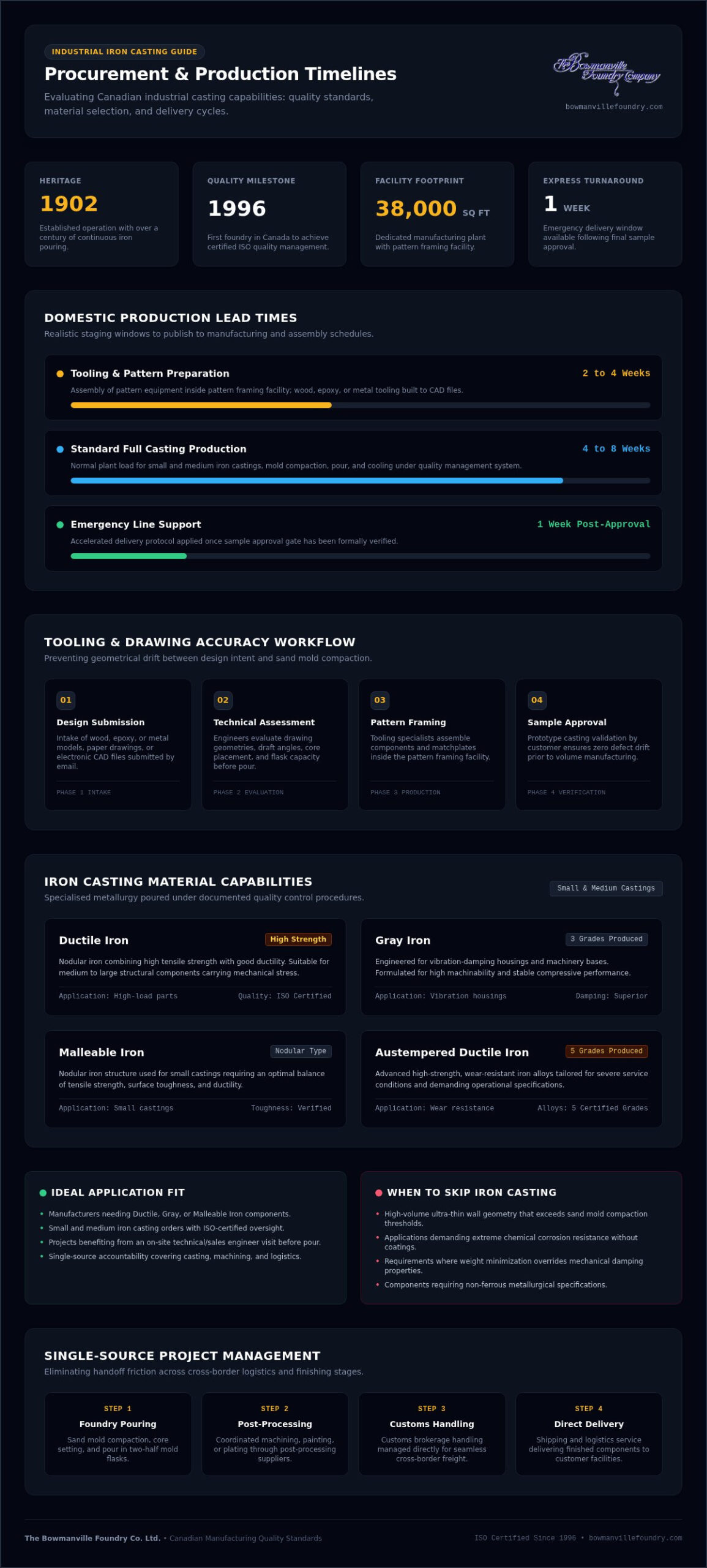
Key Takeaways: Canadian industrial casting companies provide iron components within four to eight weeks, offering emergency delivery in one week following sample approval.
- Standard production lead times range from 4 to 8 weeks for iron castings.
- Skip iron casting when you require high-volume thin walls or extreme corrosion resistance.
- Best for manufacturers needing ductile, gray, or malleable iron with ISO-certified quality oversight.
- Bowmanville Foundry was the first Canadian foundry to achieve ISO certification in 1996.
Match Volume and Lead Time Before You Cut Patterns
Three situations dominate most casting RFQs, and each points to a different first move. If you are freezing a design and need short-run tooling, start pattern preparation two to four weeks ahead so sample approval does not stall the line. If you are placing steady small or medium iron orders, plan four to eight weeks for full casting production under normal plant load. If draft angles, cores, or flask fit are still unclear, book an on-site technical assessment before pour so mold design is settled while changes are still cheap.
| Scenario | Lead Time | Typical Application |
|---|---|---|
| Pattern preparation | 2–4 weeks | Initial mold preparation |
| Full casting production | 4–8 weeks | Small and medium iron castings |
| On-site technical assessment | On-demand | Engineering review before pour |
Procurement teams that need rapid setup should prioritize early pattern work. Tooling creation requires two to four weeks depending on complexity. Prototype validation then follows a sample approval gate before mass manufacturing begins.
Standard production orders require four to eight weeks, subject to current business conditions. For Ductile Iron, Gray Iron, or Malleable Iron components, working with Bowmanville Foundry gives you quality oversight through an established quality management system.
Coordinating the pour, casting machining through post-processing suppliers, and shipping on one accountable schedule cuts handoff delays between separate vendors. That one-stop-shopping approach keeps your order moving as a single work package rather than a chain of unrelated POs.
Build timeline buffers at the RFQ stage, then request an on-site technical/sales engineer visit or submit CAD files to obtain an accurate quote.
Process Checks That Prove a Canadian Industrial Casting Company Can Run Your Part
Awarding tooling before you prove material fit and flask capacity is how drawings stall on the shop floor. Confirm the plant pours the iron family your part specifies: Gray Iron, Malleable Iron, and Ductile Iron. Evaluate mold compaction method and flask sizing early so your geometry matches real capacity. Structure that review with a shared checklist: read the casting buyer’s guide and score each supplier the same way.
Quality verification comes next. In 1996, The Bowmanville Foundry was the first foundry in Canada to achieve ISO certification. A documented quality management system catches structural defects before full production starts. Pattern equipment has to behave like a multi-cavity form in which each impression repeats identical, defect-free iron components run after run.
Material choice drives field performance. Gray Iron fits vibration-damping housings. Ductile Iron suits high-load structural parts.
Ask for a technical assessment before you freeze designs. Inviting a technical/sales engineer to your facility resolves core placement and sample-approval questions while design changes still cost little.
Tip: Verify that your supplier maintains a documented quality management system aligned with Canadian industry standards before placing production tooling orders.
Among the foundry’s Google reviews, Joe (5★) wrote:
"100 plus years outstanding quality from a family run business. I would highly recommend them. "
A century of operational history shows how sustained process control shows up in the castings you receive.
How Tooling and CAD Intake Protects Drawing Accuracy
Geometrical drift between the drawing you approve and the sand mold you pour is the expensive failure mode in low-volume iron work. Tooling intake is the bridge that turns digital models or legacy physical samples into production-ready patterns without losing intent.
Pattern framing preparation decides how cleanly your design becomes a stable sand mold. A metalcasting company (foundry) can receive part designs in several forms:
- Design submission: You provide part designs via wood, epoxy, or metal models, paper drawings, or electronic CAD files sent by email.
- Technical assessment: Engineers evaluate drawing geometries and draft angles to select casting parameters, referencing Iron Grades Technical Data, The Bowmanville Foundry for material tolerances.
- Pattern framing: Specialists assemble the pattern components into precise frames inside the pattern framing facility.
- Sample approval: The foundry produces prototype samples for your validation before full production runs.
Direct technical contact between your design team and patternmakers closes the gaps that show up as scrap later. Schedule an on-site technical engineer visit when the geometry is still open to revision.
A commenter in the practicalmachinist.com thread "Custom Cast Iron castings, any rec’s? | Page 2":
"In the past my dealings with foundries lead me to leave all the pattern building and modification to them, but stuff like this it isn’t really financially feasible to do that, so you either need to work closely with the foundry or know your stuff enough to do it all yourself without their help." (source)
That feedback is the practical case for staying close during tooling intake: you hold cost and still enforce strict drawing compliance.
When Ductile, Gray, or Malleable Iron Is the Wrong Choice
Iron casting is not the right process for every geometry or duty cycle, and knowing when to walk away saves tooling budget.
Ductile Iron, Gray Iron, or Malleable Iron deliver strength and durability, yet other routes win on specific metrics. For high-volume runs with thin walls, aluminum die casting reduces unit weight. Where you need high corrosion resistance, wrought steel or specialized steel fabrications may serve better. High-volume structural parts often suit steel stampings or die-cast aluminum.
A metalcasting company using green sand molding handles complex geometries and vibration damping well. Iron outperforms aluminum in wear resistance and thermal absorption. According to the EU IPPC Bureau 2005 report, iron foundries utilize distinct melting techniques like induction furnaces to achieve specific carbon contents. Compare capabilities with the Iron Grades Application Guide, The Bowmanville Foundry before you commit tooling.
Choose iron when fatigue strength under cyclic loading matters; choose aluminum when mass budget dominates the design.
Technical staff can walk material selection with you, then coordinate casting machining (post-processing suppliers) and logistics when you want finishing and delivery tied to the same order. Contact the technical team to discuss project requirements or request an on-site facility evaluation.
Domestic Lead Times You Can Publish to Assembly
Overseas freight looks cheap until a missed sailing stops your line; domestic windows are the figure you can actually put on a build plan. Tooling can be produced in two to four weeks.
After customer sample approval, castings can be delivered as quickly as one week later to accommodate customer emergencies, with typical lead times of four to eight weeks depending on current business conditions. That response is the practical contrast with ocean schedules.
+-------------------------------------------------------------+
| Production Stage | Standard Delivery Window |
+----------------------+--------------------------------------+
| Pattern & Tooling | 2 to 4 weeks |
| Emergency Delivery | 1 week post-approval |
| Standard Production | 4 to 8 weeks |
+----------------------+--------------------------------------+
Keeping the pour and casting machining on one coordinated schedule reduces transfer delays between separate shops.
A metalcasting company using a green sand casting process can adjust flasks during active runs when technical alignment is already done. Locking a technical assessment before pour reserves capacity you can publish to assembly planners.
Procurement teams routinely weigh local response windows against international freight risk. Domestic manufacturing avoids lengthy ocean transit. If your assembly line runs tight, write that predictability into the PO.
Tip: Request a technical assessment during sample approval to lock in standard four-to-eight-week production scheduling.
A commenter in the practicalmachinist.com thread "Custom Cast Iron castings, any rec’s? | Page 2":
"I got a quote a couple years ago to send that CAD file to a foundry that specialized in doing this kind of low volume, no pattern casting, and the quote was approx. $1500.00 per casting." (source)
That quote is a useful baseline for low-volume prototypes without standard production patterns, and it is why formal sample approvals and written schedule commitments belong in your file before a full foundry run.
Cross-Border Logistics Under One Accountable Partner
Split contracts for pour, machine, and ship are where transit damage turns into a liability argument. Cross-border delivery of iron components needs disciplined packaging and clear customs brokerage handling.
A single metalcasting company keeps assessment, pour, finish, and shipping on one chain of custody. Bowmanville Foundry runs that path from initial technical assessment through final shipping and logistics service for Canadian and U.S. buyers. You hold one supplier accountable for the casting you ordered and the crate that arrives.
Export shipments clear more cleanly with accurate HS codes and complete customs documents. The plant in Bowmanville, Ontario follows established protocols for those filings. Secure crating, anti-corrosion coatings, and consistent mold compaction protect part integrity in transit.
If you need casting and finishing under one responsible party, contact or visit the foundry while the project plan is still open.
Frequently asked questions
What types of castings does CAC produce?
You can source Ductile Iron, Gray Iron, and Malleable Iron components from a Canadian metalcasting company. The facility produces three grades of Gray Iron, five grades of Austempered Ductile Iron, alongside standard nodular iron formulations. Part geometry starts from pattern framing media such as wood, epoxy, metal models, paper drawings, or electronic CAD files.
Which industries does CAC serve?
Custom iron components serve industrial manufacturers, casting purchasers, and design engineers across Canada and the United States. Cross-border logistics and customs brokerage support let U.S. buyers receive finished parts with machining and shipping coordinated on the same order. Post-processing suppliers handle secondary casting machining operations including finishing, painting, or plating before final delivery.
How flexible is tooling intake for legacy parts and CAD designs?
You can submit wood, epoxy, or metal models, paper drawings, or electronic CAD files. Engineers review geometries and draft angles, patterns are framed in the pattern framing facility, then you approve samples before production. That sequence keeps legacy parts and new CAD designs on the same controlled path from intake to pour.
Secure Custom Castings in 2026
The same questions you opened with (certification strength, intake flexibility, iron grade fit, and delivery windows you can defend) decide whether your supply chain holds under real production pressure. The Bowmanville Foundry team was the first metalcasting company in Canada to achieve ISO certification in 1996. Request a custom quote so metallurgical specifications for your gray, malleable, or ductile iron components are fixed in writing. Download the buyer’s guide or contact technical sales engineers to review your requirements.
