
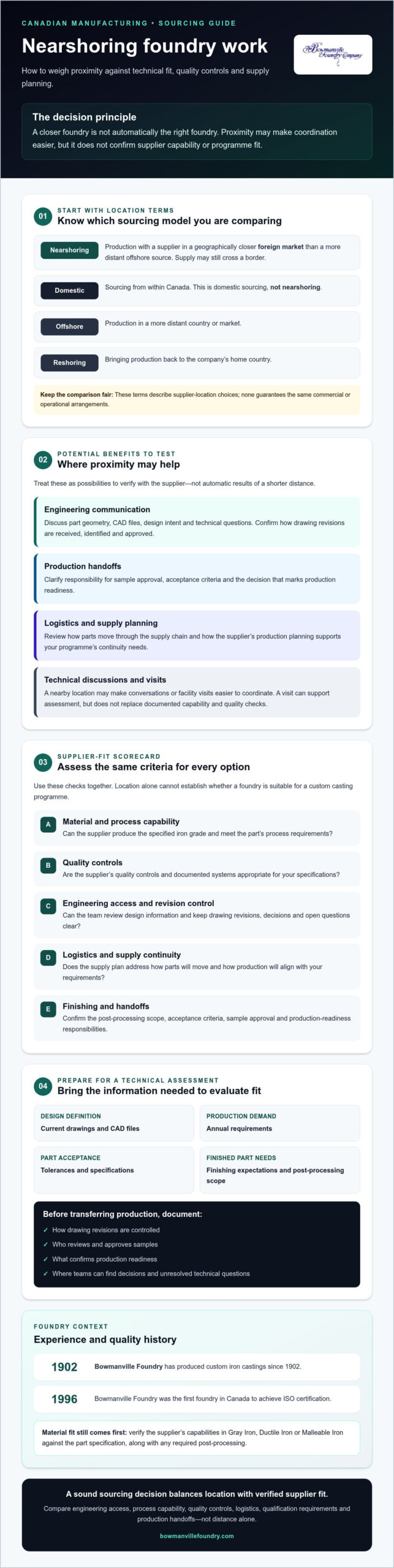
A closer foundry isn’t automatically the right foundry. The benefits of nearshoring foundry work depend on whether proximity makes communication and production handoffs easier while the supplier still meets your material, process, and quality requirements.
That’s the key consideration for Canadian manufacturers comparing domestic and overseas sourcing. Shorter distances may make engineering discussions and logistics easier to coordinate, but they don’t confirm that a supplier can produce the required iron grade, meet part specifications, or support supply continuity. Assess technical fit alongside location.
This guide explains how nearshoring can affect communication, engineering coordination, logistics, and supply planning. It also outlines what to verify before choosing a Canadian foundry, including capabilities in Gray Iron, Ductile Iron, and Malleable Iron, post-processing, quality systems, and production handoffs. Bowmanville Foundry has produced custom iron castings since 1902 and was the first foundry in Canada to achieve ISO certification, in 1996. Use the steps ahead to prepare for a technical assessment and decide whether a supplier aligns with your sourcing requirements.
Key Takeaways
- Assess the benefits of nearshoring foundry work against your part requirements. Proximity alone doesn’t establish supplier fit.
- Compare nearshore and offshore options using the same criteria, including engineering access, process capability, quality controls, logistics, and qualification requirements.
- Prepare current drawings, CAD files, annual requirements, tolerances, and finishing expectations so a supplier can make a more useful technical assessment.
- Clarify how revisions, sample approval, and production readiness will be managed before transferring work to a new foundry.
- Check that the foundry’s iron grades and post-processing capabilities match the part specifications and service scope you need.
What Nearshoring Foundry Work Means for Canadian Manufacturers
Nearshoring in industrial foundry sourcing means placing production with a supplier in a geographically closer country or market than a more distant offshore source. For a Canadian manufacturer, that could mean sourcing from a nearby country. Choosing a supplier within Canada is domestic sourcing, not nearshoring. This distinction matters when comparing supplier locations and the coordination involved in a custom iron casting programme.
Procurement teams may consider proximity because it can make technical discussions, production handoffs, and visits easier to coordinate. These are potential advantages to assess, not automatic results. Distance alone doesn’t establish a foundry’s quality controls, capacity, lead time, or suitability for a specific programme. The benefits of nearshoring foundry work depend on the fit between location, supplier capability, and your operating requirements.
Nearshoring, reshoring, and offshore sourcing compared
In manufacturing, nearshoring means assigning production to a closer foreign market, while offshore sourcing generally refers to production in a more distant country. Reshoring means bringing production back to the company’s home country. These terms describe different supplier-location choices; they don’t guarantee the same commercial or operational arrangements.
Nearshoring can involve cross-border supply. Assess the practical arrangements for the specific supplier relationship rather than assuming a nearby international source works like a domestic one. For a broad terminology reference, see Offshoring and nearshoring. The suitable model depends on part requirements, supplier capability, and priorities such as coordination and continuity.
Why foundry sourcing decisions need a technical lens
Assess custom castings as engineered components, not just line items moved between locations. Geometry affects how a part can be produced, while the selected iron grade, casting process, and finishing requirements also shape supplier fit. A nearby foundry may be convenient to contact, but that convenience has limited value if its verified capabilities don’t match the part specification.
Include engineering in the sourcing review alongside procurement and logistics. Engineering can clarify design intent and technical requirements, procurement can evaluate the supplier relationship, and logistics can consider how parts will move through the supply chain. Reviewing these perspectives together helps your team identify questions to resolve before committing to a production change.
How Nearshoring Can Improve Foundry Coordination and Supply Planning
Supplier proximity can support coordination, but it doesn’t guarantee performance. The potential benefits of nearshoring foundry work depend on how well the supplier’s communication practices, technical capabilities, and production planning match your programme. Test those factors directly instead of treating location as a substitute for qualification.
Engineering communication across the casting programme
Start with a technical assessment. Reviewing part geometry and CAD files with the foundry can bring design, tooling, molding, and finishing questions into the discussion before production readiness is assumed. For example, confirm how revised drawings will be received and identified, and specify which revision governs the work.
Agree on acceptance criteria and document who reviews and approves each sample. Clear approval responsibilities help prevent uncertainty about whether a part is ready to move forward. Keep decisions, revision status, and open technical questions in records that procurement, engineering, and production teams can all consult.
Proximity may make a supplier conversation or facility visit more practical, depending on travel, schedules, and programme needs. A visit can help when a discussion benefits from reviewing production processes in person, but it should support, not replace, an assessment of documented capabilities and quality controls. Innovation, Science and Economic Development Canada describes the manufacturing sector as a cornerstone of the modern Canadian economy, making effective coordination across manufacturing relationships an important consideration.
Production planning and supply continuity
Coordination also depends on plans that can be checked and maintained. Ask the supplier to explain available capacity for the part, the proposed production sequence, lead-time assumptions, and how changes will be communicated. Confirm how the foundry will share updates if a drawing revision, production issue, or schedule adjustment affects the plan. Nearshoring doesn’t necessarily shorten lead times or prevent disruption; outcomes depend on the specific production and logistics conditions.
A closer supplier or second source may form part of a contingency plan, but only after it has been qualified for the part. Before relying on it for continuity, confirm that the source can meet the same material, dimensional, finishing, and acceptance requirements.
For a custom iron casting programme, bring current drawings, revision history, and production requirements to a supplier discussion. To discuss a casting technical assessment with Bowmanville Foundry, prepare the part information and questions about production readiness.
Nearshore or Offshore Foundry Work: How to Compare the Options
Nearshore and offshore sourcing are options to assess, not rankings of supplier quality. Proximity may affect communication and delivery handoffs, but it can’t confirm that a foundry can produce your part or meet its requirements. To evaluate the potential benefits of nearshoring foundry work, compare suppliers against the same technical and operational criteria, then verify their answers.
A buyer’s framework for comparing foundry suppliers
Use a consistent set of questions for every candidate. Compare experience with the required iron type, casting size, and application. Ask for information about the supplier’s quality management system, inspection expectations, and production documentation. Confirm which post-processing operations are available and whether any would be handled by post-processing suppliers.
| Comparison area | Questions to verify |
|---|---|
| Engineering access | How will technical questions, drawing revisions, and design clarifications be reviewed? |
| Process capability | Can the foundry support the required iron type, casting size, geometry, and finishing expectations? |
| Quality controls | What quality management system information, inspection steps, and records can the supplier provide? |
| Logistics | Who coordinates shipping, customs brokerage where applicable, documentation, and delivery handoffs? |
| Qualification | What sample approval, production validation, and change-control steps apply before release? |
Use the answers to identify gaps, not just to score location. A nearby supplier may make discussions easier to arrange, while a more distant supplier may meet the technical and operational requirements. The useful comparison is how each option performs against your part specification and programme priorities.
Cross-border logistics and qualification questions
For a cross-border source, confirm responsibilities with the supplier and the parties handling the shipment. Ask who arranges transportation, what customs brokerage support is included in the supplier’s scope, who prepares or provides required documentation, and where responsibility for the delivery handoff changes. Confirm each point for the specific arrangement rather than making assumptions based on location.
Before committing to a source, document how samples will be reviewed and approved, what production validation is required, and how drawing or process changes will be controlled. Have the responsible parties confirm border, documentation, and delivery assumptions. This makes the comparison more useful than relying on a nearshore-versus-offshore label.
How to Assess a Nearshore Foundry Before Moving Production
Base a sourcing decision on a documented qualification process, not location alone. The benefits of nearshoring foundry work matter only if the supplier can meet the part’s technical, quality, and production requirements. Prepare the information below, then use it to guide discussions with the foundry.
Prepare a clear casting inquiry
Begin with a complete, current definition of the part. Include the information a supplier needs to assess material, geometry, production requirements, and finished condition.
- Define the application and requirements. Provide current drawings and CAD files, the required iron type or material specification, dimensional tolerances, and relevant application conditions.
- Describe production expectations. State annual requirements and known schedule needs. Ask the foundry to assess capacity and lead-time assumptions rather than presuming it can meet them.
- Identify finishing needs. Specify whether machining, heat treating, or surface coating is required after casting, and clarify which operations must be included in the supplier’s scope.
- Set approval expectations. Identify required inspection information, acceptance criteria, and the people responsible for reviewing and approving samples.
If material selection is still open, consult How to Choose the Ideal Iron Casting Grade as a separate resource, then confirm the proposed selection against the part’s application requirements with engineering input.
Review technical fit and production readiness
Next, request a technical assessment of the part. Ask how the foundry will evaluate design feasibility, tooling, cores, and mold requirements. The discussion should identify questions or constraints to resolve before production, rather than treating a drawing alone as confirmation of manufacturing readiness.
Confirm the supplier’s relevant production capabilities for the required iron type, casting geometry, and finishing scope. Request information about its applicable quality management processes, inspection approach, and the documentation available for the part. Verify any certification claims and their applicable scope directly. Don’t infer certification from a supplier’s location or general quality statements.
Before production transfer, agree on sample approval, inspection records, and how drawing or process changes will be reviewed and controlled. Ask the foundry to state any capability gaps or unresolved assumptions in writing. This gives procurement, engineering, and production teams a shared basis for deciding whether to proceed.
For support assessing an iron casting requirement, contact Bowmanville Foundry about a technical assessment.
When a Canadian Iron Foundry Makes Sense for Nearshoring
A Canadian supplier may suit a sourcing programme when its iron casting capabilities, technical communication, and available services align with the part requirements. For buyers across Canada, working with a foundry in the national market can provide a direct supplier relationship without treating location as proof of technical fit. The benefits of nearshoring foundry work still depend on confirming material, production, quality, and service requirements with the supplier.
Bowmanville Foundry serves customers across Canada and provides additional support for United States customers. For cross-border supply, confirm shipping and customs brokerage responsibilities with the parties involved. Don’t assume these arrangements are included in a supplier’s service scope without checking.
Bowmanville Foundry capabilities buyers can assess
Bowmanville Foundry has produced custom iron castings since 1902. Its casting capabilities include Gray Iron, Ductile Iron, and Malleable Iron. The foundry produces three grades of Gray Iron and five grades of Austempered Ductile Iron. Compare the applicable grade and casting capability with your drawings, specifications, and service conditions rather than inferring suitability from a material name alone.
Post-processing services are also available. Confirm which operations the part requires and whether they fall within the foundry’s current scope. Bowmanville Foundry operates a 38,000-square-foot plant and was the first foundry in Canada to achieve ISO certification, in 1996. These details provide context for a supplier discussion. Verify current certification information and its applicable scope as part of your quality review.
Next steps for a technical sourcing discussion
For an initial review, prepare part drawings or CAD files, material requirements, dimensional tolerances, finishing expectations, and anticipated production needs. A technical assessment can help determine whether the part design and requested scope warrant further discussion. Buyers can ask about technical or sales engineer support and whether an on-site visit may help clarify the application.
Don’t assume a fit before technical requirements and service responsibilities have been reviewed. Discuss the part, expected production, and any outstanding questions directly with the foundry. Contact Bowmanville Foundry to discuss your iron casting requirements.
Make Your Next Foundry Sourcing Decision with Confidence
The benefits of nearshoring foundry work depend on more than supplier location. Compare engineering communication, production capability, quality controls, logistics responsibilities, and qualification requirements against your part specifications. A technical assessment and clear sample approval process can help your team identify supplier fit and outstanding questions before transferring production.
Bowmanville Foundry has produced custom iron castings since 1902, including Gray Iron, Ductile Iron, and Malleable Iron castings. It was the first foundry in Canada to achieve ISO certification, in 1996. These facts provide context for an evaluation, but your drawings, material requirements, tolerances, and finishing needs should guide the technical discussion.
Share your casting requirements with the foundry to discuss whether its capabilities align with your programme. You can also ask about technical or sales engineer support and whether a facility visit may be appropriate. Discuss your casting requirements with Bowmanville Foundry and take the next step with clear information and a practical qualification process.
Frequently Asked Questions
What are the main benefits of nearshoring foundry work?
The main benefits of nearshoring foundry work may include more practical communication, easier coordination of engineering discussions, and closer oversight of production handoffs. A nearby supplier may also make conversations or facility visits easier to arrange, depending on travel and schedules. These are potential advantages, not guaranteed outcomes. Verify the foundry’s iron grades, production capability, quality processes, finishing scope, logistics responsibilities, and ability to meet the part’s requirements.
Does nearshoring foundry work guarantee shorter lead times?
No. Nearshoring doesn’t guarantee shorter lead times. Production timing depends on factors such as the foundry’s capacity, tooling and production sequence, part requirements, and current business conditions. Request a lead-time estimate for the specific casting and clarify what it includes, such as tooling, sample approval, and production readiness. Confirm how schedule updates will be communicated, and assess the supplier’s assumptions instead of using distance to estimate timing.
Is a Canadian foundry considered nearshore for United States buyers?
Generally, a Canadian foundry may be considered a nearshore supplier for a United States buyer because it is in a geographically closer foreign market than a distant offshore source. The label depends on the buyer’s location and sourcing context. It doesn’t mean the relationship is the same as domestic sourcing. Separately confirm technical fit, cross-border shipping responsibilities, customs brokerage scope, documentation, and delivery handoffs with the parties involved.
How do I compare nearshore and offshore foundry suppliers?
Compare suppliers using the same criteria, not location alone. Review engineering access, experience with the required iron type and casting geometry, quality management processes, inspection documentation, finishing scope, logistics responsibilities, and qualification steps. Ask how sample approval and drawing changes are managed. For cross-border supply, confirm who handles shipping coordination, customs brokerage where applicable, documentation, and delivery handoffs. Choose based on verified fit with your part and operational requirements, not a general assumption about either sourcing model.
Can nearshoring reduce supply-chain risk for iron castings?
It may help address some supply-chain concerns, but nearshoring can’t eliminate risk or guarantee continuity. A closer source could offer another qualified supply option or make coordination more practical. Its value depends on the foundry’s capability, available capacity, communication practices, and logistics arrangements. Treat a second or nearshore source as a contingency only after it has been qualified for the specific casting, material, tolerances, finishing expectations, and acceptance criteria.
What information should I provide when requesting a foundry assessment?
Provide current part drawings and CAD files, the required iron type or material specification, dimensional tolerances, and relevant application conditions. Include expected annual requirements and schedule expectations, but ask the foundry to confirm capacity and timing rather than assuming availability. Describe required finishing, such as machining or coating, and identify inspection and sample approval expectations. Clear, current information helps the foundry assess design feasibility and identify questions before production planning advances.
What does a technical assessment from a foundry cover?
A technical assessment reviews whether a part design and its requirements appear feasible for the foundry’s capabilities. Discussion may cover geometry, material requirements, tooling, cores, mold requirements, tolerances, and finishing scope. Buyers can also clarify inspection documentation, sample approval responsibilities, and how drawing revisions will be controlled. The assessment should identify capability gaps and unresolved assumptions for discussion. It isn’t, by itself, confirmation of production capacity or a guarantee that the part will meet every requirement.
