
A harder iron isn’t automatically the best choice for a wear-critical casting. The best iron for high wear resistance depends on what causes material loss in service: abrasion from particles, repeated impact, sliding contact or a combination of these conditions. A hardness comparison alone may not predict how a casting will perform when strength, geometry and production requirements also matter.
Material properties don’t always map neatly to the demands of a working component. This guide explains how to identify the dominant wear mechanism and assess operating conditions before comparing Gray Iron, Ductile Iron, Malleable Iron and Austempered Ductile Iron. You’ll learn which properties to consider, why there’s no universal ranking for wear resistance, and what design and service details to prepare for a foundry discussion. The goal is to support a material decision based on the component’s actual duties, not a single hardness value.
Key Takeaways
- Identify whether abrasion, adhesion or impact drives material loss before shortlisting an iron family.
- The best iron for high wear resistance depends on service conditions, microstructure and design requirements, not hardness alone.
- Compare Gray Iron, Ductile Iron, Malleable Iron and ADI against the component’s wear duty, then verify grade properties with the foundry.
- Document contact type, load, movement, contaminants, lubrication and operating temperature to support a useful material assessment.
- Review casting design, production requirements and finishing needs together. Bowmanville Foundry has produced iron castings since 1902 and achieved ISO certification in 1996.
Best iron for high wear resistance: start with the wear mechanism
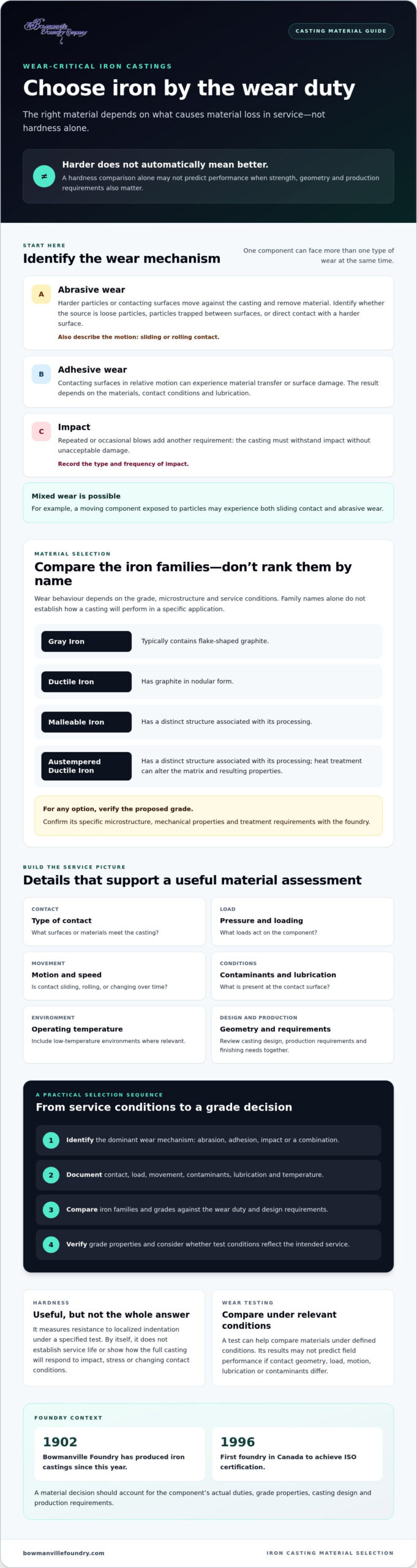
The best iron for high wear resistance is the material that resists material loss under a component’s specific service conditions. Wear resistance describes performance in a particular contact environment, not a universal property that can be ranked by hardness alone. Abrasion, adhesion and impact cause different kinds of damage, so first identify how the component contacts other surfaces or materials.
These mechanisms can occur separately or together. A moving component exposed to particles, for example, may experience both sliding contact and abrasive wear. The type of iron and its microstructure matter, as do the operating details. The Cast iron overview provides background on iron types and their general properties. Grade-specific performance still needs to be assessed against the component’s service requirements.
How abrasive and adhesive wear affect iron castings
Abrasive wear occurs when harder particles or contacting surfaces move against a casting and remove material. Establish whether the wear comes from loose particles, particles trapped between surfaces or direct contact with a harder surface. Where relevant, distinguish sliding from rolling contact, since the motion changes the conditions the casting must withstand.
Adhesive wear involves material transfer or surface damage between contacting surfaces in relative motion. The risk and resulting damage depend on the materials, contact conditions and lubrication. Don’t assume one iron family will perform best in every case. Describe the contacting materials and their motion when discussing options with a foundry.
Why impact, lubrication and environment matter
Impact adds another requirement: the surface and casting must withstand repeated or occasional blows without unacceptable damage. Record contact pressure, speed, lubrication and contamination, along with the type and frequency of impact. These details help distinguish a component dominated by sliding abrasion from one exposed to intermittent shock or mixed wear.
Include low-temperature environments in the service description, because temperature can affect material behaviour. Don’t infer a suitable grade from temperature alone. Confirm the relevant properties and requirements for the application. A wear test can help compare materials under defined conditions, but may not predict field performance if the test differs from the component’s contact geometry, load, motion, lubrication or contaminants. Note those differences when reviewing test data.
Hardness, strength and toughness describe related but distinct characteristics. Hardness concerns resistance to local indentation or scratching. Strength concerns the ability to withstand stress, while toughness relates to absorbing energy before fracture. A hardness value by itself doesn’t establish service life or show whether the casting can tolerate impact and loading. Select material by considering the combination of properties required by the identified wear mechanism.
How iron microstructure and properties influence wear resistance
Iron’s wear behaviour depends on more than its nominal family or a single mechanical property. The matrix surrounding the graphite, the graphite’s form and distribution, and any heat treatment affect how a casting responds to contact and loading. Consider these factors alongside the wear mechanism and operating conditions. The best iron for high wear resistance for one component may not suit another with different contact, impact or strength requirements.
Matrix structure and graphite morphology vary among iron families and grades. Gray Iron typically contains flake-shaped graphite, while Ductile Iron has graphite in nodular form. Malleable Iron and Austempered Ductile Iron have distinct structures associated with their processing. Heat treatment can alter the matrix and resulting properties. Confirm the proposed grade’s specific microstructure, mechanical properties and treatment requirements with the foundry rather than assuming a family name guarantees a particular wear result.
Microstructure, test conditions and application-specific wear performance are linked: a material comparison is meaningful only when the tested grade and condition, contact type, loading and test method reasonably reflect the component’s intended service.
What hardness can, and cannot, tell you
Hardness is a useful measured property, but it isn’t a complete predictor of wear life. It indicates resistance to localized indentation under a specified test, not how the entire casting will respond to repeated impact, stress or changing contact conditions. A harder reading alone doesn’t establish that the component will last longer in service.
When reviewing a hardness value, ask for the test method, material condition and location tested. A reading from a test coupon or one area may not represent every section of a casting. Don’t compare values without confirming that the grades and test conditions are comparable. Verify any target range against the selected grade’s technical documentation.
How iron families differ in engineering trade-offs
Gray Iron, Ductile Iron, Malleable Iron and Austempered Ductile Iron are candidates, not a universal ranking. Their suitability depends on the part’s geometry, required strength and toughness, casting requirements and service conditions. Verify graphite form and matrix characteristics for the specific grade, and look for relevant technical documentation to support any wear-performance claim.
For more material background, consult dedicated resources on Gray Iron and Ductile Iron, then compare their requirements with the component’s actual duty. If the grade choice is uncertain, share the application and design requirements with a foundry engineer for a technical assessment.
Gray Iron, Ductile Iron, Malleable Iron or ADI: compare for the wear duty
No iron family is the universal choice for wear resistance. Compare candidates against the identified wear mechanism, component geometry, loading, impact exposure and required mechanical properties. Then confirm the proposed grade’s specifications and test results with the foundry. Bowmanville Foundry produces three grades of Gray Iron and five grades of Austempered Ductile Iron, providing options to assess against defined casting requirements.
| Iron family | Potential consideration | Information requiring grade verification |
|---|---|---|
| Gray Iron | Assess as a candidate in light of the component’s contact conditions, geometry and strength requirements. | Grade designation, hardness, tensile properties, microstructure and relevant wear-test results. |
| Ductile Iron | Consider where the design calls for a combination of high tensile strength and ductility. | Grade-specific strength, elongation, hardness, matrix structure and performance under the expected wear mechanism. |
| Malleable Iron | Consider for small castings where good tensile strength and ductility are required. | Applicable grade, mechanical properties, casting geometry and evidence relevant to the component’s contact conditions. |
| Austempered Ductile Iron (ADI) | Include in a technical assessment where its specified properties may suit the component’s combined wear and loading requirements. | ADI grade, heat-treated condition, mechanical properties and wear-test conditions relevant to the application. |
When to assess Gray Iron and Ductile Iron
Gray Iron and Ductile Iron are distinct candidates, not interchangeable selections. Don’t infer wear performance from tensile strength or graphite form alone. The exact grade, matrix and contact conditions matter. For further background, consult Bowmanville Foundry’s Gray Iron applications and Ductile Iron material resources, then confirm that the properties discussed match the casting’s requirements.
When to assess Malleable Iron and Austempered Ductile Iron
Malleable Iron may suit small castings that require good tensile strength and ductility. ADI is another option for technical assessment, not an automatic solution to abrasion or other wear. Verify claims about hardness, strength, abrasion resistance and heat treatment against grade-specific documentation, and compare test conditions with the component’s intended service.
Use this comparison to frame a grade discussion, not to select by family name alone. The best iron for high wear resistance depends on the match between the specified grade, casting design and actual operating duty. A useful review considers wear requirements alongside strength and geometry, then checks whether test evidence supports the proposed choice.
How to specify an iron casting for high wear resistance
A useful casting specification connects service conditions to material, design and acceptance requirements. Use this checklist to prepare for a foundry’s technical assessment. Separate measured operating facts from assumptions that still need confirmation.
Record service conditions and component requirements
- Describe the wear duty. Identify the suspected wear mode, the contacting surfaces or particles, and whether contact is sliding, rolling or intermittent. Include the duty cycle and available failure history, such as where damage appears and how the component has been operating.
- Document operating conditions. Record loads, contact pressure if known, movement and speed, impact, contaminants, lubrication and operating temperature. Note low-temperature environments or changes in conditions during operation. Mark estimates clearly rather than presenting them as confirmed data.
- Define the part geometry. Provide dimensions, section details, casting geometry, critical tolerances and any core requirements. Include current CAD files or drawings, and identify contact surfaces or areas that need particular attention.
- List finishing and inspection needs. Specify required machining and the features or properties that need inspection. State how the casting will be checked and which requirements are critical to fit, function or service.
Procurement checklist: Prepare the wear mode, contact surfaces, load, movement, duty cycle, contaminants, lubrication, operating temperature, failure history, part geometry, CAD files, core needs, tolerances, machining, inspection criteria and any assumptions requiring validation.
Validate the grade before production
Use the service record and design package to assess material and casting feasibility together. Ask the foundry to review the proposed iron grade against the component’s geometry and operating demands, including any required post-processing. Confirm the applicable grade designation, material properties, test methods and acceptance criteria before production begins. Don’t rely on a property value unless its test method and relevance to the part are understood.
Agree on how the casting will be evaluated before approving production. Sample approval is the process where the customer validates a prototype casting before full production begins. Define which dimensions, features, material requirements and finishing conditions need review, and record any changes required after evaluation. This gives engineering, procurement and the foundry a shared basis for moving forward.
A clear specification helps the foundry assess the best iron for high wear resistance for the actual component, rather than selecting from a general material label. To discuss your service conditions and prepare a technical assessment, contact a foundry engineer.
Work with a foundry to select and produce a wear-resistant iron casting
Material selection is only part of the decision. The casting’s design, pattern, mold and production requirements also affect whether the finished part meets its dimensional and service needs. During design review, the foundry can assess the proposed grade alongside part geometry, sections, cores and finishing requirements. Pattern preparation defines the mold cavity. Mold compaction forms the sand around the pattern, and the prepared mold receives the molten iron during pouring. Each stage should follow the approved design and specification.
Bowmanville Foundry has produced custom iron castings since 1902 and achieved ISO certification in 1996, becoming the first foundry in Canada to do so. Its production range includes Gray Iron, Ductile Iron, Malleable Iron and Austempered Ductile Iron. The foundry produces three grades of Gray Iron and five grades of Austempered Ductile Iron. This provides useful context, but the appropriate grade still depends on the component requirements and must be confirmed for the application.
What to discuss during a technical assessment
Bring the service conditions, drawings or CAD files, annual requirements and any available evidence of past failures. Describe where wear occurs, the component’s loading and motion, and what the part must do in service. Ask how candidate grades, relevant testing and sample approval will be evaluated. Include machining or other post-processing requirements in the casting specification so they can be considered with the design. Discuss heat treating or surface coating only if the application requires it.
What a casting supplier should clarify
Confirm which relevant iron grades the supplier produces, how its quality management system applies to the work, and what inspection approach will be used. Ask how pattern, mold and core requirements will be reviewed against the geometry and critical features. Agree on the grade designation, material requirements, test methods and acceptance criteria before production proceeds. If finishing is required, clarify how post-processing will be coordinated with the approved casting.
For further preparation, consult the foundry’s information on post-processing and custom iron casting production, and confirm any guidance against your part specification. These discussions help align design intent, production steps and acceptance requirements without assuming that a general material description guarantees a particular wear result.
The best iron for high wear resistance is the grade that suits the component’s documented duty and design. Bowmanville Foundry can arrange a technical assessment with a technical or sales engineer. Contact the foundry to discuss your requirements and determine what information will support the review.
Make your next casting decision with a clear specification
The right material choice starts with the component’s actual wear duty. Identify whether abrasion, adhesion or impact is dominant, then assess grade-specific properties alongside geometry, loading and production requirements. Hardness alone can’t predict service life, and no iron family is the universal answer. A useful specification records operating conditions, defines inspection and acceptance needs, and gives the foundry a sound basis for assessing the casting.
Bowmanville Foundry has produced iron castings since 1902 and was the first foundry in Canada to achieve ISO certification, in 1996. Its casting range includes Gray Iron, Ductile Iron, Malleable Iron and Austempered Ductile Iron. These options can be reviewed against your component’s documented requirements to help determine the best iron for high wear resistance in its intended service.
Bring your drawings, service information and questions to a technical discussion. Discuss your iron casting requirements with Bowmanville Foundry and take the next step towards a well-defined material and casting specification.
Frequently Asked Questions
What is the best iron for high wear resistance?
There’s no single best iron for every wear application. The right grade depends on whether abrasion, adhesion, impact or a combination is causing material loss, as well as the component’s geometry, loading and operating environment. Compare candidate grades using relevant properties and test data, then check that the test conditions reflect the part’s service. Hardness alone isn’t enough to predict wear life.
Is Gray Iron wear-resistant?
Gray Iron can be considered for wear-related applications, but its suitability depends on the grade and the component’s operating conditions. Assess the specific contact type, load, movement, lubrication and contaminants, then verify the grade’s properties and any relevant wear-test results. Don’t infer service performance from the material name alone. Bowmanville Foundry produces three grades of Gray Iron, which can be discussed against a defined casting requirement.
Is Ductile Iron better than Gray Iron for wear resistance?
Not as a general rule. Ductile Iron and Gray Iron differ in graphite form and mechanical behaviour, but those differences alone don’t establish which will resist wear better in a particular component. The result depends on the exact grade, wear mechanism, casting design and service conditions. Compare verified properties and relevant testing, and consider strength and impact requirements alongside wear resistance before selecting either material.
Does higher hardness always mean better wear resistance?
No. Hardness is one useful measurement, but it doesn’t represent the complete response of a casting to sliding contact, abrasive particles, impact or repeated loading. A hardness result is meaningful only when its test method, material condition and tested location are identified. Compare values only when the conditions are relevant, and confirm any target against grade-specific documentation. Don’t predict service life from hardness alone.
Can Austempered Ductile Iron be used in high-wear applications?
Austempered Ductile Iron can be assessed as a candidate for a high-wear application, but it isn’t an automatic solution. Suitability depends on the specified grade, heat-treated condition, required mechanical properties, wear mechanism and component design. Ask for technical documentation and test evidence relevant to the application, and check whether test conditions match service. Bowmanville Foundry produces five grades of Austempered Ductile Iron.
What information should I provide to select an iron casting grade?
Provide the component drawing or CAD files, dimensions, critical tolerances and any core requirements. Describe the wear mode, contact surfaces, load, movement, duty cycle, impact, contaminants, lubrication and operating temperature. Include machining and inspection requirements, annual requirements and available failure history. Separate measured operating information from estimates that need confirmation. This gives the foundry a practical basis to review material options and casting feasibility.
Should I test a casting before approving production?
Testing can help confirm whether a proposed grade and casting meet agreed requirements, particularly when the test method reflects the component’s service conditions. Before production, define applicable specifications, inspection methods and acceptance criteria with the foundry. Sample approval lets the customer validate a prototype casting before full production begins. Agree in advance which dimensions, material requirements and finishing details the sample must meet.
