
A vague Request for Quote (RFQ) is often the most expensive document an industrial procurement professional will ever sign. When sourcing custom iron casting solutions, a lack of technical detail doesn’t just lead to rough estimates; it creates a vacuum where unexpected price increases and material failures thrive. You likely recognize the frustration of receiving a quote that looks competitive on paper, only to watch lead times balloon because the foundry lacked critical specifications from the start.
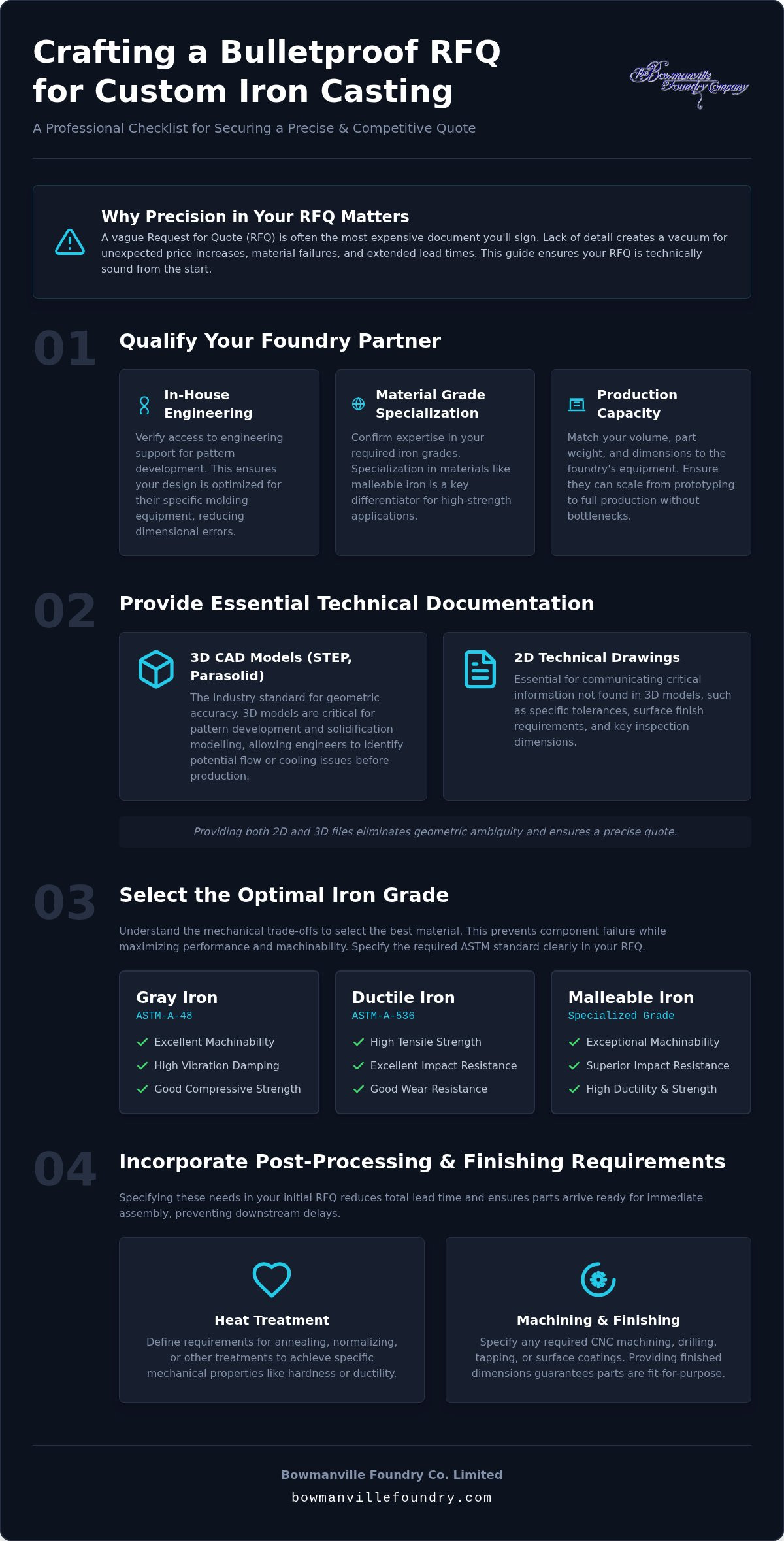
We understand that securing a precise, dependable quote is about more than just finding the lowest price per kilogram. Precision starts with the paperwork. It’s about ensuring your components meet rigorous ASTM standards while maintaining a predictable production schedule. This article provides a professional checklist to help you master the documentation needed to secure a technically sound and competitive iron casting quote for your next project. We will examine the essential components of a bulletproof RFQ package, from selecting the correct iron grade to defining post-processing requirements that ensure your parts arrive ready for immediate use.
Key Takeaways
- Learn how to qualify a foundry partner by verifying their expertise in specific iron grades, such as malleable, ductile, or gray iron, to ensure they can meet your production volume.
- Discover the essential 2D and 3D technical documentation required to eliminate geometric ambiguity and secure a precise quote for custom iron casting Ontario projects.
- Understand the mechanical trade-offs between different iron grades to select the optimal material that prevents failure while maximizing machinability.
- Identify how specifying machining and heat treatment requirements in your initial RFQ can reduce total lead times and provide parts that are ready for immediate assembly.
- Master the primary cost drivers and pattern development timelines to ensure your industrial procurement remains both predictable and within budget.
Qualifying Your Canadian Iron Foundry Partner
Selecting a partner for your custom iron casting Ontario project requires a methodical assessment of technical capabilities rather than a simple price comparison. In the Canadian industrial sector, a foundry’s longevity often serves as a proxy for reliability. For instance, a facility that has operated since 1902 demonstrates an established ability to adapt to shifting engineering standards and economic cycles. You need a partner that acts as a mentor, guiding you through the complexities of metallurgical selection to ensure your project’s success.
Before requesting a quote, confirm the availability of in-house engineering support. This expertise is vital for pattern development, as it ensures the design is optimized for the foundry’s specific molding equipment. When engineering and production are synchronized, the risk of dimensional errors decreases, and the path to a finished part becomes much more predictable. A reliable partner will be transparent about their institutional knowledge and willing to share data that helps you make an informed decision.
Material Expertise and Grade Specialization
Expertise in malleable iron is a significant differentiator in the modern market. While many facilities focus strictly on gray or ductile iron, the specialized heat treatment required for malleable iron is increasingly rare. This material is essential for high-strength hardware and pipe fittings that require excellent machinability and impact resistance. You should verify that the foundry can meet specific ASTM standards, such as ASTM-A-48 for gray iron or ASTM-A-536 for ductile iron.
Ask potential partners detailed questions about their metallurgical testing and quality control processes. They should be able to provide documentation proving that every pour aligns with your mechanical requirements. Understanding the fundamental metal casting process helps procurement professionals verify if a foundry’s quality control measures are sufficiently robust for their specific application. This technical certainty prevents material failure and ensures the longevity of your industrial components.
Production Capacity and Equipment Modernization
Volume requirements dictate the type of equipment a foundry must utilize to remain competitive. High-volume projects often require automated molding lines to maintain consistency, whereas smaller, complex runs are better suited for specialized floor molding. It’s critical to match your part’s weight and dimensions to the foundry’s equipment limits. A facility that invests in modern pouring technologies and sand management systems is better positioned to deliver consistent quality across long-term projects.
Scalability is equally important for your supply chain. A dependable partner should demonstrate the capacity to handle initial prototyping and full-scale production without compromising on lead times. Evaluate their history of handling production frequencies similar to yours. By choosing a facility with modernized equipment and a clear understanding of your required volume, you reduce the risk of bottlenecks that can delay your entire project timeline.
Essential Technical Documentation for Your RFQ
A Request for Quote (RFQ) for custom iron casting Ontario projects acts as the technical blueprint for your partnership. If the documentation is incomplete, the foundry is forced to make assumptions that often lead to conservative, higher pricing or, worse, parts that don’t meet your functional needs. To secure a precise quote, you must provide a package that eliminates geometric and mechanical ambiguity. This level of detail allows the foundry to conduct a thorough review of the project’s feasibility and resource requirements before a single kilogram of iron is poured.
CAD Files and Design Specifications
Modern foundries rely on 3D CAD models to drive pattern development and solidification modelling. While 2D drawings are necessary for communicating tolerances and finish requirements, 3D files in formats like STEP or Parasolid are the industry standard for geometric accuracy. These models allow engineers to visualize the part in a digital space, identifying potential issues with metal flow or cooling before production begins.
Your design must account for the physical realities of the casting process. The placement of parting lines and the inclusion of adequate draft angles are not merely aesthetic choices; they dictate how easily a part can be removed from the sand mould. Providing this data early reduces the need for expensive physical prototypes. If you’re unsure how your design translates to the foundry floor, consulting a Free Casting Buyer’s Guide can provide clarity on aligning your CAD data with manufacturing constraints.
Tolerance Standards and Mechanical Requirements
Defining acceptable dimensional tolerances is a critical step in managing project costs. Over-specifying tolerances is a common pitfall that inflates quotes by requiring additional machining or specialized inspection processes that may not be necessary for the part’s function. Instead, clearly identify Critical-to-Quality (CTQ) dimensions where precision is non-negotiable, and use broader standards for non-mating surfaces.
To ensure compliance with safety and performance benchmarks, your RFQ should reference the ASTM A834 Standard. This document provides the mandatory technical requirements for iron castings, including material composition and testing protocols. Beyond dimensions, you must specify the required surface finish and any stress or load requirements. Components used in high-stress industrial applications require a deep understanding of tensile strength and elongation. A proactive approach to casting failure prevention begins at this stage, ensuring your material specifications and tolerance requirements are robust enough to eliminate defects before production starts.
Finally, include your expected annual volume and typical batch sizes. This information is vital because it determines how the foundry amortizes tooling costs and schedules production runs. A project requiring 500 units per year suggests a different tooling strategy than a one-time run of 50 pieces. Clear volume data ensures your quote reflects the most efficient production path available.
Defining Material Specifications and Iron Grades
Selecting the appropriate iron grade is the foundation of a successful custom iron casting Ontario project. It is a decision that balances mechanical performance against total production costs. While a design might look perfect in a CAD environment, the physical crystalline structure of the iron determines how that part handles stress, heat, and vibration in the field. Procurement professionals must move beyond generic requests and specify the exact metallurgical properties required for the component’s specific application.
Malleable vs. Ductile Iron Selection
The choice between malleable and ductile iron often depends on the part’s geometry and the required impact resistance. Malleable iron is a specialized material, increasingly rare in modern foundries, that is ideal for thin-walled or complex hardware such as electrical fittings and small hand tools. It’s created through a rigorous heat treatment process that transforms brittle white iron into a tough, ductile material. This process gives malleable iron excellent machinability and the ability to be cast in very thin sections without cracking.
Ductile iron is the preferred choice for heavy machinery and high-pressure applications. It contains spherical graphite nodules that provide superior tensile strength and elongation. Unlike malleable iron, ductile iron’s properties are achieved through ladle metallurgy rather than an extended annealing cycle. This makes it a robust solution for larger components like crankshafts and hydraulic cylinders. You must analyze the following trade-offs when selecting between these two:
- Wall Thickness: Malleable iron excels in thin sections where ductile iron may struggle with consistency.
- Impact Strength: Ductile iron generally offers higher resistance to sudden mechanical shocks.
- Production Speed: Ductile iron often has shorter lead times because it requires less post-pour heat treatment.
Gray Iron for Vibration Damping and Cost-Efficiency
Gray iron is the most common and cost-effective grade for non-structural components. Its unique flake graphite structure provides exceptional vibration damping and thermal conductivity. This makes it the industry standard for engine blocks, machine bases, and enclosures where stability and heat dissipation are more critical than high tensile strength. It’s also the most machinable iron grade, which can significantly reduce your post-processing expenses.
When requesting a quote for gray iron, you must specify the required ASTM class, such as Class 30 or Class 40. These classes define the minimum tensile strength of the iron, ensuring your part meets the necessary safety margins. Consulting the foundry’s technical data guides early in the process allows you to align your design with these established standards. This technical alignment prevents over-engineering and ensures that the material you select is the most efficient choice for your industrial project. Understanding how improper grade selection contributes to field failures is a key element of any industrial engineering guide to casting failure prevention, and it reinforces why precise material specification belongs in every RFQ.
Incorporating Post-Processing and Finishing Requirements
Integrating post-processing into your initial RFQ is the most effective way to eliminate hidden costs and supply chain bottlenecks. When you request a quote for custom iron casting Ontario services, specifying finished dimensions rather than just raw casting weights allows the foundry to provide a comprehensive, ready-to-use part price. This approach shifts the responsibility of quality assurance to a single entity, ensuring that any defects found during machining are handled by the foundry itself before the part ever reaches your assembly line. Precision starts with the paperwork.
Machining and Secondary Operations
Sourcing machined castings from a single Canadian supplier provides a distinct logistical advantage. It eliminates the need to transport heavy iron components between multiple vendors, which significantly reduces shipping costs and potential handling damage. In your RFQ, you must clearly define datum points and machining allowances. These references tell the machinist exactly how to orient the part, ensuring that critical features align perfectly with the cast geometry. A comprehensive quote for custom iron casting Ontario must account for these secondary operations to provide a true total cost of ownership. By consolidating these operations, you avoid the common finger-pointing that occurs when a third-party machine shop discovers a casting flaw halfway through a production run.
Heat Treatment and Surface Finishing
Heat treatment is often a prerequisite for achieving the final mechanical properties of specific iron grades. For instance, stress relieving is vital for complex gray iron components to prevent warping after machining. You should also detail your surface coating preferences based on the component’s final environment. In Canadian climates, where exposure to road salt and extreme humidity is common, coatings such as galvanizing or specialized industrial painting are essential for corrosion resistance. Your quote request should specify these needs to ensure the foundry includes the costs of specialized finishing equipment and testing protocols. Consider the following finishing options for your project:
- Annealing: Used to improve machinability and ductility, particularly in malleable iron.
- Stress Relieving: Removes internal stresses caused by the cooling process or heavy machining.
- Surface Coatings: Options include painting, plating, or galvanizing to prevent oxidation.
For components that are part of a larger assembly, consider requesting kitting or sub-assembly services to further streamline your operations. To ensure you haven’t missed any critical post-processing steps, request a Free Casting Buyer’s Guide to help structure your next RFQ package.
Finalizing Your Custom Iron Casting Quote in Ontario and Canada
Finalizing a quote for custom iron casting Ontario projects involves more than just accepting a bottom-line figure. It requires a clear understanding of how raw material volatility and tooling amortization influence your final unit price. As of mid-2026, the Industrial Product Price Index in Canada has shown a 12.4 per cent year-over-year increase, while the Raw Materials Price Index rose by 20.7 per cent. These fluctuations mean that quotes are often time-sensitive, as foundries must account for the shifting costs of scrap metal and energy. By providing a highly organized RFQ package, you position your business as a preferred partner, allowing the foundry to dedicate more engineering resources to your specific technical challenges rather than chasing missing data.
Managing Lead Times for Canadian Projects
In 2026, the timeline for developing a new pattern typically ranges from 12 to 16 weeks, followed by the critical first-article approval process. This duration is influenced by the complexity of the component and the foundry’s current engineering backlog. While standard mill lead times for raw materials have generally shortened, specialty grades still require extended delivery windows. Design changes made after the initial quote can significantly delay the delivery date; even minor geometric adjustments might require a complete redesign of the gating system. To reduce these timelines, you should involve the foundry’s engineering team during the early stages of your design process. This early collaboration ensures the part is optimized for the casting process, preventing costly revisions during the production phase.
The Value of Domestic Sourcing
Choosing a Canadian foundry for your industrial components offers tangible advantages that go beyond the initial purchase price. Domestic sourcing eliminates the complexities of customs delays and the high costs associated with international shipping. You also gain the benefit of technical support within the same time zone, which is invaluable when troubleshooting production issues or discussing urgent design modifications. A local partner understands the specific regulatory environment, including Ontario’s O. Reg. 419/05, ensuring your supply chain remains compliant and resilient. By keeping your production within Canada, you reduce your environmental footprint and support a sector that contributed over 600 million dollars in value-added manufacturing to the economy in recent years.
Request your custom iron casting quote from Bowmanville Foundry today.
Securing Technical Certainty for Your Next Project
Securing a precise quote for your industrial components requires a commitment to technical transparency from the very first document. By providing comprehensive CAD models and clearly defining ASTM material standards, you eliminate the assumptions that lead to cost overruns. We’ve explored how qualifying a partner’s material expertise and integrating secondary operations into your RFQ creates a predictable production path. This methodical approach ensures your project remains on schedule while meeting the highest mechanical requirements. Precision starts with the paperwork.
When you’re ready to source custom iron casting Ontario solutions, partner with an institution that values technical mastery. Bowmanville Foundry has functioned as specialists in malleable, ductile, and gray iron since 1902. We provide full-service post-processing and finishing to deliver ready-to-use parts directly to your facility. Our team offers comprehensive technical application guides to assist you in refining your specifications before production begins. Request a Quote for Custom Iron Castings today to begin your technical consultation. Your project’s success is rooted in the precision of the initial request.
Frequently Asked Questions
What is the typical lead time for a custom iron casting quote in Canada?
Standard lead times for a custom iron casting Ontario quote typically range from three to five business days. This duration allows engineers to conduct a thorough review of your CAD models and material specifications. If your project requires complex solidification modelling or specialized post-processing, the timeline may extend slightly. Providing a complete RFQ package initially is the most effective way to ensure a prompt and accurate response from our technical team.
Do I need to provide my own patterns when requesting a quote?
You don’t need to provide your own patterns to receive a quote. A professional foundry can engineer and produce new patterns based on your 2D drawings or 3D CAD files. If you already possess existing tooling, we can evaluate its compatibility with our automated moulding lines. In many cases, developing new, optimized patterns in-house results in higher dimensional consistency and reduced scrap rates over the project’s total lifespan.
How do I choose between malleable and ductile iron for my project?
Choosing between these grades depends on your component’s geometry and mechanical needs. Malleable iron is ideal for thin-walled, complex hardware that requires excellent machinability. Ductile iron is better suited for heavy-duty industrial components requiring high tensile strength and impact resistance. Our technical application guides provide detailed data on these trade-offs, helping you select the grade that ensures project success without over-engineering the material requirements for your specific application.
Can a foundry provide a quote for fully machined and painted components?
Yes, a full-service foundry can provide a comprehensive quote that includes machining, heat treating, and surface finishing. Sourcing finished, ready-to-use parts from a single Canadian supplier reduces your logistics costs and simplifies quality control. We offer various coatings, such as painting or galvanizing, to protect components in harsh environments. This integrated approach ensures that any casting defects are identified and addressed before the part ever reaches your facility.
What ASTM standards should I reference in my iron casting RFQ?
You should reference specific ASTM standards to define your material’s mechanical properties accurately. Common standards include ASTM A48 for gray iron, ASTM A536 for ductile iron, and ASTM A47 for malleable iron. Referencing these established benchmarks ensures that the foundry pours iron that meets your required tensile strength and elongation. Including these standards in your RFQ eliminates ambiguity and helps you secure a technically sound custom iron casting Ontario estimate.
How does production volume affect the cost per unit in an iron casting quote?
Production volume is one of the most significant cost drivers in any casting project. Higher annual volumes allow the foundry to amortize the initial tooling and pattern development costs over a larger number of units, significantly reducing the price per kilogram. Conversely, small batch runs often carry higher unit costs due to the setup time required for moulding and pouring. Clearly stating your batch sizes helps us optimize the production schedule.
What are the most common mistakes to avoid when requesting a casting quote?
The most common mistakes include providing vague dimensional tolerances and failing to specify the required iron grade. Missing 3D CAD files can also lead to geometric ambiguity, forcing the foundry to make conservative assumptions that inflate the quote. Additionally, neglecting to mention annual volumes makes it difficult to recommend the most efficient tooling strategy. Providing a clear, organized RFQ package prevents these issues and ensures a more competitive, accurate production estimate.
Does Bowmanville Foundry offer engineering support for design optimization?
Yes, Bowmanville Foundry offers extensive engineering support to help optimize your designs for the casting process. Since 1902, we’ve acted as a patient mentor to our clients, sharing institutional knowledge to improve part performance and reduce manufacturing costs. Our team can suggest modifications to draft angles or wall thicknesses that enhance metal flow and cooling. This early involvement often leads to more reliable components and significantly shorter production lead times.
