
A casting isn’t assembly-ready simply because it has cooled. For Canadian engineers, foundry post processing services help move a component from raw iron to a part prepared for machining, finishing and assembly. Coordinating separate casting, heat-treating and coating vendors can add handoffs and complicate scheduling and quality control.
Procurement teams and design engineers can simplify those handoffs by coordinating casting and finishing through one source. Bowmanville Foundry produces Gray Iron, Ductile Iron and Malleable Iron castings and provides post-processing services. Established in 1902, it was the first foundry in Canada to achieve ISO certification, in 1996.
This article explains how heat treating, precision machining and surface finishing can support a component’s specified requirements. It also covers material selection, relevant ASTM specifications and practical details to include when planning for finished castings.
Key Takeaways
- Understand how foundry post processing services prepare iron castings for installation or assembly.
- Learn how heat-treatment cycles such as annealing, normalizing and stress relieving are selected to meet specified material requirements.
- See how casting geometry and machining allowances work together to achieve drawing dimensions without unnecessary material removal.
- Compare surface preparation and coating steps, including shot blasting, grinding, painting, powder coating and plating.
- Identify how coordinating casting and finishing through one source can reduce production handoffs and simplify shipping logistics.
Defining Foundry Post-Processing Services for Industrial Iron
A casting leaves the mold in an as-cast state, but it may not yet meet the dimensional, metallurgical or surface requirements of its application. The Casting manufacturing process describes how molten metal takes shape and solidifies. Post-processing comprises the additional operations that prepare the casting for its intended function. Foundry post processing services can include heat treating, machining and surface finishing. The drawing, iron grade and service conditions determine which operations are needed and in what sequence.
Post-processing connects the foundry floor to the assembly line. It prepares a casting for installation or assembly without assuming that every part needs the same finishing steps. Bowmanville Foundry provides post-processing for Gray Iron, Ductile Iron and Malleable Iron castings, coordinating finishing with casting production.
The Difference Between As-Cast and Finished Components
An as-cast part may have gates, risers or flash left from molding and solidification. Where required, these features are removed or dressed through operations such as grinding so they don’t interfere with fit, handling or later machining. Surface preparation can also provide a consistent base for a specified finish.
Finishing can change more than appearance. Heat treatment affects metallurgical properties, while machining brings selected faces, holes or other features to the dimensions and tolerances on the engineering drawing. The result is a casting prepared to meet its specified requirements, not simply a cleaner surface.
Key Drivers for Post-Processing in Canadian Industry
Sand casting forms a component’s overall geometry, but a drawing may call for tighter tolerances on selected features than the as-cast surface can provide. Machining those critical areas allows engineers to specify dimensions for interfaces, fasteners or bearing surfaces while retaining the advantages of a cast shape elsewhere.
Surface requirements depend on service conditions. One component may need a prepared surface and coating for protection or appearance; another may require only cleaning and dressing. Matching operations to the drawing and application helps avoid unnecessary finishing and keeps the process focused on functional requirements.
Material and process specifications guide these decisions. For example, ASTM A48/A48M applies to Gray Iron castings, and ASTM A536 applies to Ductile Iron castings. The specified grade and engineering drawing establish acceptance criteria. Post-processing must support those requirements. Coordinating casting and finishing through one source can reduce internal handling and the work involved in managing separate production steps, leaving the receiving team with components prepared for its assembly workflow.
Heat Treatment: Optimizing Metallurgical Properties
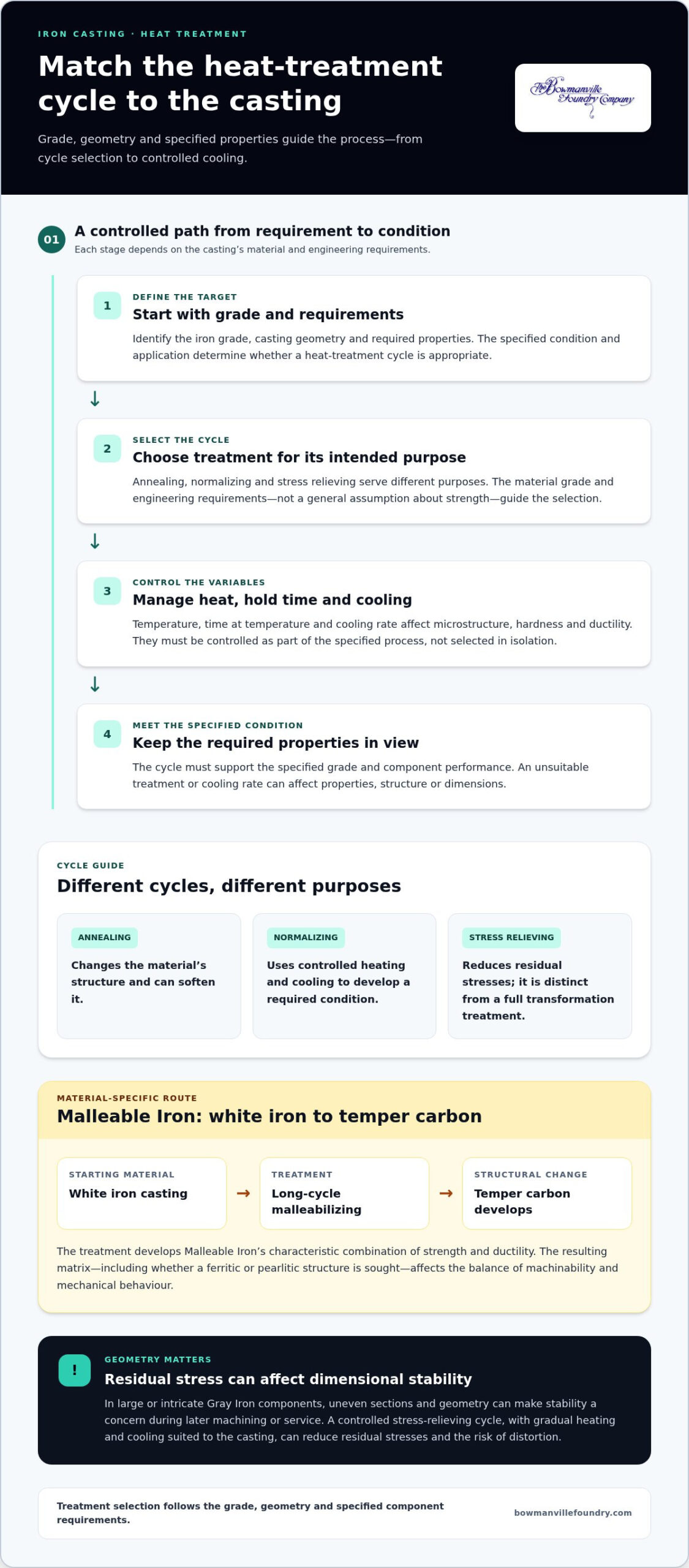
Heat treatment controls how an iron casting responds to load, wear and machining. The cycle must match the material grade and engineering requirements. The treatment used to produce Malleable Iron differs from a cycle selected to alter the properties of a Ductile Iron or Gray Iron casting. Temperature, time at temperature and cooling rate all affect the resulting microstructure, hardness and ductility. These variables must be controlled as part of the specified process rather than selected in isolation.
Common cycles include annealing, normalizing and stress relieving. Annealing changes the material’s structure and can soften it. Normalizing uses controlled heating and cooling to develop a required condition. Stress relieving reduces residual stresses and serves a different purpose from a full transformation treatment. The appropriate cycle depends on the grade, casting geometry and specified properties.
Annealing and Malleabilizing Processes
Malleable Iron production begins with white iron castings, which undergo a long-cycle heat treatment that transforms their structure and develops temper carbon. This malleabilizing process produces the material’s characteristic combination of strength and ductility. Changes to the treatment affect the resulting matrix, including whether a ferritic or pearlitic structure is sought for the required balance of machinability and mechanical behaviour. For grade-specific background, see The Malleable Iron Casting Guide for Canada.
Ductile Iron is produced with nodular graphite, but its matrix and final properties can also depend on the specified thermal treatment. Distinguish between the material’s as-cast condition and a condition achieved through additional heat treatment. The required grade and application determine whether a cycle is appropriate. Heat treating is not a universal way to increase strength.
Stress Relieving for Complex Geometries
Cooling after solidification can leave residual stresses in a casting. In large or intricate Gray Iron components, uneven sections and geometry can make dimensional stability a concern during later machining or service. A controlled stress-relieving cycle, with gradual heating and cooling suited to the casting, can reduce residual stresses and the risk of distortion. Where residual stresses contribute to cracking, reducing them can help support component reliability.
Process control matters for every grade. Excessive or insufficient treatment can produce properties that miss the engineering target, while an unsuitable cooling rate can affect dimensions or structure. Foundry post processing services coordinate heat treating with the casting grade and required component performance, so the specified condition guides the cycle from start to finish.
Precision Machining and Dimensional Accuracy
Castings can form complex shapes close to a part’s final geometry, while machining brings selected features to the dimensions and surface condition required for assembly. This near-net-shape approach can limit material removal compared with machining the full component from solid stock. The casting design still needs suitable machining allowances at critical surfaces, since the as-cast form alone may not meet the drawing’s dimensional requirements.
Machining plans should account for iron grade and microstructure. Malleable Iron contains temper carbon, while Ductile Iron contains nodular graphite. Both can be machined, but cutting conditions and tool selection should reflect the specific grade, hardness and feature being produced. Coordinating casting and machining helps align the part’s geometry with its finishing plan. Bowmanville Foundry coordinates iron casting and machining to support production quality control.
Turning, Milling, and Drilling Operations
Secondary machining varies with a part’s function. A bracket may need milled mounting faces, a housing may require a turned bore, and a fitting may need drilled passages or tapped holes. For tapped features, define hole location, thread specification and engagement in relation to the casting wall. The pilot-hole diameter and depth must be suited to the thread and part geometry to preserve thread integrity and avoid breaking through a wall or into a nearby cavity.
Tool choice and cutting parameters depend on the iron’s properties and the operation. A machining plan accounts for material hardness and structure, as well as tool wear, workholding and feature geometry. These details matter when several machined surfaces must align accurately with one another.
Maintaining Critical Tolerances
As-cast dimensions and precision-machined dimensions serve different purposes. Casting establishes the overall form, while machining produces specified interfaces such as a mounting face, bore or fastener pattern. The engineering drawing should identify critical dimensions and datums, the reference surfaces from which those dimensions are measured. A stable datum scheme helps control feature alignment during machining and the way the finished part locates in an assembly.
CNC machining can repeat programmed tool paths across production runs, while inspection against the drawing verifies the resulting features. Repeatability depends on setup, workholding, tool condition and consistent datum references, not the machine alone. For additional design and production considerations, consult Optimizing Custom Iron Casting Production.
By coordinating casting geometry, machining allowances and finished-part requirements, foundry post processing services can help prepare iron components for their assembly requirements.
Surface Finishing and Protective Coatings
Surface finishing prepares an iron casting for its working environment and intended appearance. Before coating, loose sand, scale and other surface residues may need to be removed. Select a coating system according to the component’s exposure, required appearance and maintenance needs. For infrastructure exposed to moisture and de-icing salts, also consider access for inspection and recoating.
Shot Blasting and Surface Cleaning
Shot blasting cleans a casting by directing abrasive media against its surface, removing residual sand and loose scale. Grinding can remove local irregularities or smooth areas that need additional preparation. The aim is a clean, consistent surface suited to the next operation, not to change the casting’s designed dimensions.
Surface texture affects coating adhesion. A coating specification should identify the preparation method and any required roughness measurement. Ra describes average surface roughness, while RMS is another roughness measure. They are not interchangeable values. There is no single finish grade appropriate for every iron casting. The coating system and part function determine the required surface condition, so the drawing or finishing specification should state applicable acceptance criteria.
Industrial Coating Selection
Liquid paint and powder coating are different application options. Liquid paint can be applied to varied shapes and may suit parts that need a specified colour or touch-up approach. Powder coating applies dry powder that is cured to form a coating; the part’s geometry and process requirements affect its suitability. Neither option is automatically best for every casting. Select a system based on service environment, coating coverage, finish requirements and maintenance plan, rather than a general durability comparison.
Other systems serve distinct purposes. Galvanizing applies a zinc coating, while plating deposits a metallic layer. These treatments may be considered for demanding exposure conditions, but the coating choice must suit the base material, component design and required performance. A coating specification should also identify areas to mask, such as machined interfaces or threaded holes, to prevent interference with assembly.
For architectural or consumer-facing iron components, colour, gloss and surface uniformity may be as important as protection. For industrial parts, a finish that supports inspection and a practical maintenance cycle may take priority. In either case, include preparation and coating requirements in the component specification.
Bowmanville Foundry provides post-processing services, including surface coating, for iron castings. Discuss your iron casting finishing requirements with the foundry team.
The Strategic Advantage of Single-Source Finishing in Canada
When casting, heat treating, machining and coating are divided among separate suppliers, each handoff adds coordination, shipping and inspection requirements. A single-source model brings these stages together, giving production teams a clearer view of the component’s progress and reducing transfers between facilities. For manufacturers managing projects across Canada, fewer handoffs can also reduce exposure to transit delays and damage during repeated shipments.
Integrated scheduling helps align foundry and finishing operations. Casting and machining requirements can be considered together, so the production plan accounts for material grade, heat-treatment needs, critical dimensions and final surface finish. This coordination can support more predictable scheduling, though actual lead times depend on the project and current business conditions. One supplier also provides a clear point of accountability for questions about the finished component and its production record.
Streamlining Procurement for Canadian Projects
For procurement teams, consolidating work can reduce the effort spent coordinating separate purchase orders, schedules, shipping arrangements and quality records. It also brings metallurgical and machining considerations into the same production relationship. For example, machining allowances and datum surfaces can be planned alongside casting geometry, rather than addressed only after the raw casting reaches another facility. This approach is useful on projects where consistent specifications and delivery coordination matter across multiple components.
Next Steps: Sourcing Ready-to-Use Components
A clear request for quotation (RFQ) gives the foundry the information needed to assess the casting and its finishing route. Include:
- CAD files, drawings, material grade and applicable specifications
- Critical dimensions, tolerances and datum references
- Required heat treatment, machining features and coating finish
- Quantity, production schedule and inspection or documentation requirements
Review material selection early, before finalizing part geometry. The professional iron casting grade guide can help engineers compare iron grades against application requirements. Bowmanville Foundry provides foundry post processing services for Gray Iron, Ductile Iron and Malleable Iron castings, coordinating casting and finishing as a single Canadian source.
Contact our engineering team to discuss your finished component requirements and provide the details needed for a technical assessment.
Plan Your Next Iron Casting Project with Confidence
Turning a raw casting into an assembly-ready component takes more than a final inspection. Heat treatment must suit the iron grade and required properties, machining must meet drawing dimensions, and surface finishing must match the component’s service conditions. Coordinating these operations with casting production helps maintain continuity from material selection through delivery.
For Canadian manufacturers, foundry post processing services from a single source can simplify supplier coordination and provide one point of accountability for the finished part. Bowmanville Foundry has served industry since 1902, integrating casting and finishing for Gray Iron, Ductile Iron and Malleable Iron components. Technical support can help engineers assess iron grade selection against the component’s design and operating requirements.
Start with your drawing, material specification, critical tolerances and finishing requirements. Request a quote for ready-to-use iron components and discuss how integrated casting and post-processing can support your next project. Clear requirements and technical guidance help establish a finishing plan around the part’s intended use.
Frequently Asked Questions
What are the most common post-processing services for iron castings?
Common services include heat treating, machining and surface finishing. Heat treatment adjusts metallurgical properties to suit the specified grade and application. Machining produces critical dimensions, holes, threads and interfaces that the as-cast surface may not provide. Surface finishing can include cleaning, grinding and coating, depending on the part’s requirements. Together, these foundry post processing services prepare Gray Iron, Ductile Iron and Malleable Iron castings for their intended use.
How does heat treating improve the machinability of malleable iron?
Heat treating creates the structure that gives Malleable Iron its characteristic properties, including improved machinability compared with its white iron starting condition. During malleabilizing, a prolonged annealing cycle transforms the iron’s structure and forms temper carbon. The resulting matrix, such as ferritic or pearlitic, affects the balance of machinability and mechanical properties. The appropriate cycle depends on the required grade and component specification, rather than a single universal treatment.
Can you machine ductile iron to the same tolerances as steel?
Ductile Iron can be machined to drawing-specified tolerances, but the achievable result depends on the component, material condition, feature geometry, setup and machining process. A material comparison alone cannot establish whether two parts will meet the same tolerance. Identify critical dimensions, datums, surface requirements and inspection criteria on the engineering drawing. The machining plan can then be matched to the component’s requirements, including bores, mounting faces and threaded features.
Why is shot blasting necessary before painting or coating an iron part?
Shot blasting removes residual sand, loose scale and surface contaminants that can interfere with a coating. It also creates a more consistent prepared surface when the coating system calls for that preparation. It isn’t a substitute for specifying the required finish: the coating and part requirements determine the appropriate preparation method and acceptance criteria. Masking may also be needed to protect machined faces, threaded holes or other features from coating buildup.
How much do post-processing services typically add to the lead time?
There is no fixed amount of time that post-processing adds, because the schedule depends on the operations, their sequence and the production requirements. Heat treating, machining and coating may each affect scheduling differently. Bowmanville Foundry’s typical lead times are four to eight weeks, depending on current business conditions. This is the typical overall lead-time range, not a separate estimate for finishing alone.
Is it better to source machining from the foundry or a separate machine shop?
Sourcing machining through the foundry can simplify coordination because casting geometry, machining allowances and finished dimensions can be planned together. It also gives procurement one point of contact for production stages and quality questions. A separate machine shop can involve additional scheduling and shipping handoffs. The practical choice depends on the part and production plan; integrated casting and machining is particularly useful when the drawing has critical features that must relate to the casting’s datums.
What surface finishes are best for preventing rust in outdoor Canadian applications?
No single finish is best for every outdoor iron component. Selection should account for exposure to moisture, de-icing salts, required appearance, coating coverage and future maintenance access. Painting, powder coating or plating may be considered according to the component and its service conditions. Proper surface preparation is essential, and specifications should identify the coating system, areas to be masked and required finish. Regular inspection and maintenance also help preserve protection over time.
