
A coating can’t compensate for an unclear specification or inadequate surface preparation. Choosing surface coating for iron castings starts with the component’s service conditions, but the iron grade, casting surface and preparation process also affect the result. Assess the part and its application together to define the finish requirements.
This article explains how to match coating requirements to exposure and operating demands, why surface cleanliness matters for adhesion, and which finish details to define for a custom casting. It also covers how coating fits into the casting and post-processing sequence, so requirements can be coordinated before production.
Bowmanville Foundry has produced custom Gray Iron, Ductile Iron and Malleable Iron castings since 1902, with post-processing services that include surface coating. The sections ahead outline practical considerations for discussing coating requirements with a technical or sales engineer and preparing a clear specification for your iron component.
Key Takeaways
- Base finish requirements on the component’s exposure, handling and function, not appearance alone.
- Keep the casting grade and coating requirements distinct: Gray Iron, Ductile Iron and Malleable Iron address material needs, while the finish serves its own purpose.
- Compare coating options by service conditions, part geometry, surface condition and downstream operations.
- Specify surface coating for iron castings alongside surface preparation and clear acceptance requirements.
- Coordinate material, design and finishing early so coating requirements are part of the custom casting plan.
Why surface coating matters for iron castings in service
A surface coating is a layer applied to an iron casting to meet defined service or finish requirements. It is separate from the iron substrate: the casting provides the component’s material properties and structural function, while the coating has its own specified role. Surface coating for iron castings should be selected for the part’s actual use, not treated as a default finish for every component.
What a surface coating does on an iron casting
A coating may be specified for a particular exposure, finish or identification purpose. Those functions are not interchangeable. A finish selected for appearance does not automatically meet a protection requirement, and a coating intended for one service condition should not be assumed to perform the same way in another. Define the required function before selecting a coating.
Surface finishing includes processes that alter or add to a part’s surface. The broad overview of Surface finishing processes provides useful context, but the coating and acceptance requirements for a casting should be based on its application.
Which service conditions should the specification describe?
Describe where and how the component will operate. Include relevant environmental exposure, handling during installation and use, and the component’s function within the assembly. These details help engineers assess what the finish must do and identify requirements that may affect coating selection.
- Exposure: Describe the environment the part will encounter in service.
- Handling: Note whether the component will be handled, moved or installed in ways that matter to the finish.
- Operating conditions: State the conditions the casting experiences while performing its function. Include low temperature environments only when they apply to the application.
- Use and finish: Separate functional needs, such as protection, from preferred colour, appearance or identification.
For example, a component inside an assembly may have different appearance requirements from a visible part, while its service conditions determine the functional needs of both. A clear specification identifies which requirements are essential and which are preferences.
Defining service conditions early helps keep the finish aligned with the casting’s purpose and the rest of the project requirements. Next, consider how the iron type and component design relate to coating decisions.
How coating selection relates to Gray Iron, Ductile Iron and Malleable Iron
Choose the casting material for the component’s design and mechanical requirements, then define the coating for its service conditions and finish requirements. These related decisions answer different engineering questions. A material grade does not, by itself, determine which coating is suitable or establish how that coating will perform.
Start with the iron grade and component requirements
Gray Iron, Ductile Iron and Malleable Iron are distinct material choices. The part’s geometry, function and required material properties guide grade selection; its exposure, handling and specified finish needs guide the coating requirements. For background on comparing iron materials, see the iron casting grade selection guide.
Keep these requirements separate in the part specification. Don’t assume a coating is compatible with a particular grade or will provide a specific result on that substrate without technical review. Assess the coating system and preparation details for the actual casting and application.
Compare coating options by the job they must perform
General coating examples include liquid-applied paint and powder coating. Naming a method is not enough to specify it. Define the intended function, relevant surface condition and acceptance criteria, then have method-specific details reviewed. Claims about adhesion, corrosion resistance or response to operating temperatures require verification for the proposed system and part.
The table below frames useful questions without assigning unsupported performance to a material grade.
| Material grade | Project question | Coating-specification consideration |
|---|---|---|
| Gray Iron | What material and design requirements does the component need to meet? | State the coating’s intended function and the service conditions that inform its selection. |
| Ductile Iron | What mechanical requirements and component use govern the grade choice? | Specify required finish and acceptance criteria separately from the casting grade. |
| Malleable Iron | What part function, geometry and material requirements apply? | Describe the exposure and coating purpose; leave compatibility and performance claims to technical review. |
For each option, assess how the proposed process will address the part geometry, surface condition and downstream operations. Don’t select a finish solely because it is familiar or preferred for appearance. Separating material, coating and acceptance requirements gives the project team a practical basis for review.
Bowmanville Foundry provides custom iron castings and post-processing services, including surface coating. Share the part requirements with a Bowmanville Foundry technical or sales engineer to discuss how the casting and finish specifications fit together.
How to compare coating options for an iron casting
Compare coating options against the part’s requirements, not a general preference for a particular finish. Review the service environment, the coating’s function, the casting’s surface and geometry, and any operations that follow coating. No single coating is right for every iron casting. The trade-offs depend on the component and its specified use.
Which performance requirements should buyers compare?
Separate required performance from preferences. Identify relevant exposure and the coating’s purpose, such as a specified protective function, then state any appearance or identification needs separately. If colour is for identification, define that requirement without treating it as proof of functional performance.
Set acceptance criteria that can be assessed on the finished component. Describe the required result and any project-specific inspection or verification method. Don’t assume a coating method meets a particular requirement by name alone. Claims about adhesion, corrosion resistance or response to operating conditions should be verified for the proposed coating system and application.
| Comparison factor | Questions to include in the review | Specification focus |
|---|---|---|
| Exposure | What conditions will the part encounter in service? | Describe relevant environmental and operating conditions. |
| Function | What is the coating required to do? | Separate required performance from colour or appearance preferences. |
| Surface condition | What condition will the casting be in before coating? | Coordinate surface preparation with the proposed coating for technical review. |
| Geometry | Which features or surfaces are difficult to access or critical? | Identify areas that need specific coverage or protection from coating. |
| Downstream operations | Will machining or other post-processing follow coating? | Define the sequence and any affected surfaces or dimensions. |
Liquid-applied paint and powder coating are examples of coating families that may be considered. Compare them against the project requirements and proposed process details rather than assuming one performs better in every application. Verify method-specific compatibility and performance for the part.
How do geometry and machining affect the finish plan?
Part features can affect access during coating and the ability to assess the finished surface. Identify critical dimensions, surfaces that must remain uncoated, and areas where finish coverage matters. State whether machining or other post-processing occurs before or after coating, since sequence affects which surfaces receive the finish. For related process context, see integrated iron casting and machining.
Bowmanville Foundry provides surface coating as part of its post-processing services for custom iron castings. Discussing the casting and finish requirements together helps align the specification and operation sequence. Talk with a Bowmanville Foundry technical or sales engineer about your project requirements.
How to specify coating and surface preparation for a casting project
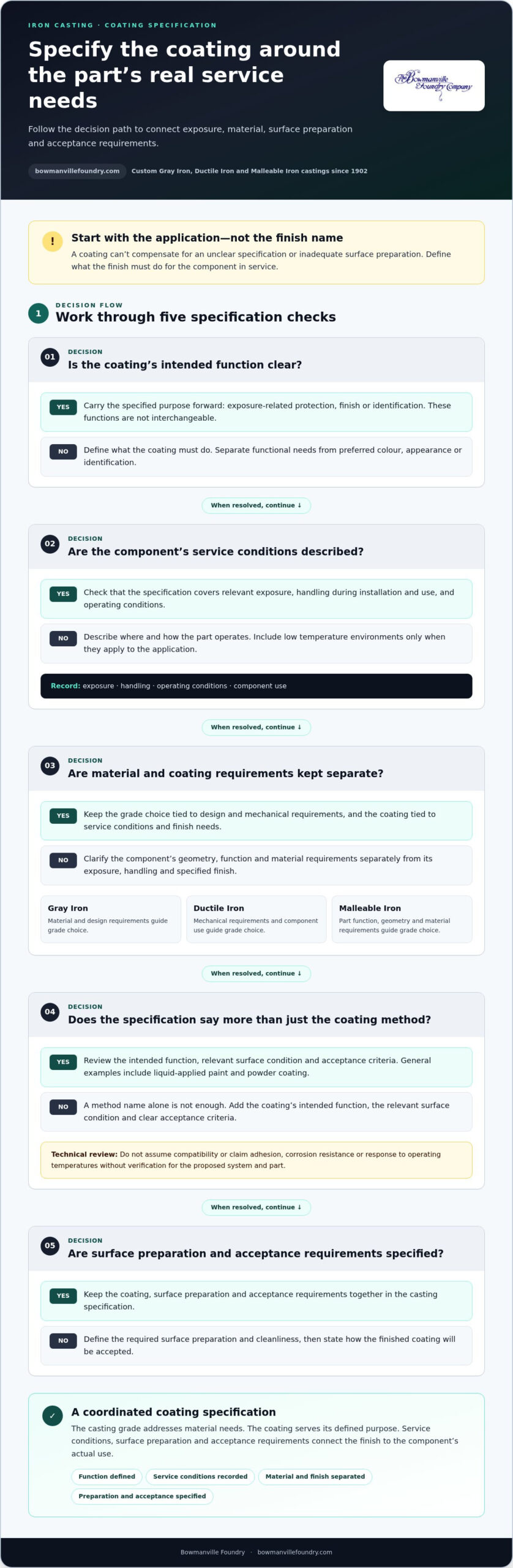
A usable coating specification connects the component’s service conditions to its finish, preparation and acceptance requirements. Define surface preparation alongside the coating because the casting’s condition before finishing is part of the project plan. Details depend on the part and proposed coating, so have method-specific requirements reviewed rather than assuming them.
Build a clear coating specification
Use this sequence to prepare a project brief for surface coating for iron castings:
- Describe the application. State what the casting does and where it will operate.
- Record relevant exposure and handling. Include the conditions the component will encounter in service, during installation and in use.
- Identify the required finish function. Separate functional requirements from preferred colour, appearance or identification.
- Describe the proposed coating and coverage. Identify the coating specified for the project, the surfaces requiring coverage and any areas to be masked or left unfinished.
- Define preparation requirements. State the required surface condition or preparation details where established. Have project-specific methods reviewed for the casting and coating.
- Set acceptance and inspection requirements. Describe what will be assessed on the finished part and how the result will be reviewed. Establish project-specific values or test methods through engineering assessment, not guesswork.
Consider geometry as part of the brief. Recesses, edges, difficult-to-access areas, machined surfaces and critical dimensions may affect coverage expectations or inspection. Identify these features on drawings or in written requirements where applicable.
A coating specification should identify the component’s service conditions, required finish function, coating and preparation requirements, coverage, affected surfaces, acceptance criteria and inspection expectations.
Coordinate casting, preparation and post-processing
Map the finishing sequence against the full part plan. Identify whether machining or other post-processing is required, which surfaces are critical, and whether coating should occur before or after those operations. This coordination helps the team account for surfaces that need masking, later machining or specific inspection. For broader project-planning context, see custom iron casting production guidance.
Bowmanville Foundry provides surface coating as part of its post-processing services for custom iron castings. Discuss your casting and coating specification with a technical or sales engineer to coordinate the part requirements and finishing plan.
Plan iron casting surface coating with Bowmanville Foundry
Surface coating is most useful when planned as part of the custom casting and post-processing sequence. Bowmanville Foundry produces Gray Iron, Ductile Iron and Malleable Iron castings, with surface coating among its post-processing services. Discussing material, part design, finish and acceptance requirements together helps align the coating plan with the component’s intended use.
Bring coating requirements into the casting discussion early
Share available CAD files, drawings and stated functional requirements so part geometry and service needs can inform a technical assessment. The review can consider design and production requirements alongside the proposed finish. Treat coating method, preparation and performance expectations as project-specific details for technical review, not assumptions based on the iron grade or a general finish description.
Early coordination also gives the team a chance to identify critical surfaces, machining requirements, coverage expectations and inspection criteria before finishing begins. Bowmanville Foundry has manufactured iron castings since 1902, and its modern plant covers 38,000 square feet. The foundry was the first in Canada to achieve ISO certification in 1996, a milestone in its quality record.
Move from specification to project discussion
For a productive technical or sales discussion, bring together the component’s purpose, selected iron grade, service conditions, coating function and acceptance requirements. Include drawings or CAD files where available, and note any surfaces that require machining, masking or particular inspection. This gives engineering and procurement teams a shared basis for discussing the casting and its post-processing plan.
Bowmanville Foundry’s technical or sales engineers can discuss a technical assessment, coating requirements and the project as a whole. Discuss your iron casting requirements with Bowmanville Foundry or request a project quote to begin the conversation.
Set your casting project up for a suitable finish
A sound coating plan begins with the component’s actual service conditions and function. Keep material-grade selection distinct from coating requirements, then define surface preparation, coverage, geometry and acceptance criteria together. This gives procurement and engineering teams a clear basis for reviewing surface coating for iron castings as part of the full casting and post-processing sequence.
Bowmanville Foundry has manufactured iron castings since 1902 and offers post-processing services that include surface coating. In 1996, it became the first foundry in Canada to achieve ISO certification. These milestones reflect a long history in iron casting and a focus on supporting customers with technical information.
Bring your drawings or CAD files, selected iron grade, service conditions and finish requirements into the project discussion. A technical assessment can help connect part design and production needs with the finishing plan. Discuss your iron casting requirements with Bowmanville Foundry and take the next step towards a clear, project-ready specification.
Frequently Asked Questions
What is the purpose of surface coating on an iron casting?
A surface coating adds a specified finish layer to an iron casting for a defined service or finishing requirement. Depending on the selected system, it may be intended to provide a protective function, meet appearance requirements or support part identification. These purposes are distinct, and a coating should not be assumed to deliver every benefit. Specify the component’s use and required finish so the coating can be assessed for the application.
Which surface coating is best for iron castings?
There is no single best surface coating for iron castings across all applications. Selection depends on the component’s service conditions, required finish function, surface condition, geometry and downstream operations. General coating families, such as liquid-applied paint and powder coating, raise different process questions. Define performance and acceptance requirements first, then review a proposed coating and preparation plan for the specific casting rather than choosing by habit or appearance alone.
Do iron castings need surface preparation before coating?
Address surface preparation as part of the coating specification. The required preparation depends on the casting’s condition and the proposed coating system, so don’t assume a specific method without technical review. Include the expected surface condition, areas requiring preparation, and any masking or inspection needs. Coordinating preparation and coating requirements helps assess the finish against the component’s service conditions and acceptance criteria.
Can Gray Iron, Ductile Iron and Malleable Iron use the same coating?
Don’t automatically assign the same coating system to all three grades. Gray Iron, Ductile Iron and Malleable Iron are material choices, while coating selection addresses the part’s finish and service requirements. Whether a proposed coating is suitable for a particular casting depends on project-specific factors, including its surface condition and application. Have coating compatibility and performance reviewed for the selected grade and component rather than inferring them from the material name.
Can an iron casting be machined before it is coated?
Yes, machining can be planned before coating, but define the operation sequence for the part. Identify machined surfaces, critical dimensions and any areas that must remain uncoated or require masking. State whether further machining or other post-processing follows coating, since this affects which surfaces receive the finish. Review the proposed sequence alongside the casting and finishing requirements.
What information should a coating specification for an iron casting include?
A coating specification should identify the component’s application, iron grade, service conditions and required finish function. It should also describe the proposed coating, surface preparation, coverage expectations, critical or masked areas, machined surfaces and acceptance criteria. Include inspection expectations where specified. Flag project-specific technical values, test methods or performance requirements for engineering assessment rather than assuming a value or method.
How does coating fit into iron casting post-processing?
Coating is a post-processing operation that should be coordinated with casting, machining and other required finishing steps. The project plan should identify the sequence, surfaces requiring coverage, areas to mask and inspection criteria for the finished part. Bowmanville Foundry offers post-processing services that include surface coating for custom iron castings. Discuss your casting and coating requirements with Bowmanville Foundry to coordinate the finish with your project.
