
Blackheart and whiteheart describe metallurgical outcomes, not colour or surface-finish options. The blackheart vs whiteheart malleable iron distinction comes from how a white iron casting is annealed, and that treatment affects the material’s microstructure across the section. Confusing the terms can leave a drawing or supplier discussion open to interpretation.
To compare the two, look beyond appearance. The annealing atmosphere affects how carbon is distributed in the casting, but the names alone do not establish the grade or confirm that a material suits a component. Selection should account for the required properties, geometry and service conditions.
This article explains how a neutral atmosphere allows temper carbon to form within blackheart iron, while an oxidizing atmosphere removes carbon from the surface of whiteheart iron. It also compares these conditions with Gray Iron and Ductile Iron and outlines what information supports a clear specification. Bowmanville Foundry manufactures Malleable Iron castings and can provide a technical assessment to help relate material terminology to component requirements.
Key Takeaways
- Blackheart and whiteheart malleable iron are metallurgical distinctions, not descriptions of colour or finish.
- Compare the resulting structure with the casting’s section geometry and intended service conditions.
- Check required properties against the specified grade. Do not assume one condition is universally stronger or more suitable.
- Make drawings and specifications precise by stating the material criteria and governing standard or grade when established by engineering requirements.
- A foundry technical assessment can help align component requirements, drawings and a practical Malleable Iron casting plan.
Blackheart vs. Whiteheart Malleable Iron: What the Terms Mean
Blackheart and whiteheart malleable iron are material conditions produced by different annealing treatments of white iron castings. The terms describe metallurgical structure, not the exterior colour of a casting, fitting, coating or finished component. In the blackheart vs whiteheart malleable iron comparison, the key difference is how heat treatment affects carbon distribution.
Both types begin as white iron. During annealing, the atmosphere influences whether carbon remains within the casting or is removed from its surface. The resulting structure can vary through the section, so neither label alone confirms that a material is suitable for a particular component. Establish the required grade and properties from the applicable material specification and engineering requirements.
What does blackheart malleable iron mean?
Blackheart malleable iron is produced by annealing white iron in a neutral, non-decarburizing atmosphere. Carbon forms temper carbon, small, irregular aggregates within the iron matrix. In other words, carbon separates from the surrounding iron during heat treatment. This structure differs from the graphite flakes in Gray Iron and the spheroidal graphite in Ductile Iron.
“Blackheart” is a metallurgical term, not a description of a black exterior. A casting’s surface appearance can reflect its finish or coating, while the term refers to its material condition. A fracture surface may reveal internal features, but it is not the same as the component’s colour or finish in service.
What does whiteheart malleable iron mean?
Whiteheart malleable iron is made by annealing white iron in an oxidizing, decarburizing atmosphere. This treatment removes carbon from the surface region, producing a decarburized outer zone. The interior can retain a different structure, particularly in thicker sections. The depth and resulting condition depend on the casting and heat-treatment process, so a general label cannot define properties across the full section.
The name does not mean a component must have a white exterior. Surface colour can change with finishing, exposure or coating, and is not a substitute for material identification. For an overview of the material and its types, see Malleable iron. In drawings and supplier discussions, state the applicable specification or grade and required properties rather than relying on “blackheart” or “whiteheart” alone.
How Annealing Produces Blackheart and Whiteheart Malleable Iron
Both forms begin as white-iron castings. In the as-cast structure, much of the carbon is chemically combined with iron as cementite, a hard iron-carbon compound. Annealing changes this structure and makes the casting more malleable. The controlled atmosphere and heat-treatment cycle influence where carbon remains or is removed, and therefore the structure that develops.
Controlled annealing transforms white iron, while the atmosphere determines whether carbon is retained as temper carbon or removed from the surface.
The shared starting point: white-iron castings
Before annealing, the casting’s white-iron structure is hard and comparatively brittle. Heat treatment allows the structure to change: carbon can separate from cementite and form temper carbon, the irregular carbon particles characteristic of Malleable Iron. The relationship between the starting structure, annealing and resulting material is described in this overview of the properties of malleable cast iron.
Casting dimensions and section thickness matter because heat and carbon movement occur through the material, not just at the surface. Consider the resulting structure across the section and in relation to the specified grade.
Where the blackheart and whiteheart routes differ
The process sequence is broadly:
- Cast white iron. The casting has a hard structure in which carbon is largely combined as cementite.
- Anneal under controlled conditions. Temperature, duration and atmosphere are set for the intended material condition and casting. Exact cycle values should come from the applicable process and material requirements, not be treated as universal figures.
- Develop the malleable-iron structure. In a neutral, non-decarburizing atmosphere, carbon precipitates as temper carbon within the matrix, producing the blackheart condition. In an oxidizing, decarburizing atmosphere, carbon is removed from the surface region, producing the whiteheart condition. The interior can retain a different structure, particularly in thicker sections.
These different carbon distributions can also produce different fracture appearances, which is the historical basis for the “blackheart” and “whiteheart” names. Fracture appearance is not the same as exterior colour, finish or coating. Nor does the name alone establish mechanical properties or service suitability. Those depend on the material specification, grade and component requirements.
For a casting, the useful question is which specified material condition fits the part’s geometry and service demands. A foundry technical assessment can connect those requirements to a practical Malleable Iron casting plan. Bowmanville Foundry provides an on-site technical assessment to review customer needs and requirements.
Blackheart vs. Whiteheart Malleable Iron: Compare the Engineering Factors
The engineering value of the blackheart vs whiteheart malleable iron comparison is understanding how the annealing route affects structure, then checking the properties the component requires. The labels alone do not establish a grade, guaranteed property values or suitability for a particular duty. Treat process-related differences as context for specification, not a replacement for material requirements.
| Engineering factor | Blackheart | Whiteheart | Specification consideration |
|---|---|---|---|
| Annealing process | Annealed in a neutral, non-decarburizing atmosphere. | Annealed in an oxidizing, decarburizing atmosphere. | Identify the required material condition and governing grade or specification. |
| Resulting structure | Temper carbon forms within the iron matrix. | A decarburized surface region develops; the interior may have a different structure, particularly in thicker sections. | Consider section geometry and the specified material condition across the casting. |
| Mechanical and machining properties | Tensile behaviour, ductility, hardness and machinability: verify for the specified grade. | Tensile behaviour, ductility, hardness and machinability: verify for the specified grade. | Use documented requirements and applicable test criteria, not assumptions based on the name. |
| Terminology | “Blackheart” refers to metallurgical condition, not exterior colour. | “Whiteheart” refers to metallurgical condition, not exterior colour. | Use precise material and grade descriptions in drawings and purchase documents. |
Which properties should engineers compare?
Start with the properties that govern the part’s function. Compare specified tensile strength and elongation or other ductility criteria, hardness where relevant, and machinability if finishing operations are required. Verify each value against the selected grade and material specification. A general label cannot establish test results or prove that a casting meets a design requirement.
Keep the drawing, material callout and inspection criteria aligned. If a specification sets a minimum value or test method, cite it clearly. Do not carry values over from a different grade or source.
How do component design and operating conditions affect the comparison?
Review the casting’s section thickness, transitions, holes, cores and other features alongside its loading and required finished surfaces. These factors inform a foundry’s assessment of feasibility and material requirements. If the component operates in low temperature environments, use service-specific property data rather than inferring performance from the blackheart or whiteheart designation.
Historical terminology and supplier naming can vary, but engineering requirements must remain unambiguous. Specify the governing standard or grade when established by the design requirements. A project review of Malleable Iron casting requirements can connect the material callout to the component drawing and service conditions.
How to Specify Blackheart or Whiteheart Malleable Iron for a Casting
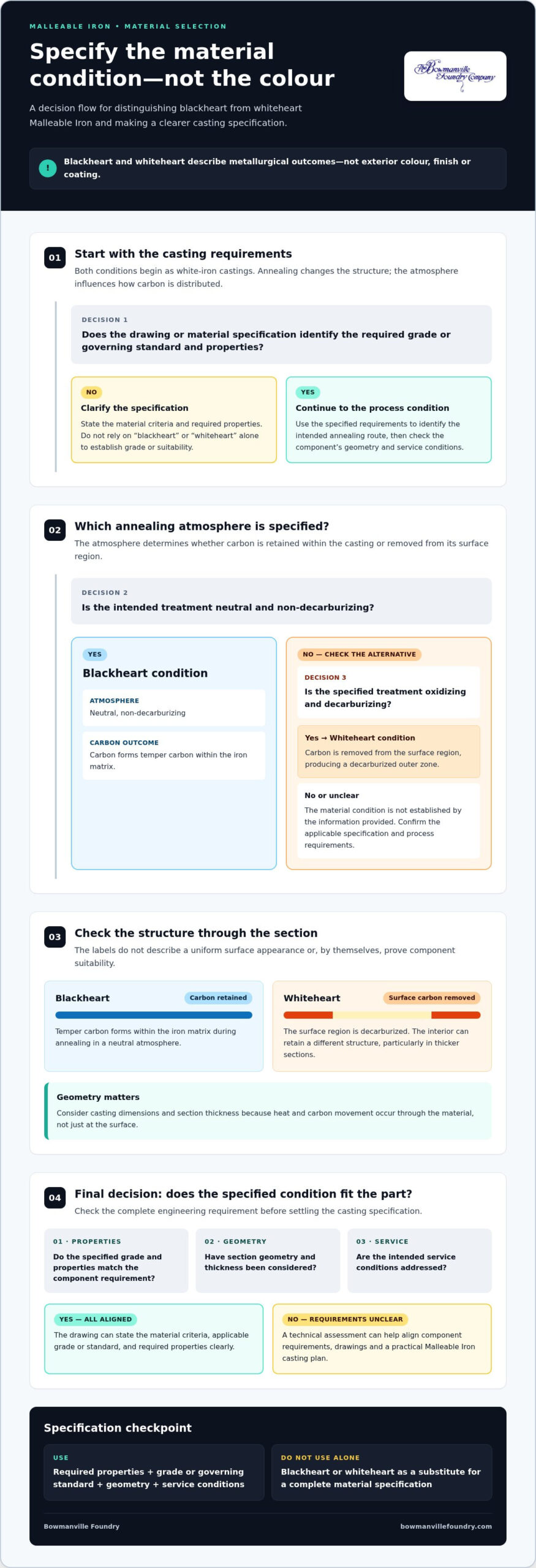
A clear specification connects material requirements to the part’s function and geometry. In the blackheart vs whiteheart malleable iron decision, the process label is only one part of the description. The drawing and purchase documents should identify the properties the component must meet and the service conditions it will face.
Use this sequence to organize the specification:
- Define service requirements. Record the component’s function, loading, operating environment and required material properties. Include relevant temperature conditions and finishing needs.
- Review the design information. Provide current drawings or CAD files, with critical dimensions and tolerances. Identify section changes, cores and features that affect casting design or machining.
- Set material criteria. State required properties and acceptance criteria. Name a governing standard or grade only when established by the engineering requirements.
- Assess casting feasibility. Review the material callout and part design together before finalizing the specification.
Information to include in a casting specification
Give the foundry enough detail to relate material requirements to the component. Alongside function, loading and operating environment, state the required properties and how they will be assessed. Drawings should identify critical dimensions and tolerances. CAD files can help communicate complex geometry, including core-created hollow sections and features that need machining.
List required machining, heat treating and surface finishing operations, and define sample approval needs. Sample approval allows the customer to validate a prototype casting against agreed requirements before full production begins. Keep the material callout, drawing notes and inspection criteria consistent.
When a technical assessment can resolve material uncertainty
A foundry engineer can review design intent, manufacturability and stated material criteria together. This technical assessment can identify where a drawing needs clearer requirements or where geometry, cores, tolerances and machining should be considered in the casting plan. For background on choosing an ideal iron casting grade or planning a custom iron casting production guide, use the relevant foundry resources alongside your engineering requirements.
Bowmanville Foundry’s engineering team provides technical assessments and on-site technical/sales engineer visits to discuss customer needs and requirements. Arrange a casting technical assessment to connect the component drawing with a clear material specification.
Turn the Material Comparison into a Clear Casting Plan
A sound casting plan moves from terminology to evidence: identify whether the design calls for blackheart or whiteheart Malleable Iron, verify required properties against the applicable material specification, then align those requirements with the component drawing. The term alone is not a complete material callout. Geometry, operating conditions, tolerances and finishing requirements all inform the technical review.
What to prepare before discussing a casting project
Gather information that explains both the part and its intended use. A clear project package helps the foundry team review design intent and assess casting feasibility.
- Current component drawings or CAD files, including critical dimensions, tolerances and features that may require cores or machining.
- Expected quantities, component function, loading, operating conditions and any relevant low temperature environments.
- Required finishing details, such as machining or surface treatment, and whether sample approval is part of the project plan.
- Existing material designations, standards, grades or performance criteria, along with questions about the blackheart or whiteheart terminology.
If engineering requirements establish a governing standard or grade, include it in the project information. If material criteria are still being assessed, identify that so the review can focus on the component’s needs rather than assumptions based on a label.
Get technical input on your Malleable Iron casting requirements
A foundry engineer can consider the drawing, stated properties, geometry and service conditions together to discuss casting feasibility and clarify material requirements. Bowmanville Foundry has produced iron castings since 1902 and operates a 38,000-square-foot plant. It was the first foundry in Canada to achieve ISO certification, in 1996. These facts provide context for a technical discussion, while the project’s specification and acceptance criteria remain the basis for review.
For custom component requirements, a technical assessment can translate an initial material comparison into a casting plan. Share the available project information or arrange an on-site technical/sales engineer visit to discuss your needs and requirements.
Discuss your casting requirements with Bowmanville Foundry.
Make Your Material Specification Ready for Review
To resolve the blackheart vs whiteheart malleable iron question, specify the required material condition, verify properties against the applicable grade, and keep the drawing, service requirements and acceptance criteria aligned. Neither name is a colour choice or a complete specification on its own.
For a custom component, Bowmanville Foundry’s engineering team provides technical assessments and on-site technical/sales engineer visits to discuss your requirements. Established in 1902, the foundry was the first in Canada to achieve ISO certification, in 1996, and operates a 38,000-square-foot plant.
Bring your drawings or CAD files, operating conditions and known material criteria to the discussion. Discuss your casting requirements with Bowmanville Foundry and take the next step towards a clear, component-specific casting plan.
Frequently Asked Questions
What is the difference between blackheart and whiteheart malleable iron?
The difference is the annealing atmosphere and the resulting carbon distribution within the casting. Blackheart malleable iron is annealed in a neutral, non-decarburizing atmosphere, allowing temper carbon to form within the iron matrix. Whiteheart malleable iron is annealed in an oxidizing atmosphere that removes carbon from the surface region. The blackheart vs whiteheart malleable iron distinction describes a metallurgical condition, not simply an exterior colour.
Is blackheart malleable iron stronger than whiteheart malleable iron?
Neither type can be ranked as stronger based on its name alone. Mechanical properties depend on the specified grade and applicable material requirements. Compare verified tensile strength, ductility, hardness and other relevant criteria for the particular grade, rather than relying on a general label or assumed ranking. For design, use documented property values and confirm that they match the component’s service requirements.
Does blackheart malleable iron mean the casting is black?
No. “Blackheart” refers to the metallurgical condition developed during annealing, not a requirement for a black exterior. A casting’s visible colour can reflect surface preparation, coating or other finishing. Blackheart iron cannot be identified reliably by exterior appearance alone. For procurement and design documentation, specify the material condition and applicable grade or requirements rather than using colour as a substitute for material identification.
How is whiteheart malleable iron produced?
Whiteheart malleable iron is produced by annealing a white-iron casting in an oxidizing, decarburizing atmosphere. The treatment removes carbon from the surface region, creating a decarburized zone. The structure inside may differ, particularly in thicker sections. The resulting material condition depends on the casting and heat-treatment process. Specify the required grade and properties using the applicable engineering requirements, not appearance or the name alone.
Can blackheart and whiteheart malleable iron be used interchangeably?
Do not treat them as interchangeable without reviewing the component specification and service requirements. The two conditions result from different annealing routes and can have different carbon distributions through the casting. Whether either meets a design requirement must be established using the required grade and verified properties. If a drawing or purchase document names one condition, resolve any proposed change through engineering review before revising the material callout.
What information should I provide when requesting a malleable iron casting assessment?
Provide current drawings or CAD files, the component’s function, loading, operating conditions, quantities, critical dimensions and tolerances. Include known material grades or standards, required properties, cores, machining and finishing details, and any sample approval requirements. These details help a foundry engineer review design intent and casting feasibility. List uncertainties about material terminology or geometry so the technical assessment can address them directly.
Are black pipe fittings the same as blackheart malleable iron?
No. “Black pipe fitting” commonly describes a product’s visible finish or appearance, while “blackheart malleable iron” identifies a metallurgical condition resulting from annealing. The word “black” has different meanings in these terms. A dark-looking fitting’s appearance alone does not establish its material structure or grade. For a casting specification, identify the required material condition and properties separately from any coating or surface-finish requirement.
