
What if a counterweight meets its target mass but does not fit the equipment or mounting points? Choosing a custom counterweights manufacturer starts with more than a weight figure. Load requirements, part geometry and interface details help determine whether the design will work in the assembly and can be produced as a casting.
Material and shape affect fit, performance and manufacturing feasibility. When drawings are incomplete or requirements are unclear, design decisions can lead to avoidable revisions. A clear technical brief gives the foundry a practical basis for assessing the component before production planning advances.
This guide explains how to define counterweight requirements, compare cast iron options and document features such as mounting holes, slots and finishing needs. It also outlines what to discuss with a manufacturing partner when reviewing casting capability and planning production. Bowmanville Foundry produces custom Gray Iron, Ductile Iron and Malleable Iron castings, with post-processing services for specified component requirements. These capabilities are relevant to buyers evaluating an iron casting for a counterweight application.
Key Takeaways
- Define the counterweight’s load, fit, operating conditions and mounting interfaces before settling on material or manufacturing route.
- Compare Malleable Iron, Ductile Iron and Gray Iron against the application’s requirements. High strength is only one design consideration.
- Evaluate a custom counterweights manufacturer by its engineering support, casting grades, quality system and ability to coordinate finishing.
- Prepare current drawings, CAD files, revision details, material requirements and production expectations for a focused project discussion.
- Discuss how design review, casting and required post-processing fit together in a practical path to a custom iron component.
What should a custom counterweight manufacturer understand about your application?
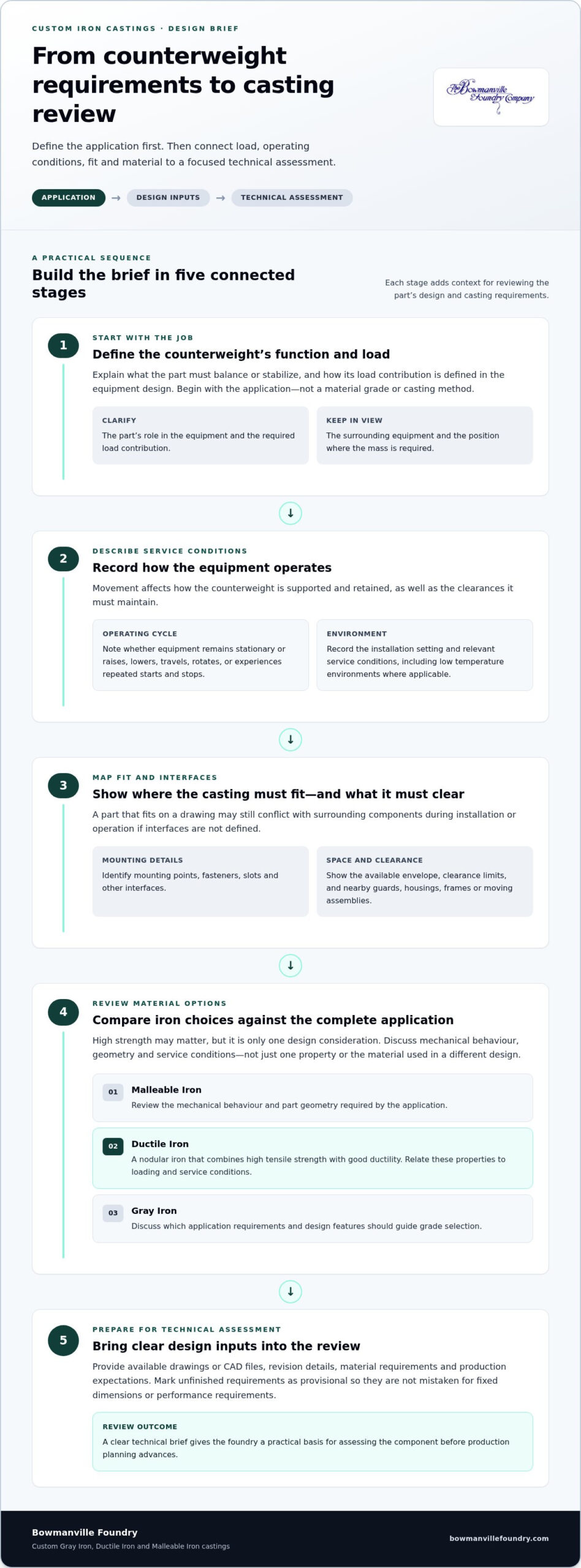
Start with the job the counterweight must perform, not with a material grade or casting method. A counterweight helps balance or stabilize equipment by placing mass in a required position. Its purpose is straightforward, but its shape, mounting details and production route depend on the equipment around it. The general role of a Counterweight appears across many types of machinery. The design brief needs to describe the operating conditions for the specific part.
For a custom iron casting, the application brief connects the part’s function to manufacturable geometry. Describe the required load contribution, available space, installation method and interfaces with connected components. Include drawings or CAD files where available, and identify requirements that affect dimensions or position. A custom counterweights manufacturer needs this context to assess whether the proposed geometry and casting route suit the intended application.
Consider movement as well as static fit. Equipment may raise, lower, travel, rotate or experience repeated starts and stops. These motions affect how the counterweight is supported and retained, as well as the clearances it must maintain. Nearby guards, housings, frames and moving assemblies also define the available envelope. A part that fits on a drawing may still conflict with surrounding components during installation or operation if those interfaces are not defined.
Which operating requirements belong in the initial brief?
Record the part’s function, operating cycle and installation environment before discussing material selection. Note how the counterweight is mounted, what it contacts and what it must clear. Where relevant, describe exposure to low temperature environments and other service conditions that could affect material behaviour or design review.
- Function and load: Explain what the counterweight balances or stabilizes and how its contribution is defined in the equipment design.
- Operating cycle: State whether the equipment remains stationary or moves during normal use. Describe repeated motion where it is relevant to the part.
- Fit and interfaces: Identify mounting points, fasteners, slots or other interfaces, along with clearance limits and adjacent components.
- Environment: Record the installation setting and relevant service conditions, including low temperature environments where applicable.
These details give the foundry a useful basis for a technical assessment. If a requirement is still being finalized, mark it as provisional. That prevents an assumption from being mistaken for a fixed dimension or performance requirement.
How do application examples shape the design conversation?
Examples provide context, but they do not define the specification. A crane, forklift and other mobile equipment may each use counterweights, yet their loading, mounting arrangements, available space and operating cycles differ. Even machines in the same category can require different geometry because their frames, interfaces and movement paths are not identical.
Use the application name to establish context, then describe the actual component requirements. State where the counterweight sits, how it is secured, which components surround it and what movement occurs nearby. Do not select a material grade just because another machine uses it. Reviewing load, fit, operating conditions and interfaces first helps the buyer and foundry discuss a suitable casting design without treating an example as a specification.
How do material and casting design affect a custom counterweight?
Material selection and casting design should follow the part’s function. A counterweight must meet its required load and fit the available space, while its material must suit the mechanical behaviour and service conditions. High strength may matter, but it is only one consideration alongside geometry, mounting features and equipment operation.
The useful question is not simply which iron has the highest strength. It is which material and casting configuration suit the complete application. A technical assessment can relate the design brief to the casting process and identify geometry questions before production planning proceeds. The Dynamic Properties of Counterweights paper from Purdue University offers further context on counterweight behaviour under dynamic conditions.
When should buyers discuss Malleable Iron, Ductile Iron, or Gray Iron?
Discuss material while reviewing the part’s required mechanical behaviour and operating conditions. Ductile Iron is a nodular iron that combines high tensile strength with good ductility. Malleable Iron and Gray Iron are also options for application-specific engineering review. Select the grade against the full set of requirements, not one property or the material used in a different design.
| Material option | Questions to address in the review |
|---|---|
| Malleable Iron | What mechanical behaviour and part geometry does the application require? |
| Ductile Iron | How do tensile strength and ductility relate to the part’s loading and service conditions? |
| Gray Iron | Which application requirements and design features should guide grade selection? |
For a closer comparison, Bowmanville Foundry’s iron casting grade selection guide outlines material-selection considerations. Use it to prepare project questions, then assess each option against the component’s stated requirements.
What design features can affect casting feasibility?
Section thickness, transitions between sections and overall geometry all inform casting design. A hollow feature may require a core, a hardened sand insert used to create hollow sections. Mounting holes, slots and interface surfaces also need to be shown clearly so the design review can consider how the casting fits with connected components.
Provide current CAD files where available. They communicate three-dimensional geometry, interfaces and dimensions more clearly than a written description alone. A technical assessment can identify questions such as whether a feature needs a core or a dimension needs clarification before production planning advances. This lets a custom counterweights manufacturer evaluate the design as a casting, rather than treating the drawing as a complete manufacturing plan.
To discuss iron casting requirements or arrange a technical conversation, contact Bowmanville Foundry.
How can you compare custom counterweights manufacturers?
Compare manufacturers against the needs of the part, not the strength of their marketing language. Look for relevant iron casting experience, engineering support, documented quality processes and coordination of required finishing. These criteria help distinguish demonstrated capability from broad claims that do not explain how a project moves from design review to production.
Use the same criteria for each supplier and record what the available documentation shows. Bowmanville Foundry produces custom Malleable Iron, Ductile Iron and Gray Iron castings, and offers post-processing services. In 1996, it became the first foundry in Canada to achieve ISO certification.
| Comparison area | What to look for | Bowmanville Foundry context |
|---|---|---|
| Engineering support | Can the team review part geometry, interfaces and production questions? | A technical assessment can address design feasibility and production requirements. |
| Casting grades | Are the iron options relevant to the specified mechanical behaviour and application? | Custom Malleable Iron, Ductile Iron and Gray Iron castings are produced. |
| Quality system | Are quality processes documented, and how do they address customer requirements? | The foundry was the first in Canada to achieve ISO certification, in 1996. |
| Finishing coordination | Can required post-processing be coordinated with casting and acceptance needs? | Post-processing services are available for casting projects. |
What evidence helps assess foundry capability?
Review material experience alongside the technical documentation used to define the part and its acceptance requirements. Clarify which post-processing operations the project needs and how they fit into the production plan. A technical assessment can identify geometry or manufacturing questions early. Bowmanville Foundry’s custom iron casting production guide provides further context for planning a casting project.
How should quality and finishing enter the comparison?
Discuss inspection expectations and acceptance criteria before production begins. Define which dimensions or features need review and what documentation is required for approval. If a prototype is part of the plan, sample approval is the customer’s validation of a prototype casting before full production begins. Agree on the criteria for reviewing the sample and record the outcome against the relevant part revision.
Plan finishing around the component’s requirements. Machining may be needed for specified interfaces; heat treating or surface coating should be included when the requirements call for them. A custom counterweights manufacturer should be able to discuss how casting and required post-processing fit together, so handoffs and acceptance expectations are clear.
To discuss an iron casting project and its requirements, contact Bowmanville Foundry’s technical team.
What information should you prepare before requesting a counterweight quote?
A clear request for quotation (RFQ) gives a foundry the information needed to review the part, identify open questions and plan next steps. Send the latest design information, distinguish confirmed requirements from assumptions, and describe the intended production scope. A useful casting RFQ brings the component requirements together with current design documents.
Use this checklist to assemble the request:
- 1. Part function and expected load: Explain what the counterweight does, how it contributes to balancing or stability, and any known load requirements.
- 2. Drawings and revisions: Provide current drawings and CAD files where available. Include dimensions, tolerances, revision identifiers and notes that clarify which version governs.
- 3. Interfaces and operating conditions: Show mounting features and connected surfaces. Describe relevant movement, clearances and service conditions.
- 4. Material requirements: State the specified iron type or grade if it has been selected. If selection is still open, identify the required mechanical behaviour and operating conditions for review.
- 5. Production expectations: Describe the expected production scope and any planning or delivery requirements that affect the project schedule.
- 6. Inspection and finishing: Identify inspection expectations and acceptance criteria. Specify required machining, heat treating or coating, and whether sample approval is part of the process.
Separate mandatory requirements from items open to review. For example, if a mounting dimension is fixed but a non-functional surface can be discussed, make that distinction explicit. If a drawing is being revised, mark the superseded version so it is not mistaken for the current design.
Which documents and specifications support a useful technical review?
Attach drawings or CAD files that show dimensions, tolerances and revision details, along with notes needed to interpret them. Document mounting interfaces, expected loads and known operating conditions. List inspection and finishing requirements in the RFQ rather than relying on assumptions. If sample approval is required, describe the approval point and the criteria for evaluating the casting.
How does an engineer help resolve open design questions?
A technical assessment is an evaluation by a foundry engineer of a part design’s feasibility. Direct discussion can clarify assumptions, identify missing information and distinguish essential specifications from details that remain open. This is useful when drawings are incomplete or the material choice is still under review.
Before submitting the RFQ, gather questions from engineering, procurement and quality teams so the foundry receives a consistent set of requirements. Bowmanville Foundry’s technical or sales engineer can discuss the project details with you. Request a technical or sales engineer discussion to review your requirements and available design information.
How does Bowmanville Foundry support a custom iron casting project?
Bowmanville Foundry produces Malleable Iron, Ductile Iron and Gray Iron castings, with post-processing services for finished component requirements. A custom iron casting project begins with a discussion of the customer’s requirements and available design information. That context guides design review, material discussion and production planning for a component made to the project specification.
Buyers evaluating a manufacturer for a custom counterweight component can bring drawings, CAD files and project questions to a technical or sales engineer. The discussion can focus on how the part’s geometry and interfaces relate to the casting plan, and which finishing operations are needed to meet the drawing requirements. Customers can also arrange an on-site technical or sales engineer visit to discuss their needs and requirements.
What does an iron casting project pathway involve?
After the initial discussion, design review aligns the part information with the planned production route. Pattern development and preparation support mold creation. Molding forms the cavity, and pouring fills it with molten iron. The sequence and details depend on the design and project requirements.
After casting, required post-processing is planned against the component’s specified features and acceptance criteria. If customer validation is part of the project plan, sample approval provides a review point before full production. Clear revision control and agreed inspection expectations help keep the design, casting and finishing stages aligned.
Where can buyers get further technical support?
For general guidance on material and casting decisions, the free Casting Buyer’s Guide is a useful resource. Buyers planning finished components can also consider how casting and machining requirements fit together, as outlined in integrated iron casting and machining.
Bowmanville Foundry’s experience in iron casting supports project discussions grounded in the supplied design information and production requirements. Discuss your iron casting project with a Bowmanville Foundry technical or sales engineer to identify the next steps for your component.
Move your casting project forward with a clear brief
A well-defined project gives engineering and production teams a shared starting point. Before moving ahead, make sure the latest drawing reflects the intended interfaces, required features and acceptance criteria. Mark details that are still under review so they can be addressed during technical discussion rather than treated as fixed specifications.
Choosing a custom counterweights manufacturer is ultimately about aligning the component’s purpose with a feasible casting plan. A focused conversation can connect your design information and material requirements to the next steps for a custom iron casting project.
Discuss your custom iron casting requirements with Bowmanville Foundry. Bring your current drawings, CAD files and outstanding questions to start a practical review of the project.
Frequently Asked Questions
What information should I send a custom counterweights manufacturer?
Along with the technical package, include context that may not appear on the part drawing. For a replacement component, a photograph of the installed part or a physical sample can help explain its orientation and surrounding assembly. Identify the equipment or assembly by its internal part number, and note whether the request concerns a new design or a replacement. This context can help prevent confusion between similar-looking components.
Can a counterweight be made from cast iron?
Yes, cast iron can be used for counterweight components when it suits the application. Its density can provide the required mass within a compact form, but replacing a component made from another material is not automatically a direct substitution. Differences in mass, dimensions and attachment details can affect the assembly. Treat material changes as an engineering decision and review the resulting part requirements before adopting a casting design.
How does a foundry assess whether a counterweight design is castable?
A foundry can review features that affect pattern and mold production, including the parting line, pattern withdrawal and how molten iron reaches thicker sections. For example, a recessed feature may affect mold construction, while a change in section size may prompt review of how the casting will form. These are design-review considerations, not automatic reasons to reject a part. The foundry can discuss possible approaches with the customer.
What is sample approval for a custom iron casting?
Sample approval is also a useful point to formalize decision-making. Before reviewing a sample, the customer and foundry can agree who has authority to approve it, how comments will be recorded and how any deviation from the drawing will be handled. Keep the approval record with the relevant part revision. This creates a clear reference for production and helps prevent informal feedback from being mistaken for an approved design change.
Can a foundry machine or finish a custom iron counterweight?
Yes, Bowmanville Foundry offers post-processing services for iron castings. For machining, identify datum references and indicate which surfaces or features are to be machined rather than relying on a general note. If a coating is specified, state any areas that must remain uncoated. These instructions help define the finished component and clarify the handoff between casting and secondary operations.
Why do counterweight manufacturers ask for CAD files?
CAD files can help reviewers compare design iterations and spot changes that may be difficult to see in drawing views, such as a moved recess or modified internal feature. They are especially useful when several teams have contributed revisions. Send the model associated with the current design and identify known differences from earlier versions, so the review focuses on the intended configuration rather than an outdated iteration.
