
For ductile iron valve bodies, pressure and flow requirements are only part of the design brief. Service conditions, connection details and internal passages also influence whether a design can be moulded, cored and machined as intended.
Turning those requirements into a cast component takes coordination between functional design and production planning. Wall sections, passage locations, cores and machining allowances affect the two-half mold, pattern design and finishing plan. A feature that supports flow or assembly may also add complexity to molding or machining, so it is worth reviewing these considerations together.
This article explains how valve-body features inform casting design and what to prepare for a foundry technical assessment. You’ll learn how service and connection requirements relate to geometry, where molding, coring and machining enter the review, and how early technical discussion can support practical production planning. Use these points to assess a custom design and prepare a focused discussion with a ductile iron casting partner.
Key Takeaways
- Understand how pressure containment and flow requirements inform valve-body design.
- See how CAD files, a foundry technical assessment, pattern planning and sample approval connect design to production for ductile iron valve bodies.
- Review passage layout, connection interfaces, core complexity, machining surfaces and inspection needs as part of one design assessment.
- Prepare application details, service conditions, drawings, material requirements, quantities and finishing requirements for a useful casting assessment.
- Learn how Bowmanville Foundry’s casting and post-processing services support production planning for custom components.
What Makes a Ductile Iron Valve Body Suitable for Casting?
A valve body is the main pressure-containing housing of a valve. It directs flow through the valve and supports its openings, connections and other interfaces. A ductile iron valve body is this housing made as a casting from Ductile Iron. Its suitability depends on the application, the specified material requirements and the component design.
Buyers consider Ductile Iron for valve-body components because it combines high tensile strength with good ductility and is suitable for medium to large castings. These properties make it a material option to assess, not a guarantee that a design will meet every service requirement. For an introduction to the material, see this overview of Ductile Iron. Project specifications and component needs should guide the actual selection.
Which valve-body requirements should be established first?
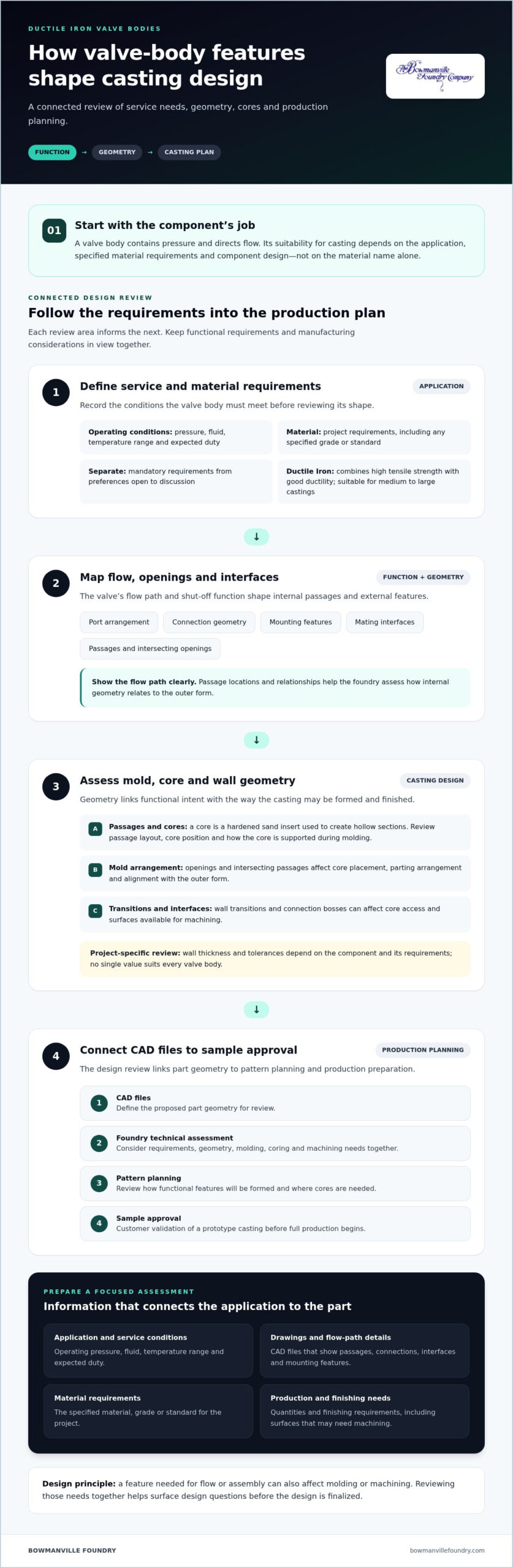
Start with the application documents. Record the service conditions, operating pressures, fluid, temperature range and expected duty, along with any material requirements specified for the project. Then document the port arrangement, connection geometry, mounting features and mating interfaces. Separate mandatory requirements from design preferences so the foundry can assess the part against clear criteria and identify where there is room for discussion.
How does valve function shape the casting?
The valve’s flow path and shut-off function determine the arrangement of internal passages and external features. Openings that meet or intersect inside the body affect how the mold cavity is formed and where a core, a hardened sand insert used to create hollow sections, may be required. Show the locations and relationships of these features clearly so the molding and coring plan can be considered alongside valve function.
Geometry connects functional intent with production planning. A passage, wall transition or connection boss may be essential to operation, while also affecting the parting arrangement, core access or surfaces available for machining. These considerations are not reasons to remove necessary features. They are reasons to review the design before it is finalized, while possible changes can still be discussed.
Keep material selection distinct from verification of the finished component. The project requirements should define the specified material and any applicable grade or standard. The body’s design must then be assessed against those requirements and its manufacturing needs. A material name alone does not establish that a finished component is suitable. A foundry technical assessment brings the requirements and proposed geometry into the same review.
For engineering and procurement teams, a clear definition of the service conditions and interfaces provides a practical starting point. Identify requirements that cannot change, note preferences that are open to discussion, and provide drawings that show the flow path through the housing. This connects valve function to castable geometry without assuming that material choice alone settles the design.
How Casting Design Shapes Ductile Iron Valve Body Geometry
Developing a valve-body casting involves more than transferring a finished outline to a pattern. The process begins with CAD files that define the part geometry, then moves through a foundry technical assessment, pattern planning and sample approval. At each stage, engineers can review how functional features will be formed, where cores are needed and which surfaces may require machining.
For ductile iron valve bodies, internal passages need early attention. A core is a hardened sand insert used to create hollow sections in a casting. Placed within the mold cavity, it forms internal passages and intersecting voids that the outer mold alone cannot create. The proposed passage layout must be reviewed alongside how the core will be positioned and supported during molding.
What design features affect mold and core planning?
Review passage geometry, openings, intersecting cavities and core positions as connected features. For example, where two passages meet, the design should show their location and relationship clearly enough for the mold and core arrangement to be assessed as a whole. Clearly defined geometry gives pattern planners useful information and helps surface design questions before tooling is finalized.
No single wall-thickness value or tolerance suits every valve body. These details depend on the component and its requirements, so establish them through project-specific review rather than assumption. A foundry technical assessment can consider the CAD files and discuss how the proposed geometry translates into a mold and core plan.
The mold cavity is formed through mold compaction: sand is squeezed in a flask, the metal frame that holds the mold, to take the shape of the pattern. The two resulting halves form a two-half mold. Joined together, they create the cavity for the casting. Openings and intersecting passages influence where the core sits within that cavity and how the internal geometry aligns with the outer form. The Ductile Iron Society provides further industry information on the material and casting context.
How do patterns and sample approval support production?
A pattern is the form used to create the mold cavity. Depending on the production plan, patterns may be arranged on a matchplate, a plate holding multiple patterns for simultaneous production of similar castings. A pattern framing facility is the workshop area where patterns are assembled and prepared for molding. These planning steps connect the part’s geometry to the way the mold will be made.
After a sample casting is produced, sample approval is the customer’s validation step before full production begins. It allows the customer to review the sample against the agreed design and requirements. For a valve body, include specified component features and any required machining or finishing in that review. Bowmanville Foundry’s technical team discusses custom casting designs and production planning through a foundry technical discussion.
How to Assess a Ductile Iron Valve Body Casting Design
Assess a valve-body design against two connected questions: does the geometry meet the valve’s functional requirements, and can the proposed features be planned for casting and finishing? Reviewing these together helps engineers identify missing details and questions to resolve before production planning advances.
A useful technical assessment relies on clear, documented requirements. Use the project specification and current drawings as the reference. Flag unresolved details instead of relying on assumptions.
Which design details deserve an engineering review?
Check that CAD files and drawings communicate dimensions, connection interfaces and required features consistently. Then focus on areas that need particular mold or core planning, such as deep passages, intersecting cavities and openings that affect internal geometry. Identify machining surfaces and finish requirements separately from the as-cast geometry so each can be assessed in context.
- Passage layout: Compare the flow-path requirements with the openings and intersections shown in the design. Note any geometry that needs clarification.
- Connection interfaces: Confirm that mating faces, ports and mounting features are identified and dimensioned in the project documents.
- Core complexity: Flag hollow sections and intersecting passages that rely on cores. Include the design details needed to show their positions.
- Machining surfaces: Identify surfaces that require machining and distinguish them from the cast form.
- Inspection requirements: Record the inspection criteria specified for the component. Do not assume a method or acceptance limit that the project documents do not state.
These are review prompts, not universal pass-or-fail rules. A passage arrangement that suits one component may raise different questions for another, depending on its design and requirements. Evaluate geometry, core planning and machining for the specific project.
When should post-processing be part of the casting plan?
Include machining, heat treating or surface coating in the plan when the component specification requires it. Each operation affects the information needed for production planning. For example, identify designated machining surfaces on the drawings and state any specified finish clearly rather than relying on an inference from the casting geometry.
Early coordination connects the casting form with required post-processing. It allows the technical team to review interfaces and finishing needs as part of the same production discussion, rather than treating them as separate afterthoughts. The iron casting post-processing guide explains how casting and machining considerations can be coordinated.
For a focused design review, provide consistent drawings, identify mandatory requirements, and list inspection and finishing needs explicitly. This gives the foundry a clear basis for assessing the proposed geometry and discussing manufacturing considerations for the component.
What Information to Prepare for a Valve Body Casting Assessment
A well-prepared enquiry gives the foundry team a clear basis for reviewing design feasibility, mold and core planning, and production needs. For ductile iron valve bodies, provide project requirements in a consistent package and identify any gaps that need engineering discussion. Include standards and acceptance criteria only when the buyer has specified them for the component.
Which files and specifications should buyers assemble?
Gather the current design and project documents before requesting an assessment. Use this checklist to confirm that the essential information is available and open questions are visible.
- Application: Describe the valve’s role and how the body fits into the larger assembly. Include assembly information that clarifies interfaces and mounting requirements.
- Service conditions: Document operating pressures, fluid, temperature range and expected duty from the project specification. Include other stated conditions that affect component requirements.
- Drawings and CAD files: Provide current CAD files, dimensioned drawings and revision details. Check that interfaces, passages and required features are represented consistently across the documents.
- Material requirements: State the specified material, grade or standard when required by the project. Use requirements supplied by the buyer rather than assuming a grade or acceptance criterion.
- Quantity: Identify the anticipated production quantity and any relevant order phasing so production planning can be discussed in context.
- Inspection and finishing: List inspection criteria and required finishing operations, such as machining or surface treatment, as stated in the component specification.
Mark unresolved dimensions, conflicting revisions or missing values for review. Do not fill gaps with assumptions. A clear note separates confirmed requirements from questions that need a decision.
How does a foundry technical assessment help?
During a technical assessment, foundry engineers review the component design against the information provided. The discussion can cover mold planning, core requirements, pattern considerations and production needs, while identifying details that need clarification. Complete, consistent documents help keep the review focused on the actual part and its specified requirements.
Include sample approval in the project plan as the customer’s review and validation of a sample casting before full production begins. Agree on what will be reviewed and which requirements apply to establish a clear transition from design evaluation to production planning.
Timing also belongs in early planning. Tooling can be produced in two to four weeks, and typical lead times are four to eight weeks, depending on current business conditions. Use these as planning references and discuss the project schedule in relation to its requirements. Buyers comparing material options can consult the iron casting grade selection guide as they prepare the specification.
Share your drawings and project requirements with Bowmanville Foundry to begin a valve-body casting assessment and discuss production planning.
Developing Custom Ductile Iron Valve Bodies with Bowmanville Foundry
Developing custom ductile iron valve bodies calls for a practical exchange between the component team and the foundry. Bowmanville Foundry manufactures custom Ductile Iron castings for industrial applications and provides technical assessment and related post-processing. Reviewing requirements early connects the valve body’s intended function and design details with casting, finishing and production planning.
Bowmanville Foundry has operated since 1902 and was the first foundry in Canada to achieve ISO certification, in 1996. Its modern 38,000-square-foot plant supports its iron casting work. Buyers can consider this history and quality framework alongside the technical requirements of a custom component.
What does a custom casting project involve?
A project moves from customer requirements into a technical assessment, followed by tooling and casting planning. The review considers the supplied component information and how its features relate to the proposed manufacturing plan. Once a sample is available, sample approval provides the customer’s review before full production begins. Project requirements guide the sequence and decisions at each stage.
Planning also covers work after casting. Bowmanville Foundry’s one-stop-shopping approach coordinates casting, post-processing and logistics support for the customer. Coordinating these activities can reduce hand-offs between separate providers and connect discussion of the component, finishing needs and movement of the finished casting. The project requirements define the scope of work.
The foundry also discusses how specified machining or other post-processing fits with the casting plan. Drawings that identify required interfaces and finishing operations, for example, give the technical team a useful basis for reviewing the component as a whole. Clear project documentation helps align casting and subsequent work with the buyer’s requirements.
How can buyers start a technical discussion?
Bring the information that defines the project: current drawings and CAD files, service conditions, material requirements, quantity expectations and applicable acceptance criteria. Include revision details and identify open engineering questions. This gives the foundry team a practical starting point for discussing design feasibility, production planning and the post-processing requirements for the component.
Buyers can discuss a valve-body project directly with Bowmanville Foundry or arrange an on-site technical/sales engineer visit to review needs and requirements. A focused conversation can clarify which project details should guide the next steps, from design review through casting and finishing.
Discuss your ductile iron casting requirements with Bowmanville Foundry and start a technical conversation about your custom valve-body project.
Move Your Valve-Body Design Towards Production
Turn the current design into a shared engineering basis for decisions. Before treating revisions as final, align the project team on which requirements are fixed, which details remain open and who will approve proposed changes. This gives the foundry discussion a clear purpose and keeps design decisions connected to the component’s intended service and production plan.
For ductile iron valve bodies, a focused conversation can identify the information needed to assess the design and plan the work ahead. Bring current drawings or CAD files, applicable material and acceptance requirements, and a concise record of unresolved questions. Bowmanville Foundry can discuss how these project details relate to custom casting and post-processing.
Discuss your custom ductile iron valve body project and take the next step towards a well-defined casting plan. Clear project information gives the technical discussion a useful starting point.
Frequently Asked Questions
What is a ductile iron valve body?
A ductile iron valve body is the cast housing that forms the valve’s main structural enclosure. It is distinct from the bonnet and internal operating parts, which have separate roles in enclosing or controlling the mechanism. The body provides the structure around which the valve’s specified connections and operating elements are arranged. Keeping these part boundaries clear helps when reviewing an assembly drawing.
Can ductile iron be used for custom valve body castings?
Yes. Bowmanville Foundry manufactures custom Ductile Iron castings for industrial applications, including components developed to customer requirements. A custom design allows the project team to define the body around its intended assembly rather than assume a standard catalogue configuration. The material and design still need to be evaluated against the application’s requirements, so keep the casting drawing consistent with the governing project documents.
How are internal passages formed in a cast valve body?
Internal passages are formed with sand cores placed within the mold. As a practical design check, show how each passage relates to the openings on the outside of the body, and provide sections where the route is hidden in a standard view. The drawing should make the intended passage shape clear without relying on assumptions from an assembly image or an incomplete view.
What drawings should I provide for a ductile iron valve body casting?
Provide a controlled drawing package with a clear revision status, consistent units and enough views to describe hidden or intersecting features. Identify the dimensions that govern fit with adjoining equipment and check that they agree across the drawing set. If you include an assembly view, use it to clarify orientation and interfaces. The part drawing should define the casting itself.
Does a cast valve body require machining after casting?
Machining depends on the specified finish and dimensional requirements. For example, the project may call for selected connection faces or other interfaces to be machined while leaving other areas in their as-cast condition. The drawing can distinguish these surfaces and identify relevant datums, the reference features used to locate measurements or machining operations. This helps avoid assuming that every surface needs the same treatment.
How long does ductile iron valve body casting production take?
Tooling can be produced in two to four weeks, and typical lead times are four to eight weeks, depending on current business conditions. The project schedule depends on its requirements and production sequence. Discuss milestones for design review, tooling, sample evaluation and release to production, and identify who will review the sample and how approval will be communicated. This makes schedule dependencies visible to engineering and procurement.
What information affects a valve body casting assessment?
Beyond part geometry, tell the foundry team which document governs if drawings and specifications conflict, and who can resolve open technical questions. Identify the intended decision at the end of the review, such as clarifying a design point or agreeing on the next project stage. Recording these responsibilities reduces ambiguity and gives the technical discussion a defined outcome.
