
A machine base can meet a strength target and still compromise precision if its geometry, damping, or machined interfaces don’t suit the machine’s operating loads. Are gray iron machine bases right for your application? The answer depends on more than the material grade.
Strength is only one design consideration. Vibration, section thickness, mounting features, and machining allowances also affect how a casting performs and fits. Gray Iron’s vibration-damping characteristics may suit machine structures, while casting geometry and cooling conditions influence the properties achieved in different sections.
This article explains how to assess Gray Iron against your machine’s loads and operating conditions, and how to resolve design and production details before requesting a foundry quotation. You’ll learn which material properties and base features deserve attention, how machining and tolerances affect finished interfaces, and what technical information helps a foundry assess feasibility. Define these requirements early to make a more informed material choice and prepare CAD files and specifications for a clear production discussion.
Key Takeaways
- Define the machine base’s structural role, mounting interfaces, alignment needs, and service conditions before settling on a design.
- Assess Gray Iron properties in relation to the application, and distinguish general material characteristics from grade-specific performance.
- For gray iron machine bases, judge suitability against the machine’s requirements rather than relying on a blanket strength assumption.
- Prepare CAD files, load information, interface details, and machining requirements to support a useful foundry technical assessment.
- Bowmanville Foundry produces three grades of Gray Iron and coordinates custom casting production with post-processing for finished components.
What Does a Grey Iron Machine Base Need to Do?
An industrial machine base is a structural casting or assembly that supports equipment and positions it in relation to other components. Its job is not simply to hold weight. It must provide mounting points and interfaces that help maintain the intended alignment during operation. Unlike a furniture base, where appearance and general support may be central, an industrial design must account for equipment loads, precision interfaces, and working conditions.
A machine base’s function determines the loads, interfaces, geometry, and machining requirements its design must address. For example, a base supporting a motor and a cutting tool may need to accommodate the equipment’s static weight as well as forces generated during operation. The relevant requirements depend on the specific machine and its engineering data.
Which machine-base requirements should be established first?
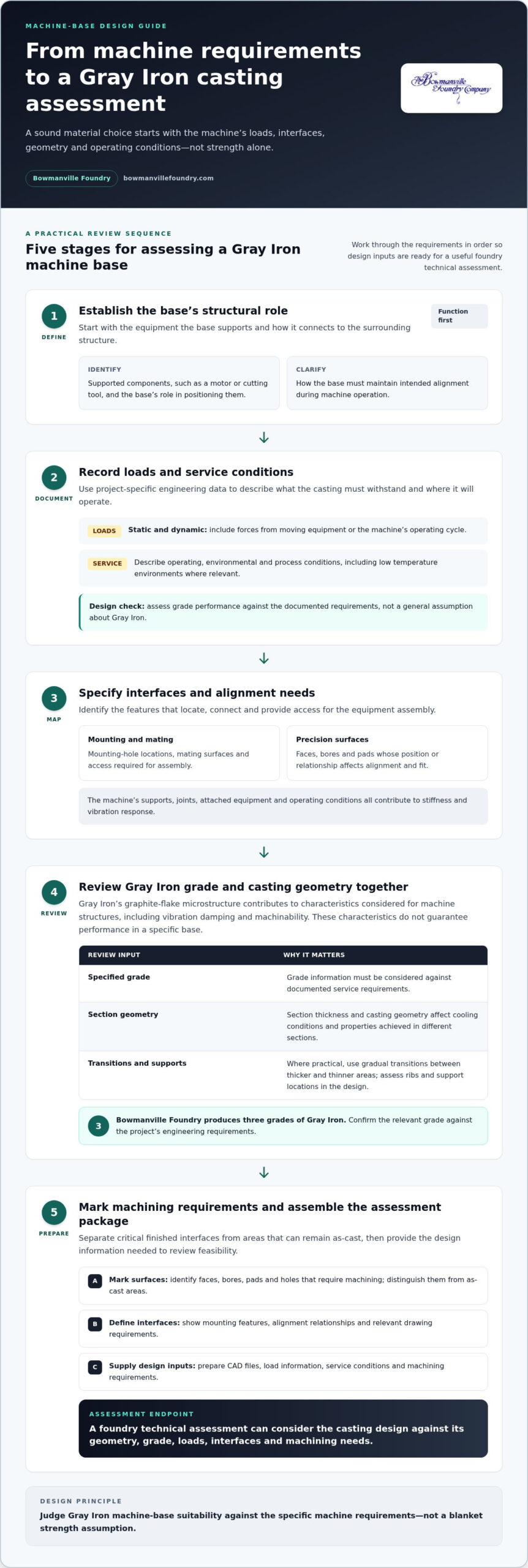
Start with the equipment the base will support and how it connects to the base and surrounding structure. Record operating conditions and identify the loads the design must withstand. These inputs help engineers assess the geometry, support locations, and surfaces that require controlled alignment.
- Equipment and interfaces: Identify supported components, mounting-hole locations, mating surfaces, and access needed for assembly.
- Loads: Document static and dynamic loads, including forces associated with moving equipment or the machine’s operating cycle, using project-specific engineering data.
- Service conditions: Describe how and where the machine will operate, including environmental or process conditions that could affect the base.
- Surface requirements: Mark which faces, bores, pads, and holes require machining, and which areas can remain as-cast.
This distinction matters because machined features need adequate material allowance and clear drawing requirements. Treating every surface as machined can add unnecessary operations, while failing to identify a critical mounting face can compromise assembly fit. Define the functional surfaces and their relationships before finalizing the casting design.
Why consider gray iron for a machine base?
Gray iron contains graphite in flake form within a metallic matrix. This microstructure contributes to characteristics often considered for machine structures, including vibration damping and machinability. Graphite flakes can help interrupt vibration transmission, but the behaviour of a finished base depends on the material grade and component design.
Vibration damping may be relevant where machine operation can produce vibration or resonance. It is not a performance guarantee: operating speed, load, geometry, support conditions, and the complete machine structure all affect behaviour. The properties of gray iron provide background on its microstructure and general characteristics, but a material overview cannot establish suitability for a particular component.
For gray iron machine bases, assess the specified grade alongside section geometry, expected loads, alignment needs, and service conditions. These requirements guide material selection and provide the basis for a foundry technical assessment of the casting design.
How Gray Iron Properties Shape Machine-Base Design
Material properties inform a machine-base design, but they do not define it on their own. Consider Gray Iron’s characteristics alongside the specified grade, casting geometry, load paths, and interfaces that will be machined. A property stated for a grade should not be treated as a guarantee that every section of a casting will behave identically.
Grade selection must reflect documented service requirements, not a general assumption about what Gray Iron can withstand. Define the operating conditions and required performance first, then review the grade and component design against those inputs. An industry roadmap discussing metalcasting industry trends offers broader context, but project-specific material decisions depend on verified grade information and engineering requirements.
How do strength, stiffness, and vibration requirements affect selection?
For a machine base, high strength means the ability to withstand stresses from specified loading conditions without deformation or failure. The design review should account for how forces enter the casting and pass through supports, ribs, and mounting features. A grade’s stated strength is one selection input, not a substitute for checking the component’s geometry and service loads.
Stiffness describes resistance to elastic deflection, while vibration response reflects how the complete structure behaves under operating forces. Both depend on more than the material: section layout, support points, joints, attached equipment, and operating conditions contribute. Gray Iron’s damping characteristics may inform the design, but they do not establish the performance of the assembled machine. Include low temperature environments in the material review, since service temperature can affect material behaviour.
What design features support a sound gray iron casting?
Section thickness affects how a casting cools, so abrupt changes in mass can create uneven cooling conditions. Where practical, use gradual transitions between thicker and thinner areas. Ribs can add support, but their size, spacing, and connection to surrounding walls should be reviewed as part of the complete casting design.
Internal cavities may be formed with a core, a hardened sand insert placed in the mold to create hollow sections. Core position and geometry affect the casting layout and should be clear in the part design. If cavities are not needed for function or assembly, avoid adding them solely to reduce material. Their production requirements also need assessment.
Keep general design guidance separate from grade-specific limits. Minimum sections, transitions, and other casting details should follow verified foundry guidance for the selected material and process. A foundry technical assessment can review the geometry and production feasibility alongside the specified grade. For a project discussion, speak with Bowmanville Foundry’s technical team about the design inputs for that review.
Is Gray Iron Strong Enough for Your Machine Base?
It can be, when the specified Gray Iron grade and casting design meet the machine’s documented requirements. “Strong enough” is not a general material ranking. The answer depends on the loads the base must carry, how those loads enter the casting, the service environment, and the performance required at mounting and alignment interfaces.
Assess the application before judging the material. A base supporting a steady load presents different design questions from one exposed to repeated impacts or changing operational forces. The table below organizes the information needed for a useful review.
| Design input | What to establish | Evidence for review |
|---|---|---|
| Loads | Static and dynamic loads, including where and how they act on the base | Project engineering data, load cases, and operating details |
| Geometry | Section layout, support locations, and features that carry or transfer loads | Current drawings or CAD files with relevant dimensions |
| Service conditions | Operating environment, temperature conditions, and any impact or unusual loading | Equipment specifications and service history, where available |
| Interfaces | Mounting points, mating surfaces, alignment needs, and machined features | Interface drawings, fit requirements, and machining specifications |
| Material evidence | Required grade and properties relevant to the application | Verified grade-specific data and the project’s material requirements |
When can Gray Iron meet the application requirements?
Start with the engineering loads, casting geometry, operating environment, and component interfaces. Then compare those requirements with verified information for the proposed grade. This ties the decision to the actual part rather than broad claims about Gray Iron or a single strength value.
Vibration damping may matter where machine operation makes vibration response a design concern. Machinability may also be relevant when mounting faces, bores, or other interfaces need finishing. Neither characteristic proves suitability on its own. Final selection requires grade-specific data and an application review that considers how the complete base will be loaded and supported.
When should the design receive closer material review?
Arrange a closer review if the base experiences impact loading, unusual service conditions, or low temperature environments. These conditions can change which material properties need attention. Provide the operating details and relevant engineering requirements so the grade and design can be assessed for the intended service.
A material change can affect more than the specification. It may require adjustments to section geometry, casting features, production planning, or machining operations. Ductile Iron may be considered as an alternative where the application calls for a review of different material characteristics. Selection should still be based on documented requirements, not a blanket ranking. For gray iron machine bases, a foundry technical assessment can bring the grade, casting design, and finished interfaces into one project-specific review.
What to Prepare Before Designing or Ordering a Gray Iron Machine Base
A production-ready design package gives the foundry a clear basis for reviewing material, geometry, casting feasibility, and finishing requirements. For gray iron machine bases, unresolved details such as mounting-hole locations or which faces require machining can affect both the casting design and finished component. Organize the information before requesting a technical assessment.
- Gather application requirements. Identify the equipment the base will support, operating loads, service conditions, and the required Gray Iron grade or material properties. Include relevant engineering data rather than relying on general descriptions such as “heavy duty.”
- Define interfaces. Document mounting points, mating components, alignment needs, assembly access, and features that connect the base to the machine or its foundation.
- Prepare drawings and CAD files. Supply current part geometry with critical dimensions and clearly distinguish machined surfaces from as-cast surfaces.
- Review the package with the foundry. A technical assessment can identify questions about geometry, production feasibility, machining, or missing requirements before production planning proceeds.
- Plan sample approval. Sample approval is the process where the customer validates a prototype casting before full production begins. Define which features and interfaces need review so acceptance is based on agreed requirements.
Which engineering information should the drawing package include?
Include overall dimensions, section details, mounting interfaces, and dimensions that control fit or alignment. Mark machined surfaces, required surface finishes, and applicable tolerances. Assign tolerances to functional features rather than assuming they apply uniformly across the casting. Include material requirements, expected loads, and relevant service conditions so the package describes both the part and its intended use.
For grade selection, connect the required material properties to documented application needs. The article How to Choose the Ideal Iron Casting Grade: A Selection Guide can provide supporting context for organizing that review. Keep the drawing, material specification, and inspection requirements aligned. Conflicting revisions can create uncertainty during assessment and production.
How do casting and machining planning work together?
A two‑half mold is formed by joining two compacted sand halves to create the casting cavity. During mold compaction, sand in a flask takes the shape of the pattern. The part’s geometry must suit this molding process, while any required internal cavity may call for a core. Discussing these features during drawing review helps align the part design with the casting plan.
Machining may be needed for mounting faces, bores, or other interfaces that require a defined fit. Identify those areas on the drawing so casting and finishing can be planned together. For details on finishing operations, see Integrated Iron Casting and Machining in Canada: A Guide to Post-Processing. To discuss a machine-base drawing package and its production requirements, contact Bowmanville Foundry’s technical or sales team.
How Bowmanville Foundry Supports Custom Gray Iron Machine-Base Projects
Custom machine-base work starts with the application requirements, not a standard shape. Bowmanville Foundry reviews part geometry, specified Gray Iron grade, mounting interfaces, loads, and machining needs as related parts of the project. This technical assessment helps identify production considerations early and gives the foundry a clear basis for planning a custom casting and any required post-processing.
Bowmanville Foundry produces three grades of Gray Iron. Match grade names and material requirements to the project specification rather than assuming them from a general application description. Established in 1902, the foundry was the first in Canada to achieve ISO certification in 1996.
What happens during a technical assessment?
A technical or sales engineer reviews the drawing package and discusses how the design relates to its intended service. The assessment can cover casting feasibility, material grade, critical interfaces, as-cast and machined surfaces, and post-processing for the finished component. Clear information about loads and operating conditions helps keep recommendations tied to the machine-base requirements.
Part geometry is reviewed in relation to the casting process, including features that may affect mold design or require a core. The assessment can also identify where machining is needed to achieve the specified mounting or alignment interfaces. Project requirements guide recommendations and production planning, so the drawing and specification should describe the part’s functional needs clearly.
How can a project move from assessment to production?
Once the design package is ready, the project can proceed through drawing review, tooling planning, casting, and any agreed machining or other post-processing. Sample approval gives the customer an opportunity to validate a prototype casting against agreed requirements before full production begins. For engineering guidance on preparing a casting project, refer to the article on optimizing custom iron casting production.
Typical lead times are four to eight weeks, depending on current business conditions. Tooling can be produced in two to four weeks. Consider these planning details alongside drawing readiness, tooling requirements, sample approval, and the finishing operations specified for the component.
For gray iron machine bases, early discussion can help resolve design questions before they affect production planning. Contact a Bowmanville Foundry technical or sales engineer to discuss your project requirements or arrange a visit to the foundry.
Move Your Machine-Base Design Toward Production
Before releasing a design, make sure the drawing package communicates what the base must do and which features control fit, alignment, or machining. This gives engineering and foundry teams a shared reference for resolving open questions before they lead to changes in the casting or finished component. For gray iron machine bases, an early review of the design intent connects the specification to practical production decisions.
In your next project review, identify assumptions that still need engineering confirmation, such as interface dimensions, material requirements, or the scope of post-processing. Bringing these details together creates a clear starting point for a technical discussion and foundry assessment.
Discuss your gray iron machine-base requirements with Bowmanville Foundry and take the next step towards a design prepared for production. A well-defined project brief keeps decisions focused on the machine’s operating needs.
Frequently Asked Questions
What makes gray iron suitable for some machine bases?
Gray Iron may suit a machine base when its specified grade and casting design meet the application’s engineering requirements. Review the load cases, geometry, support arrangement, and service conditions together rather than treating one material property as proof of suitability. For example, a design review can assess whether the proposed base and its supports align with the machine’s documented operating loads and required performance.
Can gray iron machine bases be machined after casting?
Yes. Machining can finish specified features such as mounting pads, holes, and bores after casting. Identify the datum surfaces, or reference features used to position the part during machining, so the finished interfaces relate correctly to one another. The drawing should distinguish these features from surfaces that remain as-cast. State the required tolerances and finishes for functional areas rather than assuming every surface needs the same treatment.
What information should a machine-base casting drawing include?
A useful drawing package identifies the part geometry, material specification, load and service requirements, and interfaces with attached equipment. Also include units, drawing revision, datum references, critical dimensions, and clear notes for machined surfaces, finishes, and applicable tolerances. If the package contains several views or CAD files, keep their revisions consistent. This helps the foundry assess the same design intent across the drawings and digital geometry.
Does a gray iron machine base need a core?
Only if the design calls for an internal cavity or passage that cannot be formed by the external pattern surfaces. A solid base may not need one. For a hollow feature, show its location and geometry clearly in the drawing and include it in the casting review. The foundry can assess how the core affects the mold layout and whether the feature is needed for function, assembly, or another defined requirement.
What is sample approval for a custom machine-base casting?
Use sample approval to verify that the prototype meets the agreed acceptance criteria before proceeding with the production design. For a machine base, focus the review on critical dimensions, mounting-feature locations, machined interfaces, and assembly fit. Record any deviations and required drawing changes, then ensure the approved revision matches the intended production part. Clear criteria make the review useful to both the customer and the foundry.
How long does it take to produce a gray iron machine-base casting?
Typical lead times are four to eight weeks, depending on current business conditions. The project schedule can also involve drawing review, tooling planning, casting, and specified post-processing, so provide the latest approved design information when discussing timing. Project requirements and the production plan determine how these stages fit together. Resolve drawing questions early to give the foundry a clear basis for scheduling the work.
What is the difference between a casting and a finished machine base?
A casting is the component formed in the mold; a finished machine base has also received the finishing operations specified for the application. These may include machining selected mounting faces, holes, or alignment interfaces. Some designs may require other post-processing as well. The drawing and specification define the required completion state, allowing procurement teams to distinguish an as-cast part from a component prepared for assembly.
