
The right source for a custom iron casting isn’t necessarily the one closest to your plant. Domestic sourcing for iron castings can make communication and coordination more direct, while overseas options may suit other production and supply priorities. The right approach depends on how well a foundry’s engineering support, quality processes, and delivery planning fit your project.
To compare sourcing options, look beyond location. Material grade, part geometry, finishing requirements, and production timing all affect whether a supplier can meet your needs. This guide offers a practical framework for comparing domestic and overseas options, assessing a foundry’s capabilities, and preparing the information needed to move a custom casting project forward.
We cover technical questions for Gray Iron, Ductile Iron, and Malleable Iron castings, along with quality management, post-processing, and logistics. Bowmanville Foundry has produced custom iron castings since 1902 and was the first foundry in Canada to achieve ISO certification, in 1996. Use the guidance below to assess fit against your project requirements, not geography alone.
Key Takeaways
- Assess domestic sourcing for iron castings by comparing technical fit, quality oversight, communication, and delivery planning, not geography alone.
- Use a technical assessment to review CAD files, part geometry, cores, and production requirements before committing to a casting design.
- A quality management system supports controlled processes, but part-specific requirements and validation remain essential.
- Compare domestic and overseas sourcing against your needs for collaboration, logistics, delivery planning, and supply continuity.
- Align material, finishing, sample approval, and production requirements across procurement and engineering before requesting a production proposal.
What Domestic Sourcing for Iron Castings Means for Buyers
For a Canadian buyer, domestic sourcing means purchasing a custom iron casting from a foundry in Canada. The term describes the supplier’s location relative to the buyer’s home country. It does not indicate the foundry’s processes, materials, engineering resources, or ability to meet a particular drawing. Cast iron includes materials with different compositions and uses. Cast iron is an iron-carbon alloy with a carbon content of more than 2%.
Domestic sourcing describes where a casting is made; capability describes whether a foundry can produce it to the required material, design, quality, and finish. A domestic supplier may make coordination more convenient, but location alone does not establish technical suitability or confirm how a component will perform.
Start with the part and production plan. Select material for the component’s function and service conditions. Define dimensional requirements and any inspection or documentation needs before production. A quality management system supports controlled processes, but the part’s requirements still need to be specified and validated. Delivery planning should account for the foundry’s schedule, production needs, and any post-processing. Domestic sourcing does not automatically mean a shorter lead time or better part performance.
Which sourcing questions matter before comparing suppliers?
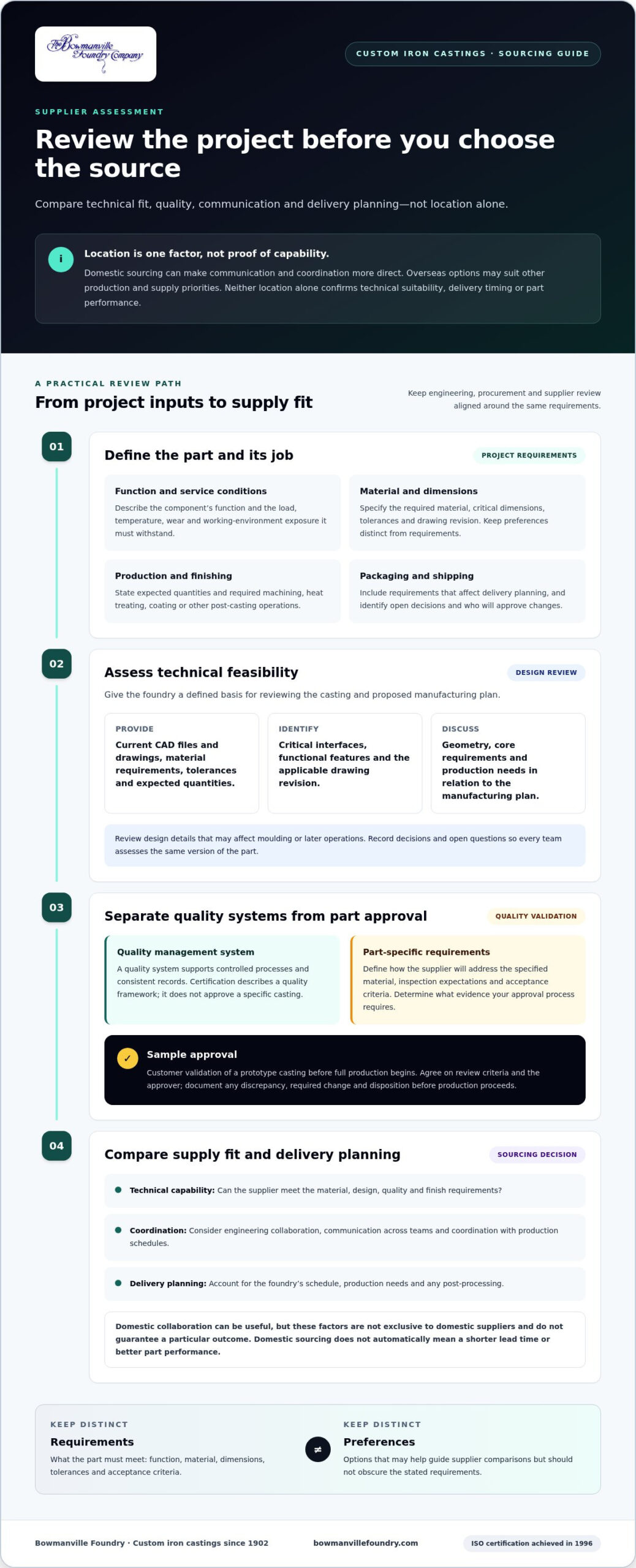
Begin with the application, then distinguish requirements from preferences. This gives procurement and engineering a shared basis for reviewing proposals and discussing technical fit.
- Function and service conditions: Explain what the component does and the conditions it must withstand, including load, temperature, wear, and exposure to its working environment.
- Material and dimensions: Specify required material, critical dimensions, tolerances, and drawing revision. Record preferences separately so they do not obscure requirements.
- Production and finishing: State expected quantities and required machining, heat treating, coating, or other post-casting operations. Include packaging and shipping requirements that affect delivery planning.
Clear inputs reduce ambiguity during technical review. If requirements are still under development, identify open decisions and who will approve changes.
When does a domestic sourcing model deserve consideration?
Consider domestic options when direct engineering collaboration, communication across teams, or coordination with production schedules matters to the project. These factors can be useful during design review, sample approval, and planning for ongoing supply. They are not exclusive to domestic suppliers and do not guarantee a particular outcome.
Compare location alongside technical capability, quality evidence, finishing needs, and delivery planning. The right sourcing model depends on the component and production programme. A consistent assessment helps buyers weigh the factors without assuming that one location suits every casting project.
How to Assess Foundry Engineering and Quality for Domestic Iron Castings
A foundry’s quality management system supports controlled processes and consistent records. Buyers also need to define how the individual component will be assessed against its drawing, material requirements, and intended application. Look for a clear link between the project requirements and the checks planned for the casting.
Foundry certification describes a quality framework. It does not, by itself, approve a specific casting or confirm that it suits an application. Assess the quality system and the part-specific validation plan as separate but related elements of supplier qualification.
What technical information helps assess casting feasibility?
Provide current CAD files and drawings, material requirements, tolerances, application details, and expected quantities. Identify critical interfaces and features that affect assembly or function, and specify the applicable drawing revision. This gives the foundry a defined basis for reviewing the design and helps prevent teams from assessing different versions of the part.
During a technical assessment, discuss how the geometry, core requirements, and production needs relate to the proposed manufacturing plan. Review design details that could affect moulding or later operations, and record decisions and open questions. For grade discussions, an iron casting grade selection guide can help organize material considerations alongside application requirements.
How should buyers interpret certification and sample approval?
Certification is one part of a quality review. Also define how the supplier will address the specified material, inspection expectations, and acceptance criteria. Determine what evidence your own approval process requires rather than assuming a general quality credential answers every part-specific question.
Sample approval is the customer’s validation of a prototype casting before full production begins. Agree on review criteria and identify who will approve the sample. If the review finds a discrepancy, document the required change and its disposition before production proceeds. This keeps the approved design basis clear for both the customer and foundry.
Bowmanville Foundry’s technical and sales engineers can discuss project requirements and support a technical assessment. Discuss your casting requirements with Bowmanville Foundry to begin a project-specific review.
Domestic vs. Overseas Sourcing: Compare the Factors That Affect Fit
Compare sourcing models against the same project requirements. A domestic foundry may make direct coordination more practical for some teams, while an overseas supplier may have processes or capacity that suit a particular programme. Neither location determines quality, responsiveness, or delivery performance on its own. Evaluate each supplier’s capabilities and plans against the component’s technical and production needs.
Select a sourcing model based on the part’s technical demands, required collaboration, quality evidence, and delivery plan, not geography alone. The comparison below highlights questions to resolve, not guaranteed advantages of either option.
| Factor | Domestic sourcing | Overseas sourcing |
|---|---|---|
| Technical collaboration | Consider access to engineering discussions and practical arrangements for design reviews. | Consider how time zones, language, and communication channels affect design reviews and issue resolution. |
| Quality oversight | Review the supplier’s quality processes, records, and part-specific validation plan. | Apply the same criteria and establish how quality information and production updates will be shared. |
| Logistics | Map the route to receiving, including finishing and post-processing steps. | Map each shipping and hand-off stage, including post-processing and receiving arrangements. |
| Delivery planning | Compare the foundry’s proposed schedule with project milestones and planned receiving dates. | Include the supplier’s proposed schedule and full shipping plan when setting milestones. |
| Supply continuity | Assess production planning, communication, and fit with the programme’s ongoing needs. | Assess the same factors, including coordination across production and shipping. |
How do communication and engineering coordination compare?
For either model, clarify who handles technical questions, how design changes are documented, and which communication channels support production planning. Time-zone differences can affect when teams are available to discuss an issue. Shared language and clear records matter as well. Consider whether access to a technical or sales engineer suits the project, especially when design review or production coordination requires discussion across teams.
How should logistics and delivery planning factor into the decision?
Map the process from casting through machining, coating, other post-processing, shipping, and receiving. Identify hand-offs and the information each party needs to keep the schedule visible. Do not assume a domestic route is automatically faster or an overseas route unsuitable. Compare the supplier’s stated lead time with required milestones, and account for current business conditions when setting the project schedule. A custom iron casting production guide can provide additional context for production planning.
The useful comparison is specific to your project. Assess how well each supplier’s engineering support, quality practices, production schedule, and logistics plan work together. Domestic sourcing for iron castings is one factor in the decision, not a substitute for confirming technical and delivery fit.
Build a Domestic Iron Casting Sourcing Plan
A clear sourcing plan gives procurement and engineering a shared basis for moving from an initial requirement to a production proposal. Define the part, its acceptance criteria, and the steps after casting before comparing schedules. This helps the foundry assess the project and your team identify decisions that still need resolution.
What should a casting sourcing brief contain?
Assemble current CAD files and drawings, the required material and grade, estimated quantities, and application conditions. Mark critical dimensions and tolerances, and describe the required surface finish. Include secondary operations such as machining, heat treating, or coating, along with packaging, shipping, and receiving needs. List target delivery milestones as planning requirements, not as a promised lead time.
Before requesting a production proposal, align procurement and engineering on mandatory requirements, who approves technical changes, and how the casting will be evaluated. Include the following steps in your project workflow:
- Define the application and requirements. Document the component’s function, operating conditions, material requirements, critical dimensions, and anticipated quantities. Identify open design decisions for the technical review.
- Prepare the sourcing brief. Gather the latest drawings and CAD files, tolerances, finish requirements, and inspection or documentation expectations. Include secondary operations and shipping details from the outset, rather than treating them as separate decisions after setting the casting plan.
- Request a technical assessment. Share the brief for an evaluation of design feasibility and manufacturing requirements. Discuss geometry, core needs, and production planning, then record agreed revisions and responsibilities. If material selection is still under review, use an iron casting machining and post-processing guide alongside the foundry’s technical discussion to consider downstream operations.
- Set sample approval criteria. Agree on what the customer will review on a sample casting, which drawing revision applies, and who has authority to approve it. Record required corrections and obtain approval before full production begins.
- Coordinate production and delivery planning. Align the approved design, quantities, finishing steps, shipping arrangements, and target milestones. Agree on how schedule updates and changes will be communicated so procurement, engineering, and receiving teams work from the same plan.
How can teams move from assessment to production?
Treat the technical assessment as a working discussion, not just a drawing hand-off. Use it to resolve design questions and connect the proposed casting route to finishing and receiving requirements. After sample approval, carry the agreed specifications and responsibilities into production planning. Bowmanville Foundry’s free casting buyer’s guide can help teams organize early project information and prepare for these discussions.
For a project-specific review of your casting requirements, discuss your sourcing plan with Bowmanville Foundry.
How Bowmanville Foundry Supports Domestic Iron Casting Projects
A sourcing decision works when foundry capabilities align with the part’s specifications and your team’s production needs. Bowmanville Foundry produces custom Malleable Iron, Ductile Iron, and Gray Iron castings for customers across Canada and supports customers in the United States. Its technical information and project assessment support help buyers connect component requirements with production planning.
Which capabilities can support a custom casting programme?
A custom casting programme can involve more than producing the casting. Bowmanville Foundry also provides post-processing services for projects that require finished components. Discussing these operations as part of the project helps teams account for finishing requirements and the route from production to receiving.
Technical and sales engineers support project assessment. Procurement and engineering teams can use the discussion to address design questions, clarify requirements, and consider how the casting and any required post-processing fit the programme. Current drawings, material specifications, and application information make the review more productive.
Production planning is also part of assessing project fit. Share required quantities and target milestones so the project can be discussed in context. This brings the component’s casting, finishing, and delivery needs into the same planning conversation.
What are the next steps for a sourcing discussion?
Prepare current drawings or CAD files, material requirements, and details about the component’s application. Include dimensional and finish requirements, along with any secondary operations. If the project includes sample approval, identify the customer reviewers and the criteria they will use. These details give a technical or sales engineer a practical starting point for discussing the assessment and production plan.
For early planning, the free casting buyer’s guide can help procurement and engineering teams organize questions about material selection and project requirements. Use it to support an internal discussion before reviewing project details with a foundry engineer.
Contact Bowmanville Foundry to discuss your casting project and its technical requirements.
Move Your Casting Project Forward
Turn your sourcing priorities into a practical project brief. Bring together current drawings or CAD files, material requirements, application details, and finishing needs. A technical discussion can connect those inputs to design review, sample approval, and production planning. Your procurement and engineering teams can then assess whether domestic sourcing for iron castings fits the programme.
Bowmanville Foundry produces custom Malleable Iron, Ductile Iron, and Gray Iron castings, with post-processing services for projects requiring finished components. Its 38,000-square-foot plant supports this work. Start with the information available, even if some design details are still being resolved. Clear questions help guide the assessment.
Contact Bowmanville Foundry to discuss your casting project or request the free casting buyer’s guide as a planning resource. Share your technical requirements to begin a project-specific discussion.
Frequently Asked Questions
Is domestic sourcing for iron castings right for every production programme?
No. Domestic sourcing for iron castings is not the right fit for every production programme. Reconsider the model if the part’s material, dimensional, or finishing requirements exceed the available technical capability, if engineering teams cannot coordinate effectively, or if the proposed schedule does not align with planned output. Revisit the decision if logistics or quality expectations change. Compare each option against documented requirements and delivery needs before choosing a sourcing approach.
Can a Canadian foundry support US manufacturing buyers?
Yes. Bowmanville Foundry supports customers in the United States as well as Canada. For an initial project discussion, share the component’s function, material and dimensional requirements, relevant drawings or CAD files, and finishing needs. Include the required delivery date and receiving arrangements early. Reviewing technical and delivery requirements together helps assess the project as a whole without assuming specific cross-border terms or outcomes.
How do CAD files help a foundry assess an iron casting?
CAD files give engineers a digital view of the component’s geometry, helping them review features such as wall sections, cores, and details that may affect production planning. For example, a drawing can clarify how a machined face relates to the rest of the casting. Include the current drawing, material requirements, tolerances, and application information as well. Together, these inputs give the technical assessment context beyond the part’s shape.
What happens if a casting design changes after tooling begins?
A design change after tooling work begins may affect the technical assessment, pattern or tooling work, and production plan. The impact depends on what changes and when. A small dimensional adjustment and a change to a core or major geometry can have different implications. Send updated CAD files and drawings promptly, identify the revision, and describe what changed so the foundry can review the effects before planning proceeds.
Is ISO certification enough to qualify an iron casting supplier?
No. Certification provides evidence of a quality management system, but it does not establish that a supplier can meet every part requirement. Assess technical capability, specified material, inspection needs, sample approval criteria, and post-processing requirements for the component. Bowmanville Foundry was the first foundry in Canada to achieve ISO certification, in 1996. That milestone is relevant quality history, while part-specific validation remains a separate consideration.
When should sample approval happen in a custom casting project?
Sample approval should take place before full production begins, after the customer and foundry have established the component’s technical requirements and review criteria. The customer uses the sample to validate that it aligns with the agreed project needs. Define who will assess the sample and how approval or requested changes will be communicated. Sample approval is distinct from supplier certification.
