
Could a tensile-strength value that looks suitable on paper still lead to the wrong material choice? The mechanical properties of malleable iron guide component design only when the grade, heat-treated condition, and test basis match the requirements being assessed.
Published values can be difficult to interpret without this context. Strength alone does not describe how a casting responds to deformation, impact, or service conditions. Heat treatment also affects the material’s microstructure and, in turn, its balance of strength, ductility, and toughness.
This guide explains what key properties indicate and how to read them alongside grade and test information. It also outlines the details to include in a material specification, such as the applicable designation, test method, and specimen basis. You’ll learn when an assumption may call for property verification or engineering review before it becomes a design or qualification risk.
Bowmanville Foundry supports technical casting decisions by relating specified properties to part geometry and service requirements. The sections ahead provide a practical framework for evaluating Malleable Iron and preparing a clear, well-grounded specification.
Key Takeaways
- Interpret the mechanical properties of malleable iron in context: confirm the grade, heat-treated condition, and test basis before applying values to a component.
- Consider how heat treatment and the resulting microstructure influence the balance of strength, ductility, hardness, and toughness.
- Read tensile strength, elongation, hardness, and toughness as complementary indicators, not stand-alone measures of suitability.
- Build a material specification from documented loads, expected movement, operating environment, and the consequences of failure.
- Use a technical assessment to relate part geometry and service requirements to material decisions. Bowmanville Foundry has produced malleable, ductile, and gray iron castings since 1902.
What mechanical properties of malleable iron tell engineers
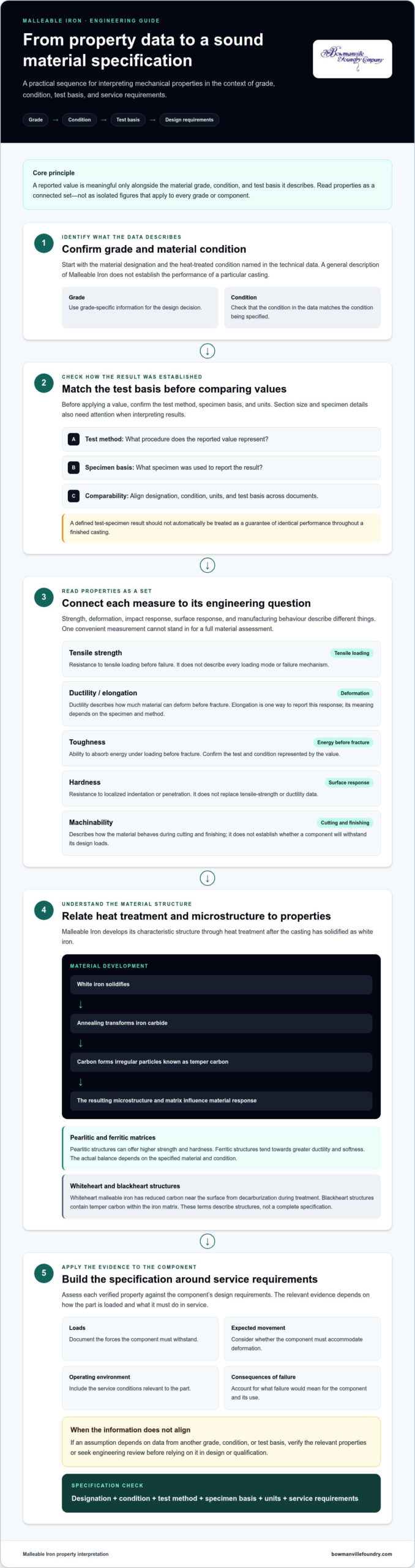
Mechanical properties are measured responses to applied loads or service conditions. They help engineers assess how a material behaves under tension, deformation, impact, or contact. A reported value is meaningful only alongside the material grade, condition, and test basis. Read the mechanical properties of malleable iron as a connected set of indicators, not as isolated figures that apply to every grade or component.
Before using a value in a design decision, identify the material designation and condition it describes, the test method, and the specimen basis. A result for a defined test specimen should not automatically be treated as a guarantee of identical performance throughout a finished casting. For background on the material and its property categories, Malleable iron is a useful starting reference. Engineering specifications should still rely on applicable, verified grade-specific data.
What tensile strength and ductility indicate
Tensile strength describes a material’s resistance to tensile loading before failure. It helps assess whether a component can withstand forces that pull it apart, but it does not describe every loading mode or failure mechanism. Interpret the value against the grade, condition, and test basis named in the technical data.
Ductility describes how much a material can deform before fracture. Elongation is one way to report this response, but its meaning depends on the test specimen and method. A percentage without that context can be misleading. Strength measures resistance to tensile failure; ductility describes the deformation a material can undergo before it fractures. A high value for one does not, by itself, establish the other.
How toughness, hardness, and machinability differ
Toughness concerns a material’s ability to absorb energy under loading before it fractures. It can matter where a part experiences impact or changing loads, but the test basis must be clear to interpret the result. Confirm which test and condition a reported toughness value represents rather than assuming one figure describes every service situation.
Hardness measures resistance to localized indentation or penetration. It can help characterize a material’s surface response, but it does not replace tensile strength or ductility data. Machinability describes how the material behaves during cutting and finishing operations. It can inform manufacturing planning, but it cannot establish whether a component will withstand its design loads.
These distinctions help prevent one convenient measurement from standing in for a full material assessment. A component subject to tensile loads may need strength data; one that must accommodate deformation calls for attention to ductility; and impact exposure may make toughness relevant. Use verified data for the specified grade and condition, then assess each property against the component’s design requirements.
How heat treatment and microstructure shape malleable iron properties
Malleable Iron develops its characteristic structure through heat treatment after the casting has solidified as white iron. During annealing, iron carbide is transformed and carbon forms irregular particles known as temper carbon. The resulting microstructure, including the matrix around those particles, helps explain how the material responds to load. Heat treatment, microstructure, and grade together shape the properties reported for a casting.
This relationship matters in design and procurement. A general description of malleable iron cannot establish the performance of a particular casting. The specified grade and condition must match the property data used for engineering decisions. The Mechanical Properties of Malleable Iron reference discusses the material’s microstructure and property categories. Use grade-specific technical data for design requirements.
Whiteheart, blackheart, and pearlitic structures
Whiteheart and blackheart describe distinct malleable iron structures associated with different heat-treatment outcomes. In whiteheart malleable iron, decarburization reduces carbon content near the surface during treatment. Blackheart structures contain temper carbon within the iron matrix. These terms describe material structures, not interchangeable names for a particular grade or a complete specification.
Pearlitic malleable iron has a matrix containing pearlite, while ferritic structures have a ferrite matrix. These matrices are associated with different property profiles: pearlitic structures can offer higher strength and hardness, while ferritic structures tend towards greater ductility and softness. The actual balance depends on the specified material and condition, so the structure alone should not replace verified mechanical-property data.
Why material condition matters when reading data
Heat treatment establishes the condition represented by a property value. If data describe one grade or condition, carrying those values over to another can lead to an incorrect design assumption. This matters when comparing figures from different technical documents: confirm that the material designation, condition, units, and test basis align before treating the results as comparable.
Section size and test specimen details also need attention. The specimen used to report a property may not represent every location or section of a finished component. Before applying the figure to a part, establish what specimen and test basis the data describe, and whether that basis is relevant to the casting under review. These details call for technical verification, not assumption.
Heat treatment creates the microstructure, and the microstructure helps determine the property profile. For a casting decision, link the required performance to the specified grade and condition, then review the supporting data against the component’s geometry and service requirements. Bowmanville Foundry’s Malleable Iron casting expertise supports this technical discussion.
How to interpret malleable iron mechanical-property data
A property table is useful only if you can identify what each value represents and the conditions under which it was measured. For the mechanical properties of malleable iron, begin by matching the material grade and condition to the data, then review the units, test method, and specimen details. Without that information, values from separate sources may look comparable while describing different test bases.
Use this framework to assess the key measurements:
- Tensile strength: Describes resistance to tensile loading before failure. Confirm the grade, condition, units, test method, and specimen basis reported with the value.
- Elongation: Indicates deformation before fracture as measured in a tensile test. Check the specimen dimensions and test basis; an elongation value without this context is incomplete.
- Hardness: Describes resistance to localized indentation or penetration. Confirm the stated hardness scale and test method before comparing results.
- Toughness: Describes energy absorption under loading before fracture. Identify the test method and conditions, since toughness results depend on how the test is performed.
Values from unlike test bases cannot be compared directly, even when they carry the same property name. A difference may reflect the grade, heat-treated condition, method, or specimen, rather than a meaningful difference in component suitability.
Read each property alongside its test basis
For each data source, record the material designation or grade, condition, units, and test method. If any of these are absent, treat the value as a reference point, not a complete material requirement. Pay particular attention to elongation: the reported result is tied to the tensile specimen and its test basis, so do not transfer it to another dataset without checking those details.
Keep published reference data distinct from the requirement for a specific component. A reference value can help frame material selection, but the design specification should state the properties and acceptance basis needed for the part. Avoid turning a general range or summary into a guaranteed component-level result.
Separate material data from component performance
A test specimen does not automatically reproduce the behaviour of a complete casting in service. Component performance also depends on part geometry, how the load is applied and oriented, and operating conditions. A value measured under one defined test cannot account for every feature or service demand of a finished part.
For practical review, compare the documented property requirement with the casting’s critical sections, loading direction, and operating environment. If a design depends on meeting a narrow property threshold, or if the test specimen basis is unclear, include an engineering review before using the value as a qualification criterion. This keeps the material data connected to the actual component rather than relying on an assumption that the test result transfers unchanged.
How to turn service requirements into a malleable iron specification
A useful Malleable Iron specification starts with the component’s job, not a grade selected from a general property summary. Document how the part is loaded, what it must do in service, and which features are essential to its function. Then translate those needs into material and processing requirements for engineering review. This gives design, procurement, and foundry teams a common reference and helps prevent preferences from being mistaken for mandatory acceptance criteria.
Use this workflow to organize the information:
- Describe the component’s function. State what it supports, connects, contains, or controls. Identify the interfaces with adjoining parts, any fit or movement requirements, and the consequences if the casting deforms or fractures.
- Record service conditions. Document static, repeated, impact, and directional loads where applicable. Note expected movement, operating temperature, and exposure to the surrounding environment. Include low temperature environments if they affect service, and distinguish known conditions from assumptions.
- Separate requirements from preferences. List essential material properties and acceptance needs separately from preferred characteristics. Record machining, heat treating, or coating instructions as distinct processing requirements, and identify which operations are needed for function, fit, or surface protection.
- Define the evidence for review. Identify the required material designation and the property data, units, test method, and specimen basis needed to assess it. State the source of any proposed acceptance limits, and leave values unresolved if they have not been established from verified engineering data.
- Review and validate the plan. Compare the documented requirements with the part geometry and service conditions. Record open questions and the decisions needed before release. Use sample approval as a project checkpoint before full production proceeds.
Document loads and operating conditions
Describe not only the load type, but also where it enters the part and which surfaces or sections carry it. Note whether forces change direction, whether the component is constrained by adjacent hardware, and whether movement is permitted or must be limited. Include temperature and environmental exposure that could affect operation. A clear description of the part’s role helps reviewers assess which service demands are critical.
Also state what a failure would mean for the assembly. A change in fit, loss of support, or interruption of a connected function may carry different consequences. This information helps the team prioritize design requirements and identify where further review is needed.
Define evidence and acceptance requirements
Specify the documentation needed to evaluate the proposed material, including the material designation and the property or test basis relevant to the design. Keep acceptance thresholds tied to verified engineering requirements rather than adopting figures from an unrelated reference. Where the application has a critical interface or finishing need, record it in the drawing notes or procurement documents so it remains visible through review.
Keep machining, heat treating, and coating instructions separate from material-property requirements so each can be considered on its own terms. Bowmanville Foundry provides a technical assessment for your casting requirements, relating specified properties to part geometry.
How Bowmanville Foundry supports malleable iron property decisions
Property information is most useful when considered alongside the actual casting design. A technical assessment gives the foundry and customer a structured opportunity to discuss part geometry, intended function, and specified material requirements together. This helps surface unresolved design details early and keeps a general property reference from being treated as a complete assessment of a particular component.
Bowmanville Foundry produces Malleable Iron, Ductile Iron, and Gray Iron castings. It was the first foundry in Canada to achieve ISO certification in 1996. Foundry engineering input can help relate a proposed material requirement to the design and identify questions to resolve before the project advances. This is useful when the material specification, part details, or service description leave room for interpretation.
Prepare design information for a technical assessment
CAD files and drawings give the technical discussion a clear reference for part geometry, interfaces, and critical features. Add the relevant loads and service conditions, along with the material designation and property requirements under consideration. If documents use different design revisions or property sources, identify which information is current. Clear revision control helps prevent a discussion from relying on outdated geometry or requirements.
The technical assessment can consider whether the part design and documented requirements provide a workable basis for casting, and identify information that needs clarification. For example, a drawing may define the overall shape but leave a critical interface or machining allowance unclear. Resolving such points helps align design intent with the casting plan. As the project proceeds, prototype review and sample approval provide a practical checkpoint before the transition to production.
Bowmanville Foundry’s experience across Malleable Iron, Ductile Iron, and Gray Iron castings provides context for discussing the casting route in relation to the part. The aim is not to replace design engineering or treat a general material property as a performance guarantee. It is to discuss design information, material requirements, and production considerations as connected parts of the same project.
Move from technical requirements to a foundry discussion
The free Casting Buyer’s Guide is a useful resource for buyers preparing for a casting project. Note any related post-processing needs, such as machining, heat treating, or surface coating, so those requirements can be considered with the casting design. Keeping these operations visible helps establish a clear scope for review and coordination.
Bring your project questions and available design information to Bowmanville Foundry. A technical/sales engineer can discuss the casting requirements with your team or visit your facility to assess your needs. Contact Bowmanville Foundry to discuss your project or arrange a facility visit.
Put your material requirements into a design review
Before a material decision becomes a released specification, make sure the engineering record connects the required performance to the component’s actual use. Identify which requirements are essential to function, which remain subject to review, and what evidence will support acceptance. This helps keep design intent clear as the project moves from material selection into casting development and production planning.
The mechanical properties of malleable iron can inform that decision only when the selected data fit the specified material and the component’s demands. If a requirement depends on a narrow threshold or an unusual service condition, resolve the technical basis before finalizing the specification. A focused review can help the team identify open questions, align design documentation, and establish a sound basis for the next project milestone.
For a practical next step, assemble the current drawing or CAD files and the property requirements your team intends to specify. Submit your casting requirements to Bowmanville Foundry for technical review. A well-prepared design package gives the discussion a clear starting point and helps move your project forward with greater confidence.
Frequently Asked Questions
Is malleable iron suitable for low temperature environments?
It may be suitable, but there is no universal yes or no. The decision depends on the specified grade, service temperature, loading, and applicable test evidence. For a component exposed to cold starts or outdoor winter service, include the expected temperature range and load conditions in the design requirements. Review the relevant material data before relying on a general description of Malleable Iron for the application.
Can malleable iron be welded?
Weldability should not be assumed from the material name or a general property summary. The answer depends on the grade, heat-treated condition, part geometry, and required procedure. If a design includes welded joints or repair welding, state that requirement early and include the joint location and component details for technical assessment. Avoid applying generic welding instructions or assuming one procedure will suit every Malleable Iron casting.
How does malleable iron compare with ductile iron?
Both material families can provide useful combinations of strength and ductility, but their structures, available grades, and supporting property data differ. Neither is the right choice in every application. For example, a bracket’s geometry, load path, and production requirements may affect the selection as much as a headline property. A focused malleable iron versus ductile iron comparison frames the choice around component needs, not a single overall ranking.
Can malleable iron be used for components under cyclic loading?
It can be considered, but cyclic service needs evidence relevant to the component’s loading pattern and operating conditions. Static tensile values alone do not establish fatigue performance. Document the expected cycle pattern, load direction, part geometry, and consequences of failure. An engineer can then determine what material data or testing is relevant to the design. This is especially important where repeated loading governs service life or safe operation.
Is malleable iron corrosion resistant?
Corrosion performance depends on the service environment, material condition, and any specified surface protection. Malleable Iron should not be treated as universally corrosion resistant. Describe the component’s exposure, such as contact with moisture or process substances, and state any protection required by the design. A surface coating may form part of post-processing; select protection to suit the component’s intended conditions and include it in the project requirements.
What information should accompany a request for malleable iron property data?
Include the component drawing or CAD files, requested material designation, service loads, operating conditions, and the property or test basis needed for review. If the part has critical load directions or defined failure consequences, include those details too. This context helps the foundry relate property information to the casting rather than provide a general value without application context. Keep acceptance limits tied to the project’s verified engineering requirements.
