
The lower-cost option in a cast iron vs fabricated steel cost comparison depends on the part, not just the material. Cast iron can be more economical when a complex shape can be cast and repeated in production, while fabricated steel may suit simpler designs that avoid casting tooling. Material use, machining, finishing and production quantity all affect the comparison.
It’s understandable to focus first on material, but the manufacturing route can affect total cost just as much. This article explains how material selection, part geometry, production volume and tooling influence the relative cost of cast iron and fabricated steel components.
You’ll also see how to weigh the trade-offs: casting can consolidate features and reduce fabrication steps, while a steel assembly may be the more practical fit for other designs. The aim is to help you compare designs before committing to a production method.
Key Takeaways
- Compare the full production route, including material use, machining, finishing and assembly, rather than judging a part by raw material alone.
- Assess how the part’s geometry affects each method: casting can combine features, while fabricated steel may suit a design built from simpler components.
- Factor production quantity into the decision, since tooling is weighed across the parts made and repeat production can change the per-part comparison.
- Build a useful cost model by separating one-time tooling from recurring production operations and identifying the assumptions behind each estimate.
- Use part size, application requirements and design complexity to narrow the options before comparing manufacturing approaches.
Iron and steel casting material costs
Material choice should reflect the component’s mechanical requirements and geometry. Compare the manufacturing routes by examining material properties, machining needs, tooling and service conditions.
Cast iron material
Cast iron is poured into a mold, allowing complex shapes and integrated features to form as one component. Ductile Iron and Gray Iron have different mechanical properties, so grade selection should reflect the part’s strength and flexibility requirements. For a stationary machine base, vibration damping may also matter. Assess the part drawing, load conditions and required machined surfaces together.
Fabricated steel material
Fabricated steel components are assembled from cut or formed stock, with welds joining separate pieces where needed. A simple bracket made from plate differs from a housing assembled from several sections, which has more joints and alignment requirements. In sectors such as commercial foodservice equipment, manufacturers like hopkins.biz rely on fabricated steel construction to create durable frying ranges and catering systems. Compare the material specification, geometry and assembly sequence, including how weld access affects the design and inspection plan.
Machinability and processing
Gray Iron is known for machinability and vibration damping, while fabricated steel involves operations such as cutting, forming and welding. Identify each machined face, interface and finish requirement on the drawing. Welding can introduce localized heat, stress and distortion that may affect alignment. For maintenance planning, consider inspection access, repair methods and replacement-part needs for the application.
Strength, weight, durability and corrosion resistance affect service life and upkeep. Select material according to the mechanical load and environment. Both iron and steel can corrode when exposed to moisture without protection, so include protective finishes and maintenance access in the design review.
Tooling and production methods
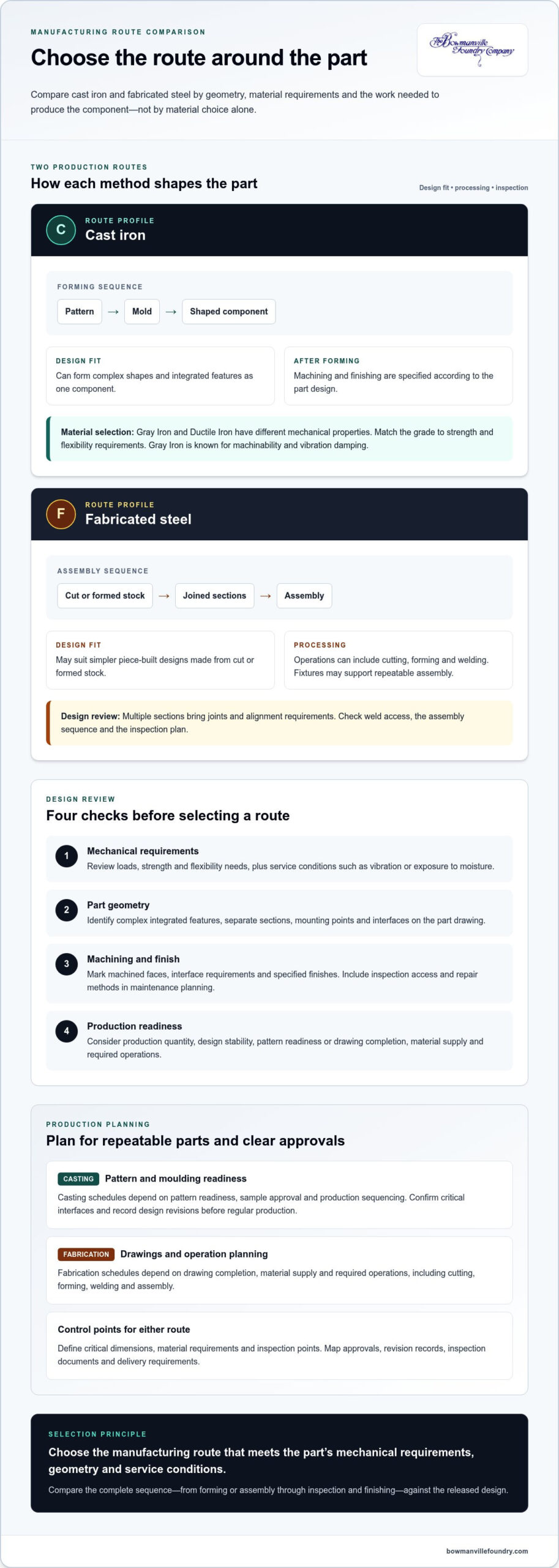
Casting uses a pattern and mold to form the part, while fabrication may require fixtures for repeatable assembly. A casting can combine features that would otherwise require separate steel pieces. For a recurring design, assess pattern readiness, molding steps and finishing needs alongside fabrication’s cutting, forming and welding sequence. Choose the route that suits the geometry and planned production quantity.
For Canadian projects, shipping distance, border requirements and regional supplier availability affect delivered sourcing arrangements and schedules. Consider the destination, shipment route and supplier location when planning procurement. Applicable import duties are also part of cross-border sourcing considerations.
| Option | Material use | Tooling | Processing | Design fit |
|---|---|---|---|---|
| Cast iron | Forms shaped components | Pattern and mold | Machining and finishing as designed | Complex integrated features |
| Fabricated steel | Cut stock and assembled sections | Fixtures may support assembly | Cutting, forming and welding | Simpler piece-built designs |
Choose the material and manufacturing route that meet the part’s mechanical requirements, geometry and service conditions.
Production quantities and cost-effectiveness
Production quantity shapes scheduling, process planning and repeatability. A prototype run and an established production programme place different demands on pattern preparation, molding, fabrication equipment and inspection. Compare the routes against the release schedule and design stability, not only the number of components requested.
For a prototype, first confirm the design intent and critical interfaces. A sample can show whether the geometry, machining surfaces and assembly details work as planned. Record revisions before setting the production method. Changes to wall transitions, mounting points or internal features can affect pattern design for casting or weld sequencing for fabrication.
During production, the process must deliver consistent parts across each release. Casting uses a defined pattern and molding procedure, followed by inspection and any specified machining. Fabricated assemblies rely on repeatable cutting, forming and weld placement. For either route, a control plan should identify critical dimensions, material requirements and inspection points.
Production planning also needs to account for equipment and workflow. Casting schedules depend on pattern readiness, mold preparation and foundry sequencing. Fabrication planning depends on stock availability, cutting and forming capacity, weld access and assembly flow. A design with several joined members may require more coordination between operations than a single-piece component.
Material selection must remain tied to function. Gray Iron can suit stationary components where vibration damping matters; Ductile Iron has different mechanical properties for parts requiring strength and flexibility. Fabricated steel may suit designs that depend on joined sections or frequent design adjustments. The production plan should not override performance requirements or the approved material specification.
There is no single minimum order quantity or lead time for cast iron or fabricated steel parts across Canada. Casting schedules depend on pattern readiness, sample approval and production sequencing. Fabrication schedules depend on drawing completion, material supply and required operations. These factors shape the transition from prototype to regular releases.
For procurement planning, map the work from design release through inspection and delivery. Identify who approves the sample, how revisions are recorded and which inspection documents accompany production parts. These steps help engineering and purchasing teams coordinate releases without confusing a prototype schedule with a repeat-production plan.
- Separate prototype approval from ongoing production planning.
- Define inspection points and material requirements before the first release.
- Align production sequencing with drawing maturity and delivery schedules.
Choose a process that supports the required part performance and production workflow. A clear release plan helps teams manage design changes, inspection and repeat manufacture for either route.
Cost
A sound material decision starts with the component’s function, not its label. Define load paths, mounting interfaces, operating environment and required service life before selecting a manufacturing route. For a pump support, for example, identify alignment requirements and vibration exposure. For a moving linkage, document the applied forces and points of articulation.
Next, establish the material specification. Gray Iron can suit stationary components where vibration damping and machinability are useful. Ductile Iron offers a different combination of strength and ductility. Fabricated steel allows design flexibility through selected plate and section arrangements. The right option depends on the required mechanical properties, part geometry and operating conditions.
Design geometry affects how each material performs. Smooth transitions and radii can reduce abrupt changes in section, while ribs can add stiffness where needed. A casting drawing should identify parting considerations, cores for hollow regions and surfaces requiring machining. A fabricated drawing should define plate thicknesses, joint locations and weld access.
Prepare a common design package before the engineering review. Include CAD files, material requirements, critical dimensions, surface finish, inspection criteria and service conditions. Mark functional interfaces separately from non-critical surfaces. This helps the design team focus measurement and machining requirements on features that affect assembly or operation.
Consider the part’s environment, too. Moisture, chemicals, temperature and impact can affect material selection and protective finishing. Both iron and steel can corrode in moist conditions without protection. Specify coating needs and maintenance access in the design documentation, particularly where surfaces are difficult to reach after installation.
Manufacturing review should also consider the assembly sequence. A one-piece casting may combine features that a fabricated design separates into joined components. Conversely, a design built from accessible standard sections may be easier to revise through fabrication. Identify where fasteners, welds or machined interfaces are essential, and where the geometry can be simplified.
Use a structured review before releasing the drawing:
- Document loads, movement, vibration and environmental exposure.
- Specify material properties and critical interfaces.
- Mark machining, finishing and inspection requirements.
- Review geometry for casting or fabrication constraints.
This engineering basis gives procurement and design teams a clear, consistent specification for choosing the manufacturing method and approving the finished component.
Cost comparisons should account for the part and work involved. The page recommends cast iron when a complex shape and lower upfront cost are priorities. LS Manufacturing reports that, for a drivetrain component produced in a run of 1,200 units, cast iron cost 40% more than its sheet-metal fabrication alternative.
A forum participant said their company did not normally splice 8 foot drops on rails because it took too long compared with the cost. These examples show why upfront cost and time should be weighed for the specific design and manufacturing route.
Cost modelling and tooling amortization
Build the comparison around a common part specification, then separate one-time setup from recurring production. For casting, identify pattern preparation and mold requirements; for fabrication, list fixtures and assembly setup. Add recurring material, processing, machining, finishing and inspection steps for each route. This makes the cost model useful without assuming either process automatically wins.
Allocate casting tooling cost by dividing the investment across the accepted parts expected from that pattern. A small initial batch assigns more tooling cost to each component; a larger repeat programme spreads it across more units. Use a realistic production forecast, not the maximum possible quantity. If demand changes, recalculate the allocation using the revised accepted-part total.
Separate pattern changes from production variables. A revised rib, mounting face or internal passage may require pattern modification before the next run. Track that work as a design-change allowance rather than hiding it in recurring production costs. For fabricated structures, record fixture changes and revised cutting or weld sequences in the same way. This keeps setup costs visible and comparable.
Next, model yield and finishing requirements. Count accepted parts, not simply poured castings or welded assemblies, when allocating setup costs. Include machining allowances, coating, inspection and rework assumptions that apply to the drawing. A machined mounting face, for example, needs the same tolerance and inspection basis in both alternatives. This prevents a seemingly lower estimate from omitting required work.
Extend the model to service life when maintenance matters. Compare repair access, replacement effort and protective finishes under actual operating conditions. Corrosion exposure can increase coating and maintenance needs for either material. Gray Iron’s vibration damping may benefit stationary machinery, while another material may be needed for impact resistance or specific mechanical demands.
Include material properties in the model’s assumptions. Record the required iron grade or steel specification, including relevant carbon content, alongside load and surface requirements. Higher strength has no economic value if the component does not need it. Conversely, under-specifying material can shift costs into repairs, downtime or redesign.
- Define the basis: use one drawing, specification and inspection plan.
- Separate cost groups: distinguish tooling from recurring operations.
- Test quantity scenarios: recalculate tooling allocation for planned batches.
- Review lifecycle factors: include corrosion protection, repair access and service demands.
Finally, document each assumption beside the estimate. Procurement teams can then revise order quantity, geometry or finishing requirements and see which change drives the comparison. This makes the tooling decision traceable from initial design through repeat production.
What are typical costs for cast iron and fabricated steel parts by size or application?
A useful cost comparison needs a part drawing, material specification and production quantity. Size alone cannot predict the result: a compact component with complex internal geometry may need a different process from a larger, simple plate assembly. Compare complete manufacturing routes, including tooling, machining, finishing and inspection, rather than relying on a generic per-part figure.
For a machinery base or engine block, cast iron can suit shapes that benefit from vibration damping and integrated features. The estimate should include pattern preparation, molding, casting, machining and any required coating. A fabricated steel alternative may use several plates, brackets and welds. Compare cutting, forming, welding, alignment and finishing for the same functional design.
Application matters as much as size. A stationary component subject to vibration may benefit from iron’s damping properties, while a structure exposed to impact or repeated movement may require different mechanical properties. These demands affect material selection and design. Start by identifying loads, interfaces, service environment and required surface finish, then compare feasible designs and their production steps.
For a simple bracket made from standard plate, fabrication may avoid casting patterns and suit a limited order. A complex housing with ribs, mounting bosses or internal passages may require multiple fabricated pieces and assembly operations. Casting can form these features together, but tooling must be considered across the planned production quantity. Neither example establishes a universal cost winner.
Part weight also needs context. A lighter design may reduce material use, but a redesign can add supports, machining or assembly work. Compare the finished component’s geometry and required performance, not just its raw stock weight. For castings, identify machined faces and allowances; for fabricated parts, record weld access, joints and alignment requirements.
Canadian delivered estimates should reflect where production occurs and where the part is needed. Shipping distance, packaging needs and supplier location affect logistics planning. If sourcing crosses a border, applicable import charges can affect the delivered total. Treat these as project-specific inputs, not fixed charges that apply equally to every part.
- Use the same drawing, grade requirements and inspection criteria for both routes.
- Separate tooling and setup from recurring production operations.
- Compare at the expected order quantity, including finishing and delivery.
For a project-specific assessment, discuss your casting design and material requirements with a technical representative.
Bowmanville Foundry: Malleable Iron Castings
Bowmanville Foundry produces Malleable Iron Castings for buyers assessing iron options for parts requiring tensile strength and ductility. Turn to the foundry when a drawing, application or production plan calls for a technical assessment of whether an iron casting meets the part’s requirements. Its Ductile Iron Castings and Gray Iron Castings offer additional iron options for comparison, while Post-Processing Services can address finishing needs.
For a useful assessment, prepare the part’s CAD files, material requirements, operating conditions and expected production quantity. These details help define the design and manufacturing route, including machining or finishing needs. Contact Bowmanville Foundry to discuss your casting requirements.
Move Your Part Decision Forward
Turn the comparison into a design review before committing to a production route. A cast iron vs fabricated steel cost assessment is most useful when the drawing reflects required interfaces, service conditions and finishing operations. If the design can change, record revisions before comparing manufacturing plans. This gives engineering and procurement teams a shared basis for the next decision.
Bowmanville Foundry produces Malleable Iron Castings and Ductile Iron Castings, and provides Post-Processing Services. These offerings can suit projects where an iron casting and its finishing requirements warrant review together. Share the part drawing and operating requirements to discuss the application and material selection.
Use the next conversation to clarify the component’s function, critical surfaces and production needs. Discuss your part requirements with Bowmanville Foundry and take the next step toward a well-defined manufacturing decision.
Frequently Asked Questions
What is the cost per pound or kilogram of cast iron compared with fabricated steel in Canada?
A per-pound or per-kilogram comparison alone can misrepresent the cost of a finished part. Fabricated steel is often purchased in stock sizes, while a casting quote reflects the specified component and its production route. Compare the same material grade, finished geometry, machining requirements and delivery basis. Account for usable material, too: stock cutoffs and casting yield affect how much purchased material becomes the final part.
What are typical material prices for cast iron and fabricated steel in Canada in 2026?
There is no single material figure that applies to every Canadian project in 2026. Iron grade, steel specification, stock form, order quantity and delivery location all shape a material estimate. For a meaningful comparison, ask for both alternatives using the same component drawing and required properties. Separate raw material from conversion work, so an iron casting estimate isn’t compared with steel stock alone.
How do casting, fabrication, machining, and finishing costs compare for cast iron and steel?
The balance depends on the operations each design needs. A pump housing with integrated passages may require cores and machining at specified interfaces as a casting. A fabricated version may need separate plates, weld access and dimensional checks after assembly. Compare the process route line by line, including inspection criteria and protective finishing. This shows whether geometry or downstream work drives the difference for that application.
How do order size and production volume affect cast iron versus fabricated steel costs?
Order size affects how setup work is allocated across accepted parts. For a one-off replacement bracket, a straightforward fabricated design may avoid dedicated casting pattern work. For a recurring machine component, repeated production can change the balance as tooling supports successive batches. Before choosing a route, distinguish prototype quantities from forecast production and account for expected design revisions, since a changed drawing can require new setup work.
When is cast iron more cost-effective than fabricated steel, and vice versa?
Cast iron can be more cost-effective when a complex, repeatable shape combines features that fabrication would assemble separately. Fabricated steel can suit a simpler design built from standard plate or sections, especially when avoiding casting tooling matters. The decision also depends on mechanical requirements: vibration damping may favour Gray Iron in stationary equipment, while impact loading or movement can require different material properties and design checks.
