
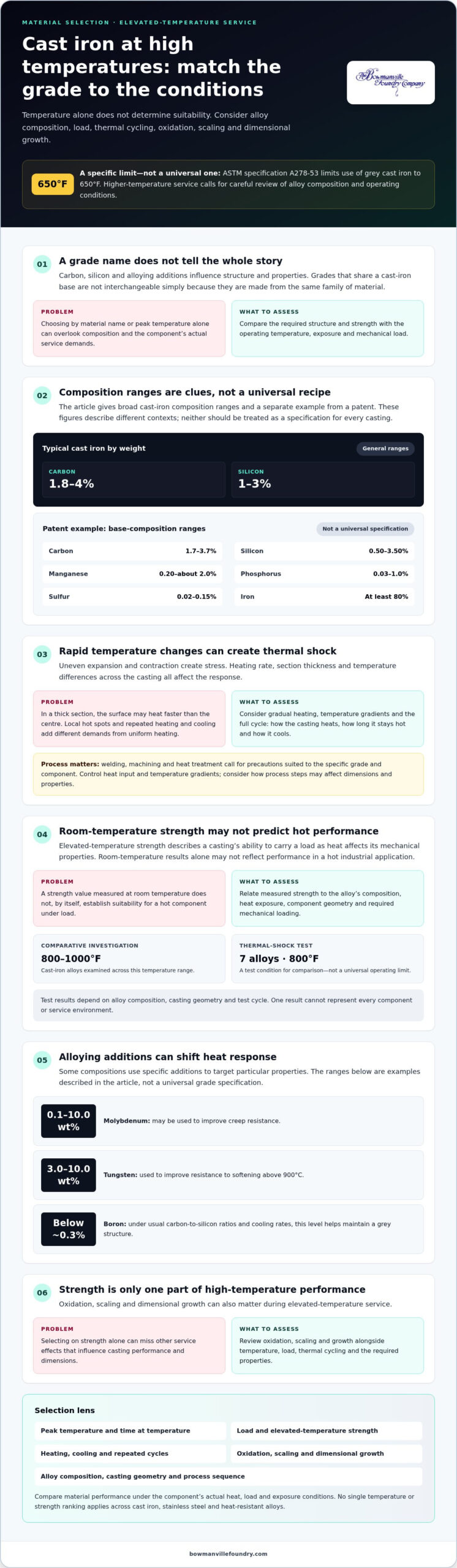
A single temperature limit does not apply to every cast-iron grade. For gray cast iron, ASTM specification A278-53 limits use to 650° F, while higher-temperature service calls for careful attention to alloy composition and operating conditions. Selecting cast iron for high temperature applications means weighing more than temperature alone: oxidation, thermal cycling, sustained load and the risk of dimensional growth also matter.
It is reasonable to expect a heat-resistant grade to tolerate elevated temperatures, but performance depends on how its structure responds to heat over time. Carbon, silicon and alloying additions influence strength, scaling resistance and thermal-shock behaviour, so cast-iron grades are not interchangeable simply because they share the same base material.
This article compares cast-iron types and compositions, then explains how boron, preheating, thermal shock, growth and scaling affect performance. The right material depends on both peak temperature and the conditions the casting must withstand in service.
Key Takeaways
- Compare cast-iron grades by composition and service demands, not by material name alone; carbon, silicon and alloying additions influence performance.
- Account for thermal cycling and temperature changes, since rapid shifts can raise the risk of thermal shock.
- Assess oxidation, scaling and dimensional growth alongside strength when selecting a casting for elevated-temperature service.
- Understand how boron and other alloying elements can affect cast-iron structure and heat resistance.
- Use the casting’s operating conditions and required properties to guide your grade selection and technical discussions.
Comparative cast iron compositions and properties
Cast iron composition varies by grade, and carbon and silicon levels influence structure and properties. A comparative investigation examined cast-iron alloys between 800° F and 1000° F, highlighting the need to assess performance under the intended service conditions.
Elevated-Temperature Strength
Elevated-temperature strength describes a casting’s ability to carry a load as heat affects its mechanical properties. Room-temperature strength alone may not reflect how a component performs in a hot industrial application.
Cast iron typically contains 1.8 to 4% carbon and 1 to 3% silicon by weight. A patent gives typical base-composition ranges of 1.7 to 3.7% carbon, 0.50 to 3.50% silicon, 0.20 to about 2.0% manganese, 0.03 to 1.0% phosphorus, and 0.02 to 0.15% sulfur. It also specifies at least 80% iron by weight.
The investigation screened twelve cast-iron alloys. One nodular-iron alloy underwent more extensive testing, primarily for comparison. The results show why measured strength should be considered alongside the alloy’s composition and its heat exposure.
Grey cast iron has compressive strength comparable to low- and medium-carbon steel. For an automotive engine block, that property can inform material assessment, but operating temperature and mechanical loading matter too. Suitability depends on the component’s strength requirements and exposure.
Comparisons With Other Materials
To compare cast iron with stainless steel or heat-resistant alloys, evaluate composition and service requirements rather than assuming one material is best for every hot environment. This distinction is important when selecting a casting for elevated-temperature service.
High-temperature cast iron can provide useful strength and stability, while stainless steel and heat-resistant alloys have different compositions and performance characteristics. There is no single temperature or strength ranking that applies across these material families. Compare their performance under the component’s actual heat, load and exposure conditions.
Alloying additions can change cast iron’s response. Heat-resistant cast irons may contain 0.1 to 10.0 wt% molybdenum to improve creep resistance, while 3.0 to 10.0 wt% tungsten is used to improve resistance to softening above 900°C. These ranges describe possible alloy compositions, not a universal specification.
Boron also requires attention: below about 0.3% helps maintain a grey structure under usual carbon-to-silicon ratios and cooling rates. For cast iron for high temperature applications, compare the required structure, strength and thermal stability with the service environment before choosing a composition.
Gradual preheating and thermal shock
Thermal shock occurs when rapid temperature changes cause uneven expansion and contraction in a casting. The heating rate, section thickness and temperature difference across the material all affect the resulting stress.
Welding, machining and heat treatment require precautions suited to the specific cast-iron grade and component. Control heat input and temperature gradients, and consider how machining or later heating may affect dimensions and properties.
A thermal-shock test examined seven cast-iron alloys at 800° F. That test condition provides a comparison point, not a universal operating limit. Results depend on alloy composition, casting geometry and the test cycle, so a single result cannot represent every component or service environment.
Gradual heating reduces steep temperature differences between a casting’s surface and interior. In a thick section, for example, the centre may heat more slowly than the exposed surface. A controlled temperature rise gives the material more time to expand, helping limit stress from uneven heating.
Consider preheating as part of the full operating cycle, not as an isolated step. Review how the component reaches temperature, how long it remains hot and how it cools. Repeated cycling creates different demands from a single heat-up, while local hot spots can cause steeper gradients than uniform furnace heating.
For castings undergoing heat treatment, choose a cycle suited to the alloy and the properties required afterward. Machining can expose internal sections or change local restraint, affecting the component’s response to later heating. Material, geometry and process sequence all influence dimensional stability.
Cookware guidance should not be transferred directly to industrial castings. Cast-iron cookware is generally preheated for 3-5 minutes on medium-low heat to help prevent thermal shock. Industrial components face different geometries, loads and heating conditions, so their thermal procedure must reflect the actual process.
Assess a casting by relating its heating and cooling conditions to the alloy and section design. This is more useful than assuming one material addition or preheating method will be best for every application.
On a gas grill, cast iron cookware may take 5-10 minutes to preheat to medium-high. For charcoal grilling, let the coals heat for approximately 10 minutes, or until they gray over. For most cooking needs, medium-high heat provides good results with cast iron, but it is advisable to start low and increase the heat as needed.
Advice for cookware should not be applied as an industrial casting control. The appropriate industrial approach depends on the component’s alloy, geometry and operating cycle. A cooking heat setting or waiting period does not establish a safe heating schedule for a thick section or heat-treatment cycle. Keep the intended use in view: cookware guidance concerns cooking, while industrial practice must suit the casting and process.
Resistance to growth and scaling at elevated temperatures
For high-temperature service, match alloy composition and casting design to operating temperature, atmosphere, load and exposure cycle. Control section transitions and metal chemistry, then assess oxidation, scaling and dimensional stability together.
Growth tests examined the same seven cast-iron alloys used in other elevated-temperature tests. Growth is dimensional change during heat exposure; even gradual expansion can affect fits, clearances and alignment. In an industrial assembly, uneven growth may cause a component to bind against adjacent parts or alter how it carries a load.
Scaling is oxidation at the surface, where heat and the surrounding atmosphere form oxide layers. If scale separates from the metal, the casting loses material and its surface condition changes. A patent describes testing specimens in air at 1500° F for 24 hours, measuring weight loss from scaling. That test illustrates how exposure conditions shape the assessment.
Chromium content influences protective scale formation. Above 15 wt% chromium, heat-resistant cast-iron compositions are identified as forming continuous Cr₂O₃ scales. Optimized compositions are reported to lose less than 5 mg/cm² after 100 cycles of cyclic oxidation testing at 900°C. Silicon additions are reported to reduce oxidation rates by 30-50% compared with silicon-free heat-resistant cast iron.
These values apply to particular compositions and test conditions, not to every casting. An alloying element’s effect depends on the full chemistry, exposure atmosphere and heating cycle. A protective surface scale, for example, can limit further oxidation, while repeated scale formation and loss can expose fresh metal.
Manufacturing control begins with composition and melting. Electric induction and electric arc furnaces are commonly used for temperature and chemistry control. Reported melting temperatures for heat-resistant cast iron range from 1450°C to 1550°C, while pouring temperatures range from 1320°C to 1420°C. Composition and process conditions influence filling, solidification and resulting casting integrity.
Designers should consider creep, oxidation and dimensional change under sustained heat. Molybdenum additions can improve creep resistance, while zirconium additions of 0.01 to 1.0 wt% are used to refine grain structure and improve oxidation resistance. Those benefits depend on the alloy and service conditions; no single addition addresses every failure mode.
At elevated temperatures, failure may involve progressive scaling, creep deformation, section loss or cracking caused by uneven changes. Compare test conditions with the component’s actual atmosphere, load and cycle to assess whether a heat-resistant cast-iron composition can maintain the required surface condition and dimensions in service.
The patent identifies specimens approximately 1 inch in diameter and 4 inches long to test boron’s influence on scaling resistance.
Cast iron types
Furnaces, exhaust systems and heat-treatment equipment may use heat-resistant gray cast iron or alloyed grades, depending on temperature, atmosphere and load. Machinable heat-resistant gray iron is described for applications below about 1800° F; Ni-resist type 2 is listed for resistance to heat and corrosion.
A grade name alone does not establish suitability. Carbon, silicon and alloying elements affect cast structure, hardness and performance, so selection should begin with the component’s service conditions.
Gray cast iron commonly contains 2.5-4.0% carbon and 1-3% silicon by weight. Its graphite flakes distinguish its structure from iron grades where carbon occurs mainly in carbides. This composition can be a starting point when assessing castings, but the application still determines which properties matter.
White cast iron contains carbon largely in carbide form, corresponding to high hardness. A comparative composition lists 3.4% carbon, 0.7% silicon and 0.6% manganese, with a hardness of 450 on the Brinell scale. That hardness helps distinguish it from gray iron, but does not by itself establish suitability for a hot component.
Ni-hard type 2 is listed for high-strength applications. Its nominal composition is 2.7% carbon, 0.6% silicon, 0.5% manganese, 4.5% nickel and 2.0% chromium, with a Brinell hardness of 550. These values identify a specific alloy, not all Ni-hard grades.
Ni-resist type 2 has a nominal composition of 3.0% carbon, 2.0% silicon, 1.0% manganese, 20.0% nickel and 2.5% chromium. It is listed for heat and corrosion resistance, making atmosphere and exposure important considerations alongside temperature.
Austenitic heat-resistant cast irons include compositions with more than 15 wt% nickel and more than 20 wt% chromium. Their structure is described as primary austenite dendrites with interdendritic eutectic carbides. This composition class differs from ordinary gray iron and must be evaluated against the component’s service requirements.
Boron-containing heat-resistant gray irons form another composition approach. Patent claims describe machinable grades containing 0.05 to 0.50% boron, and a narrower range of 0.05 to 0.30%. These figures describe claimed compositions, not a general target for every casting.
For furnace, exhaust or heat-treatment parts, compare the alloy’s chemistry and structure with its heat, corrosion exposure and machinability requirements. A composition suited to one industrial component may not provide the right combination for another. The manufacturing specification should reflect the intended service.
What maximum service temperatures can common cast iron grades withstand?
There is no single maximum service temperature for every cast-iron grade. A reported limit applies to a particular specification or test condition, while actual performance depends on composition, load, atmosphere and exposure duration. For example, ASTM specification A278-53 limits gray cast iron use to a maximum temperature of 650° F.
That 650° F figure is tied to A278-53, not a universal ceiling for all cast irons. Heat-resistant compositions differ in alloying elements and intended behaviour. A gray iron component operating near that limit may face different demands from an alloy designed to resist oxidation or creep under sustained heat.
Test conditions also matter. Creep-rupture tests were conducted on seven cast-iron alloys at 800° F and 1000° F. These temperatures identify test points, not maximum service ratings. Creep is time-dependent deformation under sustained load, so the results must be considered with applied stress and exposure duration.
Other evaluations examine distinct failure mechanisms. Thermal-shock tests on seven alloys were conducted at 800° F, while growth tests used the same seven alloys. Those test temperatures and methods help compare material responses; they do not establish a single operating limit for every casting design.
For heat-resistant gray cast iron, a patent describes machinable material for heat-resisting applications below about 1800° F. This figure applies to that described application, not all gray iron grades. It should not be substituted for the A278-53 limit or treated as a general rating for cast iron for high temperature applications.
Evaluate the full service profile, not just the peak temperature. Consider whether the casting carries a sustained load, contacts an oxidizing atmosphere or undergoes repeated heating and cooling. A furnace component exposed continuously to heat may face different creep and scaling demands from a part that reaches a similar peak temperature briefly.
Use material specifications and test evidence relevant to the component’s conditions. Compare grade, composition, stress, atmosphere and exposure cycle, then assess how dimensional growth or scaling could affect fit and function. A temperature value alone cannot describe a casting’s full service capability.
Cast-iron cookware is reported to withstand temperatures up to 650°F, but cookware guidance is not an industrial component rating. The shape, loading and exposure differ. For an engineered casting, base selection on the specific grade and operating conditions, rather than transferring a cookware temperature directly to industrial service.
For help assessing casting requirements and related finishing needs, discuss your casting and post-processing requirements.
Bowmanville Foundry: Malleable Iron Castings
Bowmanville Foundry produces Malleable Iron Castings, Gray Iron Castings and Ductile Iron Castings for manufacturers assessing casting requirements. Its modern foundry and ISO-certified quality system support a structured approach to production. Share the component’s function, operating conditions and required properties to help frame the material and manufacturing discussion.
For projects that require finishing operations, Bowmanville Foundry offers post-processing services after production. Its Free Casting Buyer’s Guide can also help you compare material and project considerations, organizing requirements before moving a casting project forward.
Contact Bowmanville Foundry or visit bowmanvillefoundry.com to discuss your casting requirements.
Build the next step into your casting specification
Turn the operating profile into a clear specification for cast iron for high temperature applications. Record the component’s function, installation context, required interfaces and acceptance criteria alongside its material requirements. This gives engineering, procurement and manufacturing teams a shared basis for reviewing the design before making production decisions.
Include information that affects how the part will be assessed, such as its drawing, relevant dimensions, loading conditions and finishing requirements. Tie the specification to the part’s actual use rather than relying on a grade name alone. A clear technical package focuses discussion on the design and manufacturing requirements that matter to the project.
Bowmanville Foundry offers Malleable Iron Castings, Ductile Iron Castings and Post-Processing Services. To discuss your casting requirements, contact Bowmanville Foundry. A well-defined specification is a practical foundation for moving your project forward.
Frequently Asked Questions
Which cast iron grades are suitable for high-temperature applications?
Heat-resistant gray iron, Ni-resist type 2 and austenitic heat-resistant cast irons are candidates for elevated-temperature service. The grade choice depends on the component’s required mechanical properties, exposure atmosphere and operating demands. For example, a part exposed to corrosive gases needs a different assessment from one whose main requirement is machinability. Compare grade-specific data with the design requirements before selecting a material for the casting specification.
How do gray, ductile, and high-silicon cast irons compare at elevated temperatures?
Cast-iron grades differ in structure and chemistry, so compare them against the component’s main design requirement. For a pressure-containing part, assess the required mechanical properties and grade data; for an exposed surface, consider relevant oxidation evidence. High-silicon iron is not automatically the right choice just because it contains silicon. Compare specific grades tested under conditions that represent the intended application.
How do oxidation, thermal fatigue, and creep affect cast iron at high temperatures?
Different failure mechanisms can create different inspection priorities for the same component. For a casting with a sealing surface, assess surface condition and dimensional tolerance; for a restrained support, pay close attention to cracks near attachment points. A part carrying a sustained load also needs review for shape changes that could affect alignment. Relate observations to the component’s function to identify which changes matter to continued operation.
How does thermal cycling affect cast iron components?
For a component exposed to repeated operating cycles, document its heating, holding and cooling stages in the service record. Note changes in fit, alignment or surface condition at critical interfaces, such as a flange joined to a pipe. Comparing observations over time can reveal changes that affect function and give engineering teams useful context when reviewing the component’s design requirements.
What Canadian standards or suppliers cover heat-resistant cast iron grades?
The article cites ASTM A278-53, which limits gray cast iron use to 650°F, and names Bowmanville Foundry in connection with malleable iron castings.
