
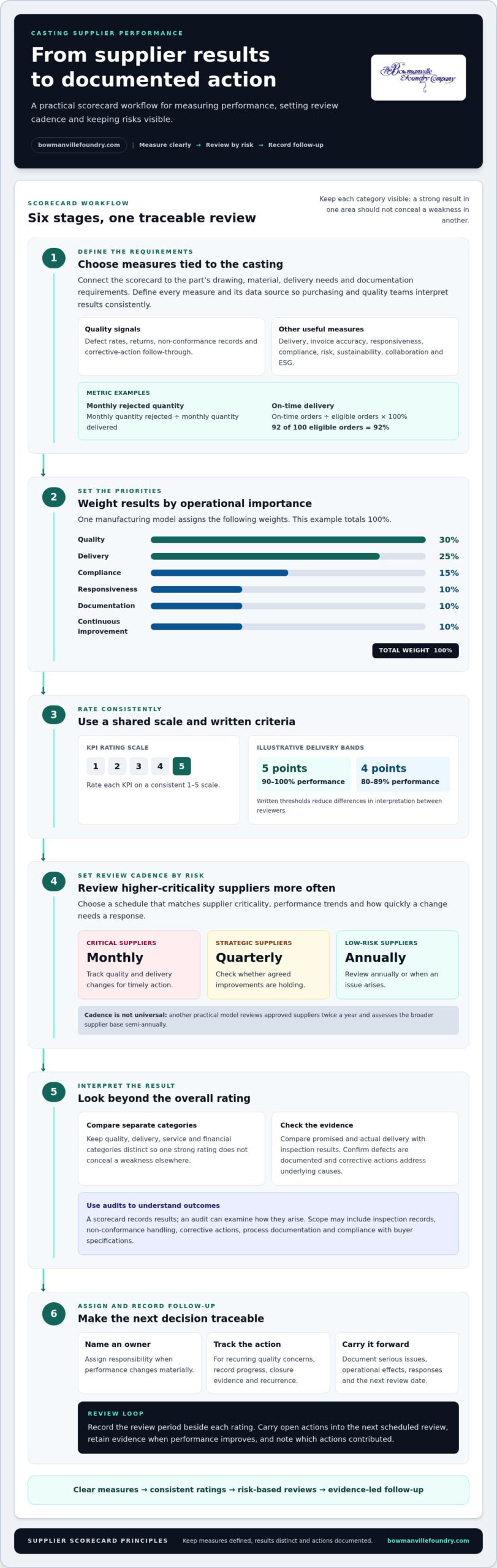
A casting supplier quality scorecard brings quality, delivery, responsiveness and other performance measures into one view, with weights that show which results matter most. Review critical suppliers monthly, strategic suppliers quarterly, and low-risk suppliers annually or when an issue arises. Rating bands help distinguish strong performance from problems that need attention.
For casting buyers, an overall score is useful only if it does not hide recurring defects, missed deliveries or weak documentation. Choose measures and weights that reflect the casting’s requirements and the consequences of a supplier falling short. This article explains what to measure, how supplier risk can shape review frequency, and how weighted ratings and bands support consistent decisions. It also shows how quality, risk and sustainability measures provide a fuller basis for comparing supplier performance.
Key Takeaways
- Choose measures that connect casting quality to real outcomes, including defects, returns and corrective-action follow-through.
- Set review frequency according to supplier criticality and risk so emerging performance issues receive timely attention.
- Assign weights to reflect operational priorities, then use consistent rating bands to interpret results and guide follow-up.
- Balance quality results with delivery, risk and other relevant factors to make supplier comparisons more useful.
What Is a Supplier Scorecard?
A casting supplier quality scorecard combines measurable supplier results to guide procurement and manufacturing decisions. Its metrics should reflect the casting’s specifications, delivery needs and supply chain risks.
Supplier Performance Measures
Supplier performance measures are defined indicators that compare results with purchasing and production requirements. They matter because an overall rating can conceal a specific weakness that affects incoming castings or production continuity.
Include defect rates, returns, non-conformance records and corrective-action follow-through. A monthly rejected-quantity metric divides monthly quantity rejected by monthly quantity delivered. Delivery performance can track on-time orders divided by eligible orders, multiplied by 100%; 92 on-time deliveries from 100 eligible orders equals 92%.
Other useful measures include invoice accuracy, responsiveness, compliance, risk, sustainability, collaboration and ESG. Define each metric clearly and identify its data source so purchasing and quality teams interpret results consistently.
Casting Assessment Criteria
Casting assessment criteria connect supplier results to a part’s technical and operational requirements. A score should show whether the supplier can meet the order’s drawing, material, delivery and documentation requirements.
A casting supplier quality scorecard can track defect and return trends, corrective-action status, delivery performance, service responsiveness and compliance with agreed quality standards. Check that reported defects are clearly documented and that corrective actions address underlying causes, not just individual rejected parts.
Include delivery reliability and the impact of delays on production schedules. Compare promised and actual delivery records with inspection results, so on-time delivery does not obscure repeated quality problems. Tailor the criteria to the casting application and purchasing requirements.
Audit and Process Requirements
Supplier audits examine documented processes and evidence of control. Process capability concerns whether production can repeatedly meet defined requirements. These are useful alongside a scorecard: it records outcomes, while an audit can help explain how those outcomes arise.
For casting manufacturers, an audit can cover inspection records, non-conformance handling, corrective actions, process documentation and compliance with the buyer’s specifications. Align the audit scope and capability evidence with the casting, its acceptance criteria and the purchaser’s quality requirements.
There is no single scorecard format established here as a universal Canadian or North American requirement. Buyers set assessment criteria and audit expectations through their purchasing and quality requirements. Applicable requirements depend on the contract and product specification.
Supplier scorecard review cadence
Set review frequency according to supplier criticality, performance trends and how quickly a change needs a response. A fixed schedule keeps procurement reviews consistent, while exception-based reviews bring emerging issues to attention between planned meetings.
Review scorecards monthly for critical suppliers so changes in delivery or quality can prompt timely action. Strategic suppliers can be reviewed quarterly, while low-risk suppliers can be reviewed annually or when an issue arises. Approved suppliers may also be reviewed twice a year, with the broader supplier base assessed semi-annually. These are practical models, not a universal schedule.
Choose a cadence that suits the decisions the rating supports. Monthly reviews can track short-term trends and open corrective actions; quarterly meetings can assess whether agreed improvements are holding. Annual reviews help procurement examine longer-term performance and supplier status. Record the review period beside each rating so readers can distinguish recent results from a longer performance history.
Use each review to assign an owner and action when performance changes materially. A lower delivery rating, for example, can prompt a review of late orders, recovery plans and production impacts. For recurring quality concerns, track corrective-action progress, closure evidence and recurrence. When performance improves, retain the evidence and note which actions contributed.
Use documented scorecard trends in contract negotiations to clarify expectations, performance measures and review responsibilities. Keep quality, delivery, service and financial categories separate so a strong rating in one area does not conceal a weakness in another. After a serious issue, document the event, its operational effect, the response and follow-up actions. Bring procurement and relevant technical teams together, then carry open actions into the next scheduled review. This creates a traceable link between the rating, the decision and the next review date.
Weighted supplier scoring and rating bands
Weights show which supplier results matter most to manufacturing operations. Consistent scales and rating bands make procurement comparisons easier to interpret.
KPI Scales and Weights
Select KPIs tied directly to scorecard objectives, then assign weights according to operational importance. One manufacturing model weights quality at 30%, delivery at 25%, compliance at 15%, responsiveness at 10%, documentation at 10%, and continuous improvement at 10%. These categories total 100%.
Rate each KPI on a consistent 1-5 scale, with written criteria for every rating. For delivery, one illustrative band assigns five points to 90-100% performance and four points to 80-89%. Defined thresholds reduce interpretation differences between reviewers.
Supplier Ratings and Risk Tiers
A 1-5 supplier scoring model converts different measures into a common rating for comparison. Use the overall result with risk tiering to identify suppliers requiring closer oversight and to guide operational or strategic decisions.
Calculate weighted points by dividing the rating by five, then multiplying by the category weight. A quality rating of four with a 30% weight earns 24 weighted points; a delivery rating of three with a 25% weight earns 15. Add category points for the overall result. Illustrative bands classify 90-100 as strong, 75-89 as generally acceptable, 60-74 as concerns, and below 60 as significant concerns.
Score Comparison and Validation
Compare suppliers using the same KPI definitions, weights, rating periods and evidence rules. This ensures score differences reflect performance, not inconsistent measurement.
To calculate a casting supplier quality score, divide each category rating by five, multiply it by the category’s weight, then add the weighted points. Inconsistent records or a high total that conceals a weak critical measure can distort decisions. Check ratings against source documents and inspection records, review exceptions with quality and procurement teams, and have multiple employees apply the criteria. For example, trace a compliance rating to the relevant documentation before assigning a supplier tier.
Balanced, quality, risk, sustainability, and selection scorecards
A balanced scorecard combines quality and delivery with risk, responsiveness, sustainability and collaboration measures. This broader view helps buyers distinguish current supplier performance from risks that could affect future supply.
Quality measures can include defect trends, returns and corrective-action status; delivery measures can track on-time results. Risk measures consider historical and current performance, while sustainability, compliance and collaboration add context to supplier selection. Keep categories visible: a strong overall rating should not hide recurring casting defects or a weak response to corrective actions.
For example, an illustrative comparison gives Supplier A scores of 96 for quality and 90 for responsiveness, with an overall score of 93. Supplier B records 88% on-time delivery, quality of 91 and responsiveness of 87. These results support a fair selection only when both suppliers are measured using consistent definitions, periods and evidence.
Separate short-term results from longer-term evaluation. One model gives monthly and six-month scores, each with a maximum of 100 points, and uses six months of data for its overall score. Suppliers with less than six months of data do not receive an overall six-month score. This distinction prevents limited history from appearing equivalent to an established performance record.
Reporting should show category results, trend direction, open corrective action and the evidence behind each rating. Automate data collection where systems allow, but retain review of exceptions and source records. For castings, a quality trend should remain visible beside delivery and risk, rather than disappearing inside one total. Use the combined view to identify which suppliers merit selection, closer oversight or improvement discussions. To discuss casting requirements and material selection, contact a foundry technical team.
Bowmanville Foundry: Malleable Iron Castings
Bowmanville Foundry produces Malleable Iron Castings for applications requiring tensile strength and ductility in small castings. Its range also includes Ductile Iron Castings and Gray Iron Castings, which teams can consider when scorecard results prompt a review of material suitability or casting requirements.
Procurement teams can include Post-Processing Services when finishing operations are part of the required casting supply. Relate the selection to the part’s specifications, service conditions and quality criteria, rather than relying on an overall supplier rating alone. A technical discussion can connect these requirements with a suitable iron casting option.
For guidance on iron casting requirements, contact Bowmanville Foundry or visit bowmanvillefoundry.com.
Turn the Scorecard Into a Clear Casting Brief
Use your casting supplier quality scorecard to prepare for the next sourcing or engineering discussion. Set out the part’s material requirements, inspection criteria, delivery expectations and the records your team will use to assess results. This gives procurement, quality and engineering a shared basis for reviewing supplier performance and clarifying priorities before production decisions.
For a project involving Malleable Iron Castings, Ductile Iron Castings or Post-Processing Services, relate the requested work to the application and acceptance criteria. Bowmanville Foundry can discuss these offerings in light of your casting requirements, helping your team consider relevant technical details as it plans next steps.
When you’re ready to discuss a casting requirement, contact Bowmanville Foundry. A clear brief is a practical starting point for a productive technical conversation.
Frequently Asked Questions
What are typical quality KPIs for foundry and casting suppliers?
Useful foundry quality KPIs track nonconformances by defect type, inspection stage and part, rather than combining every issue into one rate. For example, separate dimensional deviations from surface discontinuities when those categories apply to the drawing. Also monitor first-pass acceptance, rework or sorting, returned castings, and corrective-action effectiveness. This detail helps reveal recurring process patterns and distinguish isolated findings from repeated issues.
What are acceptable defect rates and ppm targets for casting suppliers?
No single defect-rate or PPM target suits every casting. Set targets against the part’s acceptance criteria and application. Define what counts as a defect, which inspection results are included, and whether the measure counts affected parts or individual defects. Targets should reflect defect severity and detection method. Keep definitions consistent to make supplier comparisons meaningful.
How should casting suppliers be scored for delivery, cost, and responsiveness?
Score each category using evidence that reflects the purchasing requirement. For delivery, compare actual receipt dates with the agreed schedule and record partial shipments separately. For cost administration, track invoice accuracy and differences from agreed commercial terms without blending them into quality results. Assess responsiveness by the completeness and timeliness of replies to technical questions, nonconformance notifications and production changes.
What corrective action thresholds and escalation rules should a casting scorecard use?
Base escalation on contractual acceptance criteria and the seriousness or recurrence of a nonconformance, not an arbitrary universal threshold. A critical drawing deviation or repeated defect mode can prompt containment, a documented cause investigation and a corrective-action plan. Assign an owner and due date to each action, then verify effectiveness using subsequent inspection results. Escalate overdue or ineffective actions to the designated procurement and quality leads.
