
The stronger process is not automatically the right one. In a casting-versus-forging strength comparison, forged metal generally has greater relative strength than cast metal made from the same alloy. Forging can also align the grain structure with the part’s shape, supporting toughness and resistance to impact and shear damage. Casting, by contrast, suits complex geometries that are difficult to form by force alone.
That distinction matters when a component must meet both mechanical demands and design requirements. Strength is only one factor: toughness, wear resistance, geometry and material selection all affect which process is suitable.
This article explains how casting and forging affect grain structure and mechanical performance, then compares their advantages and limitations. You’ll learn how to assess the trade-offs and choose a manufacturing route suited to your application.
Key Takeaways
- Match the manufacturing process to the part’s geometry and operating demands: casting accommodates complex shapes, while forging is suited to shaping solid metal under force.
- Consider grain structure when assessing toughness; forging can align the grain with the part’s shape and improve resistance to damage.
- Evaluate impact, shear and wear conditions alongside strength, since the best process depends on how the component will be loaded in service.
- For iron casting requirements, compare Gray Iron, Ductile Iron and Malleable Iron options, and consider whether post-processing is needed for the finished part.
Choosing between casting and forging
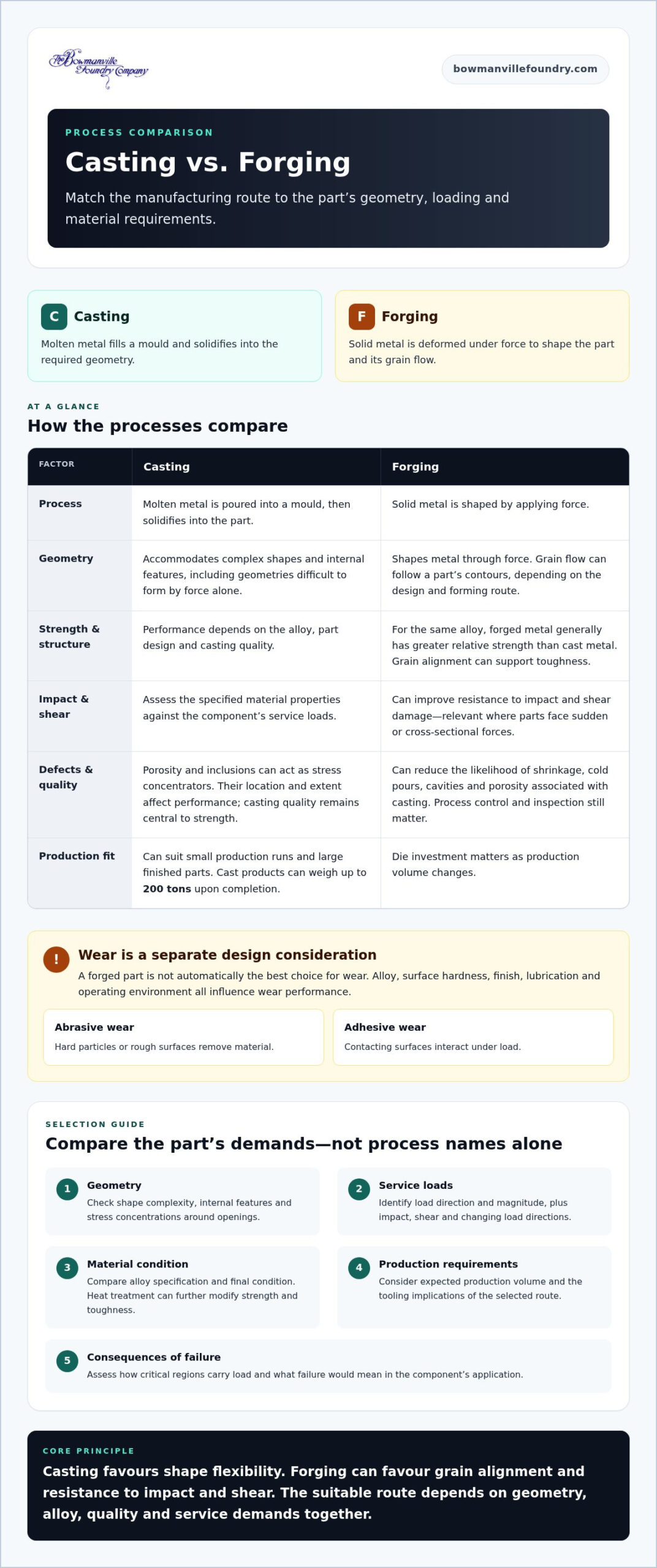
Forging shapes solid metal under force, while casting pours molten metal into a mould. The better choice depends on geometry, expected loading, production volume and the finished part’s material requirements.
Production volume and process fit
Forging applies force to solid metal, while casting forms a part inside a mould. Casting suits complex geometries that are difficult to produce by force alone. Casting tooling is cheaper than equivalent forging dies, so casting can be cost-effective for small production runs. At higher volumes, tooling is spread across more parts, making production volume part of the process decision. Cast products can weigh up to 200 tons upon completion.
| Option | Geometry | Strength considerations | Production fit |
|---|---|---|---|
| Casting | Complex shapes and internal features | Depends on alloy, design and casting quality | Can suit small runs and large finished parts |
| Forging | Shapes formed through force on solid metal | Grain alignment can support toughness | Die investment matters as volume changes |
Start by comparing the part’s geometry and expected production volume. Then assess the required mechanical properties and tooling implications.
Casting defects and strength
Porosity consists of voids in the metal; inclusions are unwanted non-metallic material trapped within it. Both can interrupt the metal’s continuity and act as stress concentrators, reducing the effective load-bearing section. Their location and extent matter: a defect near a highly loaded region can affect performance more than one outside the critical load path. Casting reduces the likelihood of defects such as shrinkage, cold pours, cavities and porosity compared with other processes, but casting quality remains central to strength.
Cast metal for demanding applications
Cast metal can serve in structural or high-load applications when the alloy, part geometry and casting quality meet the component’s design requirements. Assess the direction and magnitude of service loads, stress concentrations around openings and the consequences of failure. A cast component is not automatically unsuitable for demanding service; judge its strength against the actual application. For example, a complex load-bearing housing may favour casting if its geometry is difficult to form by force and its material properties suit the specified loads.
Casting can produce a wide range of shapes and levels of complexity, making geometry an important consideration when comparing casting with forging for a particular component.
Forging process and grain structure
Forging deforms solid metal under force, changing its shape and grain flow. When the grain flow follows the part’s contours, the resulting structure can resist damage along the load path. Casting instead fills a mould with molten metal, which solidifies into the required geometry. The process affects both the finished shape and the material structure supporting it.
Forging can reduce the likelihood of shrinkage, cold pours, cavities and porosity associated with casting. It does not mean every forged part is defect-free: process control and inspection still matter. Consider a component with a bend or changing cross-section. Grain flow can follow its shape, but the design and forming route determine whether that alignment supports the loads the part will experience.
Alloy chemistry sets the material’s baseline properties, while manufacturing process and heat treatment can alter final strength and toughness. Forging changes grain flow through deformation; casting forms the part through solidification, and heat treatment can further modify the material’s properties. Compare the specified alloy and final condition, not process names alone.
For a useful assessment, identify the main load direction, geometry around stress concentrations and required mechanical properties. Then compare the material specification and manufacturing route against those demands. Forged metals have greater relative strength than cast and plate metals made from the same alloy, but the application determines which properties govern selection. A part exposed to changing load directions may need a different assessment from one loaded mainly along a single axis.
Forging’s grain alignment can support toughness and resistance to damage, while casting provides flexibility for complex shapes. A sound decision therefore weighs geometry, alloy and required properties together. For cast iron applications, iron casting material guidance can help connect material selection with part requirements.
Forging resistance to wear and damage
Wear is a separate consideration. Abrasive wear occurs when hard particles or rough surfaces remove material; adhesive wear develops when contacting surfaces interact under load. A forged part is not automatically the best answer to either condition. Alloy, surface hardness, finish, lubrication and the operating environment all influence wear performance. For example, a moving shaft and a struck linkage face different combinations of contact and impact.
- Impact: Identify whether sudden loading can cause deformation or fracture.
- Shear: Locate pins, joints and other sections that transfer force across a plane.
- Wear: Assess contact surfaces, abrasive particles and lubrication conditions.
Use these service conditions to define the material requirements before comparing processes. A forged component may suit an application where impact or shear damage is the primary concern. A cast component may suit complex geometry, provided its alloy and design meet the required performance. Process choice alone does not establish wear life; consider contact surfaces and operating conditions too.
For a practical selection, map the load path and identify where damage would affect function. A lever exposed to sudden impacts, for instance, has different priorities from a housing subject mainly to surface abrasion. Specify expected loads, contact conditions and finish requirements, then compare material properties against those demands. This separates impact and shear resistance from wear resistance, two related but distinct criteria in component design—considerations also evaluated by automotive specialists like Precision Offroad 4×4 when selecting resilient hardware built for harsh off-road conditions.
Strength and toughness of forged metal
Forged metals have greater relative strength than cast and plate metals made from the same alloy. A casting-versus-forging strength comparison must still account for the specified alloy, final material condition and component requirements.
Tensile, yield, and fatigue strength
Tensile strength measures resistance to pulling until failure; yield strength marks the onset of permanent deformation. Fatigue strength concerns repeated loading, so a tensile result alone cannot establish it. Typical values vary with alloy grade, heat treatment, section size and test method. Compare cast and forged results only when the material conditions and test criteria match.
For a component specification, identify which property determines design acceptance. A bracket under a steady load may be governed by yield strength, while a reciprocating part also requires attention to fatigue.
Toughness, ductility, and fatigue life
Toughness describes energy absorption before fracture; ductility describes deformation before breaking. Fatigue life concerns a component’s response to repeated stress. Forging can align grain structure with a part’s shape, supporting toughness, while cast performance depends on alloy, solidification quality and final condition.
For repeated loading, consider stress concentrations, load direction and the consequences of cracking. Neither a single tensile result nor the process label establishes fatigue life. Assess the design alongside relevant material test results.
Strength verification standards and tests
In Canada, project specifications set acceptance requirements for the material and component. Tensile testing measures tensile and yield properties; impact testing assesses energy absorption, and hardness testing measures resistance to indentation. Fatigue testing evaluates repeated loading when the application requires it. The applicable method depends on the material grade and component requirements.
Match specimen condition, test method and material grade when reviewing results. A casting vs forging strength comparison based on unlike test conditions can mislead design decisions. For iron casting requirements, Bowmanville Foundry’s Ductile Iron Castings may be relevant where the part design and specified properties align.
Casting can accommodate a wider range of specialty alloys because chrome, nickel and molybdenum can be incorporated more easily into molten metal. When a specified alloy is central to selection, compare material options against the component’s required properties and test conditions.
Bowmanville Foundry: Malleable Iron Castings
Bowmanville Foundry produces Malleable Iron Castings for small components requiring tensile strength and ductility. The foundry’s ISO certification is a relevant quality assurance point when assessing casting suppliers.
For designs calling for another iron grade, Bowmanville Foundry also produces Ductile Iron Castings and Gray Iron Castings. Its Post-Processing Services can support finishing requirements for cast components.
Contact Bowmanville Foundry or visit bowmanvillefoundry.com to discuss your iron casting requirements.
Turn your material choice into a clear specification
Prepare a written set of requirements for the component: its geometry, service loads, wear conditions, material properties and finishing needs. This gives engineering and procurement teams a shared basis for reviewing drawings, selecting materials and setting acceptance criteria before production decisions are made.
A casting-versus-forging strength comparison can guide that review, but the specification should describe the finished part’s requirements rather than rely on a process label alone. For iron components, Bowmanville Foundry produces Malleable Iron Castings and Ductile Iron Castings, with Post-Processing Services for finishing requirements.
Share your part requirements with Bowmanville Foundry to discuss a suitable iron casting path. Contact Bowmanville Foundry today and move your component specification forward with confidence.
Frequently Asked Questions
How does forging grain flow improve strength and impact resistance?
Forging directs grain flow through the part, helping it withstand loads that follow the component’s contours. For an impact-loaded hook or connecting link, engineers consider how the forged shape carries force through bends and transitions. Specify the main load direction when reviewing a design, since grain orientation relative to that load affects how effectively the part resists deformation and damage.
