
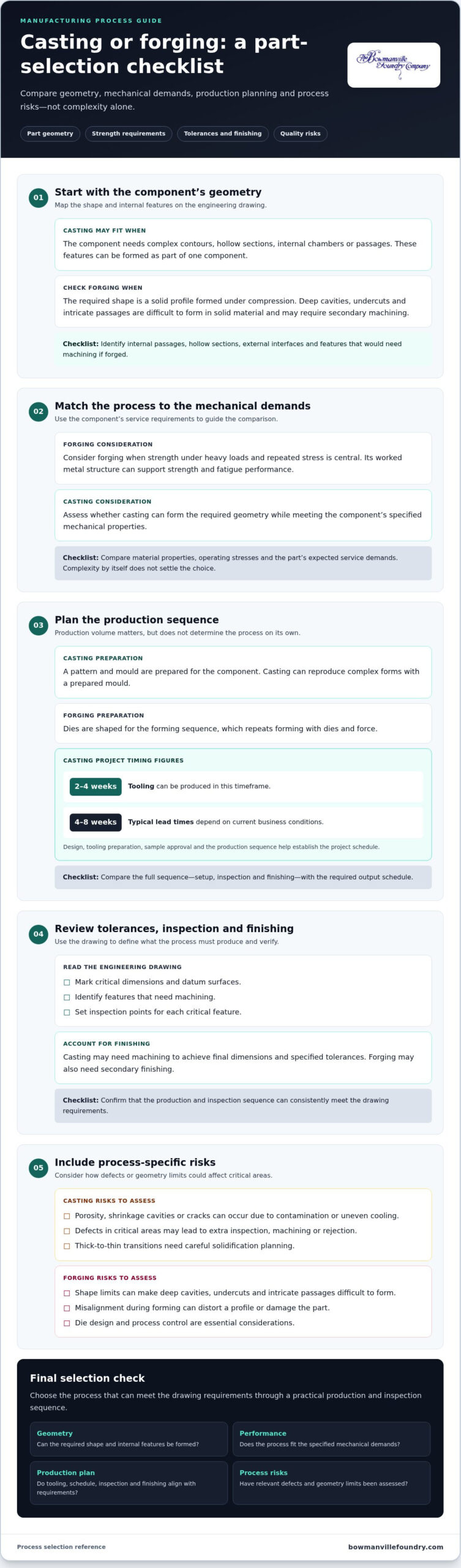
For intricate parts with thin walls, hollow sections or complex internal chambers, casting generally offers more design freedom than forging. Forging can be a better fit when strength under heavy loads and repeated stress is the priority, though complex geometry may require additional machining. Choosing casting vs forging for complex parts means weighing shape, mechanical requirements and process risks.
Both methods can produce demanding components, so a complex design alone does not settle the decision. Casting can develop porosity or cracks during cooling. Forging can limit the shapes that can be formed, and misalignment during forming can lead to defects.
This comparison explains how casting and forging work, where each may suit aerospace and automotive manufacturing, and what to consider when assessing quality risks and post-processing needs. It also offers a practical decision guide based on part geometry, strength requirements, production volume and machining. The goal is to match the process to the component’s design and service demands.
Key Takeaways
- Match the process to the part’s geometry, tolerance requirements, production volume and expected machining, rather than complexity alone.
- Consider forging when high strength and fatigue performance under repeated loads are central to the component’s function.
- Assess whether casting can form intricate contours, hollow sections or internal chambers that would need extra machining if forged.
- Include process-specific risks in the decision: casting can develop porosity or cooling cracks, while forging can limit shape complexity and be affected by misalignment.
For aerospace and automotive parts manufacturing which process is preferred?
Neither casting nor forging suits every aerospace or automotive component. Compare the part’s geometry, specified tolerances, production requirements and mechanical performance before selecting a process.
Production Volume and Speed
Production volume shapes the manufacturing plan, but does not determine the process on its own. Casting can reproduce complex forms with a prepared mould; forging repeats a forming sequence using dies and force. Compare the full sequence, including setup, inspection and finishing, with the required output schedule. A part with numerous distinct features may call for a different plan than one with a simpler repeated profile.
Tooling and Production Runs
Tooling preparation is a distinct planning step for both processes. Casting requires a pattern and mould suited to the component; forging requires dies shaped for its forming sequence. For casting, tooling can be produced in two to four weeks. Typical lead times are four to eight weeks, depending on current business conditions. The design, tooling preparation, sample approval and production sequence help establish the project schedule.
Tolerances and Production Capacity
Start with the engineering drawing. Identify critical dimensions, datum surfaces and features that need machining. Casting can form complex geometry, but machining may be needed to achieve final dimensions and specified tolerances. Forging may also require secondary finishing. Define inspection points for each critical feature, then assess whether the process sequence can produce and inspect the component consistently.
Part Size and Process Choice
Part size affects mould design, handling and the capacity of forming equipment. Casting can accommodate large parts and complex internal sections, while forging is less suited to hollow features. For a housing, map internal passages and external interfaces on the drawing. For a solid load-bearing component, compare the required profile with the forming sequence and available equipment.
| Process | Geometry | Planning focus | Finishing |
|---|---|---|---|
| Casting | Complex contours and internal sections | Pattern and mould preparation | Machining may be required |
| Forging | Solid shapes formed under compression | Die and forming sequence | Secondary finishing may be required |
Choose the process that can meet the drawing requirements through a practical production and inspection sequence.
Frequently Asked Questions
For mass production of complex parts, which process is ideal?
Casting can suit high-volume production of complex parts when a mould can repeatedly produce the required geometry and mechanical properties. Internal features can be formed as part of the component rather than machined from solid stock. When comparing casting vs forging for complex parts, consider whether strength requirements and die-formable geometry make forging a better fit. Volume alone does not settle the choice.
For which production type is casting budget-friendly?
Casting can be a budget-conscious option for small production runs, particularly when complex contours or internal features would require extensive machining from a forged blank. Sand casting has lower tooling requirements than equivalent forging dies. The full decision also depends on the specified tolerances, material properties and finishing operations needed for the finished component.
What are the advantages of casting?
Casting can form exterior features and internal passages in one component. A housing, for example, may combine mounting bosses and fluid routes without assembling separate pieces. The process can also accommodate specialty alloys, giving engineers options when matching material properties to an application. Consider casting when integrated geometry would otherwise require extensive machining or assembly.
What are the advantages of forging?
Forging creates a worked metal structure that can suit components exposed to heavy loads or repeated stress. Compression can reduce internal voids and distribute alloy constituents, supporting strength and fatigue performance. Forging may suit a solid load path, such as a shaft, when the required geometry can be formed and the finished part meets its specified mechanical properties.
What are the disadvantages of casting?
Castings can develop porosity, shrinkage cavities or cracks due to contamination or uneven cooling. Defects may affect internal soundness and lead to extra inspection, machining or rejection if they occur in critical areas. Thick-to-thin transitions need careful solidification planning. For machined surfaces, allow enough material for finishing while preserving the component’s specified dimensions.
What are the disadvantages of forging?
For casting vs forging for complex parts, forging’s main limitation is geometry: deep cavities, undercuts and intricate passages are difficult to form in solid material. These features may require secondary machining, adding operations and material removal. Accurate alignment during forming also matters. Misalignment can distort a profile or damage the part, so die design and process control are essential.
Application examples such as pump housings and engine blocks
Application requirements help determine where casting or forging may fit. A pump housing with internal passages presents different shaping demands from an automotive axle exposed to repeated loads. Compare the component’s geometry, material properties, operating stresses and production volume before selecting a process.
In automotive manufacturing, casting is used for components such as cylinder heads and engine blocks. Approximately 90% of automotive components, including those examples, are made using casting. Molten metal fills the mould, allowing the process to form external contours and internal chambers. Engine blocks and housings are also examples of cast components used in applications described as low stress. Their suitability depends on the part’s specified mechanical requirements, not its industry label alone.
A pump housing shows how complex geometry can influence material and process selection. Its design may combine mounting faces, fluid passages and hollow sections. Casting can form these features in the component, while a forged starting shape may need machining to create internal spaces. Map the passages and machined interfaces against the drawing before choosing. The material must also meet the housing’s application requirements.
Forging is used for high-strength applications in automotive, aerospace, defence, and oil and gas manufacturing. Automotive axles are one example, and in the high-performance vehicle sector, brands like ICON WHEELS leverage forged construction to deliver structural integrity under repeated dynamic loads. A forged part may suit a design that prioritizes strength under load over intricate internal geometry. For oil and gas equipment, assess the part’s mechanical demands alongside the shape that forging can produce.
For an industrial application, follow a practical sequence: identify service loads, define critical dimensions, then compare material properties and geometry. A complex housing may favour casting if its chambers are integral to the design. A load-bearing component may favour forging if strength requirements dominate. Production volume and machining needs help determine whether either process fits the manufacturing plan.
Casting and forging risks
Each method has distinct risks that affect component quality and downstream work. For an aerospace bracket or automotive housing, assess defects alongside geometry, alloy requirements, machining and operating loads. Process selection should account for how defects form, their effects on internal soundness, and the inspection or correction the design requires.
During casting, contamination can enter molten metal, while uneven cooling can cause internal tears or cracks. Porosity may also form and weaken a component. In a pump housing, pores or cavities can compromise areas where the design requires a sound wall. The casting may then need machining, finishing or defect correction. Production can also generate scrap metal and used sand, which should be considered in the manufacturing plan.
Forging reduces the likelihood of shrinkage, cold pours, cavities and porosity, but carries different forming risks. Misalignment during forging can produce an improper shape, fractures or other damage. For a load-bearing automotive part, an incorrect profile can affect fit and require extra machining. Even when an application demands greater weight or strength, die alignment must be controlled and the finished component inspected against its drawing.
Use a defined review sequence to connect process risks to the part’s requirements. First, mark critical dimensions and internal passages on the drawing. Next, identify surfaces requiring machining and the material properties needed in service. Then assess casting risks such as porosity and cooling cracks, or forging risks such as misalignment and shape damage. Finally, set inspection criteria for defects that could affect fit or function. This makes process selection specific to the component, not just its alloy or manufacturing method.
The practical takeaway is to select the method whose likely defects can be controlled while producing the required shape and mechanical properties. For complex cast parts, include porosity, cooling behaviour, machining allowance and inspection criteria in the design review. For forged parts, consider forming alignment, final shape and finishing requirements. These checks help engineers weigh process advantages against production risks.
Discuss casting requirements for your component when reviewing defect risks, machining needs and inspection criteria.
Bowmanville Foundry: Malleable Iron Castings
Bowmanville Foundry produces Malleable Iron Castings, Ductile Iron Castings and Gray Iron Castings for manufacturers considering an iron-casting route. These options may suit components whose required material properties and geometry align with iron casting rather than forging. Comparing the part drawing, service demands and machining needs helps clarify the fit.
For projects requiring finishing after casting, Bowmanville Foundry also offers Post-Processing Services. This is relevant when a component needs operations beyond its as-cast form. The process decision still depends on the design: forging may better suit parts where forged strength is essential, while casting may suit designs that rely on complex contours or internal features.
Share your component requirements with Bowmanville Foundry or visit bowmanvillefoundry.com to learn more.
Turn the process decision into a project plan
Before releasing a design for production, turn the process choice into clear engineering inputs. Mark critical dimensions, material requirements, machined surfaces and inspection criteria on the component package. This gives manufacturing teams a shared basis for assessing whether the proposed geometry and finishing sequence meet the part’s intended function.
Choosing casting vs forging for complex parts is ultimately a design decision with production consequences. If you are considering an iron casting, Bowmanville Foundry can discuss how the component requirements align with its Malleable Iron Castings, Ductile Iron Castings and Post-Processing Services. Bring the part drawing and application details to focus the discussion on relevant material and finishing needs.
Contact Bowmanville Foundry to discuss your project and take the next step with a defined set of engineering requirements.
What Are Casting and Forging?
For mass production of complex parts, which process is ideal?
Casting can suit mass production when a component’s complex features can be formed consistently in a mould. When comparing casting vs forging for complex parts, consider repeatability across the run, the number of distinct features and the sequence needed to produce each component. Set dimensional and material acceptance criteria before production, then assess whether the selected process can meet the manufacturing plan.
For which production type is casting budget-friendly?
Casting is often considered for small production runs, especially when a limited batch needs a defined shape and material. Start by documenting the expected quantity, drawing revision and required material properties. These inputs help determine whether casting suits the production plan and how sample approval should be managed before the design moves into a continuing run.
What are the advantages of Casting?
Casting can accommodate a range of specialty alloys because elements such as chrome, nickel and molybdenum can be incorporated into molten metal. This provides another material-selection route when standard alloy options do not align with an application. Compare the required alloy properties with the component specification, then assess how the selected material will perform in service.
What are the advantages of Forging?
Forging can use different forming approaches, so the suitable method depends on the component and its production requirements. Each shapes solid metal through different equipment and sequences. For a component with a mainly solid profile, compare the required shape with the available forming approach, then plan around the part drawing, material requirements and finishing operations.
What are the disadvantages of Casting?
Casting can generate waste, including scrap metal and sand, which should be considered in production planning. Assess how the moulding and pouring sequence affects material handling, leftover metal and spent mould material. For a proposed design, identify where gates and feeders sit in the casting layout, then account for their removal and handling in the production plan.
What are the disadvantages of Forging?
Forging requires high force and energy, and its forming sequence must suit the component’s shape. Hammering, pressing and rolling each apply force differently, affecting equipment and tooling requirements. When comparing casting vs forging for complex parts, review forming access and the required sequence against the part drawing before finalizing the design.
