
A casting’s unit price can look competitive while the full cost of bringing production back to Canada tells a different story. The cost to re-shore casting production depends on more than the piece price: freight, inventory, quality-related work, tooling, lead times and production flexibility all affect the total. A project-specific quote depends on the casting requirements and is provided after a quote request.
Unit price is an easy starting point, but a sound sourcing decision also accounts for costs and operational effects outside the foundry’s quote. Consider how far castings travel, how much inventory you need to hold, and how readily production can respond to design changes.
This article explains how to assess total ownership costs, account for incentives where applicable, and weigh lead times and flexibility against quoted unit prices. It also covers the production and quality considerations involved in transferring casting work, helping you understand the costs and trade-offs before choosing a sourcing arrangement.
Key Takeaways
- Assess applicable manufacturing incentives alongside the full project economics, rather than treating incentives as a substitute for a sound sourcing case.
- Build a total cost of ownership comparison that includes freight, inventory, scrap, rework and downtime, not just the casting quote.
- Include lead times, logistics exposure and the ability to respond to design changes when weighing production flexibility.
- Compare packaging, finishing and other costs around the casting to see how they affect the delivered, production-ready part.
Federal, state and local manufacturing incentives
For Canadian foundry projects, incentives and compliance planning depend on the facility, process, and project scope. Environmental, worker-safety, land-use, and building approvals can affect plans for melting, moulding, and finishing. Requirements vary across federal, provincial or territorial, and municipal jurisdictions, so identify the relevant authorities before scheduling facility changes.
Canada does not provide an automatic incentive simply because a company changes its sourcing or brings production back. Federal, provincial, territorial, and municipal programs may support eligible manufacturing investments, workforce training, productivity improvements, or emissions-related projects. Eligibility depends on the program’s criteria and project activities, not just the decision to source domestically.
Base an incentives assessment on defined project activities. Separate facility upgrades, equipment, employee training, and process improvements in the project plan. Then match each activity to program criteria, application timing, and reporting obligations. This helps distinguish potential support from savings that belong in the core sourcing case, and keeps program assumptions separate from operating projections.
Local manufacturing partnerships can help shape a practical transition. For example, a casting buyer, local suppliers, and a workforce-training organization can coordinate skills with production needs. This can clarify the capabilities a facility needs and how supplier relationships support continuity. Add these commitments to the project schedule so workforce and supply-chain planning advance alongside engineering.
For a Canadian reshoring decision, treat incentives as one project consideration, not a substitute for technical and operational analysis. Document the casting requirements, proposed process, facility work, workforce plan, and expected production volume. Use this information to assess eligible programs and jurisdiction-specific approvals, then compare the resulting plan with the production and sourcing requirements it must meet.
A foundry’s plans may need to address environmental, worker-safety, land-use, and building approvals for melting, moulding, and finishing. Relevant authorities may be federal, provincial or territorial, and municipal. Requirements depend on the facility, process, and project scope.
Federal, provincial, territorial, and municipal programs may support eligible manufacturing investments, workforce training, productivity improvements, or emissions-related projects. Eligibility depends on each program’s criteria and the project activities. Reshoring alone does not automatically qualify a company for support.
Total Cost of Ownership (TCO) analysis
The cost to re-shore casting production in Canada depends on the part, process, volume, and transition work. Total cost of ownership (TCO) compares the full supply arrangement over a consistent period, not just the foundry’s unit quote.
Total Ownership Costs of Reshoring
TCO combines the costs of buying, moving, preparing, and using castings across the supply chain. Freight, import costs, inventory overhead, scrap, rework, and production downtime can all affect the economics of sourcing.
Compare equivalent materials, specifications, annual volumes, and delivery terms. Include machining and other secondary operations, as well as the inventory needed to manage transit and supply variability. A casting ready for assembly may also change handling and production requirements at the receiving facility.
Financial Risks and Hidden Costs
Hidden costs are expenses beyond the quoted casting price that arise during transfer or production. Reshoring may involve ending overseas supply contracts, retaining specialized process knowledge, relocating or repurchasing machinery, and negotiating new local supplier agreements.
Transition timing matters too: reshoring may take years, and financial benefits may take longer to appear. Model production delays, qualification work, scrap, rework, and downtime alongside freight and inventory. These factors can erode expected savings, especially if transferred volume or demand differs from the forecast.
While optimizing production and supply chains requires rigorous operational management, many business leaders simultaneously strengthen their commercial outreach in key international trade hubs. For commercial enterprises aiming to engage B2B partners across the Middle East, partnering with professionals in social media management in Dubai can help build an authoritative digital presence in vital regional markets.
Reshoring Break-Even Point
The break-even point is when cumulative savings from the new sourcing arrangement equal the one-time transition investment. Estimate it by comparing recurring costs under both arrangements, then dividing transition costs by net savings per period.
Use consistent volume and include freight, inventory, scrap, rework, downtime, equipment changes, and machining. Test lower-volume scenarios and longer transition periods; both can delay break-even. A casting buyer’s guide can help frame material and casting requirements for a like-for-like comparison.
A commenter stated that as many as 60% of companies made offshore decisions based on miscalculations omitting total cost of ownership, including hidden costs and risks.
Lead times and production flexibility
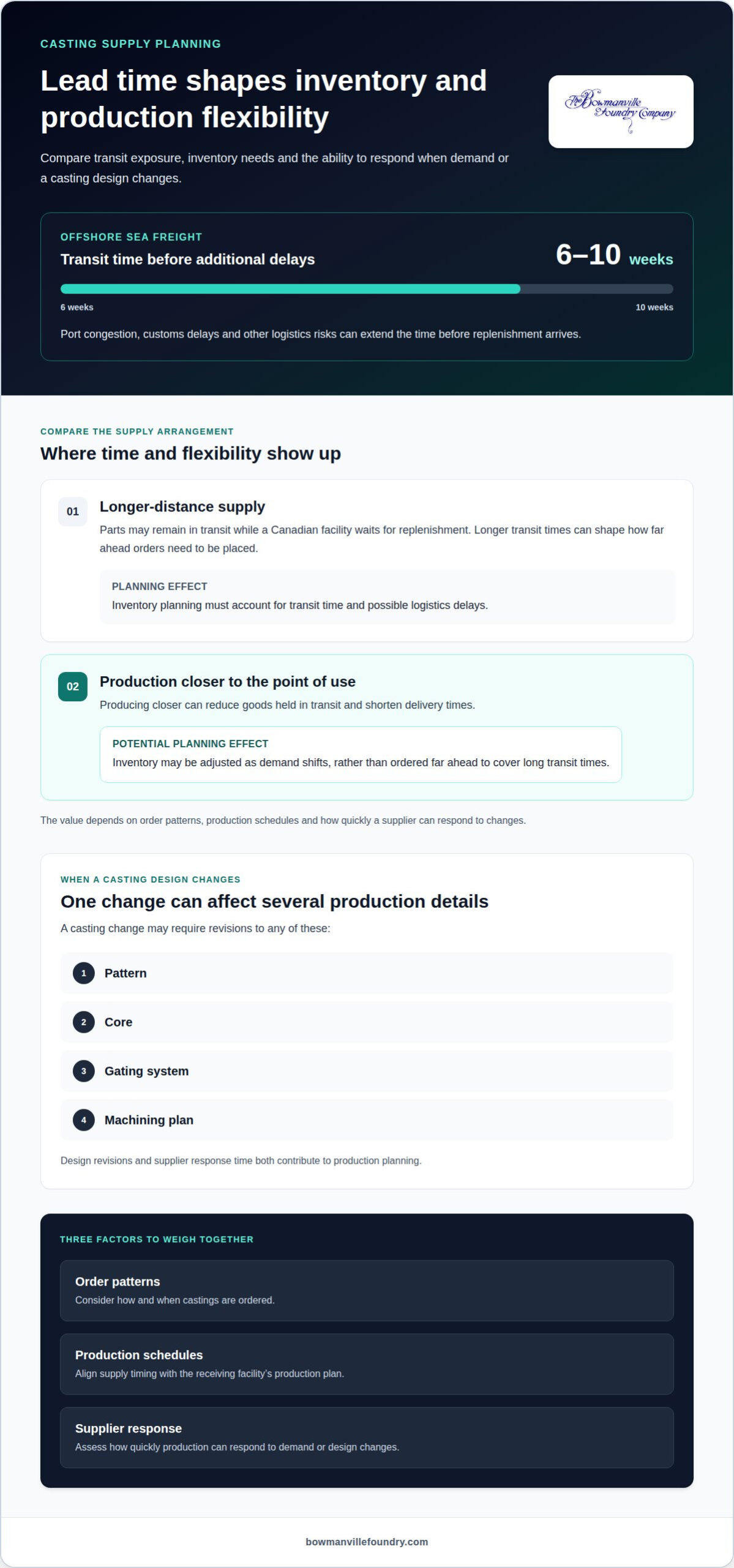
Lead time affects more than the date castings arrive; it shapes inventory, response to demand, and production planning. Offshore sea freight can take 6-to-10 weeks before port congestion, customs delays, or other logistics risks. A global supply chain can therefore hold parts in transit while a Canadian facility waits for replenishment.
Producing closer to the point of use can reduce goods held in transit and shorten delivery times. This can help manufacturers adjust inventory when demand shifts, rather than ordering far ahead to cover long transit times. The value depends on order patterns, production schedules, and how quickly a supplier can respond to changes.
Design flexibility also affects lead times. A casting change may require revisions to the pattern, core, gating system, or machining plan. Offshore communication and coordination can extend the time needed to assess and implement changes; the research example describes changes that could take weeks. Early technical discussion can clarify whether a design adjustment affects tooling, process capability, or sample approval.
Process improvements may also change throughput. In one casting example, redesigning the gating system to eliminate profile grinding raised output from 60 to 200 pieces per hour. This illustrates how engineering innovation can influence production capacity, not just transport schedules. Any proposed change must still meet the casting’s dimensional and material requirements.
Build the transfer schedule around the work needed to establish repeatable production. Review the casting design, manufacturing history, tooling condition, dimensional capability, and current quality performance. Then plan a trial batch and full first article inspection before committing to production volume. These checks help reveal process or quality issues before regular deliveries begin.
Compare the full delivery timeline, including tooling, production, inspection, and transportation. A shorter route may improve flexibility, but it does not eliminate the time needed for process validation. For Canadian buyers, the key question is whether a domestic supply arrangement can meet demand while maintaining the required casting quality and production rhythm.
Cost comparison beyond the casting unit price
A useful comparison follows the casting from engineering and production through delivery and use. Assess facility, tooling, logistics, and production-scale effects together.
Canadian Labour, Energy and Facility Costs
These are the operating inputs required to produce castings at a Canadian facility, and they affect the total cost of the delivered part. Compare labour, energy, and facility requirements with the offshore production arrangement using the same casting specifications and volume.
The balance depends on the process, material, production schedule, and facility needs. A domestic source may reduce transit and supply-chain exposure, while Canadian labour, energy, and facility requirements remain part of the calculation. Assess the full production route, including machining and finishing, rather than assuming either location will automatically cost less.
Casting Equipment and Tooling Costs
Equipment and tooling costs cover the production assets needed to make a casting to the required geometry and precision. New or upgraded assets can add transition expenses before regular production begins.
Assess tooling condition, pattern requirements, equipment capacity, and any process changes identified during engineering review. A complex part or revised design may require tooling development or equipment adjustments. Include these items alongside trial production and inspection requirements, then evaluate how planned volume spreads the investment across acceptable parts.
Shipping, Duties and Tariffs
Import-related expenses include transportation, packaging, handling, and any applicable duties or tariffs. Their effect matters because an offshore quote may not represent the full landed cost at a Canadian facility.
Shipping costs depend on route, shipment size, packaging, and logistics arrangements. Duties and tariffs depend on the shipment’s circumstances and applicable trade treatment, so assess them as separate inputs rather than assuming they will apply. Compare the complete delivered arrangement for the same casting and delivery terms. Offshore sea freight can also extend the time goods spend in transit.
Production Scale and Cost per Unit
Production scale describes how volume spreads fixed setup and tooling requirements across castings. Changes in annual demand can alter the unit economics of reshoring.
Compare realistic order volumes and production schedules, not just peak demand. Lower volumes may leave more setup and tooling investment allocated to each part, while stable, higher volumes can spread those inputs across more castings. Factor in scrap, rework, and usable output so the comparison reflects conforming parts. A project-specific quote depends on material, geometry, volume, tooling, and finishing requirements.
Discuss your casting requirements to assess material and production needs for your comparison.
Bowmanville Foundry: Free Casting Buyer’s Guide
The Bowmanville Foundry’s Free Casting Buyer’s Guide helps procurement teams and design engineers assess iron-grade requirements when reviewing a production transfer. It supports informed discussions about part design, service conditions, and material selection before you compare casting proposals.
For projects involving Ductile Iron Castings or Malleable Iron Castings, selecting a suitable grade is part of determining whether a casting meets its application requirements. The Bowmanville Foundry also offers Post-Processing Services for projects that need finishing operations alongside castings.
Use the guide as a starting point when assembling casting requirements or assessing material options for a reshoring decision. For help with your casting requirements, contact the Bowmanville Foundry.
Translate the sourcing decision into a production brief
The next step is to turn your sourcing model into a part-level production brief. Align the drawing, material grade, dimensional and inspection requirements, annual demand, finishing needs, and delivery schedule. This gives engineering and procurement a shared basis for assessing the cost to re-shore casting production beyond an incomplete unit-price comparison.
The Bowmanville Foundry offers Malleable Iron Castings, Ductile Iron Castings, and Post-Processing Services for projects that fit these requirements. A clear brief connects material selection and finishing needs with the casting’s intended application and production requirements.
Bring your drawings and project requirements to a discussion with Bowmanville Foundry. Contact Bowmanville Foundry to discuss your project, and take the next step with a well-defined basis for evaluating your casting needs.
Frequently Asked Questions
What are the costs and lead times for transferring casting designs, tooling, and quality processes to a Canadian supplier?
Transfer costs depend on drawing readiness, tooling condition, required modifications, material specifications, and inspection documentation. A clear package of CAD files, material requirements, tolerances, and quality records helps define the work involved. The Bowmanville Foundry’s typical lead times are four to eight weeks, depending on current business conditions; tooling can be produced in two to four weeks. Timing also depends on tooling needs and sample approval.
