
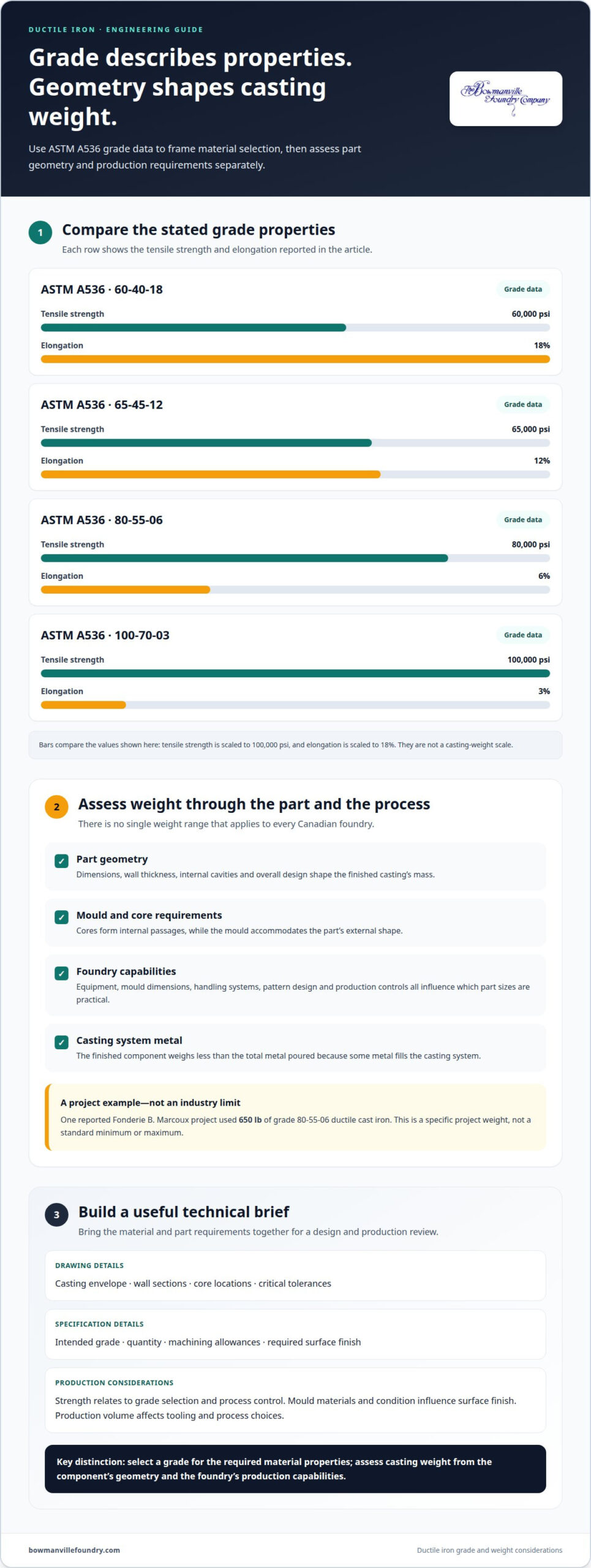
A casting’s grade and weight answer different engineering questions. Ductile iron is nodular iron, and ASTM A536 grades describe mechanical properties: grade 60-40-18 has a tensile strength of 60 000 psi and 18% elongation, while grade 100-70-03 has a tensile strength of 100 000 psi and 3% elongation. For buyers assessing custom ductile iron casting in Canada, those distinctions help frame material selection, but they don’t set a universal casting weight range.
Weight depends on a part’s geometry and the foundry’s casting capabilities, so design matters as much as grade. A clear weight range can help narrow a project specification, but understanding how grade and geometry relate makes the discussion more useful.
This article explains what ductile iron is, compares key ASTM A536 grades, and outlines the factors that shape casting weight. It also looks at how to find Canadian casting companies, so you can connect material and part requirements with a suitable manufacturing partner.
Key Takeaways
- Learn how ASTM A536 grade designations relate to tensile strength, yield strength and elongation when assessing ductile iron for an application.
- Understand why casting weight depends on part geometry and manufacturing requirements, rather than grade alone.
- Find out how to interpret Canadian supplier directories and assess what their listings can tell you about casting manufacturers.
- See how casting process choices connect part design, mould requirements and the finished component’s intended use.
What Is Ductile Iron?
For procurement, a grade designation is only one part of a casting specification. The component’s intended load, geometry and finished condition shape the production brief. These details help distinguish a casting manufacturer from a supplier that arranges production through another facility. They also help engineers assess whether a foundry’s capabilities match the part’s requirements.
Canadian manufacturer directories report employee-size bands, but workforce figures do not establish casting capacity. One list’s median employee-size band was 11-50 employees as of October 11, 2026. The oldest fitting company identified in the results was founded in 1920. These details provide context about the supplier landscape, not evidence of a facility’s equipment, quality controls or production range.
Minimum order quantities and lead times vary with pattern requirements, part complexity, production scheduling and order volume. A repeat order using established tooling may follow a different schedule from a new design that requires pattern development.
For a quote, provide a drawing that shows the casting envelope, wall sections, core locations and critical tolerances. Include the intended grade, quantity, machining allowances and required surface finish. These details help the foundry assess the design and identify production requirements.
Shipping arrangements depend on the manufacturing site, destination, packaging and freight method. For imported castings, buyers coordinate shipping documents and brokerage as part of the delivery plan. National sourcing decisions should account for where production takes place and where the finished parts need to go.
Sustainable manufacturing practices can include energy management, sand recovery and metal reclamation. These measures concern how a facility manages production materials and resources. They are separate from the casting’s grade designation and mechanical properties.
ASTM A536 grade data can also help narrow a specification: grade 65-45-12 has a tensile strength of 65 000 psi and an elongation of 12%, while grade 80-55-06 has a tensile strength of 80 000 psi. These values distinguish the stated grades, but buyers still need to match the selected grade to the component’s requirements. Supplier-directory counts offer a separate view of the market: the RevenueBase list included 12 Canadian ductile iron casting manufacturers in the 51-200 employee band. The Canadian ductile iron casting manufacturer list included six companies in the 1-10 employee band and seven companies in the 11-50 employee band.
Ductile iron casting weight range
Ductile iron castings have no single weight range that applies to every Canadian foundry. Part mass depends on the component’s dimensions, wall thickness, internal cavities and design. A reported Fonderie B. Marcoux project used 650 lb of grade 80-55-06 ductile cast iron. That example shows a specific project weight, not a standard minimum or maximum for the industry.
Geometry determines a finished casting’s weight. A compact, thick-walled housing and a longer component with hollow sections can have different masses, even if both serve industrial machinery. Cores form internal passages, while the mould accommodates the part’s external shape. The finished component also weighs less than the total metal poured, because some metal fills the casting system.
Supplier capacity depends on more than employee count. A reported employee-size range for fitting companies is 101-250 employees, but that range does not establish their casting capacity or the weight of parts they produce. Foundry equipment, mould dimensions, handling systems, pattern design and production controls all influence which part sizes are practical. A company directory’s workforce band is therefore a business descriptor, not a technical specification.
Casting methods involve trade-offs. Strength depends on the selected grade and control of the casting process, while mould materials and condition influence surface finish. Production volume affects tooling and process choices, so the right method depends on part geometry, finish requirements and expected quantity.
For custom ductile iron casting in Canada, consider weight alongside the component’s function and production requirements. Engineers can assess the part’s envelope, wall sections, cores and handling needs together. This technical review helps determine whether the design and intended casting process can produce the required component, rather than relying on weight alone.
Canadian ductile iron casting company directory
Canadian supplier directories can help locate potential casting manufacturers, but search results depend on category definitions and database coverage. One directory lists 100 ductile iron casting manufacturers in Canada. Treat that result as a starting point, not a complete inventory: a listing count does not establish how many companies operate foundries or produce ductile iron components.
Directory records can combine different kinds of business information. A company address may identify an office or headquarters rather than the facility where castings are made. Before assessing freight routes, distinguish the listed business address from the manufacturing site. This matters for national sourcing because transport planning depends on where production takes place and where finished components must arrive.
Use each listing to identify what the company does. A record may describe a casting manufacturer, a distributor or a broader metalworking business. These roles are not interchangeable. A directory entry that names ductile iron does not, by itself, specify available grades, casting methods, component dimensions or production capacity.
To build a useful shortlist, record each manufacturer’s name, stated production role and available technical information. Compare those details with the part specification: material designation, drawing requirements, critical dimensions, finish and expected production volume. If a listing lacks technical detail, treat it as a contact lead, not proof that the supplier can make the part.
Employee counts and contact totals also need careful interpretation. They describe an organisation’s size or directory data, not its moulding equipment’s capacity or ability to meet a casting specification. A directory helps buyers find and organise potential suppliers; a technical discussion connects a company’s manufacturing work to a component’s requirements. For custom ductile iron casting Canada sourcing, distinguish directory facts from production capabilities before selecting a casting partner.
The directory lists no ductile iron casting companies under Ontario in its search results. London, Richmond Hill and Winnipeg each had 2 company records in the Canadian ductile iron casting manufacturer list.
What custom ductile iron casting processes do Canadian foundries use?
For a custom component, the casting route starts with its geometry and grade requirements. Sand casting uses a pattern to form a cavity in packed sand. The pattern defines the external shape, while a core creates an internal passage or hollow section. This method accommodates varied shapes, including housings with internal features.
A typical production sequence includes pattern preparation, mould formation, pouring, cooling and finishing. The pattern first shapes the mould cavity. The foundry places cores where the design requires internal voids, then joins the mould halves. Molten iron fills the cavity and solidifies. After cooling, workers remove the sand, clean the casting and assess it against specified requirements.
Each stage affects the result. Mould design and sand condition influence surface characteristics. Core placement and mould geometry affect internal passages and wall sections. Pouring and solidification controls influence casting soundness and consistency. The required ASTM A536 grade defines mechanical properties, while the process must produce a component that meets its drawing and application needs.
Tooling choices also depend on production volume. A matchplate holds multiple patterns for repeated molding, while a single pattern may suit a different production plan. Part complexity, pattern design and required output all shape the tooling approach. Machining may follow casting when the component needs finished dimensions or specific surfaces.
Quality checks can include visual examination, dimensional measurement and tests specified for the order. Inspection criteria should align with drawing tolerances, critical sections and material requirements. If heat treatment is specified, it is a separate process step that must suit the selected grade and component requirements.
For a technical assessment, prepare CAD files, the grade specification, drawings and details about critical features. A foundry engineer can review design feasibility and process requirements with your team. Discuss your component’s casting requirements with a technical or sales engineer to identify the appropriate production route.
Bowmanville Foundry: Ductile Iron Castings
Bowmanville Foundry produces ductile iron castings for manufacturers assessing grade, part design and production requirements. Its typical lead times are four to eight weeks, depending on current business conditions; tooling can be produced in two to four weeks. These timelines help frame planning for a custom casting project.
For early material selection, the Free Casting Buyer’s Guide offers a starting point for evaluating iron casting requirements. Malleable iron castings provide another iron option, while post-processing services support finishing after casting. The right combination depends on the component’s specified material, geometry and required finished condition.
Share your drawings, CAD files, grade requirements and expected production needs to support a technical discussion. Contact Bowmanville Foundry to discuss your ductile iron casting requirements.
Move Your Casting Specification Forward
Before releasing a casting design, align engineering, quality and procurement on the same drawing revision and acceptance criteria. A controlled specification helps prevent conflicting requirements from reaching production and gives each team a clear basis for reviewing design changes.
For custom ductile iron casting in Canada, document who approves drawing revisions and how changes to the part or its intended application are communicated. This keeps technical decisions traceable as the project moves from design review to production planning.
When you’re ready to discuss the next step, share your project requirements with Bowmanville Foundry. A clear, coordinated specification gives your team a sound foundation for moving the project ahead.
Frequently Asked Questions
Which Canadian foundries offer custom ductile iron casting?
Bowmanville Foundry offers ductile iron castings for industrial customers across Canada. For a sourcing discussion, provide the part drawing, intended application and required material designation so the casting requirements can be assessed together. The Free Casting Buyer’s Guide can help buyers organize material and design considerations before discussing a project with the foundry.
What ductile iron grades and specifications are available in Canada?
Canadian ductile iron specifications use grade designations such as ASTM A536, with mechanical property requirements defined by the selected grade. The appropriate specification depends on the component’s design loads, required ductility and service conditions. Bowmanville Foundry offers Ductile Iron Castings and technical information to support material selection. Include the governing standard, grade designation, drawing tolerances and any inspection requirements in your casting specification.
Which Canadian standards and certifications apply to ductile iron castings?
ASTM A536 grades specify ductile iron mechanical properties. Canadian companies in the sector must comply with the Canadian Environmental Protection Act.
How are Canadian ductile iron castings tested, inspected, and certified?
Checks can include visual examination, dimensional measurement and tests specified for the order. Criteria should align with drawing tolerances, critical sections and material requirements. No specific certification is identified.
