
Railway castings must retain their shape and function under repeated shock, friction and demanding service conditions. Custom iron casting for railway parts begins with the component’s geometry and requirements. Patterns can be developed from customer drawings or samples, then used to produce castings for evaluation and production.
Material selection matters as much as pattern accuracy. Gray, Ductile and Malleable Iron have different mechanical properties, so the right choice depends on the part’s function, design and required performance. A casting suited to one application may not work for another.
This article explains how customer requirements shape railway casting patterns, how custom castings move through production, and how Gray, Ductile and Malleable Iron compare. It also covers finishing operations and the importance of coordinating part design, material and manufacturing process when specifying iron castings for railway use.
Key Takeaways
- Account for part geometry and operating requirements when developing a casting pattern from drawings or CAD files.
- Follow how molding, casting, cleaning and finishing operations connect across custom production.
- Compare Gray Iron, Ductile Iron and Malleable Iron by their properties and the demands of the component.
- Use railway component examples and the Free Casting Buyer’s Guide to inform material and post-processing decisions.
Casting patterns made to customer drawings and requirements
A pattern translates a railway component’s specified geometry into a mould cavity. Because its details shape the casting, clear drawings and requirements are essential from the outset.
Drawing-Based Pattern Requirements
A pattern is a physical form used to reproduce part geometry in a mould. Customer drawings, CAD files and functional requirements define features such as mounting faces, wall sections, openings and machining allowances. For example, a railway bracket may need accurately positioned mounting points and a defined interface with adjoining components. These details help pattern designers create a cavity that reflects the part’s intended fit and use. If a sample is available, its geometry can also inform pattern development alongside the drawing.
Design for Strength and Manufacturability
Design for manufacturability adapts a component’s geometry to its service demands and the casting process. Consistent wall thickness, practical transitions between sections and rounded internal corners can support metal flow and avoid abrupt changes in section. Core placement is also important for parts with internal passages or hollow areas. For a railway housing, clearly identified machining locations and accessible datum surfaces connect casting geometry with finished-part dimensions. These design decisions can simplify molding while retaining the features needed for assembly.
Ask railway casting suppliers for applicable quality-management certification and records linking inspection results to the drawing and material requirements. Testing documentation should identify the checks performed and their results for the supplied castings. Certification alone does not provide the inspection history of an individual part.
For Canadian sourcing, shipping schedules, tooling arrangements and import duties shape the procurement plan. Tooling requirements depend on part geometry, pattern design and production needs. Freight planning depends on shipment size, route and delivery terms, while import charges may depend on product classification and origin. Define these factors alongside the component specification because they affect production and delivery coordination.
Custom iron casting production steps
Production turns part requirements into a finished casting through a series of controlled stages. Each stage can affect geometry, surface condition and readiness for assembly.
Custom Casting Production Workflow
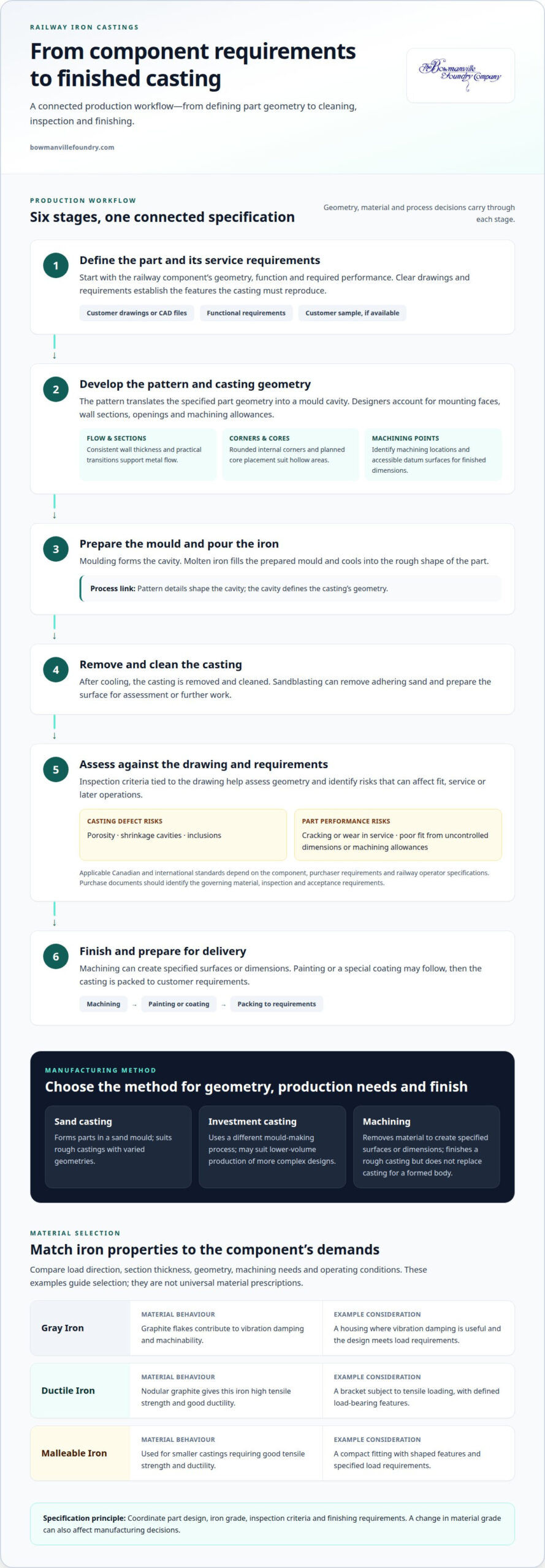
A custom casting workflow typically proceeds from pattern preparation to molding, pouring, cleaning and finishing. Each stage matters because a defect or missed requirement can affect later operations. Once the mould is prepared, molten iron fills the cavity and cools into the part’s rough shape. The casting is then removed, cleaned and assessed against the required geometry. Sandblasting can remove adhering sand, and machining can follow where dimensions or surfaces need closer control. Painting or a special coating, followed by packing to customer requirements, may complete production.
Casting and Machining Methods
Sand casting forms parts in a sand mould and suits rough castings with varied geometries. Investment casting uses a different mould-making process and may suit lower-volume production of more complex designs. Machining removes material to create specified surfaces or dimensions. It can finish a rough casting, but does not replace casting when the part needs a formed body. The right process depends on geometry, production needs and required finish.
For railway parts, applicable Canadian and international standards depend on the component, purchaser requirements and railway operator specifications. Purchase documents should identify the governing material, inspection and acceptance requirements rather than assume a single standard applies to every casting.
Potential failure modes include casting defects such as porosity, shrinkage cavities and inclusions, as well as cracking or wear in service. Poor fit can also result when critical dimensions or machining allowances are not controlled. Inspection criteria tied to the drawing help assess these risks.
For technical guidance on iron casting applications, consult the casting information and resources available here.
Gray, ductile and malleable iron
Gray, Ductile and Malleable Iron differ in graphite structure and mechanical behaviour. These differences affect how each material responds to loading, vibration and part geometry. Select a grade based on the component’s service demands and specified properties, not the material name alone.
- Gray Iron: Graphite flakes contribute to vibration damping and machinability. It may suit housings or supports where damping and compressive loading are relevant design considerations.
- Ductile Iron: Nodular graphite gives this iron high tensile strength and good ductility. It may suit components whose design requires both properties, including castings with defined load-bearing features.
- Malleable Iron: This iron is used for smaller castings requiring good tensile strength and ductility. It may suit compact components with shaped features and specified load requirements.
For a railway housing, Gray Iron may be considered when vibration damping is useful and the design meets load requirements. A bracket subject to tensile loading may call for the strength and ductility associated with Ductile Iron. A compact fitting requiring strength and ductility may be considered for Malleable Iron. These examples illustrate selection factors, not universal material prescriptions.
Compare the part’s load direction, section thickness, geometry, machining needs and operating conditions. Thin sections and complex shapes can affect casting feasibility, while machined faces shape finishing requirements. The material’s properties must match the drawing and intended function. A change in grade can also affect manufacturing decisions.
Specify the required iron grade alongside the component geometry and service requirements. Clear specifications connect material selection with pattern design, production and inspection. Compare the part’s demands with each iron’s properties rather than ranking the three materials in general.
What railway components can be made with custom iron casting?
Railway castings can form housings, brackets and other shaped components. The part’s function, material requirements and geometry determine whether iron casting is suitable.
Examples of railway applications include shock absorbers, signalling valves, arcing horns, axle boxes and brake callipers. The manufacturing route for each depends on the component design and required material.
- Axle boxes and housings: These components support railway axle assemblies. Their interfaces and machined surfaces must match adjoining parts.
- Brake callipers: A casting can provide the shaped body, with machining used where specified surfaces need finishing.
- Signalling valves: Internal passages and connection points guide pattern and core design.
- Hinges and shock absorbers: Their geometry and operating loads inform material and casting decisions.
These examples do not mean every railway component is an iron casting. Railway components may be made by different processes, depending on their design and service requirements. Pantographs collect power from overhead lines, so their electrical function differs from that of an iron housing or support. Let the application and design guide process selection.
For a proposed iron component, the drawing should show mounting points, mating surfaces, required openings and areas needing machining. These details help determine whether the geometry can be cast and where finishing is needed. Material selection must also reflect the component’s function and service loads.
To discuss a railway component’s geometry, material and casting requirements, contact the foundry about your casting project.
Bowmanville Foundry: Free Casting Buyer’s Guide
Bowmanville Foundry’s Free Casting Buyer’s Guide helps purchasers assess iron material choices and production requirements. For a railway component, use it to organize considerations such as part geometry, required properties, machining and finished condition. A clear specification connects pattern design, material selection and inspection expectations before production planning advances.
The guide supports informed discussion about whether Malleable Iron or Ductile Iron suits a component’s requirements. Ductile Iron combines high tensile strength with good ductility and suits medium to large castings. Malleable Iron is used for smaller castings requiring good tensile strength and ductility. Part size, geometry and service demands frame the material discussion, while the drawing defines the features the casting must reproduce.
For finished parts, Bowmanville Foundry’s Post-Processing Services cover operations after casting. Machining can produce specified surfaces or dimensions, while painting or plating may provide a required surface finish. The appropriate work depends on the component drawing and intended use. Identifying machined faces, interfaces and surface requirements helps coordinate the casting with its finished condition and assembly needs.
When a drawing, sample or application presents design questions, a technical or sales engineer can visit your facility to assess your needs and requirements. An on-site discussion can bring the component’s geometry, material selection and finishing needs into the same technical conversation. This option is useful when production decisions depend on understanding the part in its operating or assembly context. The Free Casting Buyer’s Guide can also help organize the information for that discussion. Contact Bowmanville Foundry to discuss your casting requirements: contact Bowmanville Foundry.
Move Your Railway Casting Project Forward
When planning custom iron casting for railway parts, treat the drawing, material specification and finished-part requirements as one coordinated package. This gives the technical discussion a clear starting point, particularly for components with critical interfaces or machining requirements. Bring these project details together for a technical assessment.
Bowmanville Foundry manufactures Ductile Iron and Malleable Iron castings and provides Post-Processing Services for finishing. Its Free Casting Buyer’s Guide helps organize material and production considerations before discussing a project. Whether you are developing a new component or reviewing an existing design, the requirements provide a clear basis for the conversation.
Share your railway part requirements with Bowmanville Foundry to discuss an appropriate path from design to finished casting. Contact Bowmanville Foundry today to start a practical discussion about your project. Clear specifications are a strong foundation for the next production decision.
Frequently Asked Questions
How Important Is Metal Casting for the Railway Sector?
Metal casting can support railway maintenance by producing replacement parts that match established assembly interfaces. In a repair program, the priority is preserving fit with adjoining components and meeting the engineering requirements for the application. Casting is one option in a broader manufacturing plan; the component’s design, operating role and required material properties determine its suitability.
Canadian foundries offering custom iron casting for railway parts
Bowmanville Foundry is a Canadian source for custom iron castings, with national service coverage. It was the first foundry in Canada to achieve ISO certification in 1996. For procurement teams, this provides a relevant point of reference when considering a supplier. A technical discussion can centre on the component’s documentation, intended use and manufacturing requirements.
Which cast iron grades and specifications are used for railway parts in Canada?
The required grade and specification depend on the component’s engineering requirements; no single designation applies to every railway part. Procurement documents should clearly identify the required grade and applicable property criteria. They should also state the drawing revision that governs production and define acceptance requirements, so engineering, purchasing and receiving teams use the same part definition.
How does the custom iron casting process work, from design to delivery?
Effective coordination depends on controlling the part definition throughout the project. Establish the governing drawing revision, who approves design changes and what constitutes sample approval before production planning advances. Procurement can also align acceptance documentation and delivery requirements with the engineering specification. These decisions clarify responsibilities for design, purchasing and receiving teams and keep expectations explicit.
What are typical minimum order quantities and lead times for custom railway castings in Canada?
The listed custom casting product has a minimum order quantity of 2,000 pieces and a stated lead time of 30-45 working days. These are product-specific figures, not Canada-wide typicals.
