
The strongest metal is not automatically the right choice for a machinery casting. Custom industrial machinery castings are designed around a part’s geometry, operating loads, environment and required finish, so material selection and production details must be considered together.
Shape and dimensions are a useful starting point: casting can form complex profiles and consolidate components that might otherwise require extensive machining or welding. Service conditions matter just as much. Gray Iron, Ductile Iron and Malleable Iron each have different properties, and the right grade depends on what the part must do.
This guide explains how custom casting accommodates part shapes, dimensions and quantities, what information helps prepare a quotation, and how inspection requirements can be specified. It also covers comparing iron materials for machinery applications and deciding whether machining or other post-processing is needed. Considering these decisions in sequence helps design and procurement teams specify a casting for the equipment, rather than choosing a material in isolation.
Key Takeaways
- Match the casting process and post-processing steps to the part’s geometry, required finish and operating conditions.
- Define dimensions, production quantities and opportunities to consolidate components before finalizing the casting design.
- Prepare a quotation package with a drawing or sample, material specification, critical dimensions, machining needs and inspection requirements.
- Compare Gray Iron, Ductile Iron, Austempered Ductile Iron and Malleable Iron by the properties the application requires, then use the Buyers Guide or technical support to inform your selection.
Iron Casting Processes and Post-Processing
Choose a casting approach by comparing part geometry, iron grade, quantity and required finish. Heat treatment, machining and finishing can then address the component’s operating and assembly requirements.
Casting process options
Sand casting, investment casting and die casting are process options for custom industrial parts. Sand casting accommodates larger parts and flexible tooling, while investment casting suits intricate shapes and finer surface finishes. Die casting forces molten metal into a reusable metal die, making the die, alloy and part design key selection factors. The suitable process depends on the specific part’s requirements.
Start with the drawing or sample, then review dimensions, wall sections, internal cavities and production quantity. A core can form hollow sections in a sand casting. Mould design also accounts for metal shrinkage as it cools, helping achieve the required geometry.
Import origin alone does not establish casting quality. For imported or Canadian-made parts, align the drawing, alloy specification, inspection records and sample-approval requirements. Shipment coordination and clear communication also matter when planning delivery.
Post-casting treatments
Heat treatment controls a metal’s temperature to change its physical properties. For an industrial casting, first specify the service conditions and required properties; the alloy and application guide the treatment. Loads, damp conditions, heat and low-temperature environments may affect requirements. Heat treatment is not necessary for every part.
Next, identify the surfaces that need machining. Bearing bores, mounting pads, shaft centres and reference surfaces often require machining to meet final dimensions. Establish machining datums early so the drawing clearly relates critical features to one another.
Then define the required surface finish and any light assembly operations in the part specification. Distinguish as-cast surfaces from machined areas, and describe relevant finishing needs, such as cleaning or a specified coating. These details help coordinate production and inspection with the finished component’s intended use.
Casting Part Shapes, Dimensions, and Quantities
Geometry, service conditions and production quantity all shape a casting specification. Making engineering decisions before tooling helps align the part with its function and expected service life.
Part shapes and dimensions
Start with a dimensioned drawing or CAD files that define the component’s geometry. Identify critical surfaces, wall sections, internal passages and features that must be machined. A core can form hollow sections, while mould design accounts for metal shrinkage during cooling.
Specify the material, dimensions, tolerances and finish together. Mark critical dimensions and machining surfaces on the drawing, then state the required tolerance for each feature. Distinguish as-cast surfaces from machined areas and describe the intended finish. Relate mounting faces and other reference features to shared datums.
Production quantities
State the expected order quantity and anticipated repeat demand. These details inform pattern and matchplate planning, production scheduling and the consistency required between parts. A matchplate holds multiple patterns for producing similar castings in a molding cycle.
For a replacement component, include the existing sample or available drawing. Photographs and mating-part dimensions can clarify how the casting fits the surrounding equipment. Details of a previous failure can also inform design changes for the next service cycle.
Review the assembly before treating each plate, spacer, boss and stiffener as a separate part. Combining these features in one casting can reduce assembly work and alignment variation. Complex shapes may also reduce the machining needed to produce the finished form.
To support a longer service life, define operating loads, wear exposure and maintenance needs. Compare those demands with the selected iron’s properties, then specify inspection points and any required machining. A clear drawing connects design intent with manufacturing and the finished component.
For help preparing a part specification, use casting design support to discuss geometry, dimensions and production needs.
Casting Quotation, Inspection, and Quality Requirements
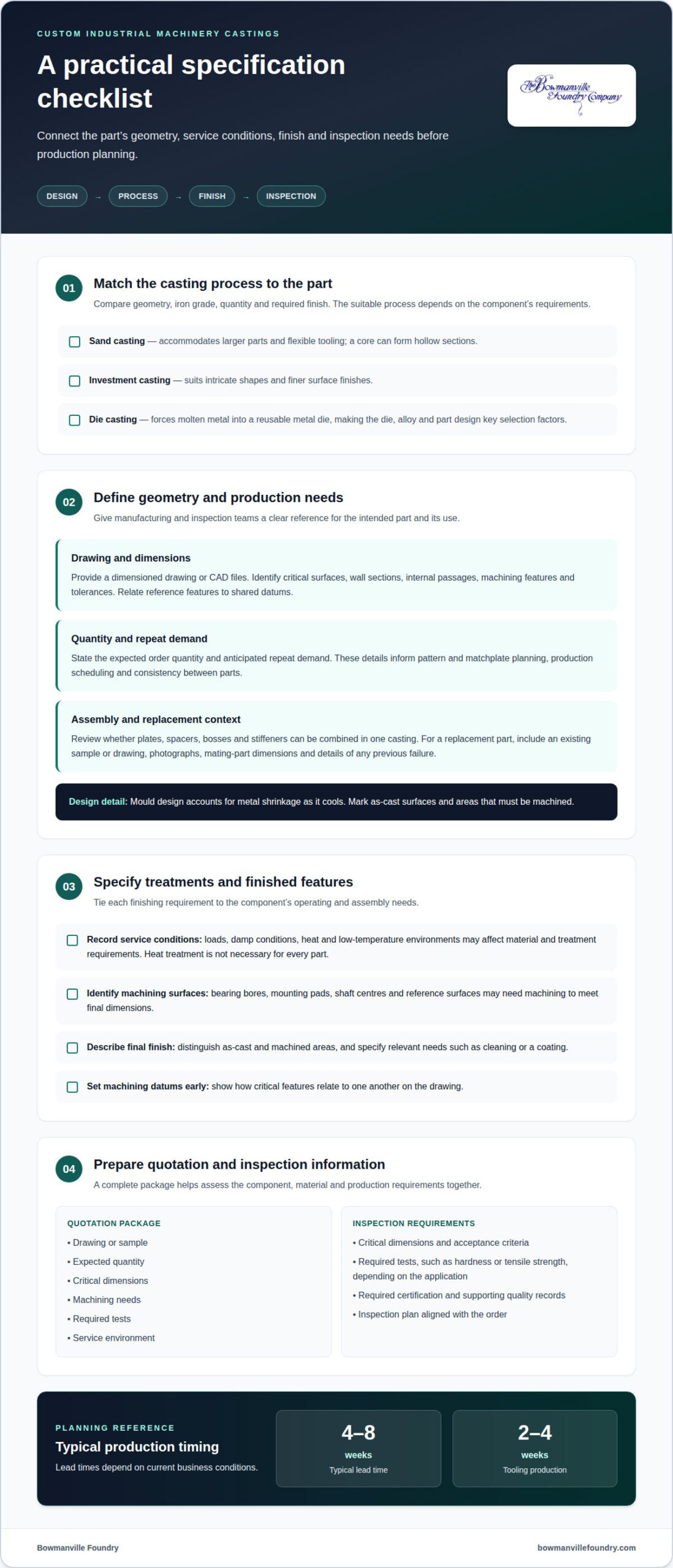
A complete quotation package lets the foundry assess the component, material and production requirements together. Include the drawing or sample, expected quantity, critical dimensions, machining needs, required tests and service environment.
If drawings are missing or outdated, an existing sample can support the quotation. For a replacement component, add photographs, mating-part dimensions and details of any previous failure. These records clarify the part’s geometry and application before production planning begins.
Typical lead times are four to eight weeks, depending on current business conditions, and tooling can be produced in two to four weeks. Include the expected order quantity in the quotation information to clarify production requirements.
Inspection requirements should identify the properties and dimensions that matter in service. Depending on the application, testing may include hardness or tensile strength. State the required tests, critical dimensions and acceptance criteria in the specification so inspection can focus on features that affect function.
Define certification requirements with the order. Identify the required certification and supporting quality records, then align them with the inspection plan. An ISO-certified quality management system supports controlled production and documented quality processes.
Delivery planning starts with the agreed production schedule and destination. Include any required packaging, shipping instructions and delivery documentation in the order details. For machinery components that must fit an assembly, coordinate sample approval and inspection before shipment. This sequence connects production, quality review and delivery requirements.
Choosing Gray Iron, Ductile Iron, or Malleable Iron
Choose an iron grade by matching its properties to the machinery’s loads, function and service conditions. The right selection starts with the part’s job, not a general ranking of metals.
Metal selection by application
Gray Iron can suit a machine base because it dampens vibration and can be machined accurately. Ductile Iron offers greater tensile strength and toughness for loaded housings and mechanical components. Malleable Iron suits smaller castings that require tensile strength and ductility.
Austempered Ductile Iron is another option to assess against the application’s requirements. Selection should account for load, geometry, wear exposure and required machining. Production includes three grades of Gray Iron and five grades of Austempered Ductile Iron, allowing engineers to compare available grades with the component’s needs.
Casting types for industrial machinery
Industrial machinery uses cast bases, housings and other mechanical components. A casting can also combine features that would otherwise be separate plates, spacers, bosses and stiffeners. Evaluate the full assembly and intended service life rather than selecting an alloy based on a part name alone.
To select a grade, begin with the component’s function and operating loads. Then compare the required strength, toughness, vibration damping and ductility with the iron’s properties. When replacing a failed part, use its service history to decide whether the next design should retain or change its material.
The practical takeaway is to reverse the usual selection sequence: define the application first, then select the iron grade and casting design. Contact a foundry engineer to discuss grade selection for your machinery component.
Bowmanville Foundry’s Free Casting Buyers Guide and Technical Support
Bowmanville Foundry is a practical next step when machinery components require an iron casting or finishing work. Its Free Casting Buyers Guide helps buyers assess casting requirements and select a suitable iron grade. Use it to organize questions about part function, service conditions and the information needed for a technical discussion.
Material selection depends on what the component must do. Ductile Iron Castings suit applications requiring strength and toughness, while Malleable Iron Castings suit smaller parts needing tensile strength and ductility. Share the part’s role, operating loads and relevant service conditions to support a focused discussion about material and design.
Finished components may also need operations after casting. Bowmanville Foundry offers Post-Processing Services for parts that require finishing alongside the casting. Identify machined surfaces, critical dimensions and the required finish in the drawing or specification. These details help define the work and connect casting requirements to the completed component.
Customers can arrange an on-site visit from a technical/sales engineer for a more direct review. The engineer can assess the part’s requirements at your facility. Drawings, CAD files, an existing sample, photographs and application details can help guide the assessment. If the original drawing is incomplete, a sample and mating-part dimensions can provide useful design context.
For a quotation discussion, include the expected quantity, iron grade if selected, inspection needs and machining requirements. These details frame the next steps around the actual component rather than a general description.
Contact Bowmanville Foundry to discuss your casting requirements or arrange an on-site visit from a technical/sales engineer.
Move Your Casting Specification Toward Production
As your project advances, keep the approved specification aligned across engineering, procurement and production. Assign responsibility for maintaining the current drawing and communicating revisions so the component’s requirements remain clear through release and manufacturing.
For custom industrial machinery castings, bring the design intent and project priorities into a focused discussion. Bowmanville Foundry can help assess your application’s requirements and the information needed to move forward.
Contact Bowmanville Foundry about your casting needs to discuss the next step for your project. A clear path forward starts with a practical conversation.
Frequently Asked Questions
Which Canadian foundries manufacture custom industrial machinery castings?
Bowmanville Foundry manufactures custom Gray Iron, Ductile Iron and Malleable Iron castings for industrial applications. Canadian buyers can discuss a machinery component’s design and production requirements with the foundry. For an obsolete part, an existing casting or clear photographs can explain its form and fit, even when original design records are unavailable.
What Canadian standards and certifications apply to industrial castings?
Applicable requirements depend on the casting’s intended use and the purchasing specification. State the required standards, certifications and supporting documents in the order requirements, rather than assuming one certification covers every application. Bowmanville Foundry was the first foundry in Canada to achieve ISO certification, in 1996. Specify any customer or project documentation requirements separately so they are clear during production planning.
How are custom castings inspected and tested for quality and defects?
Inspection and testing should follow the component’s specification and intended service. For example, a casting subject to mechanical loads may require hardness or tensile-strength testing. The inspection plan can identify the characteristics to evaluate and the records that must accompany the parts. For a multi-component assembly, focus inspection on features whose variation could affect fit or operation, rather than treating every surface equally.
How do I request a quote and prepare drawings for a custom casting?
Send the foundry a drawing or sample, and make the document easy to interpret. Include the drawing revision, units, material requirement, order quantity and any required finishing or test documentation. Clearly distinguish as-cast dimensions from final machined dimensions. For a replacement part, add photographs and relevant mating-part information. These details help prevent ambiguity when preparing a quote from older engineering records.
What factors affect the strength, durability, and service life of industrial castings?
Service life depends on how the casting’s material and design respond to operating conditions. Consider applied loads, vibration, wear, temperature, moisture and the component’s role in the assembly. A pump support, for example, may face different demands from a small bracket. Maintenance access and the consequences of component wear also help engineers set material, inspection and replacement priorities.
What are typical lead times and minimum order quantities for custom castings?
Typical lead times are four to eight weeks, and tooling can take two to four weeks. Include the expected order quantity in the quotation information.
