
For ductile iron pipe, controlled cooling is as consequential as the peak annealing temperature. In a described pipe schedule, the ductile iron annealing process heats the pipe to 940°C, then cools it through defined furnace zones to 780°C and 600°C. The appropriate schedule depends on the casting’s microstructure and the properties required in service.
Carbides can make castings harder to machine and more difficult to ferritize, so a standard heat cycle may not produce the intended result. Alloying elements, section thickness, and pipe-production requirements all affect how a casting responds to heating and cooling.
This article explains how carbides affect annealing schedules, why alloy content matters, and how ferritizing treatments can support ductility and machinability. It also outlines the controlled stages used to anneal ductile iron pipe, helping engineers and casting buyers understand how the process relates to required material performance.
Key Takeaways
- Identify whether carbides are present before selecting a schedule, since they can resist decomposition and affect the desired ferritic structure.
- Account for alloy content: molybdenum above 0.3% and vanadium above 0.05% can stabilize carbides and complicate annealing.
- Match full ferritizing conditions to the casting’s composition and section thickness to support ductility and machinability.
- For ductile iron pipe, consider how controlled furnace zones and staged cooling shape the final metallurgical properties.
Annealing schedules for castings containing carbides
Carbides can persist through heat treatment, so the schedule must account for the casting’s initial structure. A full anneal for carbide-containing ductile iron involves staged heating, holding, and furnace cooling.
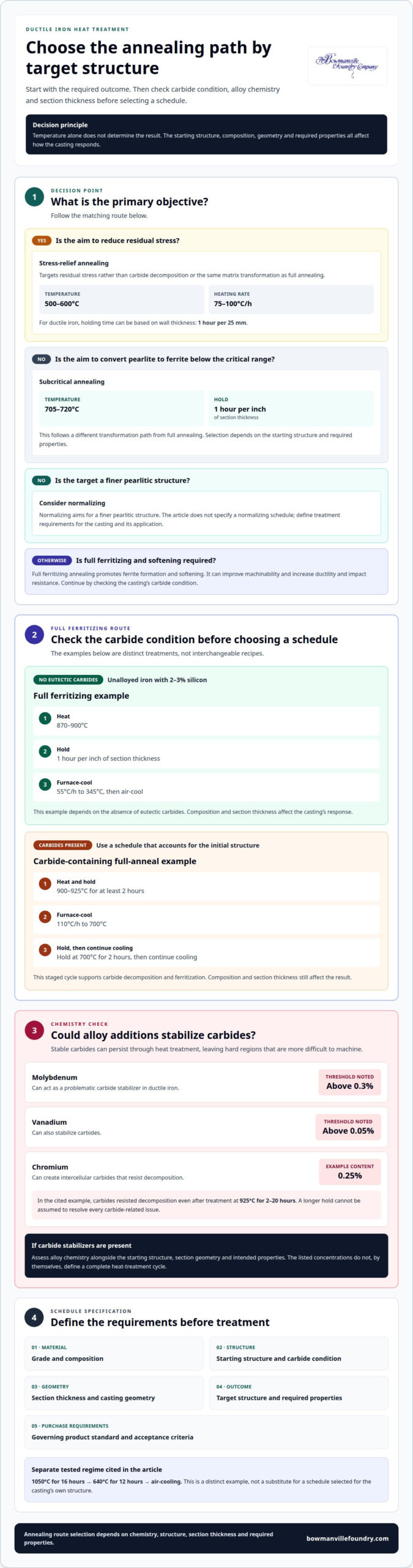
One schedule heats the casting to 900-925°C and holds it for at least 2 hours. It then furnace-cools at 110°C/h to 700°C, holds for 2 hours, and continues cooling. This staged cycle supports carbide decomposition and ferritization, but the casting’s composition and section thickness affect its response.
One tested ductile-iron heat-treatment regime held the material at 1050°C for 16 hrs, then 640°C for 12 hrs, followed by air-cooling, according to the European Union. This is a distinct example, not a substitute for a schedule selected for the casting’s own structure.
Annealing promotes softening and ferritization, while normalizing aims for a finer pearlitic structure. Stress relieving targets residual stress, often associated with complex shapes or abrupt section changes, rather than carbide decomposition. For Canadian procurement, specify the governing product standard and purchase requirements, including grade, heat-treatment schedule, target structure, and acceptance criteria. These details define the treatment required.
Mold Heat Retention and Controlled Cooling
Mold heat retention is the continued transfer of heat between a casting and its mold after pouring. In centrifugal casting, mold temperature and casting geometry affect the cooling path and the structure before annealing. Controlled cooling then manages the casting’s temperature change through furnace or air cooling, helping align the final structure with the treatment’s purpose.
Heating and Cooling During Annealing
Annealing heats ductile iron to a selected range, holds it, then cools it at a controlled rate. For a carbide-containing casting, the 900-925°C stage and furnace cooling to 700°C define one full-anneal example. Stress-relief annealing instead uses 500-600°C, with a heating rate of 75-100°C/h; holding time can be based on wall thickness. These routes serve different purposes. A heat-treatment plan should account for casting geometry, carbide content and the intended properties, including after centrifugal casting.
Effects of alloying elements on annealing and carbide decomposition
Alloy content affects how ductile iron responds to annealing because some elements stabilize carbides. Stable carbides can remain in the matrix during a cycle intended to promote ferritization, leaving hard regions that are more difficult to machine. Temperature alone, therefore, does not determine whether a treatment will produce the intended structure.
Molybdenum above 0.3% can act as a problematic carbide stabilizer in ductile iron. Vanadium above 0.05% can also stabilize carbides. These concentrations are relevant when assessing whether a ferritizing schedule can achieve the required matrix. They do not, by themselves, define a complete heat-treatment cycle; the starting structure and the desired properties also matter.
Chromium can have a pronounced effect on carbide persistence. A chromium content of 0.25% can create intercellular carbides that resist decomposition, even after heat treatment at 925°C for 2-20 hours. This example shows why extending a hold cannot be assumed to resolve every carbide-related issue. The alloy chemistry can constrain the response despite prolonged exposure.
For process planning, connect the chemistry to the required outcome. A ferritic target calls for attention to carbide-stabilizing additions and the casting’s initial structure. If hardness or machinability varies across a component, persistent carbides may be one factor to assess alongside section geometry and thermal history. These observations help distinguish an alloy-related response from a schedule that needs adjustment.
Reviewing the material specification alongside the intended application gives engineers a clearer basis for selecting a treatment. Grade selection should account for both required properties and the composition’s effect on carbide decomposition. This makes alloy chemistry part of the annealing decision from the outset, rather than a detail considered only after the casting responds unexpectedly.
Full ferritizing annealing for ductility and machinability
The main annealing routes for ductile iron include full ferritizing, subcritical annealing, and stress-relief annealing. A full ductile iron annealing process promotes ferrite formation and softening, while stress relief targets residual stress without seeking the same matrix transformation.
Full ferritizing annealing softens ductile iron to improve machinability and can increase ductility and impact resistance. For unalloyed iron containing 2-3% silicon without eutectic carbides, heat to 870-900°C. Hold for 1 hour per inch of section thickness, then furnace-cool at 55°C/h to 345°C before air cooling.
This schedule depends on the absence of eutectic carbides. The hold supports matrix transformation, while controlled furnace cooling promotes ferrite formation. Section thickness matters because heat must reach the casting’s interior, and thick and thin regions can respond at different rates. The schedule must account for both composition and geometry.
Subcritical annealing provides another route when the aim is converting pearlite to ferrite. It uses 705-720°C, with a hold of 1 hour per inch of section. Because this treatment remains below the critical range, it follows a different transformation path from full annealing. Selection depends on the starting structure and required properties.
Stress-relief annealing serves a separate purpose. For ductile iron, internal-stress elimination generally uses 500-600°C, with a heating rate of 75-100°C/h. Holding time can be based on wall thickness, at 1 hour per 25 mm. This treatment addresses stresses from casting geometry and cooling; it does not replace ferritizing when machinability is the goal.
When planning the ductile iron annealing process, match the treatment route to the required outcome. Machining needs may favour full ferritizing, while converting pearlite to ferrite may suit subcritical treatment. Chemistry, eutectic carbides, wall thickness, and the target structure all inform schedule selection.
Annealing ductile cast iron pipe
Pipe annealing uses controlled furnace zones to guide transformation and cooling. The sequence matters because each stage contributes to the required metallurgical properties.
Furnace Atmosphere and Equipment
Furnace atmosphere and equipment determine the heating environment and how a pipe’s thermal cycle is controlled. One described process uses a gas-fired, continuous chain-type furnace with controlled zones. The atmosphere and equipment matter because oxidation and uneven heating can affect the pipe’s surface and properties. Higher stress-relief temperatures may require a protective atmosphere to avoid oxidation.
In this system, pipes travel on casting iron rails, driven by fingers on a closed dog-type chain. Preheating raises them from 600°C to 940°C; the soaking zone holds them at 940°C. A fast-cooling zone then lowers temperature to 780°C, followed by controlled cooling to 600°C. Each zone has a distinct role in the pipe’s thermal path.
Annealing Defects and Prevention
Annealing defects are unwanted changes caused by an unsuitable heating, holding, or cooling cycle. Residual stress can develop as complex shapes or abrupt section changes cool, while higher stress-relief temperatures carry an oxidation risk. Prevention focuses on matching the cycle to pipe geometry, using controlled furnace zones, and selecting a protective atmosphere where needed.
Cooling control is especially relevant to alloy-containing iron. Through the critical temperature range down to 400°C, the cooling rate must be faster than 55°C/h. A separate patented pipe method describes a cooling rate of 10° C. or more per minute. These are distinct conditions, not interchangeable targets. The required schedule depends on the material and process being applied.
For pipe projects, connect the required properties with the furnace sequence and cooling profile. Discuss ductile iron casting requirements as part of defining the application and material needs.
Bowmanville Foundry: Post-Processing Services
Bowmanville Foundry provides Ductile Iron Castings and Post-Processing Services for manufacturers planning finished iron components. After reviewing annealing requirements, buyers can discuss how casting grade, geometry and required properties relate to the part’s production needs. Post-processing can be relevant when additional finishing is needed after casting.
Bring the part’s application, material requirements, and finishing expectations into the discussion. This helps establish whether ductile iron castings suit the component and how post-processing services fit the project. Bowmanville Foundry also produces malleable and grey iron castings for applications requiring those materials.
Contact Bowmanville Foundry to discuss your casting and post-processing requirements.
Define the requirements for your next casting
Before production planning, translate the part’s service conditions into clear material and acceptance requirements. Identify its intended function, the properties the finished component must meet, and any machining or finishing needs. This gives the foundry a practical basis for discussing how the ductile iron annealing process applies to the component, rather than treating heat treatment as an isolated decision.
A useful specification connects the casting’s geometry and application with its required final condition. It also clarifies whether the project needs ductile iron castings and post-processing services, or whether malleable iron castings better suit the component. These requirements help align material selection and finishing with the part’s purpose.
Bowmanville Foundry can discuss your casting requirements and the role of post-processing in your project. Share the application and key specifications to start a focused technical conversation.
Contact Bowmanville Foundry to discuss your requirements and plan the next step.
Frequently Asked Questions
What is the purpose of annealing ductile iron?
Annealing softens ductile iron, mainly to improve machinability, and can increase ductility and impact resistance. For a component that requires machining, a softer matrix can make cutting easier and help meet production requirements. Select the treatment to match the part’s specified properties, since improving machinability and ductility may require a different target structure than retaining a harder, pearlitic matrix.
What temperatures and holding times are used to anneal ductile iron?
Temperature and hold time depend on composition and whether carbides are present. For unalloyed ductile iron with 2-3% silicon and no eutectic carbides, a full anneal uses 870-900°C and a hold of 1 hour per inch of section. A carbide-containing casting may instead use 900-925°C for at least 2 hours, followed by a separate 700°C hold for 2 hours.
How does annealing affect ductile iron hardness, strength, and ductility?
Annealing softens ductile iron, so hardness generally falls as the matrix becomes more ferritic. The treatment can improve ductility and impact resistance, while final strength depends on the resulting microstructure and alloy composition. For example, a part specified for easier machining may require a different balance of hardness and ductility than one designed to retain a pearlitic structure.
How do alloy composition and casting section thickness affect the annealing cycle?
Alloying elements can stabilize carbides and make them harder to decompose; molybdenum above 0.3% and vanadium above 0.05% are relevant examples. Section thickness affects how quickly the casting heats and cools internally. A schedule based on section size helps the casting reach a consistent thermal condition, while chemistry informs whether the selected treatment can produce the required structure.
