
A supplier’s proposal alone does not show whether a foundry is the right fit. A dependable domestic iron casting supply chain starts with matching the foundry’s metallurgical capabilities, production capacity, and quality controls to your part requirements. Transportation and communication also need to fit the project.
A sound comparison goes beyond the proposal. Understand the casting process, material grade, inspection criteria, finishing requirements, and order volume behind each supplier’s plan.
This guide explains how to assess supplier reliability, capacity and quality control, and how to weigh transportation and local manufacturing partnerships in your decision. You’ll learn which technical and operational details to compare, from alloy experience and production planning to inspection records and engineering collaboration, so you can make a more informed sourcing decision for your Canadian operation.
Key Takeaways
- Compare foundry capabilities with your casting’s material, geometry, production volume and technical requirements.
- Assess capacity and quality controls together, then define inspection criteria and delivery expectations before production.
- Use the distinct properties of Gray Iron, Malleable Iron, Ductile Iron and Austempered Ductile Iron to guide material selection.
- Plan shipping, logistics and any customs brokerage needs alongside production, and consider technical support when refining your requirements.
What makes a reliable iron casting supplier?
Canadian buyers of iron castings include manufacturers in pumps and valves, railroad, agriculture, hardware, and electrical. Their parts range from pump components to agricultural and railroad equipment. A suitable foundry partner must match its metallurgy, moulding processes, and production planning to each part’s function and required volume.
Use foundry directories to identify potential suppliers, then assess each against the same requirements. Review relevant quality certifications, material experience, inspection records, machining support, and communication practices. Ask for examples of similar parts and production runs. A directory can help you build a shortlist, but documented capabilities and process controls provide stronger evidence when qualifying a supplier.
Complex castings require more than a furnace and mould. Compare melting and moulding capabilities with the required alloy, geometry, and production volume. Ask how the foundry manages cores, wall thicknesses, parting lines, and dimensional features. For bulky geometries, sand or chemically bonded processes may be suitable. Confirm that the proposed process fits the part’s design.
A dependable domestic iron casting supply chain also requires practical production planning. Discuss capacity, schedules, inventory needs, and how drawing or order changes are handled. Early engineering collaboration can identify manufacturability issues before tooling and production begin, helping teams coordinate decisions and plan repeat orders.
To keep a domestic iron casting supply chain dependable, assess how casting and machining requirements fit together. Review the plan for tooling, sample approval, production, inspection, and shipment. Clear responsibilities and agreed quality criteria help procurement teams determine whether a supplier can support both the initial order and ongoing production.
Assessing supplier capacity and quality control
Canadian requirements depend on the casting’s end use and purchase specification. Define the applicable material, dimensional, inspection, and documentation requirements for each application rather than assuming one rule fits every cast iron part.
Assess capacity against the order’s annual volume, batch pattern, and required delivery schedule. Ask for a project timeline covering tooling, first-article inspection, production, and shipment. The supplier should explain how its melting and moulding capacity supports the required alloy and repeat production. Agree on delivery milestones and how schedule or quantity changes will be handled.
Quality control should link each casting to its material and inspection records. Optical emission spectrometry can check chemical composition, while metallography can assess ductile iron microstructure. Mechanical testing records can document strength. Ultrasonic testing can help identify hidden shrinkage cavities; hydrostatic or pneumatic leak testing can assess pressure-containing parts. The required tests depend on the component’s function and acceptance criteria.
During a quality audit, review the quality management system, inspection plans, process sheets, and procedures for non-conforming castings. Check how traceability records link the source heat to finished parts, and whether dimensional inspection reports and material test certificates are retained. An ISO-certified system provides a structured framework for documented quality processes; confirm that its scope matches the work under consideration.
Put material grade, critical dimensions, inspection methods, documentation, sample approval, and delivery dates in the purchase agreement. These details give both parties clear acceptance criteria without ambiguity. For a practical reference on selecting castings and requirements, consult the casting buyer’s guide.
Requirements depend on the casting’s end use and purchase specification, so no single set applies to every cast iron part. Define the material, dimensional, inspection, and documentation requirements for the application, then include them in the purchase agreement.
Comparing Gray, Malleable, Ductile, and Austempered Ductile Iron
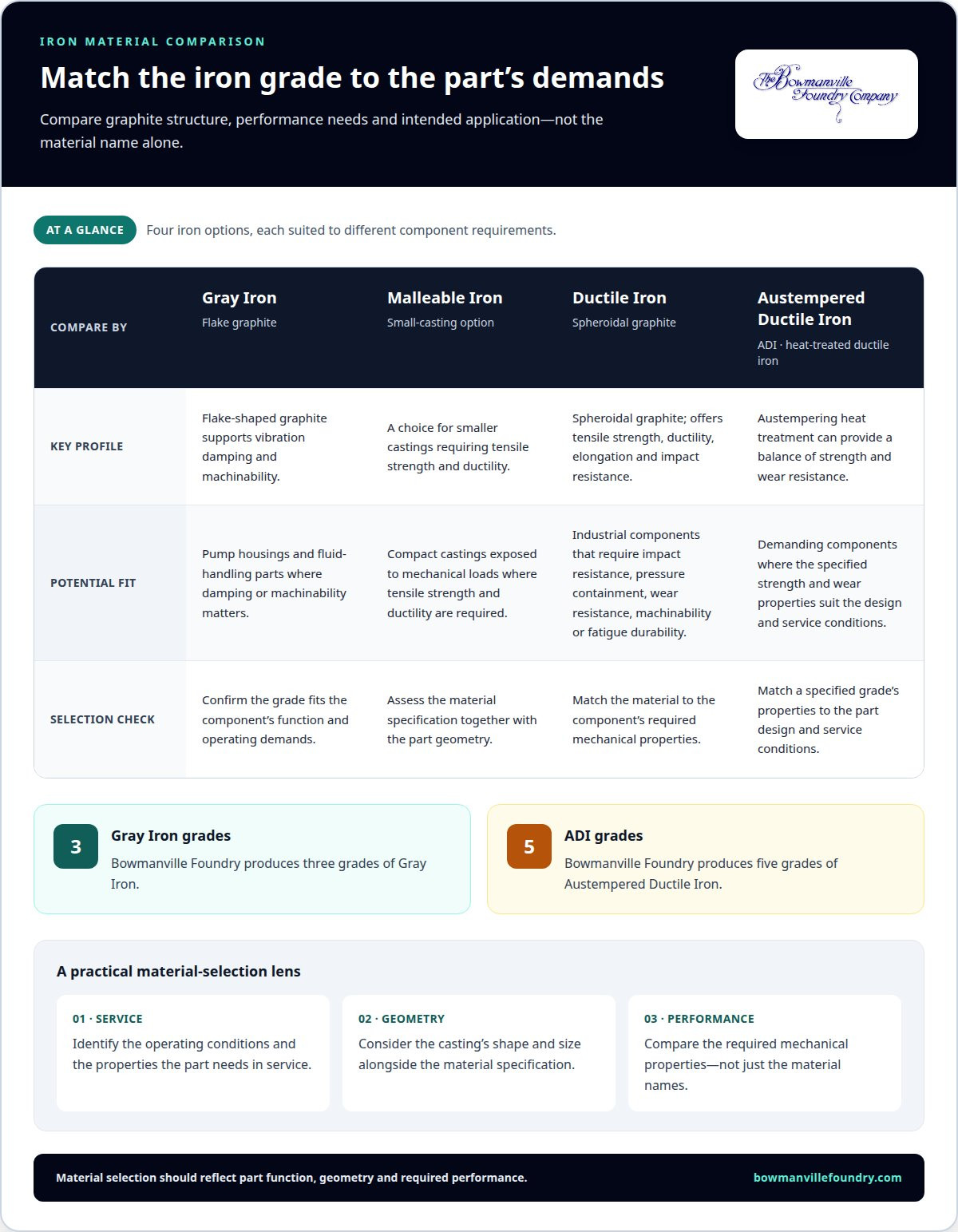
Material selection starts with the part’s service conditions, geometry, and required mechanical properties. Gray Iron contains flake-shaped graphite, which supports vibration damping and machinability. It suits components such as pump housings and fluid-handling parts. Bowmanville Foundry produces three grades of Gray Iron, giving buyers options to match the grade to the component’s function.
Malleable Iron is used for smaller castings that require tensile strength and ductility. Consider it for parts exposed to mechanical loads when the design calls for a compact casting. Assess the material specification alongside the part geometry, since both affect whether the grade suits the application.
Ductile Iron has spheroidal graphite rather than the flakes found in Gray Iron. This structure supports tensile strength, ductility, elongation, and impact resistance. Ductile Iron can suit industrial components requiring impact resistance, pressure containment, wear resistance, machinability, or fatigue durability. Bowmanville Foundry produces Ductile Iron Castings; select the material based on the component’s operating demands.
Austempered Ductile Iron (ADI) is ductile iron that receives an austempering heat treatment. Its resulting microstructure can provide a useful balance of strength and wear resistance for demanding components. Bowmanville Foundry produces five grades of Austempered Ductile Iron. Select a grade by matching its specified properties to the part’s design requirements and service conditions.
Compare grades by the properties that govern part performance, not by material name alone. A pump component, for example, may prioritize fluid containment and machinability, while impact-loaded installations—such as perimeter protection and parking posts supplied by bollardsecure.co.uk—rely heavily on ductility and impact resistance. Include the material grade, critical features, and intended application in the casting specification so the foundry can assess the selection against the design.
Shipping and logistics for domestic iron castings
Plan shipment details alongside production, not after the castings are ready. Record each part’s weight, dimensions, packaging requirements, destination, and required delivery date. For ductile iron castings, suitable packaging and handling help protect machined surfaces and critical features. Match the carrier and equipment to the shipment’s size, handling needs, and route. Include receiving hours and unloading arrangements in the delivery plan.
Coordinate foundry capacity, production schedules, and transportation bookings as one plan. A domestic iron casting supply chain benefits from early communication among manufacturing, engineering, and shipping teams. For example, a change to a custom casting’s order volume may affect production sequencing and dispatch timing. Agree on shipment frequency, delivery locations, receiving requirements, and how schedule changes will be communicated. Record delivery dates and responsibilities in the order plan.
Tariffs, trade agreements, and border procedures can affect documentation, customs brokerage, and delivery timing for castings crossing Canada’s borders. Applicable treatment depends on shipment origin, product classification, and destination. Domestic shipments within Canada do not cross an international border, while cross-border orders require coordinated export and import arrangements.
For cross-border shipments, align commercial and shipping documents with the casting description, quantity, origin, and destination. Customs brokerage can support clearance coordination, while the shipment plan assigns responsibility for documents and communication. Confirm packaging, marking, delivery appointments, and receiving contacts before dispatch. Coordinating these details helps maintain a predictable domestic iron casting supply chain when demand or production schedules shift.
Discuss route, delivery windows, packaging, and brokerage arrangements with your foundry partner early. A clear plan connects casting production with the receiving operation and supports effective coordination across the domestic iron casting supply chain. Coordinate your casting shipment plan as part of the production discussion.
Bowmanville Foundry: Free Casting Buyer’s Guide and technical support
Bowmanville Foundry helps procurement teams and design engineers move from supplier evaluation to a defined casting requirement. Its Free Casting Buyer’s Guide supports material and application selection, helping buyers organize the details for a productive technical discussion.
Prepare the part’s CAD files or drawings, intended application, required material properties, production volume, and critical dimensions. Include machining and finishing requirements. These details help clarify whether Malleable Iron Castings or Ductile Iron Castings suit the component, and whether post-processing fits the finished part’s requirements. Gray Iron Castings are also available when their properties meet the design specification.
For a part with challenging geometry or uncertain manufacturability, an on-site technical/sales engineer visit can help assess your requirements at your facility. Discuss the casting’s function, wall sections, cores, tolerances, and machining stock. Early engineering input can identify design details affecting moulding, inspection, and finishing before production planning advances.
Use the guide and technical discussion to define next steps: material selection, drawing review, sample approval, and required quality records. Clear requirements give the foundry a sound basis for assessing the part and aligning casting and post-processing work. They also help engineering and procurement teams carry the same specifications through production planning.
Whether you are developing a new component or reviewing an existing casting, Bowmanville Foundry can discuss the requirements and next steps. Contact Bowmanville Foundry to discuss your casting application or arrange an on-site technical/sales engineer visit.
Set your next casting project up for success
A domestic iron casting supply chain is more dependable when technical requirements and production responsibilities are aligned before a new program begins. Use your next project review to confirm the drawing revision, service conditions, material specification, and finishing requirements your team needs to carry through production.
Bowmanville Foundry offers Malleable Iron Castings, Ductile Iron Castings, and Post-Processing Services. Bringing these requirements into one technical discussion can help engineering and procurement teams establish a clear starting point for a new casting project or a change to an existing component.
Share the part information and intended application to begin a focused discussion about your requirements. Contact Bowmanville Foundry to discuss your needs and take the next step toward a casting specification that supports your operation.
Frequently Asked Questions
Where are iron foundries and casting suppliers located across Canada?
Iron foundries serve manufacturers across Canada, but the right location depends on your delivery destination and production needs. Consider how the shipping route, receiving schedule, and communication with engineering teams fit your operation. A national supplier search can identify options, while a project discussion can clarify how a foundry coordinates production and delivery to your facility. Bowmanville Foundry serves customers across Canada.
What iron casting processes and grades are available from Canadian foundries?
Canadian foundries offer different capabilities, so available processes and grades depend on the supplier. Bowmanville Foundry produces Gray Iron, Ductile Iron, Malleable Iron, and Austempered Ductile Iron. Its stated production includes three Gray Iron grades and five Austempered Ductile Iron grades. For a specific component, identify the required material properties and application, then match them to the grade and casting capability under consideration.
What are typical prices and lead times for iron castings made in Canada?
Lead times vary with the project schedule and current business conditions. Bowmanville Foundry’s typical lead times are four to eight weeks, depending on current business conditions. The production timeline can include preparation, casting, inspection, and shipment, so align the required delivery date with the order plan. Share the part requirements and expected production volume when discussing project timing.
What are the steps to source and qualify a Canadian iron casting supplier?
Start with a current drawing, the part’s application, material requirements, production volume, and finishing needs. Then assess the supplier’s relevant casting experience, quality documentation, and ability to support the required production plan. Agree on inspection criteria, initial sample approval, delivery expectations, and drawing revision controls. Bowmanville Foundry’s Free Casting Buyer’s Guide can help organize requirements for a technical discussion.
What is the outlook for Canadian iron casting capacity, demand, and investment?
Acme Foundry expected the trend of domestic customers reshoring iron casting services to continue into 2025 and beyond.
