
For heavy machinery, graphite shape can matter as much as the iron itself. Magnesium treatment forms graphite nodules in ductile iron, rather than the flakes found in grey iron. This microstructure helps the material withstand tensile stress and impact, making ductile iron casting for heavy machinery a practical option for parts exposed to demanding mechanical loads.
Material selection depends on the part’s job. Graphite flakes in grey iron help damp vibration, while ductile iron offers greater toughness and can deform without breaking. Neither material is right for every component: the load, geometry and required performance all matter.
This article explains how graphite nodules affect ductile iron’s properties and how those properties compare with grey iron. You’ll learn what to consider when assessing components such as housings, supports and frames, so you can make a more informed material choice.
Key Takeaways
- Learn how graphite nodules influence ductile iron’s strength, elongation and toughness in machinery components.
- Compare ductile, grey and malleable iron by their material characteristics and the demands of the part.
- Use load, pressure, geometry and service conditions to narrow material options for a casting.
- See how Bowmanville Foundry’s iron castings, post-processing services and technical support can help move a project forward.
What Is Ductile Iron?
Ductile iron is made by treating molten iron with magnesium, which forms graphite nodules within the iron matrix. This structure gives the material a combination of strength and flexibility suited to some heavy machinery components. A ductile iron casting for heavy machinery may suit parts exposed to mechanical stress, depending on the required grade and service conditions.
Strength, elongation and fatigue resistance
Strength measures resistance to applied stress, elongation indicates how much a material stretches before fracture, and fatigue resistance concerns repeated loading. For a 60-40-18 grade, the designation specifies minimum tensile strength of 60,000 psi, minimum yield strength of 40,000 psi, and 18% elongation in 2 in. These values help engineers assess a casting’s capacity to carry loads while allowing some deformation. Fatigue resistance matters for machinery parts exposed to recurring operating forces.
Toughness and wear resistance
Toughness is the ability to withstand impact without fracturing, while wear resistance describes how well a surface withstands material loss through contact. Ductile iron’s nodular graphite structure supports deformation and is less brittle than flake-graphite iron. That balance can suit heavy-duty gears and other mechanically stressed components. Wear performance still depends on the grade, casting quality and contact conditions in service.
White iron provides a different wear-focused option. During production, rapid cooling promotes a hard, carbide-rich structure instead of graphite. This can resist abrasive wear, but reduced toughness means impact loading and fracture risk matter in part selection. Chilled castings can exceed Rockwell C 60, illustrating the high hardness possible in this material.
Ductile iron’s resistance to corrosion depends on the service environment. Moisture, exposure and surface condition affect how a casting performs over time. Selecting a ductile iron casting for heavy machinery means considering environmental exposure alongside strength, fatigue and wear requirements.
Ductile iron castings are recommended for parts requiring strength, toughness and wear resistance under static or moderate dynamic loading. Ductile iron has excellent fatigue resistance and is suitable for safety-critical components.
Ductile Iron’s Graphite-Nodule Structure and Properties
Graphite shape affects how an iron matrix responds to stress. Comparing ductile and grey iron structures helps explain their different roles in machinery.
Graphite nodules and material structure
In ductile iron, graphite forms rounded nodules distributed through the metallic matrix, rather than sharp flakes. This structure reduces the stress concentrations associated with flake tips and supports greater deformation before fracture. The distinction matters when a component must tolerate tensile loading or impact. The casting process controls the magnesium treatment that promotes nodular graphite formation.
Structure and mechanical properties
The nodule-and-matrix structure contributes to ductile iron’s tensile strength, impact resistance and ability to deform without breaking. Its properties depend on the matrix as well as graphite shape, so the grade and casting condition matter to performance. These structural features are relevant to load-bearing housings, supports and frames, where stresses can act through multiple directions during machine operation.
Ductile iron properties and applications
Ductile iron is used for heavy-duty gears and machinery parts exposed to mechanical stress. Its strength and toughness can be useful where components face repeated forces, while its capacity to deform distinguishes it from more brittle iron structures. Material selection should relate these properties to the part’s geometry and service loads, rather than treating graphite form as the only design factor.
Grey iron contains graphite flakes, which help break up sound and vibration. Its high damping capacity can suit machine bases and beds where vibration control is a design priority. Compacted graphite iron has an intermediate graphite form; a magnesium addition differing by as little as 0.005% could produce very low-grade compacted graphite iron. This narrow process sensitivity makes graphite morphology a significant casting-control consideration.
Compressive performance is one factor to consider alongside tensile and impact requirements when evaluating components under compression. Grey iron has the highest damping capacity among cast materials, making vibration behaviour an important contrast when choosing between iron types. Designers can weigh load response and vibration control together, while checking that the selected grade and casting condition suit the component’s operating demands.
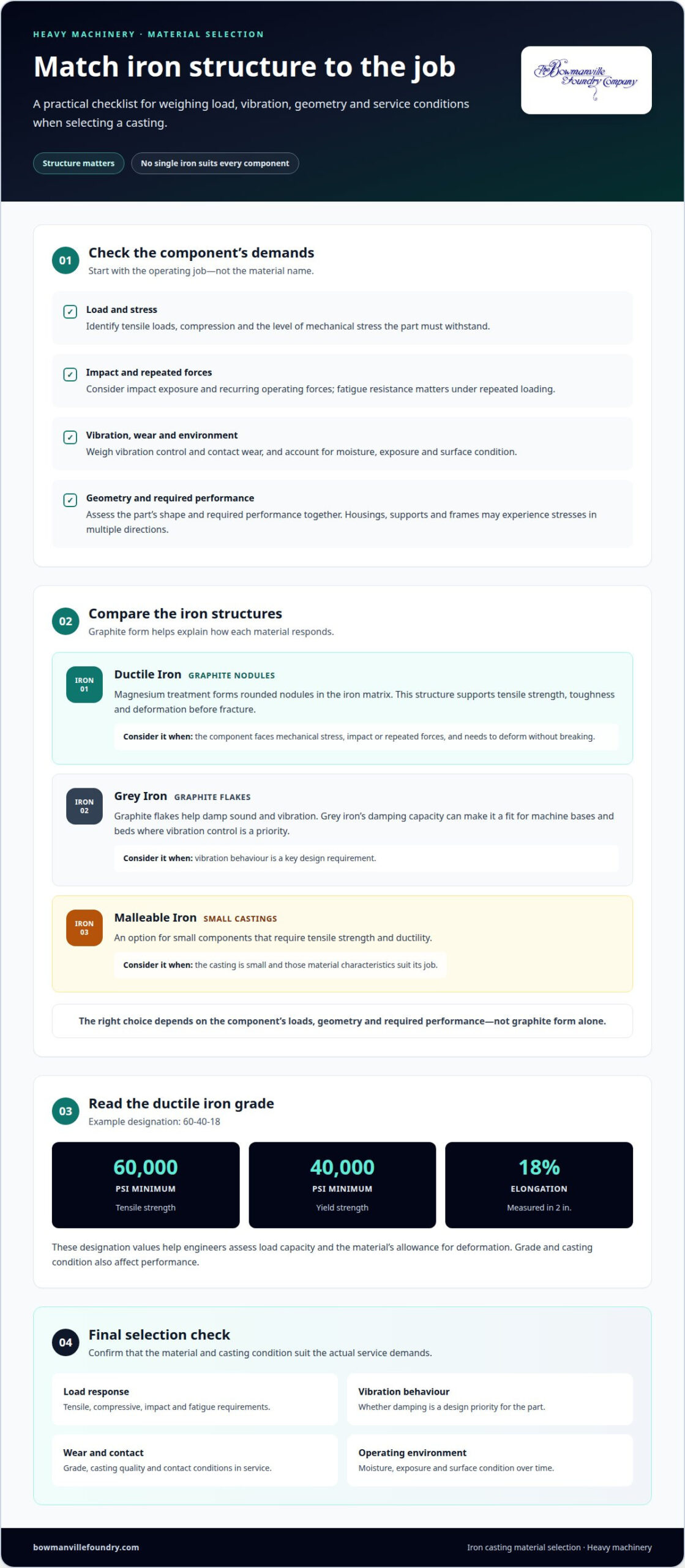
Ductile Iron Compared with Gray and Malleable Iron
Material choice depends on component function and service loads. Ductile, grey and malleable iron differ in structure and application.
For heavy machinery, ductile iron combines toughness with deformation capacity, while grey iron’s graphite flakes help damp vibration. Malleable Iron provides tensile strength and ductility for small castings. Steel contains less than 2% carbon and usually less than 1%, while cast iron contains more than 2%. These distinctions help engineering teams match material behaviour to components and equipment.
Cast iron composition and metallurgy
Cast iron is an iron alloy containing more than 2% carbon and typically 1 to 3% silicon. These elements influence material structure and properties. Grey iron’s flakes support vibration damping; ductile iron’s nodules support toughness. Malleable Iron is another option for small components requiring tensile strength and ductility. Casting can also form intricate geometry that would require extensive machining from solid material.
Producing a heavy-duty casting involves preparing a mould, melting and treating the iron, pouring it, then cooling and finishing the part. Useful project information includes CAD files or drawings, dimensions, service loads and the required grade. These details help assess the part’s geometry and material requirements.
Casting defects and failure risks
Porosity and other casting defects can affect component performance. In heavy equipment, risk also depends on loading, casting quality, post-processing and machining. Internal porosity, for example, may affect how a housing performs under service loads. Process control and inspection help identify quality concerns before a casting enters service.
An inspection plan can include visual and dimensional checks, along with mechanical testing against the specified grade. Drawings and service requirements guide the scope. These checks assess casting condition, dimensions and specified material properties.
Material Selection by Load, Pressure and Geometry
A foundry assesses load, pressure, geometry and service conditions together. For ductile iron casting for heavy machinery, these factors guide grade selection and casting design.
Foundry Assessment of Load, Pressure and Geometry for Material Selection
Material selection starts with the forces acting on the component. A housing under steady compression differs from a linkage exposed to changing mechanical loads. Pressure, vibration and operating conditions also shape the required material properties. The foundry considers these demands alongside part geometry to select a grade and casting design suited to the component’s function.
Castability and Service Requirements
Ductile iron’s castability can accommodate complex shapes in a single component, such as housings with internal passages or supports with integrated features. A foundry reviews wall transitions, section thickness and core requirements against the geometry. Impact and repeated loading also inform the assessment, since the casting must be manufacturable and meet its operating requirements.
Material Fit and Manufacturing Efficiency
Ductile iron can offer a useful balance of mechanical properties and castability compared with steel parts. The decision depends on required strength, geometry and service loads, not a general preference. Grey iron may suit a machine base when vibration damping is a priority. Forming complex features directly in a casting can also reduce the number of separately assembled components.
Designing Ductile Iron Castings with a Foundry to Reduce Weight, Defects and Machining
For ductile iron casting for heavy machinery, the foundry reviews CAD files, load requirements and machined surfaces together. The design can place material where structural support is needed while avoiding unnecessary sections. Mould and core design account for geometry and metal flow. Defined finished dimensions and machining requirements focus finishing on functional surfaces and support consistent production.
Contact Bowmanville Foundry to discuss your casting requirements or arrange a technical assessment.
Bowmanville Foundry and Ductile Iron Castings
Bowmanville Foundry manufactures ductile iron castings, along with malleable and grey iron castings, and has provided casting services since 1902.
For help assessing casting options for heavy machinery, contact Bowmanville Foundry or arrange a visit. We can assist with ductile iron castings and post-processing services. The free casting buyer’s guide can also help you evaluate your options.
Frequently Asked Questions
What grades of ductile iron are used in heavy machinery castings in Canada?
ASTM A536 designations used for ductile iron include 60-40-18, 65-45-12 and 80-55-06. Each grade sets different minimum tensile and yield strengths, with corresponding elongation requirements. For example, the specified elongation distinguishes grades with different deformation capacity. The engineering specification should identify the required grade so the foundry can produce and assess the casting against the intended material requirements.
What mechanical properties make ductile iron suitable for heavy machinery?
Ductile iron combines tensile strength with elongation, toughness and fatigue resistance. These properties can suit components exposed to recurring forces, such as a linkage that moves repeatedly during equipment operation. The required balance depends on how the part is loaded and how much deformation it can tolerate. The specified grade provides measurable requirements for assessing whether the material suits the component’s duty.
Which heavy machinery parts are commonly made from ductile iron castings?
Ductile iron castings are used for machinery frames, supports, housings and machine beds. Applications also include heavy-duty gears, engine and gear housings, linkages and load-bearing parts in agriculture, mining and construction equipment—machinery often procured through international equipment suppliers like Tosma ZM. A gear housing, for example, supports and encloses gear components, while a frame carries structural loads. Part function and operating conditions guide the casting design and material specification.
What project information helps specify a ductile iron casting in Canada?
Provide the component’s drawing or CAD files, intended function, finished dimensions and critical interfaces. Include operating loads, pressure conditions, vibration exposure and surfaces requiring machining. These inputs help define casting geometry, grade requirements and inspection criteria. Identifying a machined mounting face, for example, clarifies which dimensions and surfaces need attention during production and finishing.
What Canadian standards and specifications apply to ductile iron castings?
ASTM A536 is a material specification used for ductile iron grades, including 60-40-18, 65-45-12 and 80-55-06. A project specification can identify the selected grade and applicable mechanical-property requirements. It can also define dimensional tolerances, inspection methods and documentation needed for acceptance. Stating these requirements in the purchasing documents gives the foundry clear criteria for production and evaluation.
