
Ductile iron can require less energy to cast than carbon steel because it is poured at a lower temperature and needs smaller risers to compensate for shrinkage. In a ductile iron vs carbon steel comparison, these process differences affect manufacturing requirements. The right material still depends on the component’s design and service conditions.
When selecting a casting material, weigh strength alongside manufacturing requirements. This comparison explains how ductile iron and carbon steel differ in corrosion resistance, flexibility and impact resistance at low temperatures, helping you identify which properties matter most for your application.
The casting process also affects manufacturing requirements, while material grade and microstructure influence performance. Use these factors together to decide when ductile iron is a practical fit and when the application calls for a different balance of properties.
Key Takeaways
- Assess corrosion exposure and surface protection requirements when narrowing material options for a component.
- Compare casting process demands, including pouring temperature and shrinkage control, as well as the required strength.
- Account for grade and microstructure when evaluating impact performance in low temperature environments.
- Consider how graphite shape affects ductility, then match the material choice to the part’s design and service conditions.
Corrosion resistance
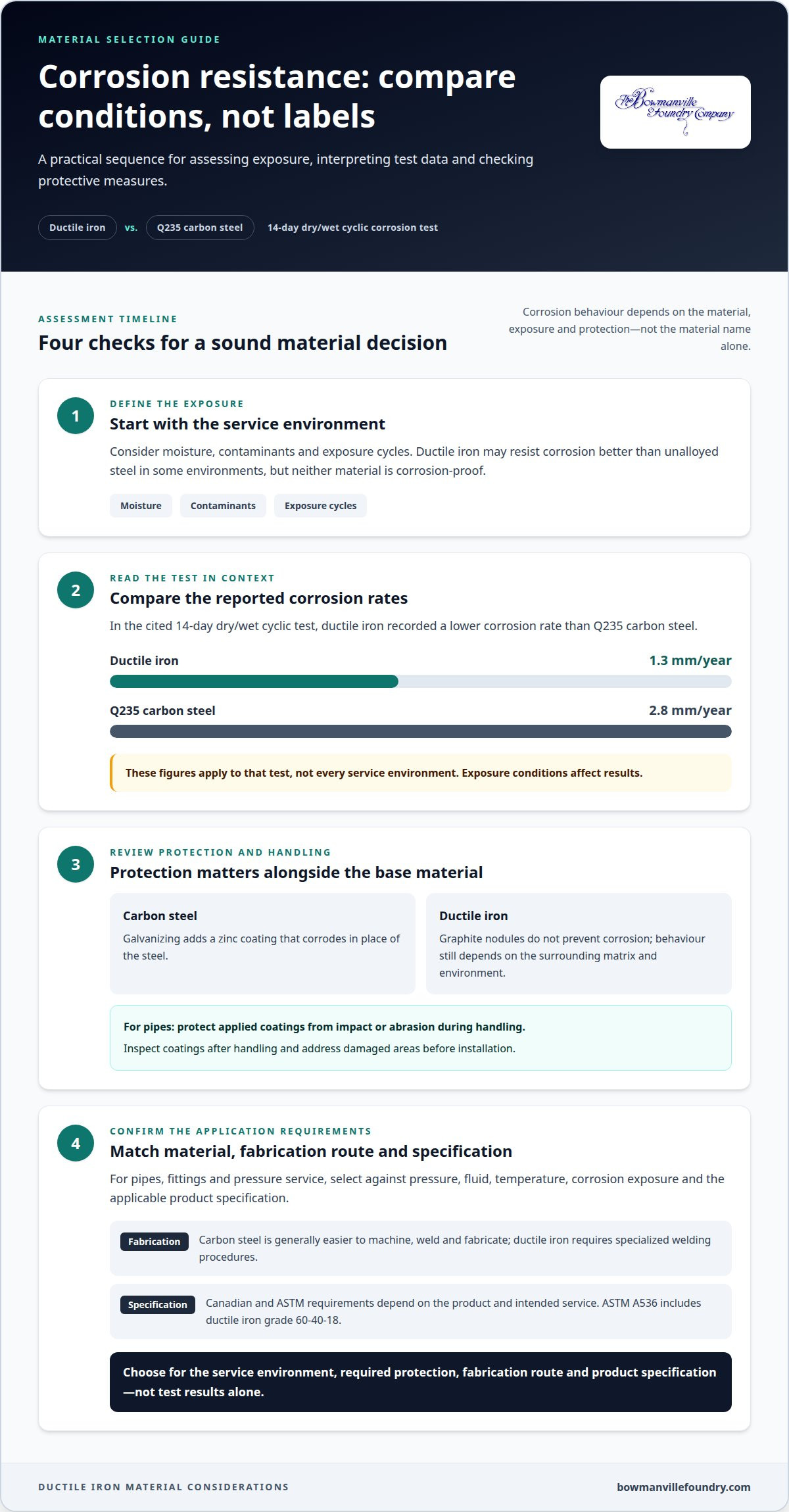
Corrosion resistance depends on the material, exposure conditions and protective measures. Galvanizing protects carbon steel with a zinc coating that corrodes in place of the steel. Ductile iron can also resist corrosion better than unalloyed steel in some environments, but neither material is corrosion-proof. In a ductile iron vs carbon steel assessment, consider the service environment rather than relying on the material name alone.
A 14-day dry/wet cyclic corrosion test recorded a corrosion rate of 1.3 mm/year for ductile iron and 2.8 mm/year for Q235 carbon steel. This comparison applies to that test, not every service environment. Moisture, contaminants, coating condition and exposure cycles affect results.
Ductile iron’s graphite occurs as rounded nodules rather than flakes. Its corrosion behaviour still depends on the surrounding matrix and environment; graphite does not prevent corrosion. During pipe handling, protect applied coatings from impact or abrasion, since damage can expose the underlying metal. Inspect coatings after handling and address any damaged areas before installation.
| Material | Corrosion consideration | Example |
|---|---|---|
| Ductile iron | May resist corrosion better than unalloyed steel in some environments | 1.3 mm/year in the cited test |
| Q235 carbon steel | Galvanizing can provide zinc protection | 2.8 mm/year in the cited test |
Carbon steel is generally easier to machine, weld and fabricate, while ductile iron requires specialized welding procedures. Ductile iron is used for cast components; carbon steel is common in fabricated parts and structures. For pipes, fittings and pressure service, select a material based on pressure, fluid, temperature, corrosion exposure and the applicable product specification. A ductile iron vs carbon steel pipe decision should account for all these service requirements.
Canadian and ASTM requirements depend on the product and its intended service. ASTM A536 includes ductile iron grade 60-40-18; the governing material and product specifications belong in the project documents.
Choose based on the service environment, required protection, fabrication route and product specification, not test results alone.
HOW DO DUCTILE IRON AND STEEL COMPARE IN PERFORMANCE?
Start material selection with the required performance, not the assumption that one material is stronger in every application. Tensile strength measures resistance to pulling forces; yield strength marks the start of permanent deformation. Rigidity describes resistance to elastic deformation, making it a separate design consideration from strength.
Grade-specific data helps make the comparison meaningful. ASTM A536 ductile iron grade 65 lists a tensile strength of 65 ksi, a yield strength of 45 ksi and 12% elongation. Those properties describe that grade, not all ductile iron. Carbon steel performance also varies by grade and product condition, so compare specified values rather than broad material labels.
The form of graphite in cast iron affects how it responds to stress. Flake-shaped graphite can act as a stress concentrator, while ductile iron’s nodular graphite allows greater deformation before fracture. Part geometry matters too: sharp transitions, section changes and local stress concentrations can affect performance in either material. Casting design should account for load paths and required deformation limits.
| Selection criterion | Ductile iron | Carbon steel |
|---|---|---|
| Strength data | Specified by grade and casting condition | Specified by grade and product condition |
| Rigidity | Assess against geometry and loading | Assess against geometry and loading |
| Fabrication | Welding requires specialized procedures | Generally easier to weld and fabricate |
Ductile iron’s limitations include specialized welding requirements and less convenient fabrication. Carbon steel may suit designs that depend on welded assemblies or formed sections. For either material, assess loading, allowable deformation, joining method and casting geometry. Compare the specified grade and service requirements rather than treating a single strength value as a complete design decision.
Cast iron’s high carbon content creates graphite flakes that make the material more brittle, while ductile iron’s graphite form supports a different response to stress. Ductile iron grade QT450-10 has a listed tensile strength of 450 N/mm2 and a listed yield strength of 310 N/mm2. Ductile iron grade QT500-7 has a listed tensile strength of 500 N/mm2.
For comparison, carbon steel grade ZG270-500 has a listed tensile strength of 500 N/mm2, while carbon steel grade ZG310-570 has a listed tensile strength of 570 N/mm2. These figures illustrate why material comparisons should account for the particular grade and required performance.
Impact resistance at low temperatures
Impact performance depends on grade and microstructure, not just the material name. Good-quality ferritic Ductile Iron grade 60-40-18 has fracture toughness down to −62°C (−80°F). At that temperature, the reported critical flaw size is 0.5 in. These values show why low-temperature design must consider both material condition and flaw tolerance.
Ferritization affects ductile iron’s impact properties. A ferritic structure behaves differently under impact than a more pearlitic structure, so a grade designation alone does not describe every casting’s response. Carbon steel also varies by grade and condition. Compare impact test requirements at the expected service temperature instead of relying only on tensile strength.
Steel has better shock resistance than ductile iron. This difference can matter for components exposed to impact or abrupt changes in force. Toughness describes resistance to fracture, while fatigue strength concerns repeated loading. Neither property can be determined from tensile strength alone: grade, geometry, surface condition and loading cycle all affect performance.
| Property | Ductile iron | Carbon steel |
|---|---|---|
| Low-temperature impact | Depends on grade and microstructure | Depends on grade and condition |
| Shock resistance | Lower than steel | Better than ductile iron |
| Temperature range listed | −30 to 350 degrees | −29 to 425 degrees Celsius |
For wear applications, ductile iron has greater abrasion resistance than cast steel and is used in friction-wear mechanisms such as engine crankshafts. This comparison is with cast steel, not every carbon steel grade. Select a material based on the actual wear mode, impact exposure and operating temperature.
Temperature limits and impact suitability are different measures. A listed operating range does not establish fracture toughness at its lowest temperature. For low-temperature service in Canada, specify the minimum service temperature, impact requirement and grade together. This gives designers a clearer basis for assessing toughness, fatigue loading and wear in the finished component.
Ductile iron composition and flexibility
Ductile iron typically has a carbon content of 3.0%-3.9%; cast steel normally contains 0.08%-0.60%. The difference reflects distinct material structures and production routes. In ductile iron, magnesium treatment changes graphite flakes into rounded nodules. The resulting graphite form is a defining feature of the material, not simply a change in its carbon content.
Composition alone does not determine flexibility. The iron matrix surrounding the nodules also affects mechanical behaviour, and heat treatment can alter that matrix. Engineers assess the specified grade and casting condition alongside the part’s shape and service loads. A thin arm, thick hub and section with abrupt transitions can respond differently, even when made from the same grade.
Grade data can help describe these differences. For ferritic ductile iron grade 60-40-18, the typical ratio of proportional limit to 0.2% yield strength is 0.71. For pearlitic grade 80-55-06, the typical ratio is 0.56. These ratios compare two points in the material’s mechanical response; they are not direct measures of flexibility.
| Material or grade | Typical carbon content | Graphite structure |
|---|---|---|
| Ductile iron | 3.0%-3.9% | Rounded nodules |
| Cast steel | 0.08%-0.60% | No graphite nodules |
Specify the required grade, matrix condition and component geometry together. This gives the design review a clearer basis for assessing deformation and performance under the intended load. It also aligns the casting specification with the part’s functional requirements, rather than relying on carbon content alone.
To discuss how composition and grade relate to a casting design, contact Bowmanville Foundry.
Bowmanville Foundry: Ductile Iron Castings
Bowmanville Foundry produces ductile iron castings for manufacturers assessing material options against component geometry and service requirements. Share the part’s design, required mechanical properties and operating conditions to support a practical discussion of grade selection.
When an application calls for another iron type, Bowmanville Foundry also produces Gray Iron and Malleable Iron castings. Post-processing services can support finishing requirements after casting. The free Casting Buyer’s Guide offers further help for buyers planning a casting project.
For a closer review of material and casting requirements, contact Bowmanville Foundry to discuss your application.
Move from material choice to part requirements
Turn the material comparison into a clear design brief. Record the component’s geometry, loading conditions, operating temperature, corrosion exposure and finishing requirements. These details help assess ductile iron vs carbon steel against the part’s actual service demands, rather than a general material preference.
Also identify constraints on joining, machining and dimensional tolerances. If the design is still developing, CAD files and performance requirements can focus a technical discussion on feasible casting options and post-processing needs. A well-defined brief gives procurement and engineering teams a shared basis for evaluating next steps.
Contact Bowmanville Foundry to discuss your component requirements. With the design criteria in hand, you can move forward with a more informed material decision and a practical path toward production.
Frequently Asked Questions
What is the difference between ductile iron and carbon steel composition and manufacturing?
Ductile iron contains graphite nodules within an iron matrix, while carbon steel has carbon distributed through its iron matrix. Ductile iron is made by treating molten iron and pouring it into a mould. Carbon steel components are often shaped through forming and fabrication. These processes affect design options, joining methods, finishing needs and the sequence of manufacturing operations.
How do ductile iron and carbon steel compare in tensile strength, yield strength, and elongation?
There is no single ranking across all grades. For example, ASTM A536 ductile iron grade 65 lists 65 ksi tensile strength, 45 ksi yield strength and 12% elongation. ASTM A27 cast steel grade 60 lists 60 ksi tensile strength, 30 ksi yield strength and 22% elongation. Compare grade-specific values with the component’s loads and permitted deformation.
How do ductile iron and carbon steel compare in corrosion resistance?
The better choice depends on exposure and protection. Components exposed to moisture or corrosive substances need material selection and surface protection suited to their service environment. For carbon steel, galvanizing provides a zinc coating that corrodes in place of the steel. Ductile iron may perform differently across environments, so define the part’s exposure conditions and protection requirements.
What are the typical weight differences between ductile iron and carbon steel?
There is no single typical weight difference for finished components. Mass depends on the material and part design, including dimensions, wall thickness, ribs and internal geometry. A hollow casting and a solid fabricated part with similar external dimensions can have different masses. Compare designs against the same functional requirements, then assess section thickness and geometry for each material.
Which Canadian and ASTM standards apply to ductile iron and carbon steel products?
Canadian and ASTM requirements depend on the product and its intended service. ASTM A536 includes ductile iron grade 60-40-18; the governing material and product specifications should be included in the project documents.
