
The most expensive casting your company will ever purchase isn’t the one with the highest unit price. It’s the one that fails in the field, causing unscheduled downtime or a costly liability claim. You likely realize that high scrap costs from internal defects aren’t just a line item in your budget; they’re a clear sign that your production process needs a more robust approach to casting failure prevention. Relying on inconsistent suppliers often leads to a cycle of frustration that compromises the integrity of your finished machines and your reputation for quality.
This industrial guide provides the technical framework you need to break that cycle. You’ll learn how to identify the root causes of common defects and implement a rigorous engineering strategy to ensure the durability of your malleable, ductile, or gray iron components. We’ll explore how precise material grade selection and a deep understanding of ASTM standards lead to zero-defect production runs. Drawing on over 120 years of metallurgical experience, this resource provides the technical certainty required to move from initial design to long-term mechanical reliability.
Key Takeaways
- Learn why shifting your focus from inspection to proactive design significantly reduces the long-term cost of quality and scrap rates.
- Identify the specific metallurgical and environmental factors behind common defects like gas porosity and shrinkage to strengthen your casting failure prevention strategy.
- Determine the mechanical advantages of malleable, ductile, and gray iron to ensure your material selection aligns with ASTM standards and field performance needs.
- Establish a collaborative workflow with your foundry that uses simulation software to predict and eliminate structural weaknesses early in the design phase.
- Understand how 120 years of institutional expertise and integrated post-processing services provide a dependable defence against inconsistent component quality.
Understanding the Root Causes of Casting Failure
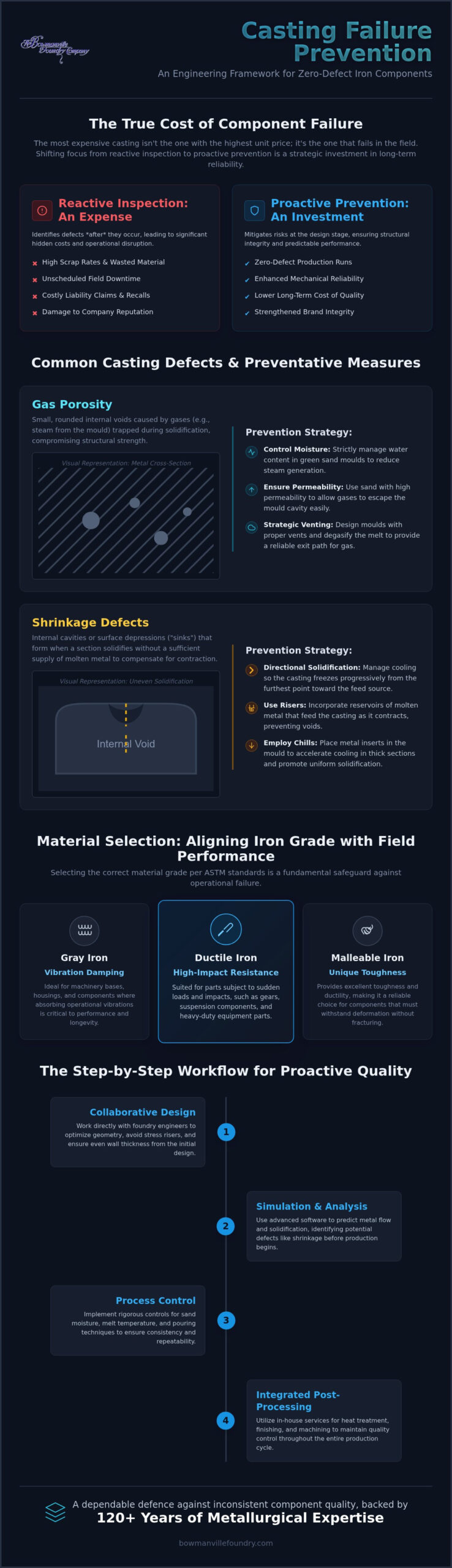
Effective manufacturing begins with the realization that inspection is an expense, while prevention is an investment. In the foundry industry, the “Cost of Quality” isn’t merely the price of a discarded part. It includes the wasted energy, machining time, and administrative overhead associated with every rejected component. Casting failure prevention is a proactive engineering strategy that identifies and mitigates risks at the design stage to ensure structural integrity. By focusing on three critical pillars—design, metallurgy, and process control—engineers can move beyond reactive troubleshooting and toward a zero-defect environment.
Distinguishing between a cosmetic casting defect and a true structural failure is vital for maintaining production schedules. While surface irregularities like slight roughness might only require minor finishing, structural failures such as internal shrinkage or hot tears compromise the component’s mechanical capacity. These deep-seated issues often remain hidden until a part is under load in the field, where the consequences of failure become far more severe and potentially lead to significant liability.
The Impact of Poor Design on Integrity
Integrity starts at the drawing board. Sharp corners and abrupt transitions in geometry act as stress risers, providing a focal point for cracks to develop during cooling or under operational stress. Similarly, uneven wall thicknesses can lead to isolated pools of molten metal that cool slower than the surrounding areas, causing internal voids. Gate placement is equally critical. If the gating system isn’t designed to minimize turbulent flow, it can trap air and impurities within the iron, creating weak spots. Even over-engineering a part with excessive mass can backfire; thicker sections are often more prone to shrinkage defects that undermine the very strength the designer intended to provide.
Environmental and Operational Factors
A component’s success depends on its ability to withstand its specific working conditions. Engineers must account for thermal fatigue, where repeated heating and cooling cycles cause the metal to expand and contract, eventually leading to microscopic fractures. Corrosion is another silent threat that can accelerate failure if the material isn’t matched to its environment. Matching the correct ASTM iron grade to the mechanical load is the final safeguard. Whether it’s the high-impact resistance of ductile iron, the vibration-damping qualities of gray iron, or the unique toughness of malleable iron, selecting the right material is a fundamental step in ensuring long-term durability. Using a resource like a Buyer’s Guide can help engineers organize their requirements to avoid these common grade-selection errors.
Categorizing Common Defects and Preventative Measures
Effective casting failure prevention requires a granular understanding of how molten metal behaves as it transitions from a liquid to a solid state. Defects aren’t random occurrences; they’re physical responses to specific variables in the foundry environment. By categorizing these issues into gas, shrinkage, metallurgical, and pouring defects, engineers can apply targeted technical solutions that ensure the integrity of the final iron component.
Preventing Gas and Porosity Issues
Gas porosity remains a primary concern in iron casting, appearing as small, rounded voids within the metal structure. These are often caused by the release of steam or gases from the mould material during the pour. To prevent this, foundries must strictly control moisture levels in green sand moulds, as excessive water leads to high gas volumes. High mould permeability is essential; it allows these gases to escape through the sand rather than becoming trapped in the iron. Proper degasification of the melt and the strategic use of vents within the mould design provide a reliable path for gas to exit, reducing the risk of subsurface blowholes that compromise structural strength.
Addressing Shrinkage and Solidification
Shrinkage defects occur because iron contracts as it cools. If a section of the casting lacks a consistent supply of molten metal during this phase, internal cavities or “sinks” develop. The solution lies in mastering directional solidification, where the cooling process is managed so that the part freezes from the furthest point toward the feed source. Risers act as reservoirs of molten metal, while “chills”—internal or external metal inserts—help accelerate cooling in thicker sections to maintain a uniform thermal gradient. Precise control of the pouring temperature is also vital, as overheating the melt can lead to excessive volumetric shrinkage. Engineers often find it helpful to consult with a technical foundry partner to determine the optimal placement of these solidification aids.
Metallurgical defects like “chill” in gray iron represent a different challenge. This occurs when the edges of a casting cool too rapidly, causing the iron to form a hard, brittle white iron structure instead of the intended gray iron. This makes the part difficult to machine and prone to cracking. Similarly, pouring defects such as cold shuts and misruns are usually the result of insufficient fluidity or low pouring temperatures. A cold shut happens when two streams of metal meet but don’t fuse; a misrun occurs when the metal freezes before the mould is full. Both can be prevented by optimizing the gating system and ensuring the melt maintains the correct temperature throughout the pouring cycle.
The Role of Material Selection in Failure Prevention
Selecting the correct iron grade is a technical requirement for long-term component durability. Casting failure prevention begins with a thorough analysis of the mechanical loads the part will encounter. If the material cannot handle the specific stress types, such as tensile, compressive, or shear forces, the component will fail regardless of the quality of the pour. Adhering to strict ASTM standards for chemical composition and microstructure is the only way to guarantee that the iron possesses the material properties specified in your engineering drawings. This alignment ensures that the foundry produces a consistent product that matches your performance expectations every time.
Malleable vs. Ductile Iron for Stress Resistance
Ductile iron is often the primary choice for high-impact or high-stress applications. Its nodular graphite structure acts as a natural buffer that stops cracks from propagating through the metal. This characteristic makes it exceptionally resilient under heavy mechanical loads. In contrast, malleable iron undergoes a specialized, multi-day heat-treatment process. This annealing transforms hard, brittle white iron into a tough, ductile material with excellent surface finish capabilities. Malleable iron is particularly effective for complex, thin-walled components where uniform toughness is essential. For engineers designing for the extreme temperature fluctuations of Canadian climates, choosing a grade with high impact toughness is a vital defence against brittle fracture during the winter months. Understanding the nuances of these materials is a key part of any rigorous casting failure prevention strategy.
Gray Iron: Vibration Damping vs. Tensile Strength
Gray iron offers a unique set of properties, most notably its superior vibration damping capacity. The flake graphite within the iron matrix absorbs energy, which makes it the standard material for machinery bases, engine blocks, and heavy equipment housings that must remain stable during operation. However, those same graphite flakes create internal stress points that limit the material’s performance in high-tensile or shock-loading scenarios. While gray iron is cost-effective and highly machinable, it lacks the elongation properties found in ductile or malleable options. When a design requires a balance of complexity and impact resistance, exploring a malleable vs. ductile iron comparison can help you determine the most reliable path forward. By matching the specific damping or strength requirements to the correct iron grade, you eliminate the material mismatches that frequently lead to field failures and inconsistent quality.
A Step-by-Step Workflow for Proactive Casting Quality
Transitioning from inspection-based quality to a prevention-based model requires a structured technical workflow. It isn’t enough to catch defects at the end of the line; you must design them out of the process from the start. This begins with a collaborative design review between your engineering team and the foundry. By involving metallurgical experts early, you can align part geometry with the physical realities of the casting process. This partnership serves as the foundation of effective casting failure prevention, ensuring that manufacturability is baked into the specifications.
Phase 1: Design Optimization and Simulation
Modern casting simulation software allows engineers to predict potential failure points with high accuracy before any physical work begins. Before a pattern is ever created, these simulations identify “hot spots”—areas of concentrated heat that increase the risk of internal shrinkage. By adjusting draft angles to improve mould release and increasing radii to eliminate stress risers, you can significantly improve the structural integrity of the component. Standardizing tolerances at this stage also reduces manufacturing stress, ensuring the part is both functional and reliably producible.
Phase 2: Rigorous Process and Quality Control
Once the design is finalized, the focus shifts to the melt and the pouring environment. Utilizing spectrometers for real-time melt chemistry verification ensures the iron meets exact ASTM specifications before it’s poured into the mould. This level of control prevents metallurgical mismatches that could lead to brittle failure in the field. For high-criticality components, non-destructive testing (NDT), such as ultrasonic or X-ray inspection, is used to detect internal voids that surface checks would miss. Documenting every heat is a requirement for maintaining full traceability throughout your supply chain, providing a clear record of material integrity.
For new or complex projects, conducting pilot runs is an essential final check. These initial batches allow for destructive testing, where samples are cut or broken to verify that internal density and grain structure match the intended design. This step confirms that the theoretical simulations align with the physical results. To begin optimizing your next project for durability, you can contact our technical team for a collaborative design review. Setting clear inspection standards as part of a casting failure prevention plan before full-scale production begins ensures that every component meets your long-term performance requirements.
Ensuring Integrity with an Experienced Canadian Foundry Partner
Reliability in manufacturing isn’t a fluke; it’s the result of decades of refined practice. When you partner with a domestic foundry that’s been operational since 1902, you’re accessing a library of institutional knowledge that no simulation software can fully replace. This experience is the ultimate tool for casting failure prevention, as it allows for the recognition of subtle metallurgical patterns that lead to defects. A Canadian partner offers the advantage of transparent communication and direct oversight. This eliminates the risks associated with long, opaque global supply chains where quality standards can drift without immediate detection. Working within a domestic framework ensures that your specifications are interpreted accurately and that any technical challenges are addressed in real time.
The Bowmanville Foundry Approach to Quality
Since 1902, our focus has remained on custom-engineered excellence. We don’t just pour metal; we provide the technical data sheets and grade selection support that engineers need to realize their specific design goals safely. Our specialists in malleable iron, a material rare in North America, understand the unique cooling and heat-treatment requirements necessary to prevent brittle failure. By offering integrated post-processing services, we maintain control over the component’s integrity until it’s ready for assembly. This internal oversight acts as a final quality gate, ensuring that any subsurface issues are identified before the part leaves our facility. It’s this commitment to precision that protects your brand from the liability of field failures.
Next Steps for Your Project
The path to zero-defect production runs starts with informed procurement. We provide a Free Casting Buyer’s Guide to help your team navigate the complexities of iron grades and ASTM standards, preventing the costly grade-selection errors that often lead to field failures. This resource is designed to help engineers organize their technical requirements and avoid the pitfalls of inconsistent supply. If you’re working on a complex or high-stress application, we invite you to submit a technical inquiry to our engineering team. Before you do, ensure your documentation is complete by reviewing our professional checklist for requesting an accurate custom iron casting quote in Ontario, so your RFQ contains the technical detail needed to avoid unexpected cost increases. We’ll work with you to analyze your requirements and develop a robust casting failure prevention strategy tailored to your specific mechanical loads.
Request a quote for your custom iron castings today to ensure the long-term durability of your industrial components and secure your supply chain with an established Canadian partner.
Advancing Your Production with Technical Certainty
Achieving zero-defect production runs isn’t a matter of luck; it’s the result of a disciplined engineering approach. By moving your focus from reactive inspection to proactive design and simulation, you eliminate the root causes of internal defects before the first pour. Selecting the appropriate iron grade, whether the vibration damping of gray iron or the impact resistance of ductile and malleable iron, is a fundamental step in your casting failure prevention strategy. Since 1902, we’ve provided the specialized technical data and metallurgical expertise necessary to help Canadian industry partners realize their most complex design goals. Our team remains committed to sharing this institutional knowledge to ensure your components perform reliably in the field. To start optimizing your procurement process, download our Free Casting Buyer’s Guide to select the right iron grade. We look forward to helping you build more durable, high-performance iron components.
Frequently Asked Questions
What are the most common causes of casting failure in industrial applications?
The most frequent causes include improper gating design, gas porosity from high moisture in moulds, and internal shrinkage due to poor directional solidification. Material grade selection is also a primary factor; using an iron grade that doesn’t match the mechanical load leads to field failures. A comprehensive approach to casting failure prevention addresses these variables during the design phase to ensure the component’s structural integrity.
How does ductile iron prevent failure better than gray iron in high-stress environments?
Ductile iron features nodular graphite that inhibits crack propagation, providing high tensile strength and elongation. Gray iron contains flake graphite, which acts as internal stress risers, making it brittle under high-tension or shock-loading scenarios. While gray iron is excellent for vibration damping, ductile iron is the preferred choice for components subjected to heavy mechanical stress or impact, significantly reducing the likelihood of catastrophic structural failure.
Can casting defects be repaired, or must the part be scrapped?
The decision to repair or scrap depends on the defect’s nature. Cosmetic surface irregularities can often be corrected through post-processing services like grinding or shot blasting. However, structural defects such as internal shrinkage, hot tears, or severe gas porosity typically require the part to be scrapped. Attempting to repair a structurally compromised casting through welding often introduces new stress points, which undermines the component’s long-term durability and safety.
How do ASTM standards help in casting failure prevention?
ASTM standards provide a technical framework that ensures consistency in chemical composition and mechanical properties. By adhering to these benchmarks, engineers can verify that the iron possesses the required tensile strength and hardness for its application. Following these standards is a critical component of casting failure prevention because it eliminates the variability that leads to inconsistent quality from suppliers, ensuring every heat meets rigorous performance specifications.
What role does pouring temperature play in preventing casting defects?
Pouring temperature directly affects the fluidity of the molten iron. If the temperature is too low, the metal may freeze before filling the mould, causing misruns or cold shuts. Conversely, excessively high temperatures increase the risk of gas porosity and volumetric shrinkage as the metal cools. Maintaining a precise thermal range ensures that the iron flows smoothly and solidifies uniformly, which is essential for producing high-density, defect-free castings.
How can I tell if a casting failure was caused by design or manufacturing?
Failures located at sharp corners or thin-to-thick transitions often point to design issues like stress concentration or poor solidification patterns. Manufacturing failures usually manifest as internal voids, inclusions, or metallurgical mismatches. Analyzing the fracture surface and utilizing non-destructive testing can help identify whether the root cause was an inherent design flaw or a process deviation. Collaborative design reviews with an experienced foundry help clarify these distinctions early in production.
What is the difference between a cosmetic defect and a structural casting failure?
A cosmetic defect is a surface-level irregularity, such as slight roughness or minor flash, that doesn’t impact the part’s mechanical performance. A structural failure involves internal or external cracks, voids, or material brittleness that compromises the part’s ability to bear its intended load. Distinguishing between the two is vital; while cosmetic issues are manageable through finishing, structural failures represent a significant risk to the integrity of the entire machine.
Why is malleable iron used for components that require high ductility?
Malleable iron undergoes a specialized heat-treatment process that transforms brittle white iron into a tough, ductile material. This unique microstructure allows it to withstand significant deformation without fracturing. It’s particularly valued for complex, thin-walled components that require a combination of high toughness and excellent machinability. Its ability to absorb energy and resist impact makes it an ideal choice for heavy-duty industrial hardware that must operate under demanding conditions.
