
A single casting failure in a high-stress application can halt an entire Canadian operation and result in thousands of dollars in unplanned downtime. For engineers and procurement professionals, the stakes of custom iron casting production are rarely just about the unit price. They’re about mechanical integrity and the reliability of the domestic supply chain. You likely recognize that the gap between a technical drawing and a finished, ASTM-standard component is filled with variables that can easily derail your project schedule.
Whether you’re struggling to choose between the vibration damping of gray iron and the fatigue resistance of ductile iron, or you’re facing opaque lead times for complex patterns, the technical frustration is real. This guide provides a reliable engineering framework to help you reduce defects and streamline your manufacturing cycles. We’ll examine how to select the correct iron grade, manage ISO 8062 tolerances, and leverage post-processing to ensure every component performs exactly as intended from the moment it arrives at your facility.
Key Takeaways
- Learn how to identify mechanical stressors and production volumes to determine the most efficient moulding method for your specific application.
- Understand the metallurgical properties of malleable, ductile, and gray iron to optimize your custom iron casting production for performance and cost.
- Discover how to translate 3D models into foundry-ready patterns using materials that align with your production longevity and draft requirements.
- Implement rigorous quality control through non-destructive testing and heat treating to ensure every component meets strict ASTM standards.
- Realize the logistical benefits of partnering with a single-source Canadian foundry to reduce lead times and lower the total cost of ownership.
Defining the Scope of Your Custom Iron Casting Project
Success in custom iron casting production depends on a clear, technical definition of the part’s final environment. Before the first pattern is cut, you must define the mechanical limits and operational expectations of the component. This initial scoping phase prevents costly redesigns or premature failure in high-stress applications. It’s the foundation upon which all metallurgical and moulding decisions are built.
Evaluating Component Functionality and Stress
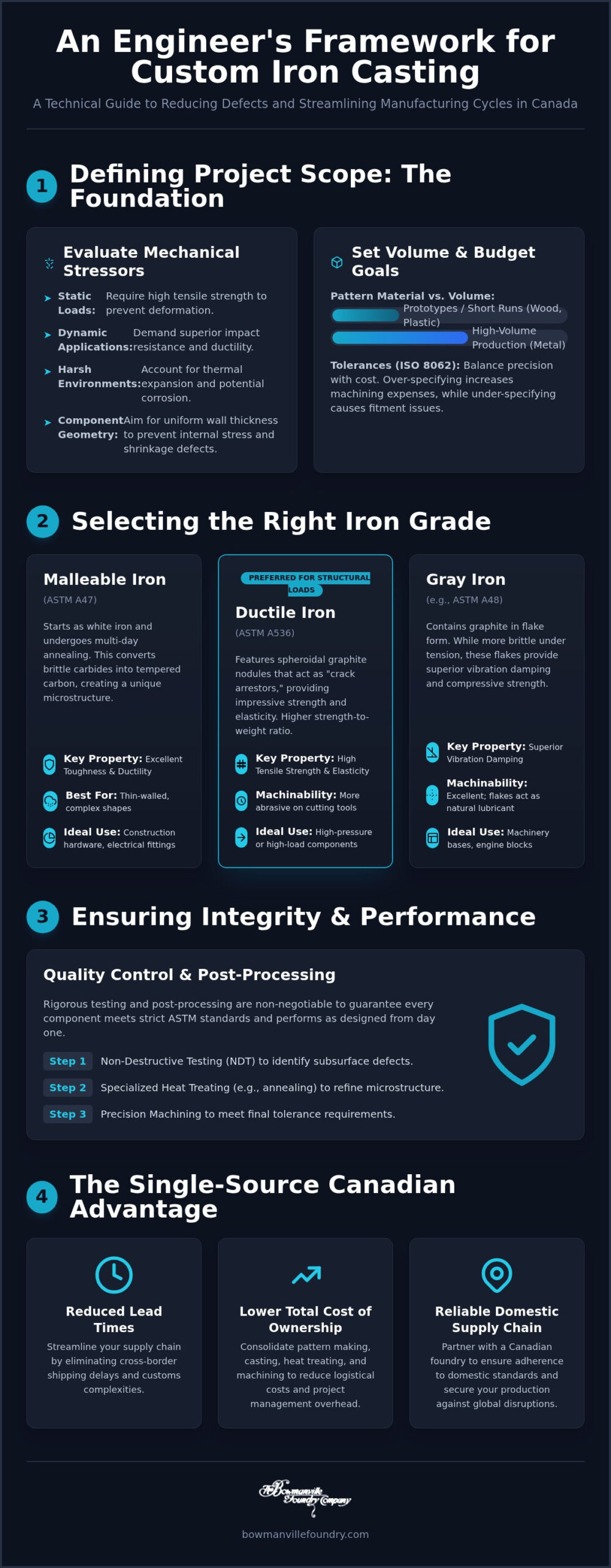
Static loads require high tensile strength; however, dynamic applications demand superior impact resistance and ductility. This demand for structural reliability is also vital in the automotive sector; for example, you can learn more about Project Faster Inc. and their engineer-certified high-performance components. If your part operates in harsh environments, you’ll need to account for thermal expansion and potential corrosion from industrial chemicals or moisture. The relationship between component geometry and cooling rates is critical because uneven section thicknesses can lead to internal stresses or shrinkage defects during solidification. Engineers should aim for uniform walls where possible to ensure a consistent grain structure throughout the casting.
Setting Production Volume and Budgetary Goals
Your anticipated volume dictates the moulding strategy and pattern material for custom iron casting production. For prototypes or short-run orders, wood or high-density plastic patterns offer a cost-effective entry point. While these materials have a shorter lifespan, they allow for rapid iteration. Conversely, high-volume production requires metal patterns. Although the initial tooling investment is higher, the durability of metal ensures a lower unit price over thousands of cycles. Simplified designs, such as those with fewer internal cores, can significantly reduce both tooling costs and lead times.
This level of engineering precision is essential for high-performance applications, including specialized automotive and motorcycle components. For those looking to see these principles in action within the racing world, click here to explore specialized bagger racing parts designed for durability and speed.
Precision is governed by the ISO 8062 standard, which defines sixteen tolerance grades from CT1 to CT16. You must determine which grade is essential for your assembly. Over-specifying tolerances often leads to unnecessary machining costs, while under-specifying can result in fitment issues. Finally, establish a timeline that respects the physical realities of the foundry. Pattern development, sand preparation, and the mandatory cooling period after pouring are non-negotiable steps. Rushing the cooling process can compromise the metallurgical integrity of the iron, leading to brittle components that fail under stress.
Selecting the Right Iron Grade for Performance and Cost
Selecting the correct metallurgy is the most consequential decision in custom iron casting production. It determines the mechanical limits of the part and the total cost of finishing. All selections must align with current ASTM standards, such as ASTM A47 for malleable iron or ASTM A536 for ductile iron, to ensure safety and regulatory compliance within Canadian industrial sectors. The choice isn’t just about strength; it’s about how the material behaves during both the pour and the eventual machining process.
Malleable Iron: The Choice for Toughness
Malleable iron starts its life as white iron and undergoes a specialized, multi-day annealing heat treatment. This process converts brittle carbides into tempered carbon nodules, creating a unique microstructure that provides excellent toughness and ductility. It’s particularly effective for thin-walled sections where other irons might become too brittle. Because it can be cast in complex, intricate shapes that remain resilient under impact, it’s a staple for construction hardware and electrical fittings. If you’re unsure which grade fits your design, consulting a specialist in malleable iron castings can clarify the technical trade-offs early in the design phase. For a deeper technical overview of material selection and ASTM A47 grade requirements, the comprehensive guide to malleable iron casting in Canada provides detailed engineering criteria for high-stress and cold-weather applications.
Ductile and Gray Iron: Strength vs. Damping
Ductile iron is characterized by spheroidal graphite nodules. These nodules act as “crack arrestors,” giving the material its impressive tensile strength and elasticity. It’s the preferred choice for components subject to high pressure or significant structural loads. For engineers evaluating suppliers, understanding the full capabilities of a ductile iron foundry in Ontario can clarify how domestic production delivers both the mechanical performance of steel and the superior castability of iron. Gray iron, conversely, contains graphite in flake form. While this makes the material more brittle under tension, it provides superior vibration damping and compressive strength. This makes gray iron the industry standard for engine blocks and heavy machinery bases where stability is paramount.
Material choice directly influences post-processing efficiency. Gray iron is often favoured for complex machining because the graphite flakes act as a natural lubricant, which reduces tool wear and heat buildup. Ductile iron is more abrasive on cutting tools but offers a higher strength-to-weight ratio that may justify the extra finishing time. Balancing these mechanical requirements with the “machinability” of the grade helps control the total cost of ownership by minimizing tool replacement and labour hours during the final assembly stages.
The Engineering Journey: From Pattern Development to Pouring
The transition from a 3D CAD model to a physical iron component is a rigorous engineering exercise. Custom iron casting production relies on the pattern as the master tool that dictates the accuracy of every subsequent part. This process begins by translating digital specifications into a physical pattern that incorporates specific foundry requirements. It’s not a direct copy of the part; it’s an engineered tool that accounts for the physical behaviour of molten metal as it cools and solidifies.
Step 1 involves adding draft angles to all vertical surfaces. Without a slight taper, the pattern will damage the sand mould during removal. Step 2 requires selecting a pattern material that matches your production goals. Wood is suitable for low-volume prototypes; however, high-density plastics or durable metal patterns are necessary for long-term production longevity and dimensional consistency over thousands of cycles.
Optimizing Pattern Design for the Foundry
A pattern is always slightly larger than the final part to account for the shrinkage allowance of the specific iron grade. For example, ductile iron and gray iron have different contraction rates as they transition from liquid to solid. Draft angles, typically ranging from 1.5 to 3 degrees, ensure the pattern slides out of the sand without causing “mould tear.” When your design requires internal cavities or complex hollow geometries, sand cores are placed within the mould. These cores are made of specialized resin-bonded sand that withstands the heat of the pour while remaining easy to remove during post-processing.
Mastering the Pouring and Cooling Process
Once the sand mould is prepared, the gating system and risers are finalized. Risers are essential reservoirs of molten metal that feed the casting as it shrinks during solidification. This prevents internal porosities that could compromise the part’s integrity. Step 3 focuses on this assembly, ensuring proper gas escape to avoid blowholes. Step 4 involves the pour itself. Molten iron must be maintained at precise temperatures to ensure it fills every intricate detail of the mould cavity without premature freezing or “cold shuts.”
The final stage, Step 5, is the managed cooling cycle. Rushing this stage is a common cause of internal stresses and warping. The timing of the “shake-out,” where the casting is removed from the sand, is critical. Removing the part too early can alter the final hardness and grain structure of the iron. A controlled, methodical cooling process ensures the component meets the required mechanical specifications without hidden defects or structural weaknesses.
Ensuring Integrity through Quality Control and Post-Processing
Quality control is the final safeguard in custom iron casting production. It ensures that the metallurgical promises made during the design phase are physically present in the finished part. For high-performance applications, the manufacturing cycle does not end when the iron solidifies. It continues through a series of secondary operations that refine the mechanical properties and dimensional accuracy of the component. This integrated approach prevents the failure of parts in high-stress environments and ensures every unit meets the required ASTM standards.
Secondary Operations and Finishing
Heat treatment is often the most critical post-casting step. Annealing, particularly for malleable iron, converts the microstructure to ensure the necessary ductility and impact resistance. Stress-relieving is equally vital for complex geometries; it eliminates internal tensions that could lead to warping during subsequent machining. Once the metallurgical properties are locked in, surface preparation begins. Sandblasting removes scale and provides the necessary profile for protective coatings. In the Canadian industrial landscape, where exposure to road salt and extreme temperature fluctuations is common, specialized primers and paints are essential to prevent oxidation and extend the service life of the part.
Precision machining turns a raw casting into a ready-to-use component. By integrating machining with the foundry process, you eliminate the logistical risk of shipping parts between multiple vendors. Understanding the full scope of integrated iron casting and machining in Canada ensures that the machinist understands the specific grain structure of the iron, leading to better surface finishes and tighter tolerances. It also reduces lead times, as the transition from the shake-out floor to the machine shop is seamless and immediate.
Rigorous Quality Assurance Protocols
To guarantee internal integrity, foundries employ non-destructive testing (NDT). Techniques such as magnetic particle inspection or ultrasonic testing identify internal porosities and hairline cracks that are invisible to the naked eye. Verifying the chemical composition of each melt is handled through spectrographic analysis. This ensures the carbon, silicon, and manganese levels align perfectly with the specified iron grade. This level of detail is necessary for maintaining consistency across high-volume orders.
Finally, dimensional precision is verified using Coordinate Measuring Machines (CMM). These tools check the physical casting against the original digital model to ensure every critical dimension meets the ISO 8062 standard. For industries requiring full traceability, documentation of metallurgical heat lots provides a clear record from raw material to finished part. You can streamline your procurement and reduce logistical complexity by utilizing integrated post-processing services that handle everything from the initial pour to final machining under a single roof.
Streamlining Production with a Single-Source Canadian Foundry
Managing custom iron casting production through a series of fragmented vendors or third-party brokers often introduces unnecessary risks and hidden costs. By partnering directly with a domestic manufacturer, you integrate engineering, casting, and finishing under one roof. This single-source model significantly reduces logistical complexity and eliminates the markups associated with brokerage services. It ensures that the technical intent of your design is maintained throughout the entire manufacturing cycle, from the initial pattern development to the final post-processing stages.
Direct communication with the foundry floor is a primary advantage. When questions arise regarding section thickness or draft angles, you speak directly with the engineers responsible for the pour. This transparency results in faster lead times and a more responsive supply chain. Leveraging over a century of institutional knowledge, specifically from a foundry operating since 1902, provides a level of project troubleshooting that newer or less specialized facilities don’t possess. This experience is vital when navigating the nuances of malleable, ductile, or gray iron grades.
The Benefits of Direct Manufacturer Partnership
A direct relationship provides real-time technical support during the critical design phase. Instead of waiting for a broker to relay information, you receive immediate feedback on how to optimize your part for the casting process. This collaborative approach leads to ready-to-use iron components that arrive at your facility meeting all assembly requirements. To assist in this decision-making process, engineers can access specialized resources like a Free Casting Buyer’s Guide, which provides the technical data needed to select the correct iron grade and understand the cost drivers of the foundry process.
Future-Proofing Your Industrial Supply Chain
In the first quarter of 2026, primary metal manufacturing sales in Canada increased by 4.3%, reflecting a robust demand for domestic industrial components. Choosing a foundry with a proven Canadian legacy is a strategic move for future-proofing your operations. With the federal “Buy Canadian” policy prioritizing domestic materials for significant infrastructure and government contracts, a local partnership ensures your components remain compliant with national procurement standards. This stability allows you to scale production seamlessly from initial prototypes to full-scale manufacturing runs without the volatility of international shipping or customs delays. If you’re ready to optimize your manufacturing cycle, consult with our engineering team for your next custom project to ensure your components are built for long-term performance.
Advancing Your Manufacturing with Integrated Foundry Expertise
Mastering custom iron casting production requires a balance of metallurgical precision and disciplined engineering. By selecting the optimal iron grade and ensuring rigorous quality control through every stage of the pour and finishing, you secure the mechanical integrity of your most critical components. Transitioning from a vendor-based model to a direct engineering partnership allows for clearer communication and a more resilient Canadian supply chain. It’s a strategic shift that moves your operations from simple procurement to technical certainty.
Since 1902, we’ve provided specialized expertise in malleable, ductile, and gray iron to meet the most demanding industrial standards. Our comprehensive in-house post-processing services ensure that your parts are delivered ready for immediate assembly, reducing the complexity of your procurement cycle. We invite you to leverage our legacy of institutional knowledge to troubleshoot complex designs and streamline your manufacturing timeline. Request a custom iron casting quote for your next project to begin developing high-performance solutions tailored to your specific operational needs. We look forward to supporting your next engineering challenge.
Frequently Asked Questions
What is the difference between custom iron casting and standard fabrication?
Custom iron casting involves pouring molten metal into an engineered mould to create complex, near-net shapes. Standard fabrication relies on welding, cutting, and bending pre-existing stock materials. Casting is often more efficient for intricate designs that require high structural integrity and fewer joints. It allows you to consolidate multiple components into a single, high-performance part, which reduces assembly time and potential failure points.
How do I choose between malleable and ductile iron for my production run?
You should select malleable iron for thin-walled, intricate components that require high toughness and impact resistance. It’s especially effective for small to medium parts like electrical fittings. Ductile iron is the better choice for larger components needing superior tensile strength and elasticity. Both materials offer distinct advantages depending on the mechanical stressors your part will encounter during its service life. For operations in extreme cold-weather environments, reviewing the technical criteria for malleable iron casting in Canada can help you determine whether ASTM A47 grades meet your specific impact resistance requirements.
What are the typical lead times for custom iron casting production in Canada?
Lead times for custom iron casting production typically range from 8 to 12 weeks, depending on the complexity of the pattern development. Developing a new pattern usually takes 4 to 6 weeks, while the moulding and pouring cycle adds several more. You can often reduce these timelines by maintaining direct communication with the foundry engineers instead of working through third-party brokers.
Can you produce custom iron components from an existing broken part?
Yes, a foundry can use a broken component as a template for reverse engineering. Engineers measure the original part to create a precise 3D model, accounting for the required shrinkage allowance and draft angles. This digital model is then used to produce a new pattern. This process is common for replacing legacy machinery parts that are no longer available from the original manufacturer.
What ASTM standards should I specify for industrial iron castings?
You should specify ASTM A47 for malleable iron, ASTM A536 for ductile iron, and ASTM A48 for gray iron. These international standards define the required tensile strength, yield strength, and elongation properties. Adhering to these specifications ensures that your components meet Canadian industrial safety regulations and perform reliably in high-stress environments across diverse operating conditions.
Why is pattern development the most critical step in custom casting?
Pattern development is critical because it’s the master tool for the entire production run. If the draft angles or shrinkage allowances are incorrect, every casting will suffer from dimensional errors or mould tear. A well-engineered pattern ensures clean removal from the sand and reduces the need for expensive post-processing machining. It’s the foundation of a successful manufacturing cycle and determines the final part accuracy.
How does heat treating improve the performance of a custom iron component?
Heat treating, such as annealing or stress-relieving, optimizes the metallurgical structure of the iron. In malleable iron production, a multi-day annealing process converts brittle carbides into tempered carbon nodules to ensure ductility. For complex parts, stress-relieving eliminates internal tensions created during cooling. This prevents warping and ensures the component remains stable during precision machining or under heavy operational loads.
What information is required to receive an accurate iron casting quote?
An accurate quote requires detailed 3D CAD models or 2D technical drawings that specify all critical dimensions and tolerances. You must also provide the desired iron grade, estimated annual production volume, and part weight. Don’t forget to include requirements for post-processing services, such as machining, painting, or specialized coatings, as these significantly impact the final unit price and logistical planning.
