
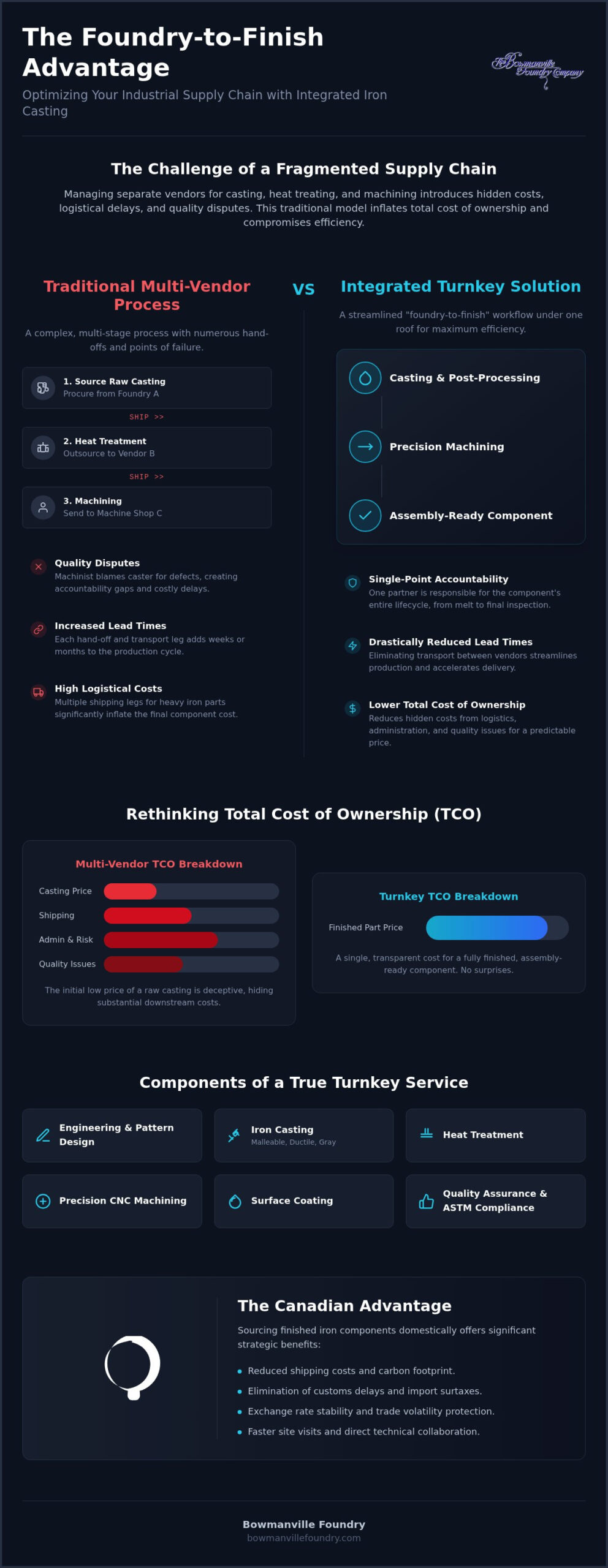
What if the hidden costs in your industrial supply chain have nothing to do with the price of raw materials and everything to do with the distance between your foundry and your machine shop? Many procurement professionals realize that managing separate vendors for casting, heat treating, and machining is a recipe for logistical delays. By utilizing turnkey iron casting services Canada, you can eliminate the frustration of quality disputes where the machinist blames the caster for a defect. These fragmented processes don’t just waste time; they drive up shipping costs for heavy iron and increase your total cost of ownership.
Consolidating these steps under one roof ensures single-point accountability for every component. Sourcing fully finished, ready-to-use iron parts from a single domestic provider allows you to streamline operations and reduce lead times significantly. This guide provides a technical overview of how a “foundry-to-finish” workflow secures your supply chain against volatility. We will examine the advantages of integrated post-processing for malleable, ductile, and gray iron, helping you make an informed decision that prioritizes precision and mechanical integrity.
Key Takeaways
- Understand the strategic shift from raw casting procurement to sourcing assembly-ready components to eliminate secondary processing delays and simplify your inventory.
- Learn how to perform a Total Cost of Ownership (TCO) analysis that reveals the hidden logistical and quality risks inherent in a fragmented, multi-vendor supply chain.
- Discover how utilizing turnkey iron casting services Canada provides single-point accountability while ensuring strict ASTM compliance for malleable, ductile, and gray iron.
- Gain a practical framework for auditing a foundry’s in-house finishing capabilities to ensure your components meet precise mechanical and tolerance specifications.
- Explore how a comprehensive “Foundry-to-Finish” workflow reduces lead times and avoids the high costs associated with moving heavy iron between multiple service providers.
What are Ready-to-Use Iron Components?
In the context of industrial procurement, a ready-to-use component is a ferrous casting that has completed every stage of production required for immediate assembly. Historically, foundries operated on a “pour and ship” model, leaving the buyer to manage secondary vendors for machining, coating, and heat treatment. This fragmented approach is changing. Modern Canadian manufacturers now prioritize finished component sourcing, where the foundry delivers a part that meets final engineering tolerances straight out of the crate. To understand the foundation of these components, one must first grasp what cast iron is and how its carbon content and micro-structure dictate the specific secondary operations required for a “plug-and-play” finish.
The transition toward turnkey iron casting services Canada reflects a broader shift in supply chain philosophy. Industrial sectors like construction, electrical hardware, and heavy machinery are moving away from raw casting procurement to mitigate the risks of multi-vendor finger-pointing. When a part fails a final inspection at a machine shop, the machinist often blames the foundry for internal porosity, while the foundry blames the machinist for improper tool pressure. Turnkey services eliminate this conflict by establishing a single point of accountability for the part’s entire lifecycle.
The Anatomy of a Finished Casting
Benefits of Sourcing Nationally in Canada
Sourcing finished iron components within Canada offers distinct logistical advantages that international vendors cannot match. Moving heavy iron across borders is expensive and environmentally taxing; domestic sourcing significantly reduces the carbon footprint by shortening the transport distance. Canadian firms also benefit from exchange rate stability and the elimination of complex customs delays. With the 2026 manufacturing landscape facing increased surtaxes on various ferrous imports, a national partner provides a hedge against trade volatility. Local sourcing allows for faster site visits and face-to-face technical consultations, which are essential when developing custom-engineered parts with complex geometries.
This emphasis on local expertise and custom engineering is equally vital for architectural ironwork. For high-quality custom fabrication and installation of gates and railings, Iron Guys offers professional services that ensure precision and aesthetic excellence.
The Components of a Turnkey Iron Casting Service
A comprehensive approach to metal casting begins long before the furnace is lit. True turnkey iron casting services Canada integrate engineering and pattern development into the initial design phase to ensure optimal castability. This foresight prevents manufacturing defects and reduces material waste. According to best practices championed by the Canadian Foundry Association, early collaboration between the engineer and the caster is the most effective way to optimize part geometry for the moulding process. This integration ensures that the final component is not only functional but also economical to produce at scale.
Different iron grades present unique challenges during post-processing. Malleable iron, for instance, offers excellent machinability due to its annealed structure, while ductile iron provides high strength but requires precise tool selection to manage its nodular graphite structure. When evaluating turnkey iron casting services Canada, it’s vital to choose a partner who understands how these metallurgical differences impact every subsequent manufacturing step. For a deeper look at how consolidating these processes protects your timeline and bottom line, our guide to integrated iron casting and machining in Canada explains how a unified workflow ensures metallurgical integrity from pour to finished part.
Precision Machining and Tolerances
Rough castings possess a “casting skin,” which is a hard, abrasive outer layer formed during the cooling process. CNC machining is essential to penetrate this layer and transform rough surfaces into tight-tolerance interfaces. For ductile iron parts, achieving critical dimensions requires high-rigidity equipment to handle the material’s toughness without compromising tool life. In contrast, gray iron’s flake graphite acts as a natural lubricant; this allows for faster spindle speeds but requires robust dust collection to manage fine chips. High-precision machining ensures that ready-to-use iron components fit perfectly into larger assemblies, eliminating the need for further adjustment on the shop floor.
Heat Treating and Surface Finishing
Heat treatment is a critical stage where the mechanical properties of the metal are finalized. For malleable iron, a specific annealing cycle is required to convert white iron into a tough, ductile material. This specific heat treatment optimizes the grain structure for high-stress applications by ensuring the carbon is properly distributed as temper carbon nodules. Stress-relieving processes may also be applied to prevent warping during machining.
Beyond internal metallurgy, surface finishing protects the component from the harsh Canadian climate. Options such as painting, plating, or hot-dip galvanizing provide a barrier against corrosion in outdoor infrastructure or heavy equipment applications. If you are unsure which grade or finish suits your specific application, reviewing a Casting Buyer’s Guide can help you navigate these technical specifications and material properties.
Comparing Single-Source Turnkey vs. Multi-Vendor Procurement
Many procurement teams evaluate vendors based on the unit price listed on a purchase order. This narrow focus often ignores the Total Cost of Ownership (TCO), which includes administrative overhead, logistical coordination, and the cost of capital tied up in extended lead times. Utilizing turnkey iron casting services Canada allows for a holistic TCO analysis. By consolidating casting, machining, and finishing, a manufacturer reduces the number of invoices to process and the hours spent managing complex vendor relationships. When you account for the time spent auditing three different facilities instead of one, the “cheapest” raw casting often becomes the most expensive finished part.
Risk mitigation is perhaps the most significant hidden cost in industrial supply chains. In a multi-vendor setup, if a CNC machinist discovers internal porosity halfway through a machining cycle, a dispute often arises. The foundry may claim the machinist used improper tool speeds, while the machinist insists the casting was defective. A turnkey provider accepts full responsibility for the final dimensions and metallurgical integrity. If a part is rejected at the final stage, the provider bears the cost of the scrap and the rework, not the client. This single-point accountability provides a level of financial predictability that fragmented sourcing cannot match.
The Logistics and Shipping Factor
Moving heavy ferrous components is a significant expense that compounds with every stop in the production chain. When iron moves from a foundry to a heat treater and then to a machine shop, the shipping costs for these heavy materials accumulate quickly. These redundant hops also increase the risk of transit damage to critical finished surfaces or threaded interfaces. In the Canadian manufacturing sector, where distances between specialized shops can be vast, reducing these “multi-vendor hops” also lowers the environmental impact of the project by cutting down on transport-related emissions and fuel consumption.
Quality Accountability and the “Foundry-Machinist Gap”
Foundries that perform their own machining benefit from immediate, internal feedback loops. If a specific geometry consistently causes tool wear or reveals minor surface defects during the first pass, the machining department can alert the foundry floor in real-time to adjust the gating system or pouring temperature. This synergy is essential for preventing casting failure and ensuring that every component meets its design intent. By bridging the gap between the caster and the finisher, turnkey iron casting services Canada eliminate the common bottlenecks that occur when one vendor waits for another to finish a batch, resulting in a more synchronized and reliable production schedule.
How to Evaluate Turnkey Iron Casting Partners in Canada
Selecting a partner for turnkey iron casting services Canada requires a rigorous technical audit that goes beyond a simple price comparison. A successful procurement strategy depends on the foundry’s ability to manage the entire lifecycle of a component without losing control of the quality chain. Start by auditing whether the finishing capabilities are truly in-house or merely managed through a network of subcontractors. While outsourcing is common, in-house control over CNC machining and heat treatment provides the most reliable feedback loops for quality assurance and schedule predictability.
Verification of ASTM standard compliance is the next critical step. Whether your project requires the high tensile strength of ductile iron or the specific vibration-damping properties of gray iron, the provider must demonstrate a history of meeting precise material specifications. Review their track record for managing large-scale national projects, especially those involving complex custom-engineered parts for the Canadian infrastructure or energy sectors. A partner with a legacy of reliability will have the institutional knowledge to navigate the specific regulatory and environmental challenges of the domestic market.
Technical Capability and Equipment
The physical capacity of a foundry’s machine shop is just as important as its pouring capacity. You must ensure the partner has the CNC envelope size required for your largest parts and the spindle torque necessary to handle the tough casting skin of ferrous metals. Additionally, evaluate their heat treatment furnace capacity and the sophistication of their atmospheric control systems to ensure consistent hardness profiles. A Coordinate Measuring Machine (CMM) is essential in turnkey verification because it provides objective, automated data to confirm that every machined feature aligns with the original CAD model. Without this level of metrology, verifying tight-tolerance interfaces becomes a manual and potentially error-prone process.
Material Expertise and Standards
Engineering support for “design for manufacturability” (DFM) is a hallmark of a high-tier turnkey provider. A knowledgeable partner will review your drawings to suggest modifications that improve castability or reduce machining time. This expertise ensures you aren’t over-specifying tolerances where they aren’t needed, which lowers your total cost. If you’re currently in the selection phase, reviewing a Casting Buyer’s Guide can provide you with the technical benchmarks needed to compare different iron grades and finishing options effectively. For a detailed assessment of how an integrated workflow can benefit your specific supply chain, request a technical consultation to discuss your project requirements.
Bowmanville Foundry: Your National Partner for Finished Iron Solutions
Since 1902, Bowmanville Foundry has served as a dependable pillar of the Canadian manufacturing sector. Our legacy of expertise is built on over 120 years of technical mastery and physical craftsmanship. We were the first foundry in Canada to achieve ISO certification in 1996, a milestone that reflects our long-standing commitment to quality and precision. Today, we provide comprehensive turnkey iron casting services Canada that bridge the gap between raw metallurgy and finished engineering. Our “Foundry-to-Finish” workflow is specifically designed to maximize efficiency by integrating pattern development, moulding, and pouring with essential post-processing services like CNC machining and heat treatment.
Why Our Turnkey Approach Wins
Our integrated approach succeeds because it establishes single-point accountability for every ready-to-use iron component. Given that supply chain volatility is a constant concern, having a national partner reduces the inherent risks of international logistics and multi-vendor coordination. We specialize in malleable, ductile, and gray iron, offering the in-house technical support required to help you select the ideal grade for your specific application. Whether your project involves high-stress mechanical parts or corrosion-resistant infrastructure components, our team manages the complexity so you don’t have to. This commitment to reducing lead times ensures your assembly line remains moving without the delays typically associated with fragmented sourcing.
Get Started with Your Turnkey Project
Launching a successful turnkey project requires a methodical start. We encourage clients to provide detailed technical specifications, including material grades and final tolerances, during the initial inquiry phase. This early data allows our engineering team to perform a “design for manufacturability” review, which can often uncover opportunities to reduce weight or simplify machining operations. By providing an accurate quote that encompasses the entire production cycle, we ensure there are no hidden costs or surprises during the manufacturing phase. If you’re looking to consolidate your industrial supply chain with a partner that values precision and integrity, you can Request a Quote for Turnkey Iron Casting Services to begin the technical consultation process.
Securing Your Industrial Supply Chain with Integrated Solutions
Transitioning from fragmented procurement to a unified workflow isn’t just about convenience; it’s a strategic move to lower your total cost of ownership. You’ve seen how integrated post-processing eliminates the quality disputes common in multi-vendor setups and ensures that every part meets strict ASTM standards before it arrives at your facility. By partnering with a provider of turnkey iron casting services Canada, you secure a streamlined path from raw melt to assembly-ready component while avoiding the high shipping costs and logistical delays inherent in moving heavy iron between different shops.
Since 1902, we’ve focused on delivering technical mastery in malleable, ductile, and gray iron. Our comprehensive finishing capabilities provide the single-point accountability your project requires for long-term success. To ensure you’re making the most informed decision for your next engineering challenge, download our Free Casting Buyer’s Guide to select the right grade for your project. Aligning your technical specifications with the right material and finishing process today will ensure your assembly line operates with maximum efficiency and precision.
Frequently Asked Questions
What exactly are turnkey iron casting services?
Turnkey iron casting services provide a comprehensive manufacturing solution where a single foundry manages the entire production cycle from initial engineering to the delivery of a finished, assembly-ready component. This includes pattern development, moulding, pouring, and all necessary secondary operations like CNC machining and heat treatment. By utilizing turnkey iron casting services Canada, you avoid the complexity of managing multiple vendors and ensure that the final part meets all engineering specifications upon arrival.
How much can I save by using a single-source provider for ready-to-use iron components?
While the initial unit price might seem higher, you save significantly on the total cost of ownership by eliminating redundant shipping costs between multiple vendors. You also reduce administrative overhead by processing a single invoice and avoiding the costs associated with quality disputes or transit damage. Domestic sourcing further protects your budget from the 2026 surtaxes on imported ferrous goods and the volatility of international exchange rates.
Can you machine both malleable and ductile iron to the same tolerances?
Yes, both malleable and ductile iron can be machined to extremely tight tolerances, though the technical approach varies based on the material’s micro-structure. Malleable iron’s annealed state offers superior machinability for complex geometries, while ductile iron requires more rigid setups to handle its higher tensile strength. A professional foundry uses specialized CNC equipment and metrology tools like CMM to verify that both materials meet your exact dimensional requirements.
What happens if a defect is found after the component is machined?
In an integrated turnkey model, the foundry accepts full responsibility for the component’s integrity throughout the entire process. If a defect like internal porosity is uncovered during machining, the provider manages the scrap and rework costs internally. This eliminates the “finger-pointing” common in multi-vendor procurement, where a machinist might blame the caster for material defects or vice versa, ensuring you only pay for parts that meet your standards.
Do you provide surface coatings like galvanizing or painting?
Yes, comprehensive turnkey services include various surface finishing options to protect components from corrosion and environmental wear. Common coatings include industrial painting, plating, and hot-dip galvanizing, which are particularly important for heavy machinery and infrastructure used in harsh Canadian climates. These finishes are applied after all machining and heat treatment stages are complete to ensure the protective barrier remains intact during final assembly.
How do turnkey services affect the overall lead time of a project?
Turnkey services typically reduce overall lead times by eliminating the weeks spent in transit between disparate vendors and the “queuing” delays at separate machine shops. When casting and finishing occur under one roof, production schedules are synchronized, allowing for immediate transitions between pouring, heat treating, and machining. This streamlined workflow allows you to move from design to assembly-ready components much faster than fragmented sourcing models allow.
Is it better to source iron components from Canada or overseas for turnkey projects?
Sourcing iron components within Canada is generally superior for turnkey projects due to reduced logistical risks and faster technical support. Domestic providers ensure compliance with ASTM standards and help you avoid the 25% surtax on certain imported steel and iron derivative goods effective as of late 2025. You also gain the advantage of easier site audits and technical consultations, which are essential for developing complex, custom-engineered components.
What information do I need to provide for a finished component quote?
To receive an accurate quote, you should provide detailed engineering drawings that include final dimensions, required tolerances, and specific iron grades. It’s also helpful to specify any necessary heat treatments, surface coatings, and expected production volumes. Providing this information early allows the engineering team to conduct a “design for manufacturability” review, ensuring the part is optimized for both the casting process and the subsequent machining stages.
