
A single misplaced alphanumeric code in your material specification can be the difference between a part that lasts decades and a catastrophic structural failure on the job site. As a Canadian engineer, you likely recognize that interpreting ASTM iron casting standards often feels like deciphering a complex, evolving language. It’s a dense landscape where the risk of selecting the wrong grade can lead to costly delays or compromised safety.
We understand the pressure to get these specifications right the first time. This guide serves as a technical resource to help you master the nuances of ASTM ferrous casting specifications, ensuring both material performance and long-term project reliability. You’ll gain a clear understanding of the A47, A48, and A536 standards. We’ll also provide the framework you need to communicate precise requirements to a foundry with absolute confidence. From the latest 2024 updates for ductile iron to the specific requirements for malleable iron, we’ve organized this institutional knowledge to support your design process.
Key Takeaways
- Learn to distinguish between the primary ASTM iron casting standards, including A48 for gray iron and A536 for ductile iron, to ensure your material selection aligns with structural requirements.
- Master the systematic process of identifying base iron types and mechanical property requirements, such as tensile and yield strength, to eliminate ambiguity in your designs.
- Understand how foundries utilize ASTM E8 and E10 protocols to verify material integrity through rigorous tensile and Brinell hardness testing.
- Gain the ability to draft precise, ASTM-based specifications for your Request for Quote (RFQ) to ensure seamless communication with Canadian foundry partners.
- Discover how adhering to these standardized specifications mitigates the risk of component failure and ensures long-term durability in heavy industrial applications.
What are ASTM Iron Casting Standards and Why Do They Matter?
ASTM iron casting standards provide the foundational language for the North American foundry industry. Originally known as the American Society for Testing and Materials, ASTM International develops consensus-based technical standards that ensure industrial safety and component reliability. For a Canadian engineer, these aren’t just suggestions. They’re precise instructions that govern the chemical composition and mechanical properties of a part. When you specify a grade, you’re relying on over a century of metallurgical research to predict how that part will behave under stress.
These specifications facilitate clear communication between the design office and the foundry floor. Without them, procurement becomes a guessing game. By referencing a specific standard, you ensure that the material’s performance is predictable across different suppliers. It’s also vital to recognize the difference between material standards, which define the iron itself, and process standards, which outline how to manufacture or test the component. Mastering ASTM iron casting standards allows you to bridge the gap between theoretical design and physical craftsmanship.
The Anatomy of an ASTM Designation
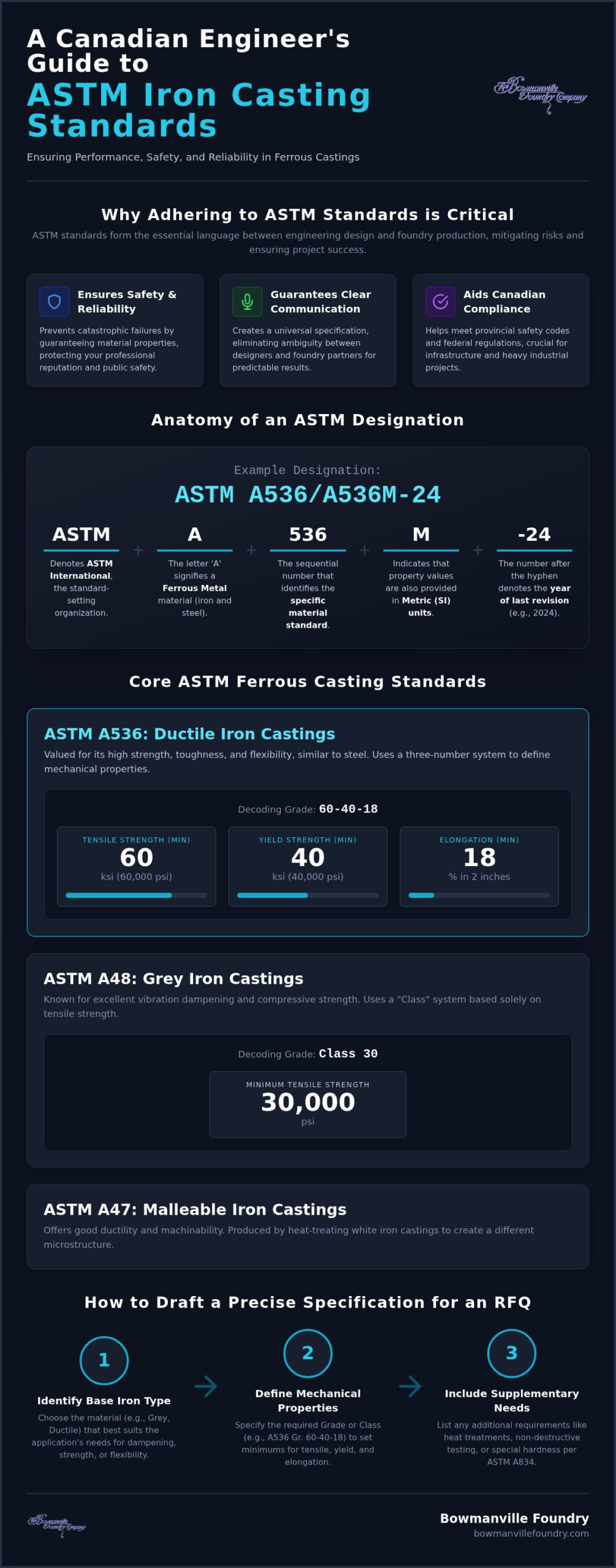
Every designation follows a logical structure that tells a story about the material. The letter “A” signifies a ferrous metal, which includes the gray, ductile, and malleable irons produced at Bowmanville Foundry. The sequence numbers that follow identify the specific material type, while the number after the hyphen denotes the year of last revision. For example, ASTM A48/A48M-22 tells you it’s a gray iron standard last updated in 2022. Understanding the code helps you avoid using outdated data for your designs. You should also distinguish between a “Standard Specification,” which lists material requirements, and a “Standard Test Method,” which describes how to conduct a specific evaluation like a tensile test.
ASTM Compliance in the Canadian Regulatory Landscape
In Canada, engineering firms rely on these standards to meet provincial safety codes and federal regulations. Whether you’re designing municipal infrastructure projects or heavy machinery for major industrial sectors across Canada, adhering to ASTM protocols helps you navigate the legal requirements of various provincial and territorial jurisdictions. While ISO standards are common in global trade, ASTM remains the dominant framework for ferrous castings in North America. Ignoring these standards carries heavy risks. Material failure can lead to catastrophic accidents, project delays, and significant legal liability. Using established ASTM iron casting standards provides a layer of protection for both the public and your professional reputation.
How to Read and Interpret ASTM Iron Specifications
Reading ASTM iron casting standards is less about memorizing numbers and more about understanding a hierarchical system of information. You must first identify the base iron type. Each material offers distinct mechanical advantages. Gray iron provides superior vibration dampening, while ductile iron offers high strength and flexibility. Once you’ve confirmed the base material, you locate the required mechanical properties. Tensile strength represents the maximum stress a material can withstand, while yield strength marks the point where permanent deformation begins. These metrics are the foundation of any safe engineering design.
Elongation is the third critical metric, particularly for ductile and malleable irons. It indicates how much the material will stretch or deform before it eventually fractures. Finally, you should review any supplementary requirements. These may include specific heat treatments or non-destructive testing protocols defined in the ASTM A834-95(2020) Standard, which covers foundational requirements for various iron castings. By following this systematic approach, you can ensure that your material choice aligns perfectly with the functional demands of your project.
Decoding the Three-Number System
Ductile iron grades under the A536 specification use a specific three-part format, such as 60-40-18. The first number represents the minimum tensile strength in ksi (60,000 psi). The second number denotes the minimum yield strength (40,000 psi). The third number is the percentage of elongation (18%). Gray iron follows a different logic; a Class 30 designation under A48 simply indicates a minimum tensile strength of 30,000 psi. It’s vital to design your components around these minimum values rather than average foundry results to maintain a reliable safety margin.
Common Units: Metric vs. Imperial in ASTM
Most ASTM iron casting standards were historically developed using imperial units like psi or ksi. Many modern versions now include an “M” designation, such as A48M, which provides metric equivalents in Megapascals (MPa). In the Canadian market, we frequently see a mix of both systems. It’s common for an engineering drawing to utilize metric dimensions while specifying material properties in imperial units. Standardizing your Request for Quote (RFQ) to a single measurement system prevents conversion errors that could lead to underspecified parts. If you’re unsure which grade fits your specific application, our Free Casting Buyer’s Guide provides detailed comparison charts to simplify the selection process.
Core ASTM Specifications for Gray, Ductile, and Malleable Iron
Selecting the correct material requires a precise understanding of the ASTM iron casting standards that govern different ferrous families. While many projects default to ductile iron, the specific mechanical demands of your application might favour the vibration dampening of gray iron or the unique toughness of malleable iron. Gray iron follows the ASTM A48/A48M-22 standard, where classes denote the minimum tensile strength. For high-volume automotive components, ASTM A602 provides specialized requirements for malleable iron used in brackets and drivetrain parts. However, for the majority of Canadian industrial projects, the choice usually centers on the A47 and A536 specifications. Our industrial casting procurement guide for 2026 provides a methodical framework for choosing between these material families based on the latest ASTM standards and domestic supply chain considerations.
ASTM A47: The Malleable Iron Standard
Grade 32510 and 35018 are the primary designations within the A47 specification. Malleable iron is unique because it begins the manufacturing process as white iron. It then undergoes a multi-day annealing heat treatment that transforms brittle carbides into tempered carbon nodules. This metallurgical shift produces a material with exceptional machinability and impact resistance, even in the cold climates common across Canada. It’s the reason A47 remains the preferred standard for electrical conduit fittings, pipe hangers, and construction hardware. At Bowmanville Foundry, we’ve maintained deep institutional knowledge of this annealing process since 1902, ensuring every casting meets the strict ductility requirements defined by the A47 protocol.
ASTM A536: Ductile Iron Grade Comparison
This is the foundational specification for ductile iron castings. Grade 65-45-12 is often the default choice for general engineering because it offers a reliable balance of strength and elongation. If your design requires higher fatigue resistance or load-bearing capacity, Grade 80-55-06 provides a significant increase in tensile strength. When you’re designing parts for pressure-retaining applications, such as valves or specialized pump housings, you should specify ASTM A395 rather than the standard A536. The integrity of any A536 casting depends on nodularity. This refers to the graphite forming into spheres rather than flakes. High nodularity prevents crack propagation and ensures the part doesn’t fail under sudden structural stress. Using these ASTM iron casting standards correctly allows you to match the material’s internal structure to the external forces it will face in the field.
The Engineering Impact: Mechanical Testing and Quality Control
Mechanical testing is the bridge between a theoretical grade and a functional component. To verify compliance with ASTM iron casting standards, foundries must perform rigorous physical evaluations. Tensile testing remains the primary method, typically conducted according to ASTM E8 protocols. This process involves pulling a machined specimen until it fails, allowing technicians to record precise yield and tensile values. Hardness testing, governed by ASTM E10, utilizes the Brinell scale to assess the material’s resistance to indentation. This measurement is a reliable proxy for machinability; a part that is too hard will destroy cutting tools, while one that is too soft may lack the necessary wear resistance.
Beyond physical strength, microstructural analysis ensures the internal architecture of the iron is correct. For ductile iron, this means verifying that graphite has formed into spheres rather than flakes. For critical components where internal defects are unacceptable, non-destructive testing (NDT) options like ultrasonic or magnetic particle inspection provide an extra layer of certainty. These steps ensure that the physical craftsmanship matches the established engineering requirements.
The Role of the Test Bar
A foundry doesn’t usually destroy the actual casting to prove it meets the specification. Instead, we use standardized “Y-blocks” or “Keel blocks” cast from the same melt. These test bars provide a controlled geometry for evaluation. It’s essential to understand that the properties of a test bar represent the quality of the iron poured, not necessarily the properties at every point of a complex casting with varying wall thicknesses. Maintaining strict traceability from the furnace to the final inspection report is a hallmark of a dependable operation. This documentation provides the proof of performance required for municipal and industrial projects across Canada.
Chemical Composition vs. Mechanical Properties
Engineers often ask why ASTM iron casting standards prioritize mechanical results over chemical formulas. Metallurgy is a dynamic process where cooling rates and inoculants significantly alter the final product, even with identical chemistry. While ASTM A536 provides a framework, the specific carbon equivalent and alloy mix are often proprietary to the foundry’s process. We focus on meeting the required class or grade through mechanical performance. If you need to verify the integrity of your current specifications, you can contact our technical team for a detailed review of your project requirements.
Sourcing ASTM-Compliant Castings from a Canadian Foundry
Writing an effective Request for Quote (RFQ) begins with technical precision. By clearly citing the relevant ASTM iron casting standards, you eliminate ambiguity and ensure that every potential supplier understands the mechanical baseline for your project. Don’t simply request “ductile iron” for a structural bracket. Instead, specify “ASTM A536 Grade 65-45-12” to establish the exact tensile, yield, and elongation requirements. This level of detail protects your design and allows for an apples-to-apples comparison between foundry bids.
A foundry’s ability to realize complex ASTM requirements depends on their institutional knowledge and equipment. When evaluating a partner, look for a history of metallurgical consistency. At Bowmanville Foundry, we’ve refined our processes over 120 years, moving from early industrial craftsmanship to modern, data-driven manufacturing. Engaging with us early in the design phase allows you to optimize your part geometry for the specific standard you’ve chosen. This proactive approach reduces scrap rates and ensures that the final casting performs exactly as intended in the field.
Post-Processing to Meet Tight ASTM Tolerances
The journey from the mould to the finished part often requires post-processing to reach the final specifications of ASTM iron casting standards. Heat treating is a critical tool in this process. For malleable iron under the A47 standard, a controlled annealing cycle is mandatory to achieve the necessary ductility. Similarly, certain grades of ductile iron may require normalizing or tempering to reach specific hardness levels. Beyond metallurgy, our in-house machining and surface finishing services ensure your components meet dimensional tolerances and coating requirements. This integrated approach maintains a single chain of custody for quality control, reducing the risk of non-compliance during third-party handling.
Next Steps for Your Iron Casting Project
The final step in any procurement process is verification. You should always request a Mill Test Report (MTR) or material certification to confirm that the chemistry and mechanical properties of your specific heat meet the ASTM criteria. This documentation is essential for project traceability and long-term liability protection. If you’re still determining which grade best suits your application, our Free Casting Buyer’s Guide offers a comprehensive overview of the most common specifications used in the Canadian market. When you’re ready to move from design to production, Consult with our engineering team on your ASTM requirements to ensure your project is built on a foundation of technical certainty.
Securing Your Project with Technical Precision
Mastering ASTM iron casting standards is a critical step in ensuring the structural integrity and safety of your industrial components. By correctly identifying the mechanical properties required for gray, ductile, or malleable iron, you eliminate the guesswork that leads to part failure. We’ve explored how rigorous tensile testing and microstructural analysis provide the verification needed to meet provincial safety codes and international trade requirements. This technical certainty doesn’t just protect your project; it protects your professional reputation.
Since 1902, we’ve served as a trusted Canadian manufacturer with deep expertise in malleable, ductile, and gray iron. Our facility provides comprehensive post-processing services to meet even the tightest ASTM tolerances. Whether you’re designing for municipal infrastructure or heavy machinery, our team is here to guide you through the complexities of metallurgical specifications. You can download our Free Casting Buyer’s Guide to select the right ASTM grade and start your next project with confidence. Let’s work together to build components that stand the test of time.
Frequently Asked Questions
What is the most common ASTM standard for ductile iron?
ASTM A536 is the primary specification for general ductile iron castings used across North America. It classifies grades based on a three-number system that represents tensile strength, yield strength, and elongation. This standard is the default choice for most Canadian industrial and automotive components requiring high strength and ductility.
Can a foundry use multiple ASTM standards for the same part?
Yes, a single component often requires the application of multiple ASTM iron casting standards to cover different stages of production. You might specify ASTM A536 for the base material properties while referencing ASTM E8 for the tensile testing procedures and ASTM E10 for Brinell hardness verification. Combining these standards ensures a comprehensive quality framework from the melt to the final inspection.
How does ASTM A48 define “Class” in gray iron?
In the ASTM A48 standard, the “Class” designation represents the minimum tensile strength of the iron in thousands of pounds per square inch (ksi). For example, a Class 35 gray iron must demonstrate a minimum tensile strength of 35,000 psi. This single-number system allows engineers to quickly match the material’s strength to the structural demands of the application.
What is the difference between ASTM A47 and ASTM A197?
ASTM A47 is the standard for ferritic malleable iron, which is the preferred choice for structural and high-strength industrial parts. ASTM A197 specifically covers cupola malleable iron, a material typically used for smaller pipe fittings and hardware. A47 offers superior mechanical properties and is the standard we typically utilize for complex Canadian engineering projects.
Do I need to specify a year for the ASTM standard in my order?
You should specify the revision year if your project has strict legal or safety requirements tied to a specific version of the code. If the year is omitted, foundries generally default to the most recent version, such as the 2024 update for ductile iron. Including the year prevents confusion and ensures that all parties are working from the same technical documentation.
What happens if a casting fails a tensile test required by ASTM?
If a test specimen fails to meet the minimum values, the foundry must determine if the failure was due to a material issue or a specimen defect. Many ASTM iron casting standards allow for a retest if the first specimen was improperly machined or contained a localized flaw. If the material itself fails the second test, the entire heat is usually rejected to maintain safety standards.
How does ASTM handle tolerances for iron castings?
ASTM material standards focus on mechanical and chemical properties rather than dimensional tolerances. For dimensional accuracy, you should reference specific standards like ISO 8062 or include your required tolerances directly on the engineering drawing. Clear communication regarding dimensions is vital because the cooling process naturally causes iron to shrink at predictable but specific rates.
Is ASTM compliance required for all industrial iron components in Canada?
While not every component is legally mandated to be ASTM-compliant, these standards are the benchmark for safety in the Canadian market. Provincial regulators and municipal engineers often require ASTM certification for infrastructure, pressure vessels, and heavy machinery. Following these protocols ensures that your parts are dependable and reduces the long-term risk of material failure in the field.
