
Why are your CNC machines burning through carbide inserts at twice the expected rate despite strictly following standard feeds and speeds? If you’re managing a high-volume production line, you’ve likely realized that the bottleneck isn’t always the machine’s capability, but rather the inconsistent metallurgical properties of the castings themselves. It’s a common frustration to see unpredictable hardness variations across a single batch, leading to excessive tool wear and surface finishes that don’t meet your quality standards.
Mastering the science of improving cast iron machinability is the most effective way to stabilize your production costs and reduce expensive downtime. This technical guide provides a deep dive into the metallurgical and mechanical factors that dictate how easily a material can be cut. We’ll examine how precise control over microstructure, graphite morphology, and post-processing services like annealing can significantly extend tool life. By the end of this article, you’ll understand how to optimize your material selection and processing parameters to achieve faster cycle times and more predictable machining outcomes for your Canadian manufacturing operations.
Key Takeaways
- Understand how graphite morphology, such as flakes in gray iron or nodules in ductile iron, directly influences chip formation and tool longevity.
- Learn how metallurgical control over pearlite-to-ferrite ratios serves as a foundation for improving cast iron machinability and ensuring predictable hardness.
- Explore the impact of post-casting treatments like stress-relieving and aging to prevent dimensional warping and stabilize components before they reach the CNC centre.
- Evaluate the performance of various tool materials and cooling strategies to find the most efficient balance between cutting speed and surface finish quality.
- Discover why malleable iron is often the optimal material for high-volume production and how to select the right grade using specialized engineering resources.
Understanding the Variables of Cast Iron Machinability
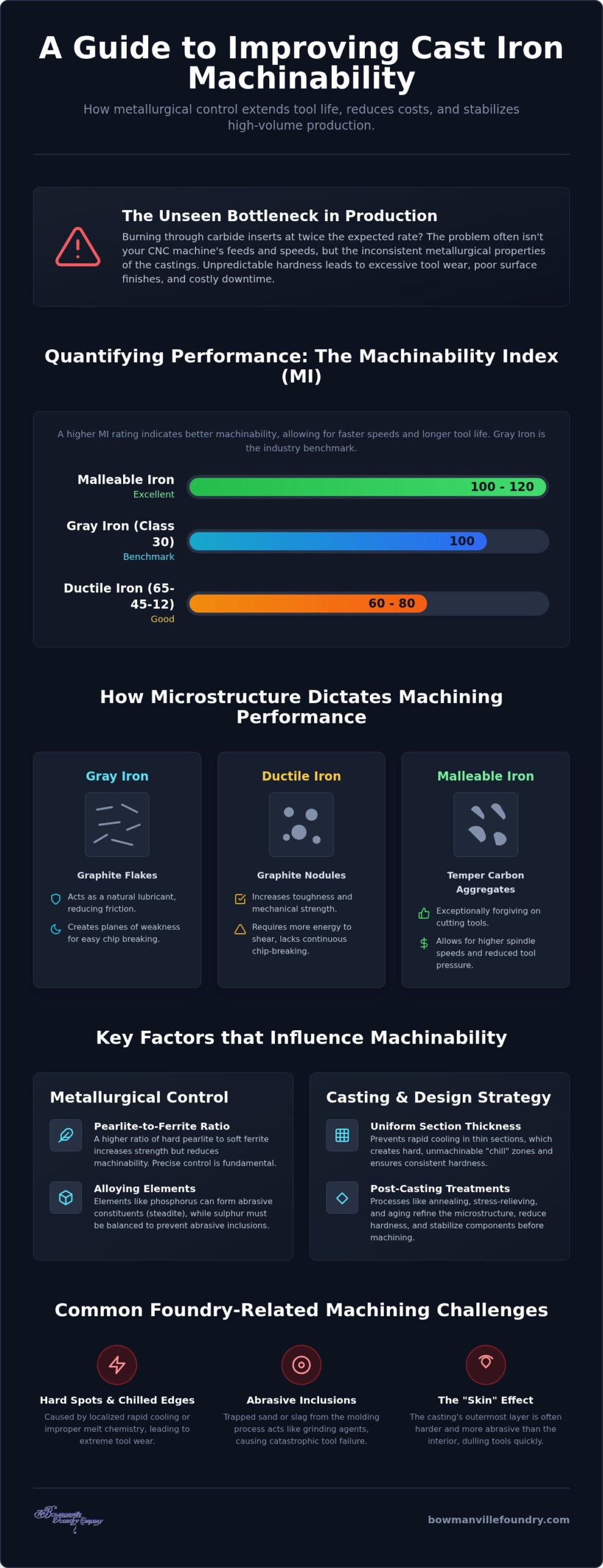
Machinability is not a single material property; it is a complex performance metric defined by the interaction between tool life, cutting force, and the final surface finish. In high-volume CNC environments, a material that allows for high speeds but destroys inserts prematurely is not truly machinable. To quantify this, the industry uses the Machinability Index (MI). In Canada, gray iron (Class 30) is often the benchmark with a rating of 100. By comparison, standard ductile iron (65-45-12) typically ranges between 60 and 80, while malleable iron often reaches ratings of 100 to 120, making it a premier choice for complex machining sequences.
The superior performance of gray iron in these tests stems from its internal structure. The graphite flakes within the iron matrix act as a natural lubricant, reducing the friction generated at the tool-chip interface. However, there is a persistent trade-off between mechanical strength and ease of processing. As you specify higher tensile strengths to meet structural requirements, the pearlite content increases, which inherently raises the hardness and reduces the MI. Gaining a thorough understanding of cast iron microstructures is essential for engineers who need to balance these competing priorities without sacrificing production efficiency.
The Impact of Casting Design on Machining
Improving cast iron machinability starts long before the part reaches the mill. Section thickness is a primary driver of cooling rates; thin walls cool much faster than thick cores. This rapid cooling can lead to the formation of hard iron carbides or “chill” zones that are nearly impossible to machine without specialized tooling. Designing for uniform section thickness ensures a consistent hardness profile across the entire component, which helps prevent tool chatter and vibration during milling operations. Additionally, providing generous draft angles allows the foundry to produce a cleaner surface with less abrasive scale, protecting your tools from early dulling. Applying the principles found in a comprehensive iron casting design guide can help engineers optimize section transitions and fillet radii before a single part is ever poured.
Identifying Common Machining Challenges
Even with an ideal design, certain foundry-related variables can create significant bottlenecks. Hard spots and chilled edges are frequently the result of localized rapid cooling or improper melt chemistry. Abrasive inclusions, such as trapped sand or slag from the molding process, act as grinding agents that can cause catastrophic tool failure. There is also the “skin” effect to consider, where the outermost layer of the casting is harder and more abrasive than the interior. Managing these challenges requires a partner capable of controlling the cooling cycle and ensuring a clean, consistent workpiece from the first part to the last.
Metallurgical Factors: Microstructure and Alloying
The internal architecture of an iron casting dictates its performance under a cutting tool. While mechanical properties like tensile strength are often the focus of procurement, the metallurgical factors of machinability are what determine the final cost per part. The primary driver is the form and distribution of graphite. In gray iron, graphite exists as elongated flakes. These flakes create natural planes of weakness that encourage chips to break easily. In contrast, ductile iron features graphite in spherical nodules. While this increases toughness, it lacks the continuous chip-breaking effect found in gray iron, requiring more energy to shear the metal.
Malleable iron presents a unique metallurgical advantage for Canadian manufacturers. Unlike the flakes in gray iron or the nodules in ductile iron, malleable iron contains “temper carbon” aggregates. This specific morphology, combined with a highly controlled annealing process, provides a material that is exceptionally forgiving on cutting tools. It allows for higher spindle speeds and reduced tool pressure, which is why it remains a preferred material for high-volume industrial components. If you’re struggling with tool breakage on complex geometries, reviewing a Free Casting Buyer’s Guide can help clarify which grade best suits your machining capabilities.
Alloying elements also play a decisive role in chip formation. Phosphorus, for instance, can form a hard constituent called steadite. While steadite increases wear resistance in the final part, it is highly abrasive to cutting tools. Similarly, sulfur must be carefully balanced with manganese to prevent the formation of abrasive inclusions. Controlling these elements is a critical step in improving cast iron machinability across large production batches.
The Ferrite vs. Pearlite Debate
The ratio of ferrite to pearlite in the iron matrix is the most influential factor in determining hardness. Ferrite is soft and highly ductile, offering the least resistance to a cutting tool. However, a purely ferritic matrix may lack the strength required for structural applications. Pearlite is much harder and provides better wear resistance in the final part. While pearlitic iron allows for a superior surface finish, it significantly increases tool wear. Optimizing your matrix requires a precise balance; too much pearlite slows down production, while too much ferrite can lead to “built-up edge” on the tool tip.
The Role of Free Graphite as a Solid Lubricant
Free graphite serves as a built-in solid lubricant that reduces the heat generated during the cutting process. As the tool moves through the metal, graphite is released, coating the tool tip and reducing the coefficient of friction. This natural lubrication is most efficient in gray iron due to the high surface area of the flakes. In ductile iron, the spherical nodules provide less surface coverage, leading to higher temperatures at the cutting zone. Graphite flakes improve chip breakage in gray iron by acting as internal stress risers that cause the material to fracture ahead of the tool.
Foundry Techniques for Enhancing Machinability
The foundry’s control over the cooling cycle and post-casting environment is vital for anyone focused on improving cast iron machinability. Internal stresses are an inherent byproduct of the solidification process, often leading to dimensional warping once the material is cut. To mitigate this, stress-relieving heat treatments are employed to relax the atomic structure without significantly altering the hardness. While some traditionalists advocate for natural aging, allowing castings to rest for 30 days or more to stabilize, modern manufacturing timelines rarely permit such delays. Thermal stress-relieving achieves the same stability in hours, ensuring the part remains true to its CAD model after the first pass of a mill.
Precise cooling in the mold is equally critical. If a casting cools too rapidly, especially in thin sections, it can develop hard iron carbides that are nearly impossible to cut. By managing the thermal gradient, foundries prevent these chill zones from forming. Clean pouring practices are another pillar of quality; eliminating slag and sand inclusions ensures that the machinist doesn’t encounter abrasive pockets that cause sudden tool failure. These metallurgical factors of cast iron machinability are the difference between a smooth production run and a graveyard of broken inserts.
Heat Treatment: Annealing and Normalizing
Annealing involves heating the iron to a specific temperature and cooling it slowly to break down pearlite and carbides into a soft, ferritic matrix. It’s the gold standard for parts requiring extreme metal removal rates. Normalizing, on the other hand, produces a more uniform, fine-grained pearlitic structure. While normalized iron is harder than annealed iron, it provides a more consistent machining experience across the entire batch. When performing a cost-benefit analysis, the additional expense of heat treatment is almost always offset by the reduction in tool replacement costs and the elimination of scrapped parts due to hard spots.
Surface Finishing and Scale Removal
The as-cast surface of iron is often covered in a hard, abrasive skin or scale that is detrimental to initial tool engagement. Shot blasting is a standard finishing technique that removes this layer, providing a clean surface that won’t immediately dull a fresh carbide tip. Some shops also utilize specialized surface coatings to further protect the tool during the first cut. Choosing a partner that offers comprehensive Post-Processing Services ensures that castings arrive at your facility ready to be loaded directly into the CNC centre without further preparation.
Practical Strategies for the Machining Shop
Once the casting is secured on the CNC centre, the focus shifts from metallurgy to the mechanics of material removal. Selecting the correct tool material is the first step in improving cast iron machinability at the shop level. While carbide remains the workhorse for most Canadian shops, ceramic inserts offer significantly higher cutting speeds for roughing operations on pearlitic grades. For high-volume production of hardened iron, Polycrystalline Cubic Boron Nitride (PCBN) provides the wear resistance necessary to maintain dimensional tolerances over long cycles. The choice depends entirely on the Brinell Hardness (BHN) of the batch; a practical framework for calculating speeds involves using the BHN as a divisor. As hardness increases, the surface metres per minute must decrease proportionally to keep the tool temperature below the critical threshold for the coating.
Workholding is another critical variable, particularly for thin-walled components. Cast iron has excellent damping properties, but improper clamping can still lead to resonance and chatter. Using hydraulic fixtures or custom-moulded jaws that distribute pressure evenly helps maintain rigidity. Adding damping weights to the fixture can also help when dealing with long, slender castings that are prone to harmonic vibration. This is especially important when machining malleable iron, where the material’s ductility can lead to slight deformation if the clamping force is too localized.
Optimal Speeds, Feeds, and Tool Geometry
Tool geometry must be tailored to the specific chip-forming characteristics of the iron grade. Gray iron produces small, brittle chips that don’t require aggressive chip breakers, so a neutral or slightly negative rake angle is often used to strengthen the cutting edge. Conversely, ferritic malleable iron allows for much higher spindle speeds due to its lower hardness and uniform grain structure. Improving cast iron machinability through geometry adjustments ensures that the tool edge remains sharp throughout the entire production run. To maximize tool life when machining pearlitic ductile iron, a moderate feed rate combined with high-pressure coolant is generally recommended to prevent heat build-up. You can find more detailed grade specifications in our Free Casting Buyer’s Guide to help calibrate your machine settings.
Coolant and Lubrication Strategies
The choice between dry and wet machining is largely settled by the type of iron being processed. Gray iron is frequently machined dry because the graphite flakes provide sufficient internal lubrication. Adding liquid coolant to gray iron often creates a thick, abrasive mud when mixed with fine graphite dust, which can clog filters and accelerate wear on machine ways. Ductile iron, however, generates more heat and usually requires a steady flow of coolant to manage thermal expansion. For shops processing large volumes of iron, robust dust extraction systems are necessary to manage airborne particles. Proper ventilation is not just a regulatory requirement; it is a fundamental part of maintaining the precision of your equipment and the health of your shop floor.
Optimizing Production with Bowmanville Foundry
Achieving peak efficiency on the shop floor requires a casting partner that understands the nuances of the machining process. Since 1902, Bowmanville Foundry has operated as an authoritative resource for Canadian manufacturers, providing the technical expertise needed to solve complex production bottlenecks. Our approach to improving cast iron machinability involves more than just pouring metal; it is a collaborative engineering process designed to align the material’s properties with your specific CNC requirements. By managing the entire supply chain from initial melt to final post-processing, we ensure that every component arrives ready for immediate integration into your production cycle.
Sourcing ready-to-use iron components from a single-source provider eliminates the variability that often plagues multi-vendor supply chains. When heat treatment, stress-relieving, and surface finishing are handled in-house, the risk of encountering inconsistent hardness or abrasive surface scale is virtually eliminated. This integrated model allows our team to maintain strict control over the metallurgical integrity of every batch, delivering parts that meet rigorous tolerances and Canadian manufacturing standards. This reliability translates directly into predictable machining costs and significantly reduced scrap rates for your facility.
Consulting on Grade Selection
Selecting the right material is the most critical decision in the design phase. Our engineering team provides detailed guidance on matching your mechanical requirements with the best possible machinability profile. We encourage clients to utilize our Free Casting Buyer’s Guide to compare the performance characteristics of malleable, ductile, and gray iron. In many instances, we’ve helped partners achieve substantial cycle time reductions by recommending a switch to a ferritic malleable grade. This material offers the strength of steel with the superior cutting speeds of iron, making it an ideal choice for high-volume, complex components that require extensive milling and drilling.
Quality Control and Consistency
Consistency is the bedrock of CNC profitability. A single “hard spot” in a casting batch can destroy an expensive tool and halt an entire production line. We utilize advanced testing protocols to ensure uniform hardness and microstructure across every part we produce. Our commitment to ASTM specifications and Canadian quality standards means you can trust the predictability of our iron. If you’re ready to optimize your production and lower your total cost per part, request a custom iron casting quote for your next project and let our team help you engineer a more efficient solution.
Advancing Your Machining Efficiency through Metallurgical Precision
Optimizing your production line requires a shift from viewing iron as a static material to treating it as an engineered solution. By focusing on microstructure control and the specific morphology of graphite, you can significantly reduce tool wear and stabilize cycle times across every batch. Whether you’re selecting gray iron for its natural lubrication or leveraging the superior properties of malleable iron, the foundation of success lies in metallurgical consistency and precise foundry control.
Bowmanville Foundry has been serving Canadian industry since 1902, providing the technical expertise needed for improving cast iron machinability in high-volume applications. Our specialized focus on malleable iron and our comprehensive in-house post-processing services ensure that your castings arrive ready for the CNC centre with uniform hardness and minimal surface scale. Mastering these variables doesn’t just lower your immediate tooling costs; it creates a more predictable and profitable manufacturing workflow for your facility.
To start optimizing your material selection today, download our Free Casting Buyer’s Guide to find the perfect iron grade. We look forward to helping you achieve higher quality surface finishes and faster production cycles through our centuries of expertise.
Frequently Asked Questions
Which cast iron grade is the easiest to machine?
Grey iron, particularly Class 30, is the easiest to machine because its graphite flakes serve as a built-in lubricant. Ferritic malleable iron is also an exceptional choice, often providing superior results in high-volume production environments. These grades minimize tool wear and allow for higher cutting speeds compared to pearlitic ductile iron. Selecting a grade with a high Machinability Index is a primary step in improving cast iron machinability.
How does heat treatment improve the machinability of ductile iron?
Annealing is the primary heat treatment used to enhance ductile iron’s performance by converting the pearlitic matrix into a softer, ferritic structure. This process reduces the material’s Brinell Hardness, which lowers the cutting force required and extends the life of carbide tools. Normalizing can also be used to create a more uniform pearlitic structure, which eliminates inconsistent hardness across different sections of a complex casting.
Can I machine cast iron dry, or do I need coolant?
You can machine grey iron dry because the graphite flakes provide internal lubrication, but ductile iron usually requires coolant to manage heat. Machining grey iron with liquid coolant often creates an abrasive paste when mixed with graphite dust, which can damage machine components. For ductile iron, high-pressure coolant helps dissipate the thermal energy generated by the material’s higher toughness, protecting the cutting edge of the tool.
What causes “hard spots” in cast iron and how can they be prevented?
Hard spots are typically caused by localized rapid cooling in the mould, which leads to the formation of iron carbides or “chills.” They can also result from improper melt chemistry or abrasive inclusions like sand. Prevention involves maintaining precise control over the cooling cycle and ensuring clean pouring practices. Stress-relieving heat treatments are also effective at breaking down these hard constituents before the part reaches the machine shop.
How long should cast iron age before it is machined?
Traditional natural aging requires allowing castings to rest for 30 to 90 days to stabilize internal stresses. While this method was common in the past, most modern Canadian foundries use thermal stress-relieving to achieve the same results in a few hours. This controlled heat treatment is more predictable than natural aging and ensures the part won’t warp during or after the machining process, allowing for faster production cycles.
Is malleable iron more machinable than ductile iron?
Yes, malleable iron is generally more machinable than ductile iron due to its unique temper carbon microstructure. The graphite in malleable iron is more evenly distributed and less abrasive than the nodules found in ductile iron. This allows for higher spindle speeds and smoother surface finishes. It’s an ideal material for complex components where reducing tool wear is a critical factor in improving cast iron machinability.
What are the best cutting tool materials for high-volume iron machining?
Carbide remains the standard for most operations, but ceramic and Polycrystalline Cubic Boron Nitride (PCBN) are better for high-volume roughing and finishing. Ceramic inserts can handle the high temperatures generated during the rapid removal of pearlitic iron. PCBN is the premier choice for machining hardened iron grades because it maintains its edge even under extreme thermal loads, ensuring consistent dimensional accuracy throughout long production runs.
How do I reduce tool chatter when machining thin-walled castings?
Reducing tool chatter requires a combination of rigid workholding and optimized tool geometry. Use hydraulic fixtures or custom jaws to distribute clamping pressure evenly across the part. Increasing the feed rate or using a tool with a smaller nose radius can also help by changing the direction of the cutting forces. Additionally, adding damping weights to the fixture can neutralize harmonic vibrations that cause poor surface finishes in thin sections.
