
While modern alloys often dominate industrial headlines, the unique graphite flake structure of gray iron remains the most effective solution for dampening vibration in heavy machinery. You’ve likely dealt with the frustration of material fatigue or the excessive costs of machining complex components from less forgiving metals. It’s a common challenge for Canadian engineers who need to balance durability with strict budget constraints. Selecting the right material shouldn’t feel like a gamble with your project’s integrity.
In this guide, we’ll demonstrate why gray iron casting applications are still the gold standard for industrial housings and engine components. You’ll learn how to identify if this versatile material fits your specific requirements and how the damping properties of gray iron protect your equipment from premature failure. We also provide a clear framework for selecting the appropriate ASTM class to ensure your parts meet every safety and performance standard. By the end of this article, you’ll have the technical certainty needed to optimize your manufacturing process and reduce secondary machining expenses.
Key Takeaways
- Understand how the unique graphite flake microstructure provides superior vibration damping for heavy machinery bases and frames.
- Explore the most common gray iron casting applications across the Canadian automotive, transport, and manufacturing sectors.
- Learn to balance tensile strength and machinability by selecting the correct ASTM A48 class for your specific industrial component.
- Discover why high thermal conductivity makes gray iron the preferred material for heat-sensitive parts like brake rotors and engine blocks.
- Gain insights on how partnering with an established Canadian foundry can streamline your design process through expert technical guidance and post-processing services.
What is Gray Iron? Understanding the Graphite Flake Structure
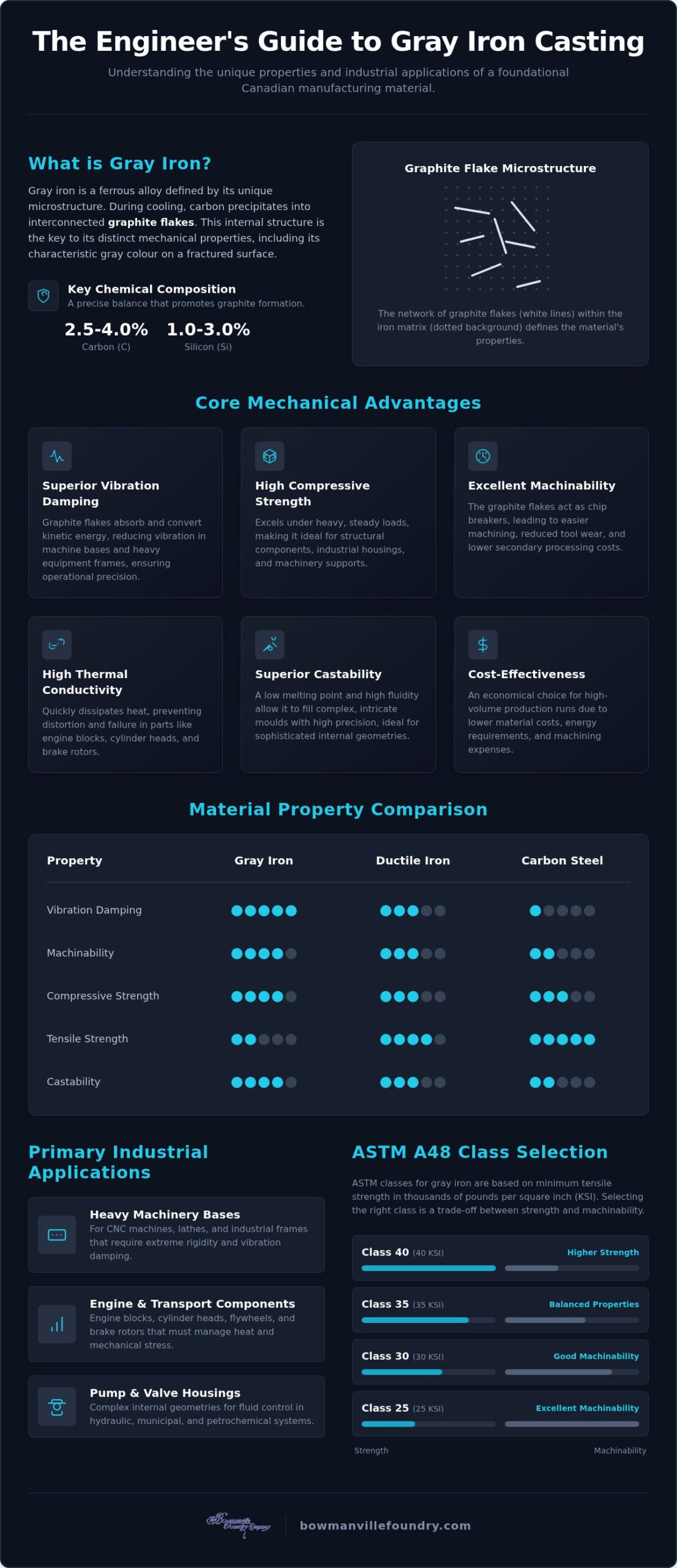
Gray iron is a fundamental material in the world of metallurgy. It’s a ferrous alloy defined by a specific microstructure where carbon precipitating out of the melt forms interconnected graphite flakes. When a piece of this metal is fractured, the exposed graphite reveals a characteristic dull gray colour, which is how the material earned its name. Unlike ductile iron, where graphite forms into spheres, or steel, where carbon is dissolved or exists as carbides, gray iron relies on this flake network for its distinct properties. It has served as the workhorse of the Canadian manufacturing sector for over a century because it offers a dependable balance of durability and economic efficiency.
The chemical composition typically involves carbon levels between 2.5% and 4.0% and silicon between 1.0% and 3.0%. This high silicon content is crucial. It promotes the formation of graphite rather than iron carbides during the cooling process. This chemical profile, combined with the cooling rate, determines the size and distribution of the flakes, which ultimately dictates the grade and performance of the final component in various gray iron casting applications.
The Role of Graphite Flakes in Material Performance
The mechanical behaviour of gray iron is a direct result of its internal flake architecture. These flakes act as internal stress risers. In practical terms, this means the metal is relatively brittle and has lower tensile strength than steel or ductile iron because cracks can propagate along the flake edges. However, gray iron excels in compressive strength, often outperforming many other alloys when subjected to heavy, steady loads. The graphite flakes also contribute to the material’s legendary wear resistance by acting as a self-lubricating interface. The presence of these graphite flakes facilitates superior vibration damping by absorbing kinetic energy and converting it into small amounts of thermal energy.
Gray Iron vs. Other Ferrous Metals
When evaluating materials for high-volume production, gray iron often emerges as the most pragmatic choice. While steel offers higher overall strength, it lacks the castability of iron. Gray iron has a lower melting point and superior fluidity in its molten state, which allows it to fill intricate mould cavities with high precision. This makes it ideal for complex gray iron casting applications where internal geometries are sophisticated. Compared to ductile iron, gray iron is generally more cost-effective to produce and easier to machine. For a detailed technical breakdown of how these two materials differ across key performance metrics, our gray iron vs ductile iron casting comparison provides an in-depth analysis of graphite microstructure and its effect on component durability. Its ability to dissipate heat quickly also gives it an edge in thermal management, such as engine blocks or braking components, where maintaining dimensional stability under heat is vital.
Primary Industrial Applications for Gray Iron Castings
The versatility of gray iron makes it a staple in Canadian manufacturing. From massive frames for mining equipment to precise engine components, gray iron casting applications are found in almost every heavy industry across the country. Its popularity stems from a unique ability to maintain dimensional stability under mechanical stress while remaining the most cost-effective choice for high-volume production.
Heavy Equipment and Machinery Bases
Vibration is the enemy of precision. Machine tool beds, such as those used in large-scale CNC milling and lathes, rely on gray iron’s damping capacity. If a base vibrates, the finished part’s tolerances suffer. In the Canadian mining and agricultural sectors, large industrial engine blocks and structural frames must withstand constant mechanical stress without warping. Gray iron provides the necessary rigidity and compressive strength to ensure these machines operate reliably over decades of service. Engineers often consult technical resources like a comprehensive casting guide to determine which grade best suits these massive structural requirements.
Pump and Valve Housings
In fluid power and hydraulic systems, housings must manage internal pressure without deforming. Gray iron’s excellent castability allows for complex internal galleries and thin-walled sections that are difficult to achieve with other metals. These valve bodies and pump components often face mildly corrosive environments or abrasive slurries, where the material’s wear resistance becomes a significant asset. Because gray iron is easier to machine than steel, manufacturers can achieve the tight tolerances required for leak-free fluid control while keeping production costs manageable. This balance is critical for the oil and gas sectors where equipment downtime leads to significant financial loss.
Municipalities across Canada also rely on gray iron for essential infrastructure. Manhole covers, storm grates, and water main fittings are almost exclusively cast from this material. It supports the heavy compressive loads of vehicular traffic without failing. Its natural resistance to oxidation in soil also ensures a long lifecycle for underground components, making it a dependable choice for public works projects from coast to coast.
Mechanical Advantages Driving Material Choice
Selecting the right metal involves more than looking at a single tensile strength figure. Gray iron’s mechanical properties make it indispensable for specific engineering challenges where other alloys might fail. Its thermal conductivity, for instance, is significantly higher than that of steel or ductile iron. This allows the material to distribute heat evenly and quickly. In the Canadian transport sector, this property is vital for brake rotors to prevent thermal cracking during heavy braking. Similarly, its high compressive strength ensures that components maintain their shape under massive, steady loads without the risk of plastic deformation.
The graphite flakes within the metal also provide a unique “self-lubricating” effect. This reduces friction in moving parts, which is why the material is frequently chosen for cylinder liners and gear housings. These mechanical benefits, combined with the material’s longevity, explain why gray iron casting applications remain so prevalent in heavy-duty environments across the country.
Vibration Damping: Protecting Sensitive Components
Damping capacity refers to a material’s ability to absorb kinetic energy and stop vibrations. Gray iron has a damping capacity roughly 20 to 25 times greater than steel. In a Canadian sawmill or a Northern Ontario mine, this prevents high-frequency vibrations from causing metal fatigue in surrounding components. If a machine bed “rings” like a bell, it leads to inaccuracy and premature wear. Gray iron acts as a mechanical sponge, soaking up those vibrations to protect sensitive electronics and maintain the alignment of moving parts. This characteristic also significantly reduces noise levels in industrial settings, contributing to a safer work environment.
Machinability and Production Efficiency
One of the most significant advantages of gray iron is how it reduces total production costs through superior machinability. The graphite flakes essentially act as internal lubricants that break up metal chips during the cutting process. This leads to faster feed rates and less tool wear compared to steel or ductile iron. For high-volume gray iron casting applications, these savings in labour hours and tool replacement are substantial. Bowmanville Foundry leverages modern post-processing services to deliver components that are closer to their final state, allowing your team to realize even greater efficiencies. By receiving ready-to-use parts, you eliminate the bottlenecks often associated with finishing complex industrial housings.
Navigating ASTM Gray Iron Grades (Class 25 to Class 40)
ASTM A48 serves as the primary standard specification for gray iron castings in Canada. This system organizes iron into classes based on the minimum tensile strength of the material, measured in thousands of pounds per square inch (psi). For example, a Class 25 iron must meet a minimum tensile strength of 25,000 psi. While it’s tempting to always specify the highest strength available, engineering success requires a more nuanced approach. Selecting a grade is a deliberate trade-off. As you move from Class 25 toward Class 40, tensile strength and hardness increase, but machinability and vibration damping capacity decrease. You must decide which mechanical property is at the centre of your specific component’s performance.
Cooling rates also play a pivotal role in the final characteristics of the metal. The thickness of a part’s cross-section directly influences how the graphite flakes form and how the surrounding iron matrix solidifies. A thinner section cools faster, often resulting in a harder, higher-strength material than a thicker section poured from the same melt. This relationship means that a single grade can exhibit different mechanical properties across various parts of the same casting. Accurate specification depends on understanding these cooling dynamics to ensure the component performs as intended in its final environment. If the design includes both very thick and very thin sections, careful grade selection is required to avoid brittleness in the thin areas.
Class 25 and 30: High Machinability and Damping
These lower classes are the preferred choice for gray iron casting applications where thermal conductivity or vibration damping is the priority. Class 25 and 30 irons possess a higher graphite content, which facilitates an excellent surface finish and allows for high-speed machining without excessive tool wear. The graphite content also dictates the characteristic gray colour of the fracture surface. You’ll commonly find these grades used in light industrial housings, decorative architectural castings, and components where heat dissipation is more critical than raw load-bearing capacity. These classes also tend to be more cost-effective for high-volume production runs where strength requirements are moderate.
Class 35 and 40: Strength and Wear Resistance
Class 35 and 40 irons are engineered for more demanding gray iron casting applications. These grades offer increased hardness and tensile strength, making them ideal for heavy-duty gears, high-pressure cylinders, and dies that must resist wear over long service lives. Achieving these properties requires more precise control during the melting and pouring stages, as the iron matrix must be predominantly pearlitic to support the higher strength requirements. Because these classes are harder to machine, they are often reserved for parts where structural integrity and durability under high stress are the non-negotiable requirements of the project.
To help you make the most informed decision for your next project, we recommend reviewing our Free Casting Buyer’s Guide. It provides the technical data and comparison charts needed to align your design with the right material class for your specific industrial needs.
Sourcing Custom Engineered Iron Components in Canada
Partnering with a domestic foundry simplifies the logistics of industrial procurement while ensuring your components meet rigorous Canadian safety and quality standards. When you source iron components locally, you eliminate the risks associated with long-distance supply chains and inconsistent material certifications. A local partnership allows for direct communication between your design team and the foundry’s metallurgical experts. This collaboration is essential for identifying the most effective gray iron casting applications and preventing material failure before production begins. Access to reliable technical data during the early design phase often determines the long-term success of a project.
Modern manufacturing demands more than just a raw casting. To remain competitive, Canadian businesses require ready-to-use components that integrate seamlessly into their assembly lines. Utilizing post-processing services, such as precision machining, heat treating, or surface finishing, allows you to receive parts that are fully compliant with your specifications. This approach reduces the burden on your internal labour and eliminates the need to manage multiple vendors for a single component. By consolidating these steps, you maintain a clear chain of custody for quality control and reduce the total cost of ownership for your industrial housings and machinery parts.
The Bowmanville Foundry Advantage
Since 1902, Bowmanville Foundry has provided industrial authority and technical mastery to the Canadian market. Our facility is uniquely equipped to produce malleable, ductile, and gray iron in a single location. This versatility allows us to offer the most appropriate material for your specific mechanical requirements without bias. Over a century of institutional knowledge ensures that we understand the nuances of complex gray iron casting applications, from high-vibration machinery beds to heat-sensitive engine components. We focus on providing custom-engineered solutions that prioritize precision and integrity, acting as a patient mentor to guide you through the intricacies of metal selection and part design.
Next Steps for Your Casting Project
Engineering certainty is the foundation of a successful manufacturing run. To support your decision-making process, we provide a Free Casting Buyer’s Guide that outlines the critical variables in iron selection and design optimization. This resource helps you navigate ASTM standards and material properties with confidence. Once you’ve defined your requirements, requesting an accurate quote is a straightforward process that involves a thorough review of your technical drawings and performance needs. Our team is committed to transparency and will provide the granular data necessary to move from initial curiosity to technical certainty.
We invite you to consult with our engineering team for your next gray iron project. Whether you’re refining an existing design or developing a new industrial component, our expertise ensures your parts are manufactured for maximum durability and efficiency.
Optimizing Industrial Performance with Precision Castings
Selecting the right material is the first step toward long-term mechanical reliability. We’ve explored how the graphite flake structure provides the damping and thermal management required for the most demanding gray iron casting applications. Whether your project requires the high machinability of a Class 30 iron or the wear resistance of Class 40, understanding these metallurgical trade-offs prevents costly material failures. Choosing a domestic partner ensures your components meet strict safety standards while reducing supply chain complexity.
Bowmanville Foundry has served the Canadian industrial sector since 1902, specializing in custom-engineered malleable, ductile, and gray iron solutions. Our modern facility also provides complete on-site post-processing and finishing services to deliver ready-to-use parts directly to your assembly line. Take the next step in your design process and download our Free Casting Buyer’s Guide to select the perfect iron grade for your project. We look forward to helping you achieve technical certainty and manufacturing excellence.
Frequently Asked Questions
What are the most common applications for gray iron casting?
Gray iron remains the primary choice for heavy machinery bases, engine blocks, cylinder heads, and brake rotors. These components benefit from the material’s ability to maintain dimensional stability under heat and pressure. In public infrastructure, gray iron casting applications include manhole covers and storm grates because they withstand heavy vehicular loads. Its versatility across these sectors makes it a cornerstone of Canadian industrial manufacturing.
How does gray iron differ from ductile iron in industrial use?
The main difference lies in the graphite microstructure. Gray iron contains graphite flakes that provide superior vibration damping and machinability. Ductile iron contains graphite nodules, which offer higher tensile strength and ductility. While gray iron is ideal for rigid housings and vibration-heavy frames, ductile iron is preferred for components that must withstand significant impact or bending without fracturing, such as automotive suspension parts. Engineers weighing these trade-offs can benefit from reviewing a comprehensive gray iron vs ductile iron casting engineering comparison to align material selection with specific load and performance requirements.
Why is gray iron preferred for engine blocks and machinery bases?
Gray iron is preferred because its graphite flake structure absorbs kinetic energy, preventing mechanical vibrations from damaging sensitive internal parts. This damping capacity is roughly 20 times higher than that of steel. Additionally, the material’s high thermal conductivity allows engine blocks to dissipate heat quickly and evenly. This combination of stability and thermal management ensures that machinery maintains precise alignment and structural integrity over long operational lifecycles.
What ASTM standards apply to gray iron castings in Canada?
ASTM A48 is the standard specification used by foundries and engineers across Canada. This standard classifies gray iron based on its minimum tensile strength, ranging from Class 20 to Class 60. By adhering to these internationally recognized classes, manufacturers ensure that every component meets the specific mechanical requirements of its intended application. Choosing the correct ASTM class is essential for balancing strength, hardness, and machinability in industrial projects.
Can gray iron be machined easily compared to other metals?
Gray iron is significantly easier to machine than steel or ductile iron because the graphite flakes act as internal chip breakers. These flakes also provide a self-lubricating effect that reduces friction at the tool tip. This leads to faster feed rates and extended tool life, which lowers overall production costs. For high-volume gray iron casting applications, the machinability of gray iron provides a substantial economic advantage over less forgiving ferrous alloys.
What are the limitations of gray iron in high-stress applications?
The primary limitation of gray iron is its relatively low tensile strength and lack of ductility compared to steel or ductile iron. The graphite flakes act as internal stress risers, which makes the material brittle under high-impact or sudden shock loads. It doesn’t deform before breaking; it fractures. Consequently, it’s unsuitable for components that must bend or withstand extreme tension, where a more ductile material would be required to ensure safety.
How do I choose between Class 30 and Class 40 gray iron?
Choosing between these classes depends on whether you prioritize raw strength or ease of production. Class 30 iron offers excellent vibration damping and is highly machinable, making it ideal for lighter housings and decorative castings. Class 40 provides higher tensile strength and better wear resistance, but it’s harder and more difficult to machine. If your part faces high mechanical stress or abrasive wear, Class 40 is generally the more dependable choice.
Does gray iron offer good corrosion resistance for industrial environments?
Gray iron offers moderate corrosion resistance because it naturally forms a protective layer of oxidation on its surface. This layer helps slow further degradation in many industrial and municipal environments. While it’s not as resistant as stainless steel, its performance in soil and water makes it a reliable choice for underground infrastructure. For harsher chemical environments, additional coatings or post-processing treatments can be applied to enhance its longevity and protect the casting’s integrity.
