
The decision between gray and ductile iron is rarely about which material is superior but rather how the microscopic shape of carbon dictates the survival of your component under load. It’s a fundamental challenge every engineer faces when balancing the need for high tensile strength against the rigid realities of a production budget. You likely recognize the frustration of deciphering dense ASTM standards, such as A48 or A536, while trying to ensure your industrial parts won’t fail during peak operation. Uncertainty in material selection often leads to costly downtime or catastrophic structural fatigue.
This guide provides a technical breakdown of gray iron vs ductile iron casting to help you select the most reliable material for your specific industrial application. We’ll examine the critical metallurgical differences, from graphite flakes to spherical nodules, that influence everything from vibration damping to elongation properties. By the end of this comparison, you’ll have a clear framework for optimizing your component’s cost-to-performance ratio and significantly reducing the risk of casting failure in the field.
Key Takeaways
- Identify the structural implications of carbon morphology, comparing how graphite flakes and spherical nodules respond to internal stress.
- Discern when to prioritize the superior tensile strength of ductile iron over the unmatched vibration damping capabilities of gray iron.
- Analyze the relationship between material hardness and machinability to optimize tool life and realize lower overall production costs.
- Apply a decision-making framework for gray iron vs ductile iron casting to ensure your project aligns with specific ASTM standards and load requirements.
- Reduce the risk of casting failure by leveraging over a century of metallurgical expertise to match material properties to the physical demands of your application.
The Microstructural Difference: Flakes vs. Nodules
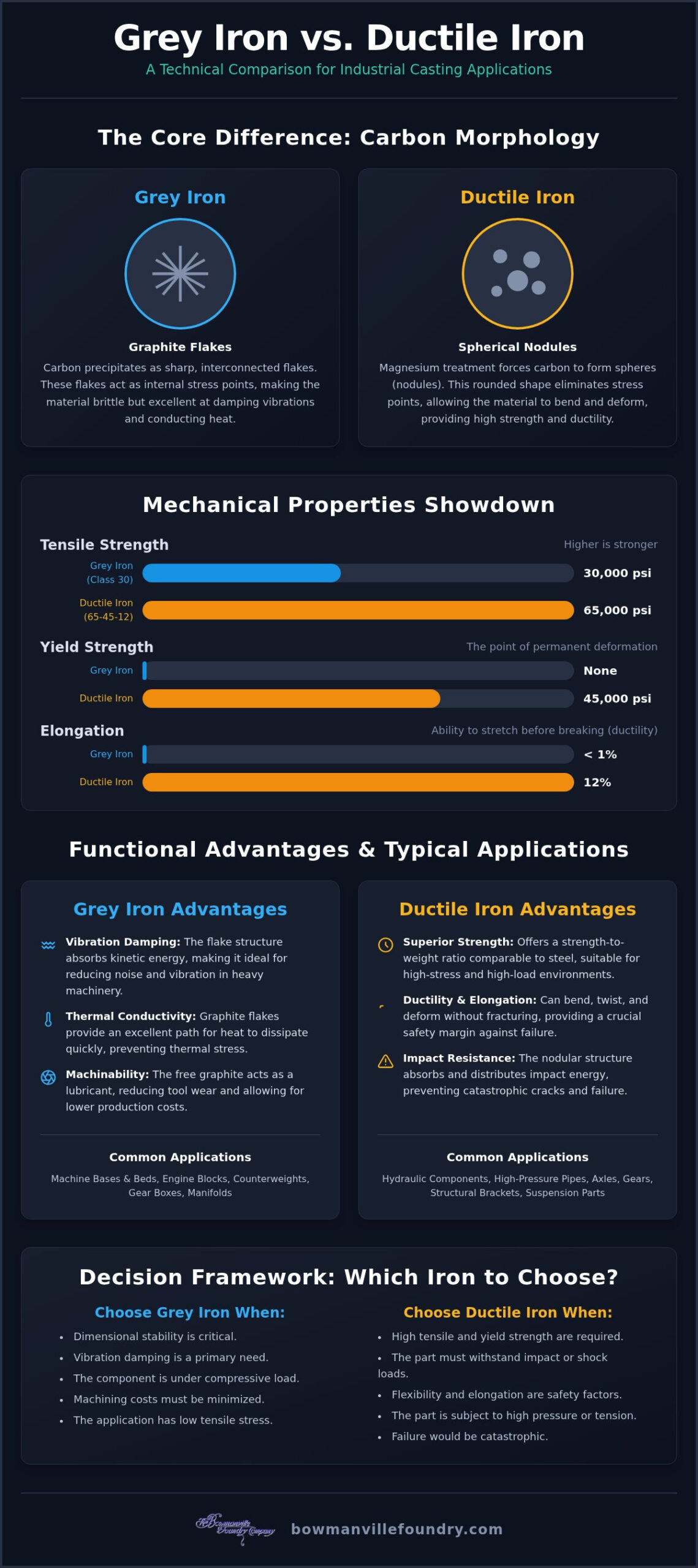
The fundamental distinction in gray iron vs ductile iron casting lies in the shape of the graphite precipitates within the metallic matrix. Carbon morphology serves as the primary driver of iron performance, dictating how the material responds to mechanical and thermal stress. While both materials contain carbon in excess of its solubility limit, the way this carbon solidifies defines the casting’s ultimate utility. A broader Cast Iron Overview reveals that while both materials share a common base, their internal structures create vastly different engineering outcomes.
The Role of Graphite in Gray Iron
Gray iron is defined by its interconnected network of graphite flakes. These flakes resemble thin, sharp-edged ribbons that permeate the iron matrix. From a functional standpoint, this structure offers exceptional thermal conductivity because heat can travel quickly along the continuous graphite paths. It also provides superior vibration damping; the “interrupted” matrix acts like a mechanical sponge, absorbing kinetic energy and reducing noise in heavy machinery bases. However, these flakes also act as internal stress risers. The sharp tips of the graphite flakes concentrate stress, making the material prone to fracturing under tensile loads. This is why gray iron is often characterized by its brittleness and lack of measurable yield point.
The Innovation of Nodular Graphite
Ductile iron represents a significant metallurgical advancement achieved through the process of “nodulizing.” By adding a controlled amount of magnesium to the molten iron, foundries force the graphite to precipitate as spheres, or nodules, rather than flakes. This spherical geometry is critical because it eliminates the sharp stress points found in gray iron. When the material is subjected to a load, these nodules prevent crack propagation by allowing the surrounding matrix to deform without immediate failure. This structural shift provides the material with its namesake “ductility,” which is the ability to stretch or bend before breaking. It’s this specific carbon shape that allows ductile iron to offer a strength-to-weight ratio comparable to some grades of steel while maintaining the castability of iron.
In the context of gray iron vs ductile iron casting, the transition from flakes to nodules represents the difference between a rigid, brittle component and a resilient, flexible one. Choosing between these two structures requires an understanding of how your component will experience stress. If your design demands the ability to absorb mechanical shock or dissipate heat, the flake structure of gray iron remains a technical favourite. Conversely, if the part must withstand high-pressure environments or significant tension, the nodular structure of ductile iron is the essential choice to ensure long-term structural integrity.
Comparing Mechanical Properties: Strength and Impact Resistance
While the microstructural differences define the internal logic of the metal, the mechanical properties dictate how these castings perform in Canadian industrial environments. When evaluating gray iron vs ductile iron casting, engineers must prioritize the specific load types the component will encounter. Gray iron excels in static, compression-heavy roles, whereas ductile iron is designed for dynamic, high-stress applications where failure isn’t an option. Understanding these performance benchmarks is essential for reducing the risk of component failure under operational stress.
Tensile and Yield Strength Benchmarks
The performance standards for these materials are codified in specific ASTM specifications. Gray iron, governed by ASTM A48, is graded primarily on its tensile strength. For instance, a Class 30 iron has a minimum tensile strength of 30,000 psi. It’s vital to recognize that gray iron has no measurable yield point. It behaves elastically until it reaches its breaking point, at which it fails abruptly. This rigid nature makes it ideal for machine beds and engine blocks that must maintain dimensional stability under heavy weight without bending.
Conversely, ductile iron follows ASTM A536, which utilizes a three-number grading system to define its capabilities. A common grade like 65-45-12 indicates 65,000 psi tensile strength, 45,000 psi yield strength, and 12% elongation. This yield strength is a critical “fail-safe” indicator. It tells the engineer exactly when the metal will begin to deform plastically. This predictability allows for safer designs in high-pressure hydraulic components or structural brackets. To better understand how these grades impact your specific project, you can review our Free Casting Buyer’s Guide to help standardize your procurement process.
Toughness and Impact Resistance
Toughness is the material’s ability to absorb energy and resist fracturing during a sudden impact or collision. In the Canadian manufacturing sector, the Charpy Impact Test is the standard method for measuring this property. It involves striking a notched specimen with a pendulum to determine how many joules of energy are absorbed before fracture. Gray iron performs poorly in this test because its graphite flakes facilitate quick crack propagation, leading to a brittle fracture even under moderate impact.
Ductile iron demonstrates significant impact resistance. The spherical graphite nodules act as “crack arrestors,” allowing the metal to absorb substantial energy without catastrophic failure. When comparing gray iron vs ductile iron casting for safety-critical components, such as automotive steering knuckles or heavy-duty suspension parts, the toughness of the nodular structure is indispensable. This ability to “stretch” or deform before breaking ensures your components can withstand the rigours of site operations without the risk of sudden, brittle fracture.
Functional Advantages: Vibration Damping vs. Structural Integrity
Selecting the right material involves more than just comparing yield points; it requires a pragmatic assessment of how the casting will behave within a larger mechanical system. The decision in gray iron vs ductile iron casting often hinges on whether the application demands the quiet stability of a machine base or the resilient strength of a structural component. Each material offers distinct functional benefits that can either enhance or compromise the long-term performance of your industrial assembly.
Why Gray Iron Dominates Machinery Bases
Gray iron is the industry standard for machinery bases and engine blocks due to its unmatched vibration damping capacity. This property is measured by the damping capacity ratio, which defines the material’s ability to dissipate kinetic energy. The graphite flakes in gray iron act as internal energy absorbers, converting mechanical vibrations into minute amounts of heat. In precision machining centres, this prevents tool chatter, ensuring that the equipment maintains tight tolerances during high-speed operations. Beyond damping, gray iron provides exceptional dimensional stability. It resists the internal stress shifts that can lead to warping over a long service life, making it the preferred choice for large-scale industrial frames and beds. For Canadian manufacturers seeking components that meet strict ASTM A48 specifications, partnering with a trusted gray iron foundry Ontario producers rely on ensures consistent quality and reliable lead times.
Ductile Iron for High-Pressure Components
When the primary requirement is structural integrity under pressure, ductile iron is the superior engineering solution. It provides a strength-to-weight ratio that rivals many grades of steel, but it’s significantly more cost-effective to produce through the casting process. This makes it an ideal replacement for expensive steel forgings or fabrications in hydraulic components, heavy-duty mounting brackets, and suspension parts. Because of its higher tensile strength, engineers can often specify thinner wall sections in their designs. This weight-saving potential is a critical factor in mobile equipment and automotive applications where reducing mass directly improves fuel efficiency and payload capacity.
Thermal management and corrosion resistance also play vital roles in material selection. Gray iron’s continuous graphite network facilitates high thermal conductivity, which is why it remains a favourite for brake rotors and engine components that require rapid heat dissipation. Ductile iron, while slightly less efficient at heat transfer, often demonstrates better resistance to surface oxidation in harsh industrial environments. Its tightly packed nodular structure provides a more robust barrier against corrosive agents than the porous matrix of gray iron. Matching these functional traits to your operational environment ensures that your components deliver the reliability and safety expected in modern Canadian manufacturing.
Machinability and Production Costs in Iron Casting
Beyond mechanical performance, the financial viability of a project often depends on the ease of finishing the raw casting. In the engineering assessment of gray iron vs ductile iron casting, machinability serves as a primary cost driver. Gray iron is widely regarded as the most machinable of all ferrous metals. This advantage stems from the graphite flakes which provide a self-lubricating effect, reducing friction between the cutting tool and the workpiece. This lubrication significantly extends tool life and allows for higher cutting speeds. Shorter production cycles and lower labour costs are the direct result of this metallurgical trait.
The Economics of Machining Iron
Machining gray iron produces small, brittle chips that break away easily. This behaviour prevents heat build-up and tool clogging, leading to a superior surface finish with minimal effort. Ductile iron presents a different set of challenges for the machine shop. Its tougher, more continuous metallic matrix creates long, stringy chips that generate more heat and friction. Consequently, machining ductile iron requires more robust tooling and specialized speeds to achieve precise tolerances. To streamline your production line and reduce internal overhead, leveraging professional Post-Processing Services ensures you receive finished components that are ready for immediate assembly.
Total Cost of Ownership (TCO)
While gray iron is typically less expensive to cast due to simpler raw material requirements, the total cost of ownership involves evaluating the component’s entire lifecycle. Ductile iron castings usually carry a higher initial price point because the nodulizing process requires expensive alloys like magnesium and more stringent process controls. However, the increased durability and higher strength-to-weight ratio can lead to long-term savings. These savings are realized through reduced replacement frequency and the ability to specify lighter, more efficient designs that lower shipping and handling expenses.
Heat treating is another factor that influences both performance and cost. Both iron grades can undergo thermal processing to adjust hardness or relieve internal stresses. For example, annealing can improve the machinability of ductile iron, while quenching and tempering can significantly boost the wear resistance of gray iron. When you analyze the gray iron vs ductile iron casting choice through the lens of TCO, it’s clear that the lower initial quote at the foundry gate doesn’t always represent the most economical choice. You must factor in machining hours, tool replacement schedules, and field maintenance to find the true cost of the part.
Selection Framework: Which Iron Grade is Right for Your Project?
Choosing between gray iron vs ductile iron casting requires a methodical evaluation of your component’s operational environment. It’s not a matter of selecting the strongest material, but the one that aligns with your specific mechanical and financial constraints. By following a structured decision-making framework, you can ensure long-term reliability while maintaining a competitive production cost. This process helps you move from initial technical curiosity to absolute certainty in your material specification.
- Identify the primary load type: Determine if your part will face heavy compressive loads or high tensile stress. Gray iron thrives under compression, while ductile iron is required for tension.
- Evaluate vibration and noise: Assess whether the assembly needs to absorb mechanical energy. If tool chatter or operational noise is a concern, gray iron is the technical favourite.
- Determine impact risk: Consider the likelihood of sudden collisions or shock loading. Safety-critical parts that cannot fail catastrophically should be specified in ductile iron.
- Assess machining complexity: Factor in the amount of secondary finishing required. Gray iron’s ease of machining can significantly lower the total project cost and reduce tool wear.
- Consult an expert foundry: Engage with a manufacturer early in the design phase to optimize the casting geometry for your chosen material and realize the best performance.
When to Specify Gray Iron
Gray iron is the ideal choice for components where dimensional stability and cost-efficiency are paramount. It’s the standard material for manhole covers, large counterweights, and heavy machine tool bases. You should prioritize this grade when your application requires high thermal conductivity or superior damping capacity to manage mechanical resonance. However, you must avoid gray iron for parts subject to significant tensile loads or sudden, high-energy impacts. Its brittle nature can lead to immediate fracture without the warning of plastic deformation.
When to Specify Ductile Iron
Ductile iron is the preferred material for high-performance applications like crankshafts, heavy-duty hinges, and automotive steering knuckles. You should specify this grade when your project demands high tensile strength, significant elongation, and a reduced component weight. It provides a reliable “fail-safe” through its predictable yield point, allowing the metal to bend before it breaks. While the initial casting fee may be higher due to the magnesium treatment, the structural integrity it offers is essential for safety-critical environments. Avoid specifying ductile iron only when the mechanical stress is negligible and the production budget is extremely restricted.
Ultimately, the most effective way to navigate the gray iron vs ductile iron casting decision is to leverage institutional knowledge. With over 120 years of metallurgical expertise, a dependable partner helps you bridge the gap between technical standards and physical craftsmanship. Whether you require the damping of gray iron or the resilience of ductile iron, selecting the right grade ensures your industrial components perform as intended throughout their service life.
Optimizing Your Component Specification for Long-Term Performance
Success in industrial manufacturing depends on matching the unique metallurgical properties of your material to the physical demands of the application. We’ve explored how the choice in gray iron vs ductile iron casting rests on the trade-off between the superior damping capacity of graphite flakes and the high tensile resilience of nodular structures. Selecting the correct grade ensures your components withstand operational stress while minimizing machining costs and the risk of brittle fracture. Since 1902, our facility has provided custom-engineered solutions for Canadian industry, combining deep metallurgical knowledge with full-service post-processing and machining to deliver high-quality parts.
Navigating these technical specifications doesn’t have to be a solitary challenge. Our institutional knowledge is available to help you refine your designs, reduce production risks, and improve component longevity. Download our Free Casting Buyer’s Guide to select the perfect iron grade for your next project. We look forward to helping you achieve technical certainty and a more efficient production cycle.
Frequently Asked Questions
Is gray iron or ductile iron more expensive to produce?
Ductile iron is typically more expensive to produce than gray iron at the foundry level. This price difference is due to the mandatory nodulizing process, which requires the addition of magnesium and other specific alloys to the molten metal. These additives, combined with more rigorous quality control and specialized melting equipment, increase the raw material and operational costs. Gray iron remains the more economical choice for projects where high tensile strength isn’t a primary requirement.
Can ductile iron be used as a direct replacement for steel castings?
Ductile iron serves as a highly effective and cost-efficient replacement for steel castings in many industrial roles. It provides a strength-to-weight ratio comparable to several steel grades while offering the superior castability and surface finish of iron. While steel is still necessary for certain high-weldability or extreme-temperature applications, ductile iron’s ability to absorb shock and resist fracture makes it suitable for structural brackets and hydraulic components across the Canadian manufacturing sector.
Why is gray iron better for damping vibrations in heavy machinery?
Gray iron’s superior damping capability is a direct result of its graphite flake structure. These flakes act as internal mechanical sponges that dissipate kinetic energy by converting vibrations into minute amounts of heat. This prevents the resonance and tool chatter that can compromise precision in heavy machinery. For large engine blocks and machine tool bases, this natural damping is essential for maintaining dimensional stability and reducing operational noise during high-speed performance.
How does the addition of magnesium change the properties of cast iron?
The addition of magnesium, known as the nodulizing agent, fundamentally transforms the iron’s microstructure by forcing graphite to form into spheres rather than flakes. This spherical shape is critical because it eliminates the sharp stress points that cause brittleness in gray iron. By changing the carbon morphology, magnesium increases the metal’s toughness and allows it to deform plastically under load. This transformation is what gives ductile iron its namesake ability to stretch before fracturing.
What are the most common ASTM standards for gray and ductile iron in Canada?
In Canada, the most widely recognized standards are ASTM A48 for gray iron and ASTM A536 for ductile iron. ASTM A48 classifies gray iron into classes based on minimum tensile strength, such as Class 30 or Class 40. ASTM A536 uses a specific three-number system, like 65-45-12, to define the minimum tensile strength, yield strength, and the percentage of elongation. These standards ensure that engineers can realize predictable performance from their industrial components.
Which iron grade offers better corrosion resistance for outdoor applications?
Ductile iron typically offers better resistance to surface oxidation and corrosion in outdoor or harsh industrial environments. Its dense, nodular matrix creates a more robust physical barrier against corrosive agents than the interconnected flake network found in gray iron. While neither material is entirely rust-proof without secondary coatings, the structural integrity of ductile iron remains more stable when exposed to fluctuating moisture and environmental stress over a long service life.
Can both gray and ductile iron be machined to tight tolerances?
Both materials can be machined to extremely tight tolerances, though the process for gray iron vs ductile iron casting differs significantly. Gray iron is exceptionally easy on tools because its graphite flakes provide a natural lubricating effect, reducing friction and heat build-up. Ductile iron’s tougher matrix requires more robust tooling and specialized speeds, but it’s fully capable of achieving the smooth finishes and precise dimensions required for complex hydraulic or automotive assemblies.
