
Specifying the wrong material for a high-stress industrial component is more than a technical oversight; it’s a liability that often leads to catastrophic failure in the field. You likely recognize the pressure of maintaining equipment integrity while navigating the confusing overlap between ductile, nodular, and sg cast iron terminology. Meeting precise ASTM A536 standards requires more than a passing familiarity with metallurgy; it demands a deep understanding of how spheroidal graphite transforms brittle iron into a resilient, high-performance material.
This technical reference provides the clarity you need to optimize your component design and ensure long-term durability. You’ll discover the specific metallurgical properties that define different iron grades and learn how to select the right material for your specific application. We’ll examine the mechanical benefits of spheroidal graphite and identify the benchmarks for choosing a reliable Canadian manufacturing partner that prioritizes technical mastery and precision above all else.
Key Takeaways
- Learn how the unique nodular structure of sg cast iron provides the high-strength performance required for demanding industrial applications.
- Discover the mechanical advantages, including tensile and yield strengths that rival carbon steel, while maintaining essential ductility for impact resistance.
- Decode the ASTM A536 numbering system to accurately specify the mechanical requirements and grade for your next engineering project.
- Identify the critical roles these castings play in ensuring the durability of components within the Canadian mining and forestry sectors.
- Understand how integrated post-processing services can streamline your procurement by delivering ready-to-use, precision-machined parts directly from the foundry.
What is SG Cast Iron? Defining Spheroidal Graphite Metallurgy
Spheroidal Graphite (SG) iron represents a significant advancement in ferrous metallurgy. It’s a high-strength alloy designed to overcome the inherent brittleness of traditional gray iron. In the engineering community, you’ll often hear professionals use the terms SG iron, ductile iron, and nodular cast iron interchangeably. While the terminology varies by region or specific industry standard, they all refer to the same material class. To understand what is ductile iron, one must look at the microscopic level where carbon exists as graphite.
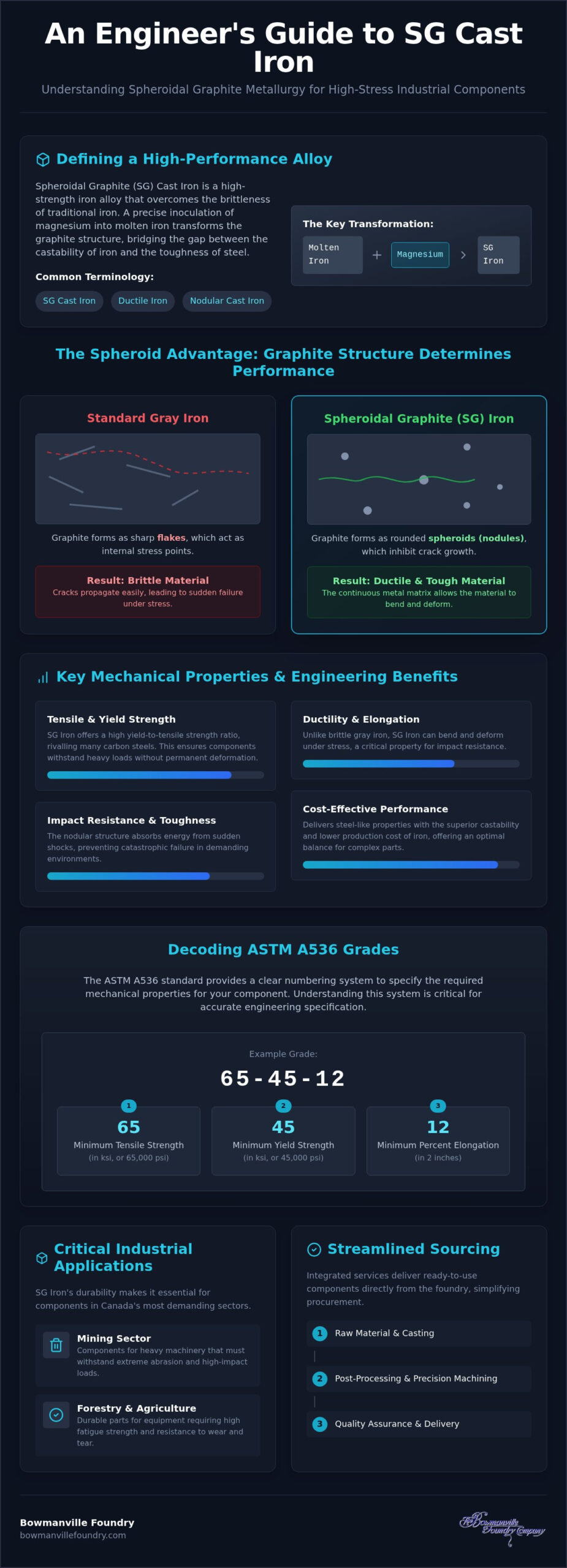
The production of sg cast iron involves a precise inoculation process. Foundries introduce a small but critical amount of magnesium into the molten iron shortly before the pour. This chemical intervention forces the graphite to precipitate as spheres rather than flakes. This fundamental shift in microstructural geometry is what grants the material its unique mechanical properties, allowing it to serve as a bridge between the castability of iron and the toughness of steel.
The Spheroid Advantage: Flakes vs. Nodules
In standard gray iron, graphite forms long, thin flakes. These flakes act as internal stress concentrators, essentially behaving like pre-existing cracks that allow a fracture to propagate easily through the component. Think of gray iron like a piece of wood; it’s strong until you apply force along the grain, at which point it splits easily. By contrast, the spheroids in sg cast iron inhibit crack growth. Because the graphite is contained in isolated nodules, the surrounding metal matrix remains continuous and tough. This structure is more akin to a solid block of reinforced material that can bend and deform without immediate failure, a property known as ductility.
A Brief History of Ductile Innovation
The discovery of ductile iron in the late 1940s revolutionized the manufacturing of industrial components. Before this breakthrough, engineers often had to choose between the cost-efficiency of iron and the mechanical reliability of steel. The introduction of magnesium treatment provided a middle ground: a material that pours as easily as iron but performs with the resilience of steel. This reliability made it the standard choice for modern infrastructure, from underground water mains to heavy-duty mining equipment. Bowmanville Foundry has been a part of this industrial evolution since 1902. We’ve spent over a century refining our casting techniques to help clients realize the full potential of these metallurgical advancements while maintaining the highest standards of craftsmanship.
Key Mechanical Properties and Engineering Benefits
The mechanical profile of sg cast iron is what makes it an indispensable material for high-stress industrial applications. By altering the graphite structure into a nodular form, as discussed in the previous section, we unlock a suite of properties that allows this iron to compete directly with many carbon steels. It offers a unique combination of strength, ductility, and wear resistance that simplifies the design process for complex components. These characteristics ensure that parts can withstand the rigorous demands of heavy machinery while remaining more cost-effective to produce than forged steel alternatives.
Tensile Strength and Yield: The Steel Alternative
Tensile strength measures the maximum stress a material can withstand before failing under tension. For engineers, yield strength is perhaps even more critical; it represents the point where the material transitions from elastic deformation to permanent, plastic deformation. If a component exceeds its yield point, it won’t return to its original dimensions, potentially causing catastrophic system failure. This is why selecting a grade with a high yield strength is vital for maintaining the structural integrity of your assembly over time.
While gray iron is known for high compressive strength, it lacks significant yield strength and fails without warning. Malleable iron provides improved ductility but often requires lengthy heat treatments that increase production timelines. In contrast, sg cast iron provides a high yield-to-tensile ratio, ensuring that components remain functional under heavy loads. Organizations like the Ductile Iron Society provide extensive documentation on how these ratios vary across different standardized grades to help designers select the appropriate specification for their specific environment.
Impact Resistance and Toughness
Impact resistance refers to a material’s capacity to withstand sudden shock or heavy loads without cracking. This is a vital consideration for machinery used in the Canadian mining and forestry sectors, where equipment frequently encounters unpredictable forces. The toughness of the casting is largely determined by its matrix. A ferritic matrix provides maximum impact resistance and elongation, whereas a pearlitic matrix increases hardness and strength at the expense of some ductility. Toughness is the ability of a material to absorb energy and deform plastically before fracturing.
Beyond raw strength, this material retains the vibration dampening qualities inherent to the iron family. This characteristic reduces noise and mechanical wear in repetitive motion components, extending the service life of the entire assembly. If you’re currently evaluating materials for a new project, reviewing a Casting Buyer’s Guide can help you weigh these mechanical benefits against your specific operational requirements.
Understanding SG Iron Grades and ASTM Standards
Engineering standards provide the necessary framework for reliability in industrial design. In North America, the ASTM A536 specification is the primary benchmark for sg cast iron. It ensures that a component manufactured in Ontario meets the exact same mechanical criteria as one specified elsewhere in the global supply chain. These standards are not merely suggestions; they are rigorous requirements that define the material’s performance under load. Without these classifications, procurement professionals would struggle to guarantee the safety and longevity of critical infrastructure.
The ASTM A536 numbering system uses a three-number sequence to define a grade, such as 65-45-12. Each figure represents a specific mechanical threshold. The first number denotes the minimum tensile strength in thousands of pounds per square inch (psi). The second indicates the minimum yield strength, and the third represents the percentage of elongation, which measures ductility. This clear nomenclature allows engineers to select a material that matches their specific safety factors and stress calculations with absolute precision. For a deeper technical breakdown of how these grades perform across different applications, our comprehensive guide to ductile iron material properties and grades provides detailed performance metrics and grade comparisons.
Choosing between grades often involves a decision between a ferritic or pearlitic matrix. Ferritic grades are characterized by higher ductility and impact resistance, while pearlitic grades offer superior strength and wear resistance. Achieving these specific microstructures requires the foundry to maintain strict control over chemical composition. Elements like silicon and manganese must be meticulously balanced during the melting process to ensure the final casting behaves exactly as the engineer intended.
Common ASTM A536 Grades Explained
- Grade 60-40-18: This is the most ductile standard grade. Its high impact resistance makes it ideal for components used in the Canadian mining and forestry sectors, where equipment often operates in extreme cold and faces sudden shock loads.
- Grade 80-55-06: This grade offers a balanced profile of high strength and moderate ductility. It is frequently specified for heavy-duty gears, crankshafts, and automotive components that require durability without becoming brittle.
- Grade 120-90-02: Representing the high end of the strength spectrum, this grade often requires specialized heat treatment. It’s used when maximum load-bearing capacity is the priority and elongation is a secondary concern.
Global Equivalents: ISO and EN Standards
For Canadian manufacturers involved in export markets, understanding global equivalents like ISO 1083 is essential. While the testing procedures and nomenclature differ slightly from ASTM A536, the underlying metallurgical principles remain the same. Standardizing grades across international borders is vital for maintaining the integrity of global engineering projects. At Bowmanville Foundry, we adhere to these strict quality control protocols to ensure every pour meets the specified international or domestic standards, providing our partners with the technical certainty they require for complex assemblies.
Industrial Applications for SG Cast Iron Components
The versatility of sg cast iron makes it a cornerstone of modern industrial manufacturing. Because it combines the cost-efficiency of traditional casting with the mechanical performance of steel, it has become the preferred material for sectors where component failure is not an option. From the high-speed demands of the automotive industry to the rugged environments of Canadian resource extraction, this material provides the durability required to maintain operational uptime in the most punishing conditions.
In the automotive and transportation sectors, engineers specify this iron for parts that undergo constant fatigue and stress. Its ability to absorb vibration while maintaining structural integrity is essential for engine and drivetrain performance. Similarly, the agriculture industry relies on these castings for heavy-duty brackets and hitch components that must endure significant towing forces without fracturing. In the oil and gas sector, the material’s inherent pressure tightness is a critical safety feature for valve bodies and pressurized fittings, ensuring leak-free performance in volatile environments.
High-Stress Structural Components
Structural components that face high tension or sudden loading require the specific elongation properties found in spheroidal graphite alloys. Steering knuckles, crankshafts, and heavy-duty hinges are prime examples of parts that must deform slightly under extreme load rather than snapping. Choosing to cast these complex shapes often provides a significant cost-benefit over welding steel assemblies. A single, high-integrity casting reduces the number of failure points in an assembly and eliminates the labour-intensive process of multi-part fabrication. If your project requires a material that bridges the gap between iron and steel, you can request a quote for ductile iron castings to see how our engineering team can optimize your design.
Heavy Machinery and Hydraulics
The Canadian mining and forestry industries operate in some of the most abrasive and demanding environments on earth. Equipment used in these sectors must withstand constant impact and exposure to grit. sg cast iron is frequently used for housing units, gearboxes, and hydraulic manifolds because of its impressive wear resistance and pressure-holding capabilities. Unlike gray iron, which may suffer from porosity and leak under high pressure, the dense nodular structure of this material ensures a pressure-tight seal for hydraulic systems.
Custom engineering is often necessary to ensure these parts meet the tight tolerances required for modern machinery. By working with a foundry that understands the specific demands of earthmoving and construction equipment, you can ensure that every component is poured to exact specifications. This level of precision is what allows heavy machinery to operate reliably for thousands of hours without the need for frequent replacement or repair.
Manufacturing and Sourcing: The Foundry Process
Transitioning from metallurgical specifications to a physical sg cast iron component requires a methodical approach to manufacturing. The process begins long before the first furnace reaches temperature. It starts with a comprehensive review of the design to ensure the part can be cast efficiently without compromising internal integrity. A reliable foundry doesn’t just pour metal; it acts as a technical consultant to identify potential issues like shrinkage or gas porosity before they become costly production delays.
Custom Engineering and Pattern Development
Early-stage engineering support is the most effective way to reduce casting defects. By refining the geometry of a part during the design-for-manufacturability phase, we ensure the molten iron flows evenly through the mould. This transition from client blueprints to production-ready patterns involves precise calculations of cooling rates and gating systems. Procurement professionals looking to streamline this process should download our Free Casting Buyer’s Guide to understand the critical variables that influence lead times and part quality.
Once the pattern is finalized, the foundry moves to the pouring stage. Quality control measures are integrated into every step. We utilize metallurgical testing, such as spectrometer analysis and ultrasonic inspection, to verify that the sg cast iron meets the specific ASTM grade requested. This rigorous oversight ensures that the nodularity and matrix structure are consistent across every batch, providing the technical certainty required for safety-critical assemblies.
Post-Processing: Delivering Ready-to-Use Parts
Sourcing “finished” components from a single supplier significantly reduces the complexity of the supply chain. Post-processing services, such as precision machining and specialized heat treating, allow the foundry to deliver parts that are ready for immediate assembly. Heat treatments like annealing or normalizing are often employed to refine the grain structure of the iron, either increasing its ductility or enhancing its hardness to meet specific performance criteria.
In harsh climates, surface coating options provide an essential layer of protection against corrosion. Whether it’s for mining equipment in the North or agricultural machinery in the Prairies, these finishing touches extend the service life of the component. By partnering with a foundry that offers full-cycle production, from the initial engineering consultation to final finishing, industrial clients can ensure their projects are built on a foundation of technical mastery and long-standing expertise.
Optimizing Component Performance with Technical Precision
Selecting the ideal material for high-stress applications requires balancing strength, ductility, and manufacturability. The unique nodular structure of sg cast iron provides a robust alternative to carbon steel while maintaining the superior casting advantages of the iron family. By adhering to strict ASTM A536 standards and leveraging precise engineering calculations, you can significantly reduce the risk of component failure in the most demanding environments.
Successful industrial procurement depends on more than just material choice; it requires a manufacturing partner with a proven history of technical mastery. Bowmanville Foundry has provided national Canadian manufacturing expertise since 1902, offering full-service engineering and comprehensive post-processing to ensure your components are ready for immediate installation. Our long-standing commitment to quality control ensures every pour meets your exact specifications.
Ready to optimize your component design? Download our Free Casting Buyer’s Guide or contact our engineering team for a quote. We look forward to helping you achieve technical certainty in your next project.
Frequently Asked Questions
What is the difference between SG iron and ductile iron?
There is no functional difference between these two materials; they are simply different names for the same ferrous alloy. The term “SG” stands for Spheroidal Graphite, which describes the nodular shape of the carbon at a microscopic level. While North American standards typically use the term ductile iron, engineers in Europe and other international markets often prefer the SG designation.
Is SG cast iron as strong as steel?
Certain grades of sg cast iron offer tensile and yield strengths that directly rival many common carbon steels. For example, Grade 80-55-06 provides a robust combination of strength and ductility suitable for heavy-duty gears and drivetrain components. While steel remains superior for specific high-tension applications, this iron provides a more cost-effective solution for complex geometries that would otherwise require expensive forging.
Can SG cast iron be welded for industrial repairs?
Welding is possible but requires strict adherence to specialized procedures to prevent cracking in the heat-affected zone. Successful repairs usually involve pre-heating the component and using nickel-based welding rods to maintain the integrity of the graphite nodules. Because the material’s properties depend on its specific microstructure, you should consult with a metallurgical expert before attempting structural repairs on safety-critical parts.
How do I choose the right ASTM grade for my application?
You should select a grade based on the specific balance of strength and ductility your project requires. The ASTM A536 numbering system provides a clear guide; a grade like 60-40-18 is ideal for high impact resistance, while 120-90-02 prioritizes maximum load-bearing capacity. Evaluate whether your component faces sudden shocks or steady loads to determine if a ferritic or pearlitic matrix is appropriate.
What are the main advantages of SG iron over gray iron?
The primary advantage of sg cast iron over gray iron is its significant ductility and impact resistance. While gray iron is brittle and prone to sudden fracturing under tension, the nodular graphite in SG iron allows the material to bend or deform before failing. This makes it far more reliable for structural components in the mining and forestry sectors where equipment encounters unpredictable forces.
Does SG iron require special machining tools or techniques?
This material generally offers excellent machinability, often surpassing that of many carbon steels. Standard carbide tooling is typically sufficient, though the specific grade will influence tool wear; pearlitic grades are more abrasive than ferritic ones. Because the material is free-machining, it allows for faster speeds and feeds, which can reduce overall production costs for complex, finished components.
How does temperature affect the performance of SG iron castings?
Extreme temperatures can influence the material’s impact toughness and ductility. Like many ferrous metals, SG iron undergoes a ductile-to-brittle transition at low temperatures, which is a critical consideration for Canadian outdoor applications. Selecting a high-ductility grade, such as 60-40-18, ensures the component retains its ability to absorb energy and resist cracking during harsh winter operations.
What information should I provide to get an accurate iron casting quote?
You should provide detailed 2D or 3D technical drawings, the required ASTM grade, and the estimated annual production volume. It’s also vital to specify any post-processing requirements, such as machining, heat treating, or surface coatings. Clear information regarding the part’s end-use environment helps the foundry identify potential design-for-manufacturability improvements that can lower your total cost of ownership and reduce labour-intensive fabrication.
